Single Phase Fixed Shunt Reactor Market Size, Share & Demand Report By Insulation Type (Oil-Immersed Shunt Reactors), By Voltage Rating (Below 220 kV, 220 kV to 400 kV, 400 kV to 765 kV, Above 765 kV), By Application (Utility Transmission Networks, Renewable Energy Integration), By End Use (Electric Utilities, Renewable Energy Developers), By Cooling Method (Oil Natural Air Natural, Oil Natural Air Forced, Oil Forced Air Forced) By Region & Segment Forecasts, 2026–2034
USD 3950
Market Overview
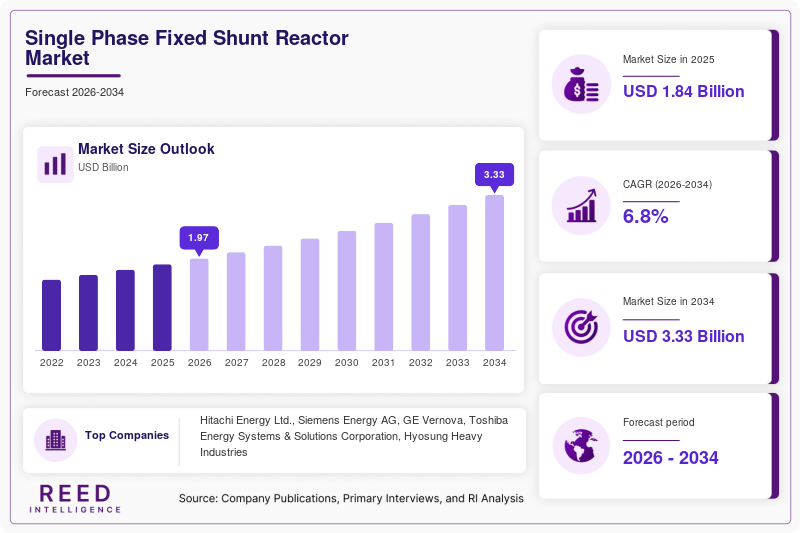
The Single Phase Fixed Shunt Reactor Market size was valued at USD 1.84 billion in 2026 and is projected to reach USD 3.12 billion by 2034, expanding at a CAGR of 6.8% during the forecast period from 2026 to 2034. The global Single Phase Fixed Shunt Reactor Market growth has been supported by the increasing expansion of high-voltage transmission networks worldwide. Rising investments in power grid modernization, renewable energy integration, and long-distance electricity transmission infrastructure have accelerated the deployment of single phase fixed shunt reactors across utility networks.
The Single Phase Fixed Shunt Reactor Market has experienced stable growth due to the increasing need for voltage regulation and reactive power compensation in transmission systems. Single phase fixed shunt reactors are widely used to control overvoltage conditions in long transmission lines and underground cable systems. Utilities and grid operators are increasingly adopting these systems to improve transmission efficiency and grid reliability.
Key Highlights
- Asia Pacific accounted for 38.7% of the global Single Phase Fixed Shunt Reactor Market share in 2025, while the Middle East & Africa is projected to register the fastest CAGR of 7.6% during the forecast period.
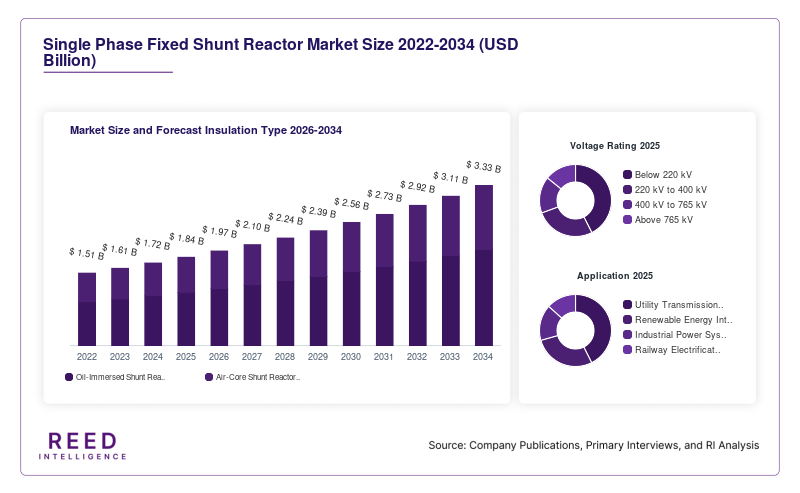
- By insulation type, oil-immersed shunt reactors held the leading market share of 69.4% in 2025, whereas air-core shunt reactors are anticipated to expand at a CAGR of 7.3% through 2034.
- By voltage rating, 400 kV to 765 kV reactors dominated with 44.2% share in 2025, while above 765 kV reactors are forecast to grow at a CAGR of 7.8%.
- By application, utility transmission networks accounted for 58.6% of the Single Phase Fixed Shunt Reactor Market share in 2025, whereas renewable energy integration applications are expected to grow at a CAGR of 8.1%.
- By end use, electric utilities represented 61.3% of the market share in 2025, while renewable energy developers are projected to register a CAGR of 8.4% during the study period.
- China Single Phase Fixed Shunt Reactor Market was valued at USD 286.4 million in 2024 and increased to USD 309.7 million in 2025 due to ongoing transmission infrastructure expansion projects.
Market Trends
Increasing Deployment of Smart Grid Infrastructure
One of the major trends shaping the Single Phase Fixed Shunt Reactor Market is the increasing deployment of smart grid infrastructure. Utilities are modernizing transmission systems with advanced digital monitoring and automation technologies to improve operational efficiency and grid reliability. Single phase fixed shunt reactors are being integrated with intelligent monitoring systems that provide real-time performance tracking and predictive maintenance capabilities.
This trend has encouraged manufacturers to develop reactors with advanced sensing technologies and remote diagnostic systems. Grid operators are increasingly focusing on minimizing downtime and improving asset management efficiency, which is expected to strengthen demand for digitally enabled shunt reactor solutions.
Rising Integration of Renewable Energy Transmission Corridors
The growing integration of renewable energy transmission corridors has emerged as another significant trend in the Single Phase Fixed Shunt Reactor Market. Wind and solar power generation projects require stable transmission infrastructure to manage fluctuating power output and maintain voltage stability across long-distance transmission lines.
Single phase fixed shunt reactors are increasingly deployed in renewable energy evacuation networks to reduce transmission losses and improve reactive power compensation. Utilities are investing in dedicated high-voltage transmission corridors for renewable projects, creating favorable conditions for reactor manufacturers.
Market Drivers
Expansion of High-Voltage Transmission Networks
The expansion of high-voltage transmission networks has become a primary driver for the Single Phase Fixed Shunt Reactor Market. Increasing electricity demand and cross-border power exchange projects have accelerated investments in long-distance transmission infrastructure. Single phase fixed shunt reactors are essential components for maintaining voltage stability in extra-high-voltage systems.
Governments and utility operators are strengthening national transmission grids to support industrial growth and urban electrification. The increasing development of ultra-high-voltage alternating current transmission projects has significantly increased demand for advanced reactive power compensation systems.
Increasing Investments in Grid Stability and Power Quality
Growing investments in grid stability and power quality improvement have contributed significantly to the Single Phase Fixed Shunt Reactor Market growth. Utilities are increasingly focusing on reducing transmission losses and minimizing voltage fluctuations to improve power delivery efficiency.
The modernization of aging transmission infrastructure in developed economies has accelerated the replacement of outdated grid equipment with advanced reactor systems. In addition, industrial consumers are demanding stable electricity supply to support energy-intensive operations, encouraging utilities to invest in improved voltage regulation technologies.
Market Restraint
High Initial Installation and Maintenance Costs
High installation and maintenance costs remain a major restraint for the Single Phase Fixed Shunt Reactor Market. Large-capacity shunt reactors require substantial capital investment due to their complex engineering design and high-grade insulation materials.
Utilities and industrial operators may face budget constraints associated with transmission infrastructure upgrades. In addition, reactor maintenance and transportation costs can increase total project expenditure, particularly in remote transmission locations.
Market Opportunities
Development of Offshore Renewable Energy Networks
The development of offshore renewable energy transmission networks presents a strong opportunity for the Single Phase Fixed Shunt Reactor Market. Offshore wind farms require advanced voltage compensation systems to support stable electricity transmission over long submarine cable networks.
Manufacturers are expected to introduce compact and corrosion-resistant reactor designs suitable for offshore installations. Rising investments in offshore renewable energy infrastructure are likely to create long-term demand for high-performance shunt reactors.
Increasing Electrification in Emerging Economies
The growing electrification of rural and industrial regions in emerging economies offers significant opportunities for the Single Phase Fixed Shunt Reactor Market. Governments across Asia Pacific, Africa, and Latin America are investing heavily in transmission expansion projects to improve electricity accessibility.
Large-scale electrification programs require advanced transmission equipment capable of supporting stable power distribution. This trend is expected to create favorable growth opportunities for manufacturers operating in developing markets.
Segmental Analysis
By Insulation Type
Based on insulation type, the Single Phase Fixed Shunt Reactor Market is segmented into oil-immersed shunt reactors and air-core shunt reactors.
Oil-immersed shunt reactors dominated the market with a 69.4% share in 2025 due to their superior cooling efficiency and suitability for high-voltage applications. Utilities widely preferred these systems for long-distance transmission projects because of their operational reliability.
Air-core shunt reactors are projected to witness the fastest CAGR of 7.3% during the forecast period. Their lower maintenance requirements and improved environmental safety characteristics are expected to increase adoption across urban transmission infrastructure projects.
By Voltage Rating
Based on voltage rating, the Single Phase Fixed Shunt Reactor Market is categorized into below 220 kV, 220 kV to 400 kV, 400 kV to 765 kV, and above 765 kV.
The 400 kV to 765 kV segment held the largest market share of 44.2% in 2025 because these reactors are extensively used in national transmission networks and utility interconnection systems.
Above 765 kV reactors are expected to grow at a CAGR of 7.8% through 2034. Increasing development of ultra-high-voltage transmission projects is anticipated to strengthen demand for high-capacity voltage compensation equipment.
By Application
Based on application, the Single Phase Fixed Shunt Reactor Market is segmented into utility transmission networks, renewable energy integration, industrial power systems, and railway electrification.
Utility transmission networks accounted for the highest market share of 58.6% in 2025 due to increasing grid modernization and transmission expansion activities worldwide.
Renewable energy integration applications are forecast to register the fastest CAGR of 8.1% during the study period. The growing number of wind and solar power projects requiring voltage stabilization systems is expected to accelerate segment growth.
By End Use
Based on end use, the Single Phase Fixed Shunt Reactor Market is segmented into electric utilities, renewable energy developers, industrial facilities, and railway operators.
Electric utilities dominated the market with a 61.3% share in 2025 because transmission operators require advanced reactive power compensation systems for stable grid operations.
Renewable energy developers are projected to expand at a CAGR of 8.4% through 2034. Increasing investments in renewable transmission infrastructure and offshore wind integration projects are expected to support segment growth.
By Cooling Method
Based on cooling method, the Single Phase Fixed Shunt Reactor Market is segmented into oil natural air natural, oil natural air forced, and oil forced air forced systems.
Oil natural air natural systems accounted for the leading market share of 47.8% in 2025 due to their operational simplicity and cost efficiency in utility-scale transmission projects.
Oil forced air forced systems are expected to witness the fastest CAGR of 7.5% during the forecast period. Their enhanced thermal performance and suitability for high-capacity applications are likely to drive demand across ultra-high-voltage transmission installations.
Regional Analysis
Asia Pacific
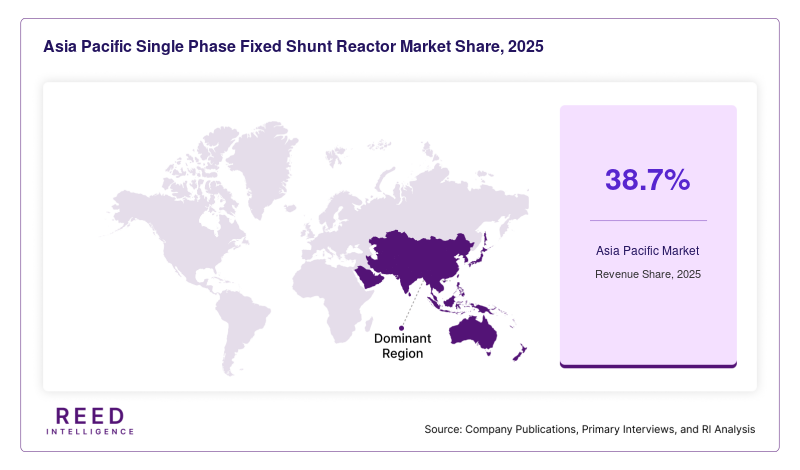
Asia Pacific accounted for 38.7% of the Single Phase Fixed Shunt Reactor Market share in 2025 and is projected to grow at a CAGR of 7.2% during the forecast period. The region maintained a dominant market position due to increasing investments in transmission infrastructure and renewable energy integration projects.
China represented the leading country within the regional market. The country experienced significant demand for high-voltage transmission equipment due to ongoing ultra-high-voltage grid expansion projects and increasing industrial electricity consumption.
North America
North America held 24.5% of the global Single Phase Fixed Shunt Reactor Market share in 2025 and is expected to expand at a CAGR of 6.1% through 2034. The regional market benefited from modernization of aging transmission infrastructure and increasing renewable energy capacity additions.
The United States emerged as the dominant country within North America due to rising investments in smart grid technologies and interstate transmission projects. The country also witnessed increasing deployment of voltage compensation systems in renewable energy transmission corridors.
Europe
Europe accounted for 20.4% of the Single Phase Fixed Shunt Reactor Market share in 2025 and is forecast to grow at a CAGR of 6.4% during the study period. The regional market benefited from strong renewable energy policies and increasing cross-border electricity interconnection projects.
Germany represented the dominant country within Europe due to extensive renewable energy integration activities and transmission network modernization initiatives. Investments in offshore wind transmission systems also contributed to reactor demand.
Middle East & Africa
The Middle East & Africa region represented 9.1% of the Single Phase Fixed Shunt Reactor Market share in 2025 and is anticipated to register the fastest CAGR of 7.6% during the forecast period. The market growth was supported by increasing investments in power infrastructure and industrial electrification projects.
Saudi Arabia dominated the regional market due to large-scale grid expansion programs and rising electricity demand from industrial sectors. The country also invested heavily in renewable energy transmission infrastructure.
Latin America
Latin America accounted for 7.3% of the Single Phase Fixed Shunt Reactor Market share in 2025 and is projected to expand at a CAGR of 6.5% through 2034. The regional market expanded because of increasing renewable energy capacity additions and transmission network upgrades.
Brazil emerged as the leading country within the region due to rising hydropower and wind energy integration projects. The expansion of long-distance electricity transmission corridors also supported reactor procurement activities.
Competitive Landscape
The Single Phase Fixed Shunt Reactor Market remains moderately consolidated, with global power equipment manufacturers focusing on technological innovation, transmission infrastructure partnerships, and expansion into renewable energy applications. Companies are investing in advanced insulation technologies, digital monitoring systems, and compact reactor designs to strengthen market competitiveness.
Hitachi Energy maintained a leading position in the market due to its extensive high-voltage transmission equipment portfolio and strong global project presence. The company recently introduced a digitally monitored single phase fixed shunt reactor designed for ultra-high-voltage renewable transmission corridors.
Siemens Energy AG continued to strengthen its grid technology business through investments in smart transmission solutions. GE Vernova focused on advanced voltage compensation systems for renewable energy applications and utility modernization projects.
Toshiba Energy Systems & Solutions Corporation expanded its manufacturing capabilities for extra-high-voltage reactor systems. Hyosung Heavy Industries increased its international transmission equipment contracts across Asia Pacific and the Middle East.
Key Players List
- Hitachi Energy Ltd.
- Siemens Energy AG
- GE Vernova
- Toshiba Energy Systems & Solutions Corporation
- Hyosung Heavy Industries
- Mitsubishi Electric Corporation
- Fuji Electric Co., Ltd.
- CG Power and Industrial Solutions Ltd.
- TBEA Co., Ltd.
- Bharat Heavy Electricals Limited
- WEG S.A.
- Nissin Electric Co., Ltd.
- SGB SMIT Group
- JSHP Transformer
- Hyunmoo Co., Ltd.
Recent Developments
- In February 2026, Hitachi Energy introduced a digitally monitored single phase fixed shunt reactor for renewable energy transmission applications.
- In April 2026, Siemens Energy AG expanded its extra-high-voltage reactor manufacturing capacity in Europe.
- In July 2025, GE Vernova secured a utility transmission modernization contract involving advanced voltage compensation systems in North America.
- In October 2025, Toshiba Energy Systems & Solutions Corporation launched upgraded insulation technology for ultra-high-voltage shunt reactors.
- In January 2026, Hyosung Heavy Industries expanded its transmission equipment distribution network across the Middle East and Southeast Asia.
Single Phase Fixed Shunt Reactor Market Segments
Insulation Type
- Oil-Immersed Shunt Reactors
- Air-Core Shunt Reactors
Voltage Rating
- Below 220 kV
- 220 kV to 400 kV
- 400 kV to 765 kV
- Above 765 kV
Application
- Utility Transmission Networks
- Renewable Energy Integration
- Industrial Power Systems
- Railway Electrification
End Use
- Electric Utilities
- Renewable Energy Developers
- Industrial Facilities
- Railway Operators
Cooling Method
- Oil Natural Air Natural
- Oil Natural Air Forced
- Oil Forced Air Forced
By Region
- North America
- Europe
- APAC
- Middle East and Africa
- LATAM