Single Point Anchor Reservoir Market Size, Share & Demand Report By Equipment Type (Sensors, Software Solutions, Hardware Systems), By Application (Structural Health Monitoring, Corrosion Detection, Load Monitoring), By End-Use Industry (Offshore Oil & Gas, Offshore Renewable Energy, Marine Infrastructure) & Segment Forecasts, 2026–2034
USD 3950
Market Overview
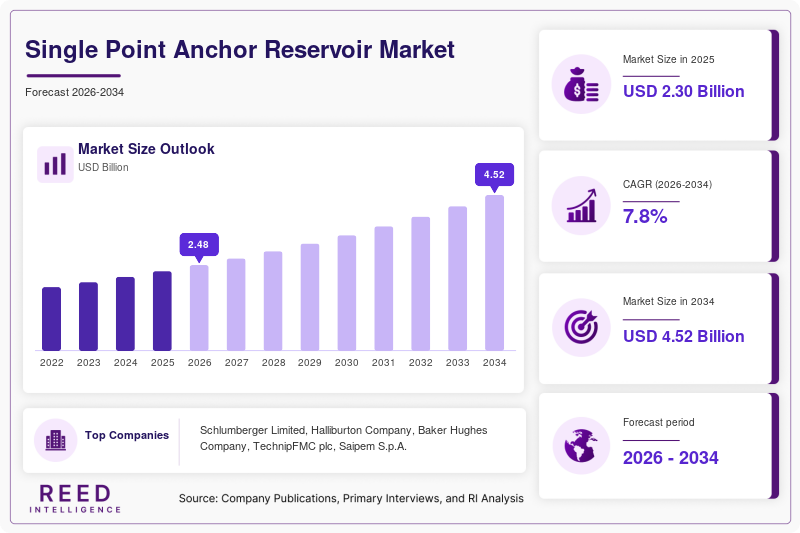
The Single Point Anchor Reservoir Market size is estimated at USD 2.48 billion, and it is projected to reach approximately USD 4.52 billion by 2034, registering a CAGR of 7.8% during the forecast period of 2026–2034. Growth is primarily driven by increasing offshore oil and gas exploration activities and the growing need for reliable anchoring systems in deepwater and ultra-deepwater environments.
One of the most significant global factors supporting market growth is the acceleration of offshore energy infrastructure investments, particularly in floating production storage and offloading (FPSO) units and offshore wind platforms. These installations require robust anchoring systems to maintain stability under extreme marine conditions, thereby increasing the adoption of single point anchor reservoir technologies. Additionally, advancements in sensor integration and real-time monitoring systems have enhanced operational efficiency and safety.
Key Highlights
- North America dominated the market with a 34.2% share in 2025.
- Asia Pacific is expected to grow at the fastest CAGR of 11.2% during 2026–2034.
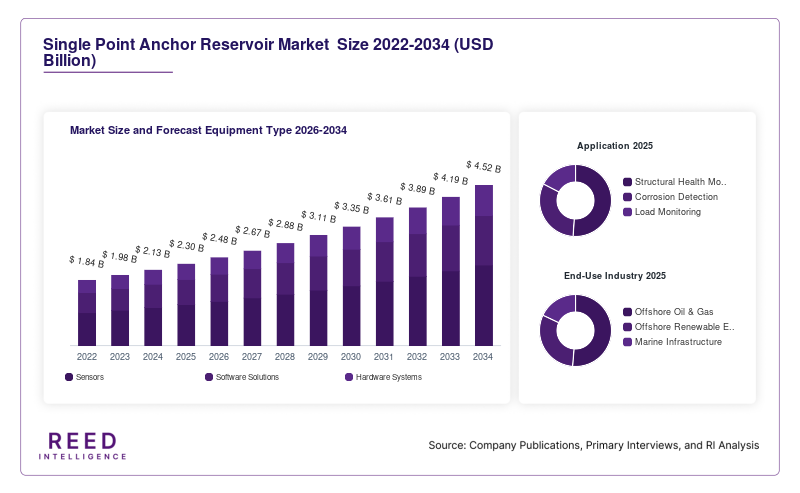
- By equipment type, sensors accounted for the largest share of 38.5%, while software solutions are projected to grow at a CAGR of 12.4%.
- By application, structural health monitoring led with a 41.7% share, whereas corrosion detection is expected to expand at a CAGR of 11.8%.
- The United States remained the dominant country, with market values of USD 510 million in 2024 and USD 560 million in 2025.
Market Trends
Digital Integration in Offshore Monitoring Systems
The Single Point Anchor Reservoir Market is increasingly influenced by the integration of digital monitoring systems that enhance real-time data acquisition and operational decision-making. Operators are adopting IoT-enabled sensors, AI-based analytics, and cloud-connected platforms to monitor anchor stress, seabed conditions, and structural stability. These digital solutions reduce downtime, improve predictive maintenance, and optimize asset lifecycle management. The shift toward digital twins in offshore infrastructure is further enhancing simulation-based performance evaluation. As offshore exploration becomes more complex in deeper waters, demand for intelligent monitoring solutions embedded in single point anchor systems is expected to accelerate steadily across major oil-producing regions.
Rising Adoption in Offshore Renewable Energy Projects
Another significant trend shaping the market is the increasing use of single point anchor reservoir systems in offshore renewable energy installations, particularly floating wind farms. As countries transition toward low-carbon energy sources, offshore wind projects are expanding rapidly, requiring stable anchoring solutions capable of withstanding harsh marine conditions. These systems ensure structural stability and reduce installation risks in deepwater environments. Technological improvements in anchoring materials and corrosion-resistant coatings are further supporting adoption. This trend is particularly visible in Europe and Asia Pacific, where governments are heavily investing in offshore wind capacity expansion.
Market Drivers
Expansion of Offshore Oil and Gas Exploration Activities
The steady rise in offshore oil and gas exploration is a key driver of the Single Point Anchor Reservoir Market. Energy companies are increasingly moving toward deepwater and ultra-deepwater drilling to meet global energy demand, where stable anchoring systems are essential for platform safety and efficiency. Single point anchor reservoirs provide structural reliability under high-pressure underwater conditions, minimizing drift and operational risks. The growing number of FPSO deployments in regions such as West Africa, the Gulf of Mexico, and Southeast Asia is further accelerating market demand. Additionally, rising global energy consumption continues to push investment in offshore infrastructure.
Increasing Focus on Structural Safety and Maintenance Efficiency
Another major driver is the growing emphasis on offshore structural safety and predictive maintenance. Operators are prioritizing systems that can continuously monitor anchor integrity and detect early signs of wear or corrosion. Single point anchor reservoir systems integrated with advanced sensors and monitoring software help reduce the risk of structural failures and environmental hazards. Regulatory frameworks across major maritime economies are also mandating stricter safety compliance, encouraging adoption of advanced anchoring solutions. This trend is particularly significant in aging offshore infrastructure, where maintenance optimization is critical for extending operational life.
Market Restraint
High Installation and Maintenance Costs in Deepwater Environments
The Single Point Anchor Reservoir Market faces a key challenge due to the high cost associated with installation and maintenance in deepwater and ultra-deepwater environments. Deploying anchoring systems in such conditions requires specialized vessels, advanced engineering equipment, and skilled labor, significantly increasing operational expenses. Additionally, maintenance activities in harsh marine conditions are complex and often require temporary shutdowns, leading to revenue losses. Smaller operators and developing economies face financial constraints in adopting these systems, limiting market penetration. Although technological advancements are gradually improving efficiency, cost barriers continue to restrain broader adoption.
Market Opportunities
Expansion of Offshore Wind Energy Infrastructure
The rapid growth of offshore wind energy projects presents a significant opportunity for the Single Point Anchor Reservoir Market. Governments worldwide are investing heavily in renewable energy infrastructure to reduce carbon emissions, and floating wind turbines require highly stable anchoring systems. Single point anchor reservoirs provide reliable stability in deepwater installations where traditional fixed foundations are not feasible. This creates strong demand for advanced anchoring technologies. Countries in Europe and Asia Pacific are leading offshore wind expansion, creating long-term opportunities for manufacturers and solution providers in the anchoring systems market.
Technological Advancements in Smart Anchoring Systems
Another major opportunity lies in the development of smart anchoring systems integrated with AI, IoT, and predictive analytics. These technologies enable real-time monitoring of anchor performance, seabed conditions, and environmental stress factors. Smart systems help reduce operational risks and improve maintenance planning efficiency. Companies investing in automation and digital transformation are expected to gain competitive advantage in the market. Additionally, advancements in corrosion-resistant materials and hybrid anchoring designs are improving system durability, further expanding application scope across both oil & gas and renewable energy sectors.
Segmental Analysis
By Equipment Type
Sensors dominated the segment with a 38.5% share in 2024, driven by increasing demand for real-time monitoring and structural safety assurance in offshore environments. Their ability to provide continuous data on anchor stress and seabed conditions has made them essential in modern offshore systems.
Software solutions are projected to grow at a CAGR of 12.4%, supported by rising adoption of predictive analytics and digital twin technologies. These solutions enable operators to optimize performance and reduce operational risks through advanced simulation and monitoring capabilities.
By Application
Structural health monitoring led the application segment with a 41.7% share in 2024, as offshore operators prioritize system integrity and safety compliance. Continuous monitoring of anchor performance is critical in deepwater environments.
Corrosion detection is expected to grow at a CAGR of 11.8%, driven by increasing awareness of material degradation in marine conditions and the need for preventive maintenance strategies.
By End-Use Industry
The offshore oil and gas sector held the largest share at 46.3% in 2024, supported by extensive exploration activities and FPSO deployment. These systems rely heavily on stable anchoring solutions for operational efficiency.
The offshore renewable energy segment is expected to expand at a CAGR of 12.1%, driven by rapid growth in floating wind farm installations and increasing global renewable energy investments.
Regional Analysis
North America
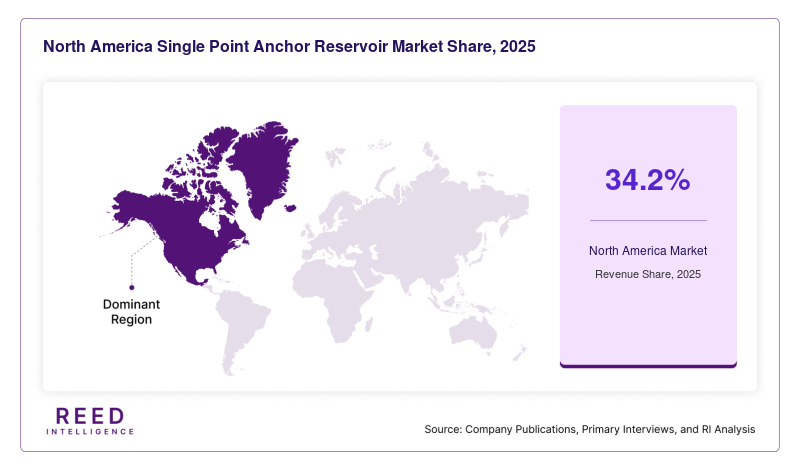
North America accounted for approximately 34.2% market share in 2025, with a projected CAGR of around 7.3% from 2026 to 2034. The region remains a mature and technologically advanced market, driven by extensive offshore oil and gas operations in the Gulf of Mexico. Strong investment in deepwater exploration continues to support demand for single point anchor reservoir systems.
The United States dominates the regional market, supported by its large offshore infrastructure base and advanced marine engineering capabilities. A key growth factor is the integration of digital monitoring technologies in offshore platforms, enhancing operational safety and efficiency.
Europe
Europe held nearly 22.5% share in 2025, with an expected CAGR of 7.9%. Growth is driven by offshore wind expansion and strict environmental regulations.
Europe represents a stable and technologically advanced market, supported by offshore wind expansion and sustainability-focused policies. Countries such as Norway and the United Kingdom are leading adopters of advanced anchoring systems, driven by their strong marine engineering expertise and renewable energy investments.
Asia Pacific
Asia Pacific accounted for 25.8% share in 2025 and is projected to grow at the fastest CAGR of 11.2%. Rapid industrialization and offshore exploration drive demand.
Asia Pacific is the fastest-growing region, driven by increasing offshore exploration, industrialization, and energy demand. Countries like China and India are investing heavily in offshore infrastructure, while Southeast Asia is emerging as a key hub for floating production systems and anchoring technologies.
Middle East & Africa
The region held 10.4% share in 2025, with a CAGR of 8.1%. Offshore oil exploration remains the primary driver.
Middle East & Africa is an emerging market with strong potential due to extensive offshore oil reserves and ongoing energy infrastructure development. Gulf countries are investing in deepwater projects, while African nations are exploring offshore reserves to boost economic growth.
Latin America
Latin America accounted for 7.1% share in 2025, growing at a CAGR of 7.6%.
Latin America is experiencing moderate growth, driven primarily by offshore exploration activities in Brazil and Mexico. Brazil remains a key contributor due to its large pre-salt reserves and increasing deployment of floating production systems requiring advanced anchoring solutions.
Competitive Landscape
The market is moderately consolidated with key players focusing on technological innovation and offshore engineering solutions. Major companies include Schlumberger, Halliburton, Baker Hughes, TechnipFMC, and Saipem. Schlumberger remains a leading player due to its strong offshore engineering portfolio and advanced monitoring technologies. Recent developments include the integration of AI-based predictive maintenance systems into offshore anchoring solutions to improve operational reliability and reduce downtime.Key players such as Schlumberger, Halliburton, Baker Hughes, TechnipFMC, and Saipem are focusing on innovation in anchoring systems, digital monitoring technologies, and advanced materials to enhance durability and operational efficiency. These companies are leveraging strategic partnerships with offshore energy operators to strengthen their market presence.The competitive environment is shaped by continuous investments in research and development, particularly in AI-enabled monitoring systems and predictive maintenance technologies. Companies are also expanding their regional supply chains to mitigate geopolitical risks and improve project execution efficiency.
Key Players List
- Schlumberger
- Halliburton
- Baker Hughes
- TechnipFMC
- Saipem
- Aker Solutions
- Subsea 7
- McDermott International
- Fugro
- Kongsberg Gruppen
- Weatherford International
- Oceaneering International
- ExxonMobil Engineering Solutions
- TotalEnergies Offshore Division
- Siemens Energy
Recent Developments
- TechnipFMC expanded its offshore monitoring systems portfolio with enhanced anchoring analytics solutions.
- Baker Hughes introduced AI-enabled structural monitoring tools for deepwater anchoring systems.
- Subsea 7 announced a strategic partnership to develop advanced offshore wind anchoring technologies for floating platforms.
Single Point Anchor Reservoir Market Segments
Equipment Type
- Sensors
- Software Solutions
- Hardware Systems
Application
- Structural Health Monitoring
- Corrosion Detection
- Load Monitoring
End-Use Industry
- Offshore Oil & Gas
- Offshore Renewable Energy
- Marine Infrastructure
By Region
- North America
- Europe
- APAC
- Middle East and Africa
- LATAM