Single Use Cystoscope Market Size, Share Demand Report By Product Type (Flexible Single Use Cystoscopes, Rigid Single Use Cystoscopes, Portable Digital Cystoscopes), By Application (Diagnostic Cystoscopy, Therapeutic/Interventional Cystoscopy, Surveillance Procedures), By End Use (Hospitals, Ambulatory Surgical Centers, Specialty Clinics), By Distribution Channel (Direct Sales, Distributors, Online Procurement), By Region & Segment Forecasts, 2026–2034
USD 3950
Market Overview
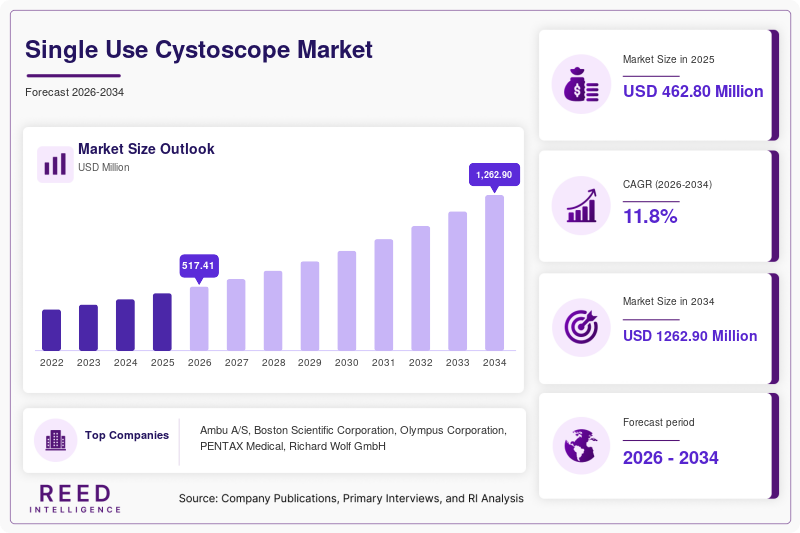
The Single Use Cystoscope Market size was valued at USD 462.8 million in 2026 and is projected to reach USD 1,128.4 million by 2034, expanding at a CAGR of 11.8% during 2026–2034. The market is gaining momentum due to the increasing preference for infection-control solutions in urology procedures. Hospitals and ambulatory care centers are adopting disposable cystoscopes to reduce cross-contamination risks, improve workflow efficiency, and avoid the cost burden linked to reprocessing reusable scopes.
Growing awareness of healthcare-associated infections, combined with stronger sterilization protocols, has encouraged healthcare providers to shift toward single-use endoscopic devices. In addition, rising volumes of bladder cancer diagnosis, urinary tract disorders, hematuria investigations, and stone management procedures are supporting steady product demand across developed and emerging healthcare markets.
Key Highlights
- North America dominated the global Single Use Cystoscope Market with 39.6% share in 2025.
- Asia Pacific is expected to be the fastest-growing regional market with a CAGR of 13.7% through 2034.
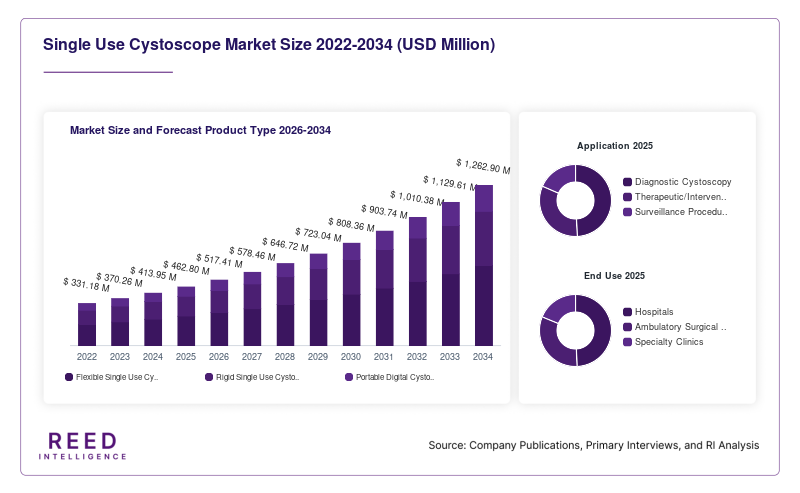
- By Product Type, Flexible Single Use Cystoscopes led with 68.4% share in 2025.
- By Product Type, Portable Digital Cystoscopes will be the fastest-growing subsegment at 14.2% CAGR.
- By Application, Diagnostic Cystoscopy held the leading share of 57.1% in 2025.
- By Application, Therapeutic/Interventional Cystoscopy is forecast to grow at 12.9% CAGR.
- By End Use, Hospitals accounted for 61.8% share in 2025.
- By End Use, Ambulatory Surgical Centers are expected to expand at 13.4% CAGR.
- The United States remained the dominant country, valued at USD 141.2 million in 2024 and USD 155.6 million in 2025.
Market Trends
Shift Toward Office-Based Urology Procedures
The use of single-use cystoscopes is increasing in outpatient clinics and physician offices. Portable imaging systems and ready-to-use sterile devices enable quick procedures without central sterilization support. This trend is improving patient turnaround time and reducing operational delays.
Integration of High-Definition Imaging and Connectivity
Manufacturers are launching disposable cystoscopes with enhanced optics, digital displays, and image capture features. Connectivity with hospital records systems and procedure documentation software is improving workflow quality and supporting clinical adoption.
Market Drivers
Rising Infection Prevention Requirements
Healthcare facilities are focusing on reducing contamination risk associated with reusable scopes. Single-use devices eliminate reprocessing steps and lower the chance of residual bioburden, driving adoption across hospitals and specialty clinics.
Increasing Burden of Urological Disorders
The growing prevalence of bladder cancer, recurrent urinary tract infections, urethral strictures, kidney stones, and aging-related urinary conditions is increasing cystoscopy procedure volumes worldwide. This directly supports growth in the Single Use Cystoscope Market.
Market Restraint
Higher Per-Procedure Device Cost
Compared with reusable cystoscopes used over multiple cycles, disposable systems can carry higher per-use procurement costs. Budget-sensitive healthcare providers may delay conversion where sterilization systems are already established.
Market Opportunities
Expansion in Emerging Healthcare Markets
Developing nations are investing in modern hospital infrastructure and day-care surgical centers. These regions offer strong opportunities for manufacturers introducing affordable single-use cystoscopy solutions.
Customized Devices for Specialized Procedures
There is growing potential for disposable cystoscopes designed for pediatric urology, female urology, and difficult-access procedures. Product specialization is expected to create premium growth avenues.
Segmental Analysis
By Product Type
Flexible Single Use Cystoscopes: Flexible devices dominated the Single Use Cystoscope Market with 68.4% share in 2025. Their superior maneuverability, patient comfort, and broad use in diagnostic procedures supported strong adoption across hospitals and clinics.
Portable Digital Cystoscopes will be the fastest-growing segment at a 14.2% CAGR through 2034. Their compact design and rapid deployment in office-based procedures will increase demand, especially in decentralized care settings.
By Application
Diagnostic Cystoscopy procedures held the leading share of 57.1% in 2025. Frequent use for hematuria evaluation, bladder surveillance, and recurrent urinary symptoms supported segment leadership.
Therapeutic/Interventional Cystoscopy Therapeutic applications are projected to grow at 12.9% CAGR. Increased use in biopsy guidance, stent support, foreign body retrieval, and minor interventions will support growth.
By End Use
Hospitals accounted for 61.8% share in 2025 due to large patient volumes, availability of urology specialists, and procurement scale advantages.
Ambulatory Surgical Centers will witness the fastest 13.4% CAGR. Lower procedure costs, shorter patient stays, and demand for same-day urological interventions will accelerate adoption.
By Distribution Channel
Direct Sales led the market with 64.3% share in 2025. Large healthcare systems preferred direct manufacturer contracts for pricing consistency and technical support.
Online & Third-Party Procurement channels are expected to grow at 12.6% CAGR as digital procurement platforms improve purchasing speed and inventory management.
Regional Analysis
North America
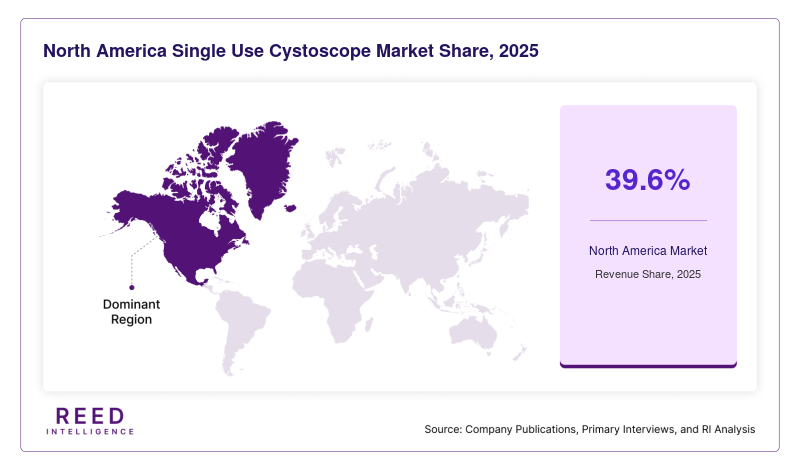
North America held 39.6% of the Single Use Cystoscope Market share in 2025 and will grow at a CAGR of 10.9% through 2034. The United States led the region due to high outpatient procedure volumes and rapid adoption of infection-control technologies. Strong reimbursement systems and advanced hospital procurement models supported market demand.
Europe
Europe accounted for 28.1% share in 2025 and will expand at a CAGR of 11.1% during the forecast period. Germany dominated the region because of its well-established urology care network and emphasis on advanced endoscopy technologies. Public and private hospitals continued upgrading disposable device portfolios.
Asia Pacific
Asia Pacific represented 19.7% share in 2025 and will register the fastest CAGR of 13.7% through 2034. China led regional demand owing to hospital expansion, rising diagnostic screening capacity, and growing awareness of infection prevention in tertiary care centers.
Middle East & Africa
Middle East & Africa captured 7.1% share in 2025 and will grow at a CAGR of 10.6%. Saudi Arabia remained the dominant country due to healthcare modernization programs, increased specialty care spending, and adoption of advanced minimally invasive devices.
Latin America
Latin America held 5.5% share in 2025 and will advance at a CAGR of 10.8% over the forecast period. Brazil led the market because of expanding private hospital chains and increasing access to urology diagnostic services.
Competitive Landscape
The Single Use Cystoscope Market remains moderately consolidated, with established medical device manufacturers and niche endoscopy companies competing through innovation, pricing, and geographic expansion. Leading participants are focusing on digital imaging quality, ergonomic designs, integrated monitors, and regulatory approvals across key markets. Partnerships with hospitals and ambulatory centers remain a major growth strategy.
Ambu A/S is a leading market participant due to its strong disposable endoscopy portfolio and broad commercial presence. The company recently expanded its urology visualization platform with upgraded imaging features and wider market availability.
Boston Scientific Corporation continues strengthening its urology business through product integration and hospital relationships. Olympus Corporation leverages imaging expertise to support advanced endoscopic offerings. PENTAX Medical focuses on precision optics and clinical usability. Richard Wolf GmbH remains active in minimally invasive urology systems with expanding disposable solutions.
Competition is expected to intensify as new entrants introduce lower-cost devices for emerging markets and outpatient settings.
Key Players List
- Ambu A/S
- Boston Scientific Corporation
- Olympus Corporation
- PENTAX Medical
- Richard Wolf GmbH
- KARL STORZ SE & Co. KG
- Coloplast A/S
- Stryker Corporation
- Medtronic plc
- B. Braun Melsungen AG
- Cook Medical
- EndoFresh Ltd.
- Vimex Sp. z o.o.
- Maxer Endoscopy GmbH
- Zhejiang Tiansong Medical Instrument Co., Ltd.
Recent Developments
- Ambu A/S launched an upgraded disposable cystoscopy platform with improved digital imaging capabilities.
- Boston Scientific expanded its outpatient urology solutions portfolio through new commercial partnerships.
- Olympus introduced workflow-focused visualization enhancements for minimally invasive diagnostics.
- Several regional manufacturers entered Asia Pacific markets with cost-efficient single-use cystoscopes.
- Hospitals increasingly signed volume-based contracts for disposable endoscopy products to improve infection control programs.
Single Use Cystoscope Market Segments
Product Type
- Flexible Single Use Cystoscopes
- Rigid Single Use Cystoscopes
- Portable Digital Cystoscopes
Application
- Diagnostic Cystoscopy
- Therapeutic/Interventional Cystoscopy
- Surveillance Procedures
End Use
- Hospitals
- Ambulatory Surgical Centers
- Specialty Clinics
Distribution Channel
- Direct Sales
- Distributors
- Online Procurement
By Region
- North America
- Europe
- APAC
- Middle East and Africa
- LATAM