Skull Clamp Market Size, Share, Demand & Growth Analysis Report By Product Type (Radiolucent Skull Clamps, Modular Skull Clamps, Standard Metallic Skull Clamps), By Application (Neurosurgery, Spinal Surgery, Trauma Surgery), By End-Use (Hospitals, Ambulatory Surgical Centers, Specialty Clinics), Regional Outlook and Forecast 2026–2034
USD 3950
Market Overview
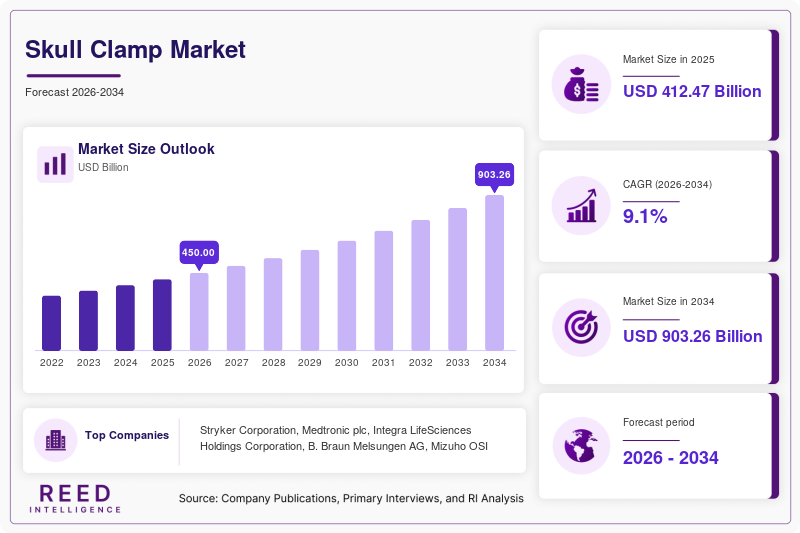
The Skull Clamp Market is projected to expand from USD 450 million in 2026 to USD 980 million by 2034, registering a CAGR of 9.1% during the forecast period (2026–2034). Growth is primarily supported by the increasing volume of neurosurgical procedures worldwide and the rising need for high-precision cranial stabilization systems in complex surgeries. Skull clamps are widely used in neurosurgery, trauma care, and spinal operations, where rigid head fixation is essential to ensure procedural accuracy and patient safety.
A key global factor driving market expansion is the continuous advancement in neurosurgical operating room technologies. The integration of imaging-guided surgery systems and minimally invasive procedures has increased reliance on advanced skull clamp systems that offer radiolucency, adjustability, and ergonomic design. Additionally, healthcare infrastructure expansion in emerging economies is improving access to advanced surgical equipment, further supporting adoption.
Key Highlights
- North America dominated the market with a 34.2% share in 2025.
- Asia Pacific is expected to grow at the fastest CAGR of 11.2% during 2026–2034.
- By equipment type, radiolucent skull clamps accounted for the largest share of 38.5%.
- By application, neurosurgery led with a 41.7% share.
- whereas spinal surgery applications are expected to expand at a CAGR of 11.8%.
- The United States remained the dominant country, with market values of USD 510 million in 2024 and USD 560 million in 2025.
Market Trends
Shift Toward Radiolucent and Carbon Fiber-Based Skull Clamps
One of the major trends shaping the Skull Clamp Market is the increasing adoption of radiolucent and carbon fiber-based systems. Traditional metallic clamps are gradually being replaced due to their interference with intraoperative imaging systems such as CT and MRI. Radiolucent clamps allow surgeons to maintain clear imaging visibility during procedures, improving accuracy in tumor resections and complex cranial surgeries. Carbon fiber materials also reduce overall device weight, improving patient safety by minimizing pressure-induced complications. Hospitals are increasingly prioritizing advanced materials that enhance surgical workflow efficiency. The demand for imaging-compatible surgical tools is expected to remain strong as image-guided neurosurgery becomes a standard practice in advanced healthcare facilities.
Rising Integration of Modular and Adjustable Fixation Systems
Another significant trend is the growing preference for modular and highly adjustable skull clamp systems. Surgeons require flexible positioning options during complex neurosurgical and spinal procedures, which has driven innovation in clamp articulation mechanisms. Modular systems allow rapid configuration changes without compromising stability, improving procedural efficiency in operating rooms. Additionally, manufacturers are introducing clamps with enhanced locking mechanisms and ergonomic designs to reduce setup time. This trend is further supported by increasing surgical volumes in trauma care centers, where quick patient stabilization is critical. The integration of smart adjustment features and compatibility with robotic-assisted surgical platforms is expected to shape future product development in the Skull Clamp Market.
Market Drivers
Rising Incidence of Neurological Disorders and Trauma Cases
The increasing prevalence of neurological disorders such as brain tumors, epilepsy, and aneurysms is significantly driving demand for skull clamp systems. Additionally, a growing number of traumatic brain injuries caused by road accidents, sports injuries, and workplace incidents has led to higher surgical intervention rates. Skull clamps are essential for ensuring precise cranial immobilization during such procedures, reducing surgical risks and improving outcomes. Expanding elderly populations across developed regions also contribute to higher neurosurgical case volumes. As healthcare systems focus on improving emergency care capabilities, the demand for reliable cranial fixation devices is expected to rise steadily.
Expansion of Neurosurgical Infrastructure and Operating Rooms
Global investments in healthcare infrastructure, particularly in neurosurgery departments and trauma centers, are supporting market growth. Emerging economies are establishing advanced operating rooms equipped with modern surgical tools, increasing adoption of high-performance skull clamps. In developed regions, hospitals are upgrading existing surgical suites with imaging-compatible and ergonomic fixation devices. Government initiatives aimed at improving surgical care access are further supporting procurement of advanced neurosurgical equipment. The rise in outpatient and minimally invasive neurosurgical procedures is also contributing to higher utilization rates of skull clamp systems, reinforcing steady market expansion.
Market Restraint
High Cost and Maintenance Complexity of Advanced Skull Clamp Systems
One of the primary restraints affecting the Skull Clamp Market is the high cost associated with advanced radiolucent and modular systems. Carbon fiber-based clamps and imaging-compatible devices are significantly more expensive than conventional metallic models, limiting adoption in cost-sensitive healthcare facilities. Smaller hospitals and clinics in developing regions often face budget constraints, restricting access to advanced neurosurgical equipment. Additionally, maintenance and sterilization requirements for reusable skull clamps increase operational costs. Frequent calibration, replacement of components, and compliance with surgical safety standards further add to expenses. In some cases, healthcare providers opt for refurbished or basic clamp systems, which may not offer advanced features. This cost barrier slows down market penetration in low-income regions and restricts overall adoption despite increasing clinical demand. Manufacturers are working to reduce production costs through material innovation and scalable manufacturing processes, but affordability remains a significant challenge in widespread market expansion.
Market Opportunities
Growing Demand in Emerging Healthcare Markets
Emerging economies in Asia Pacific, Latin America, and parts of the Middle East present significant growth opportunities for skull clamp manufacturers. Rapid expansion of healthcare infrastructure, increasing government healthcare expenditure, and rising awareness of advanced neurosurgical procedures are driving demand. Countries such as India, China, and Brazil are investing heavily in trauma care centers and tertiary hospitals. This creates a favorable environment for the adoption of modern skull clamp systems. Additionally, medical tourism in these regions is increasing demand for high-quality neurosurgical equipment, encouraging international manufacturers to expand their presence.
Technological Integration with Robotic and Image-Guided Surgery
The integration of skull clamps with robotic-assisted and image-guided surgical systems represents a strong growth opportunity. Modern neurosurgical procedures increasingly rely on precision robotics and navigation systems, requiring compatible fixation devices. Skull clamps designed with digital alignment and real-time adjustment capabilities are gaining attention. Manufacturers investing in smart surgical ecosystems can benefit from strong adoption in advanced hospitals. This trend is expected to reshape surgical workflows, improving accuracy and reducing operation time. Continuous innovation in sensor integration and digital feedback systems is likely to open new revenue streams in the Skull Clamp Market.
Segmental Analysis
By Product Type
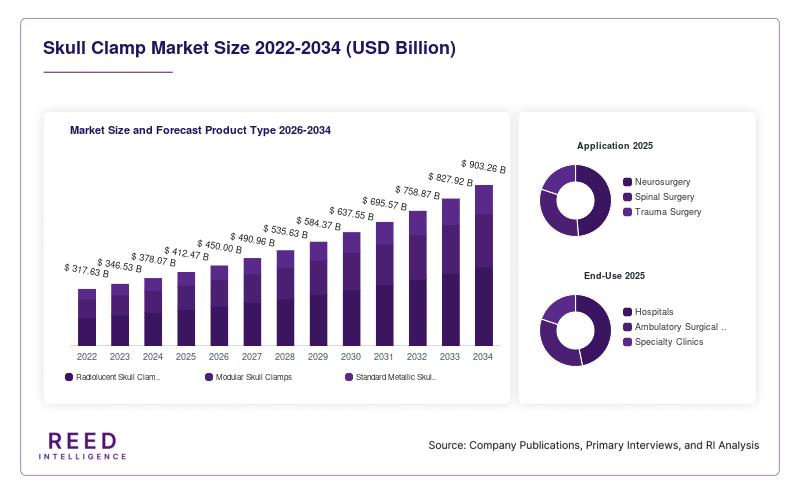
The radiolucent skull clamp segment dominated the market with a 2024 share of approximately 38.5%, driven by increasing demand for imaging-compatible surgical tools. These clamps are widely used in neurosurgical procedures where intraoperative imaging is essential. Their ability to reduce imaging interference makes them the preferred choice in advanced hospitals.
The fastest-growing segment is modular skull clamp systems, projected to register a CAGR of 11.6%. Growth is supported by increasing preference for adjustable and customizable surgical equipment that enhances procedural flexibility. Surgeons prefer modular systems for complex cranial and spinal procedures requiring multiple positioning adjustments.
By Application
Neurosurgery accounted for the largest share of 41.7% in 2024, driven by high volumes of brain tumor surgeries, aneurysm treatments, and trauma-related procedures. Skull clamps are critical in ensuring patient stability during delicate cranial operations, making this segment highly dominant.
Spinal surgery is the fastest-growing application segment with a projected CAGR of 11.8%. Increasing adoption of minimally invasive spinal procedures and rising incidence of degenerative spine conditions are contributing to demand for advanced fixation systems.
By End-Use
Hospitals represented the dominant end-use segment with a 45.2% market share in 2024, as most neurosurgical procedures are performed in hospital settings equipped with advanced operating rooms. Hospitals also have higher procurement capacity for premium skull clamp systems.
Ambulatory surgical centers are expected to grow at the fastest CAGR of 12.1%, driven by the rising shift toward outpatient neurosurgical procedures. These centers require compact, efficient, and easy-to-use skull clamp systems suitable for shorter surgical workflows.
Regional Analysis
North America
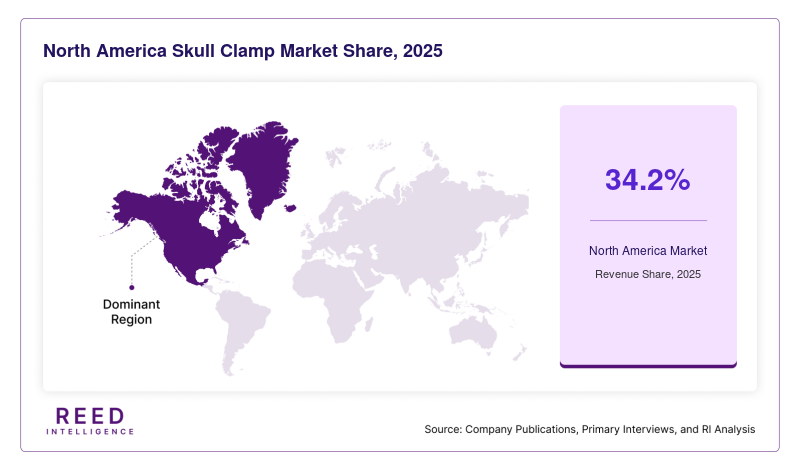
North America accounted for approximately 34.2% market share in 2025, and is projected to grow at a steady CAGR of around 8.7% through 2034. The region remains a mature and technologically advanced market for skull clamp systems, driven by high neurosurgical procedure volumes and strong adoption of advanced surgical equipment. Hospitals in the United States and Canada continue to invest in radiolucent and ergonomic fixation devices, supporting consistent demand growth.
The United States dominates the regional market due to its extensive network of neurosurgical centers and strong healthcare spending. A key growth factor is the early adoption of image-guided neurosurgery systems, which require high-precision skull clamps for accurate cranial stabilization during procedures.
Europe
Europe held around 27.5% market share in 2025, with an expected CAGR of 8.3% during 2026–2034. The region benefits from well-established healthcare infrastructure and strong emphasis on surgical safety standards. Demand is particularly high in Germany, France, and the United Kingdom, where advanced neurosurgical procedures are widely performed.
Germany leads the European market due to its strong medical device manufacturing base and hospital modernization programs. Increasing investments in minimally invasive neurosurgery systems are supporting demand for advanced skull clamp technologies across the region.
Asia Pacific
Asia Pacific accounted for 22.8% market share in 2025, and is projected to record the fastest CAGR of 11.2% through 2034. Rapid healthcare infrastructure development, rising patient population, and increasing trauma cases are key growth drivers. Countries such as China, India, and Japan are witnessing significant expansion in neurosurgical capabilities.
China dominates the region due to large-scale hospital expansion projects and government investment in advanced medical technologies. Growing accessibility to specialized neurosurgical care is a major factor supporting increased adoption of skull clamp systems.
Middle East & Africa
The Middle East & Africa region held 9.1% market share in 2025, with a projected CAGR of 9.5% through 2034. Growth is driven by improving healthcare infrastructure and increasing investments in tertiary care hospitals. Countries in the Gulf Cooperation Council are leading adoption due to advanced healthcare modernization programs.
Saudi Arabia is the dominant country in this region, supported by government initiatives to expand neurosurgical care facilities. Increased focus on medical tourism is also contributing to higher demand for advanced surgical equipment.
Latin America
Latin America accounted for 6.4% market share in 2025, with a CAGR of around 8.9% during the forecast period. The region is experiencing gradual growth supported by improvements in healthcare access and rising neurosurgical procedures. Brazil and Mexico are the key markets driving regional demand.
Brazil leads the Latin American market due to increasing investments in public healthcare infrastructure and trauma care centers. Expansion of private hospitals is also enhancing adoption of modern skull clamp systems.
Competitive Landscap
The Skull Clamp Market is moderately consolidated with the presence of global medical device manufacturers and specialized neurosurgical equipment providers. Key players include Integra LifeSciences, Stryker Corporation, Medtronic, B. Braun Melsungen AG, and Mizuho OSI. These companies focus on product innovation, material advancement, and ergonomic design improvements to strengthen their market position.
Among these, Stryker Corporation remains a leading player due to its strong neurosurgical product portfolio and continuous investment in surgical technology development. Recent developments include the introduction of advanced radiolucent head fixation systems designed for compatibility with modern imaging platforms. Companies are also focusing on strategic partnerships with hospitals and research institutions to expand clinical adoption and improve product performance.
Key Players List
- Stryker Corporation
- Medtronic plc
- Integra LifeSciences Holdings Corporation
- B. Braun Melsungen AG
- Mizuho OSI
- Codman & Shurtleff Inc.
- Adeor Medical AG
- Pro Med Instruments GmbH
- Allen Medical Systems
- OsteoMed
- Reliance Medical Systems
- Schaerer Medical AG
- Heal Force Bio-Meditech
- Rudolf Storz GmbH
- Zorayr Medical Instruments
Recent Developments
- Several manufacturers introduced next-generation radiolucent skull clamp systems designed for enhanced MRI and CT compatibility in advanced neurosurgical environments.
- Hospitals in Asia Pacific expanded procurement of modular cranial fixation devices as part of broader investments in neurosurgery infrastructure modernization.
- Leading medical device companies announced collaborations with robotic surgery developers to integrate skull clamps with navigation-assisted surgical platforms.
Skull Clamp Market Segments
Product Type
- Radiolucent Skull Clamps
- Modular Skull Clamps
- Standard Metallic Skull Clamps
Application
- Neurosurgery
- Spinal Surgery
- Trauma Surgery
End-Use
- Hospitals
- Ambulatory Surgical Centers
- Specialty Clinics
By Region
- North America
- Europe
- APAC
- Middle East and Africa
- LATAM