Sleeping Pod Market Size, Share & Trends Analysis Report By Pod Type (Compact Nap Pods, Single Sleeping Pods, Double & Family Sleeping Pods), By Application (Airports & Transit Hubs, Hotels & Hospitality, Workplaces & Coworking Spaces), By Revenue Model (Direct Sales, Rental & Pay-per-Use), By End User (Travelers, Employees, Students, Patients & Wellness Users) and By Region (North America, Europe, APAC, Middle East and Africa, LATAM) Forecasts, 2026–2034
USD 3950
Sleeping Pod Market Size
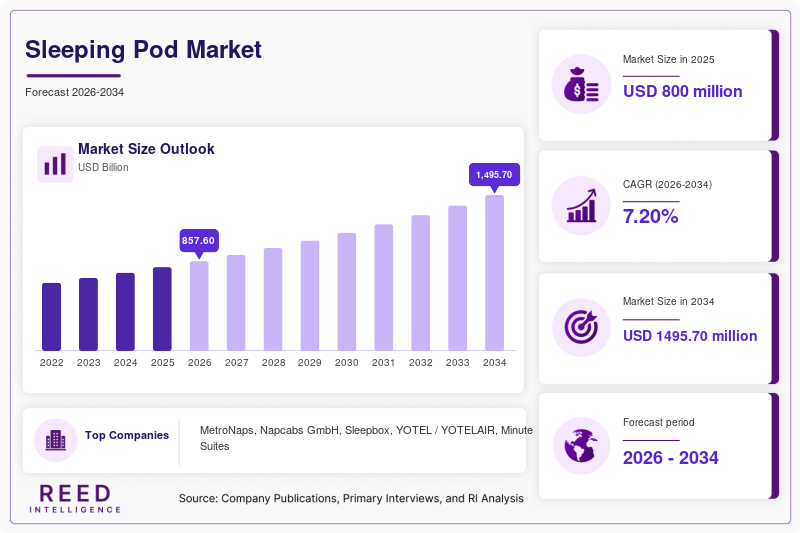
The global Sleeping Pod Market size was valued at USD 800 million in 2025 and is projected to grow from USD 860 million in 2026 to USD 1,495.70 million by 2034, registering a CAGR of 7.20% during the forecast period from 2026 to 2034.
The Sleeping Pod Market is developing around a simple commercial problem: people increasingly need short-duration private spaces for sleep, rest, recovery or focused downtime in locations where a conventional hotel room is impractical. Airports are the most visible application, but the market also includes workplace nap pods, hotel and capsule accommodation, wellness facilities, hospitals, universities and other institutional environments.
Airport demand provides a strong underlying signal. ACI World reported that global airports handled a record 9.8 billion passengers in 2025, while its January 2026 forecast projected 10.2 billion passengers for 2026. Higher passenger volumes increase the number of travelers exposed to long layovers, overnight connections and early departures.
Sleep quality is also becoming a consumer and workplace-wellness issue. The U.S. CDC reported that 30.5% of adults slept fewer than seven hours on average in 2024, while Hilton's travel research found that two in five travelers choose hotels where they believe they can sleep better.
Commercial models are consequently diversifying. Napcabs operates self-service airport cabins with time-based pricing, while MetroNaps supplies EnergyPods to offices, hospitals, universities and fitness centers.
Sleeping Pod Market Drivers
Rising Airport Passenger Volumes Are Expanding the Addressable Customer Base
Airports are a major demand center for sleeping pods because travelers often need rest for periods that are too short to justify leaving the airport or booking a conventional hotel. ACI World recorded 9.8 billion airport passengers globally in 2025, 3.7% above 2024, while international passenger traffic reached approximately 4 billion.
The commercial mechanism is based on dwell time. Passengers facing long connections, overnight layovers, delays or early departures can purchase a private sleeping space by the hour. Napcabs, for example, provides cabins directly inside airport terminals and charges according to actual usage time. Its cabins combine a bed, workspace, internet access, ventilation, lighting and flight-information functionality.
Airports also have a financial incentive to introduce these facilities because pods can monetize relatively small areas that may not support conventional retail or hospitality operations. Napcabs explicitly operates under a model in which it rents terminal space and handles operation, cleaning and maintenance.
The counterbalance is that airport traffic can be affected by geopolitical disruption, economic conditions and capacity constraints. ACI reported a significant slowdown in global passenger growth during the first half of 2026.
Sleep and Wellness Are Becoming Part of Hospitality and Workplace Design
The sleeping-pod concept is expanding because sleep is increasingly treated as part of wellness rather than simply a private activity. Hilton's 2025 travel research found that more than a quarter of travelers planned to book a spa or wellness treatment specifically to improve sleep, while two in five travelers said they choose hotels where they expect better sleep.
This creates demand for compact rest infrastructure in hotels, resorts, coworking spaces, offices and wellness centers. The same logic applies to employers. MetroNaps reports installations of its EnergyPod in offices, hospitals, universities and fitness centers across multiple countries. Its product combines a reclined position, programmed lighting and vibration, audio and usage tracking.
The commercial mechanism differs from airport use. Employers purchase or install pods as employee amenities, while hotels and wellness operators can incorporate them into premium services. This broadens the market beyond passenger traffic and reduces dependence on aviation.
Pay-Per-Use Models Make Pods Economically Practical
Sleeping pods occupy substantially less space than conventional hotel rooms and can be monetized through short stays. This makes them suitable for locations where a conventional room would have low utilization or excessive construction costs.
Napcabs demonstrates the model through self-service booking and minute-based billing. Its airport cabins require approximately four square meters per unit, can be booked for periods of up to 24 hours and are cleaned between users.
YOTELAIR follows a similar short-duration model. Its airport sleep cabins at Istanbul Airport are bookable by the hour for stays of up to four hours and combine a private bed with a workstation, television and access to shared facilities.
The mechanism improves asset utilization: the same pod can generate revenue from several users in one day. For airports and hospitality operators, this can turn previously underutilized floor area into a service revenue stream.
Sleeping Pod Market Restraints
Space, Hygiene and Installation Requirements Limit Deployment
Sleeping pods must satisfy fire safety, accessibility, ventilation, electrical, cleaning and emergency-access requirements. These requirements become more complex in airports, hospitals and other high-traffic environments.
The operating model also requires rapid cleaning between users. Napcabs automatically notifies cleaning personnel after each booking before the cabin becomes available again.
For airports, available space is particularly valuable. Pods compete with lounges, retail, foodservice, seating areas and other passenger amenities. Operators must therefore demonstrate enough utilization to justify allocating terminal space to sleeping facilities.
Conventional Hotels, Lounges and Free Rest Areas Remain Substitutes
Sleeping pods compete with airport lounges, hotel rooms, airport retiring rooms, reclining seats and free public rest areas. In some airports, passengers can access conventional short-stay accommodation without purchasing a pod.
The Airports Authority of India, for example, provides retiring rooms and dormitories at Chennai Airport for transit passengers staying up to 24 hours.
This creates a price and convenience comparison for operators. Pods must offer enough privacy, proximity and flexibility to justify their price relative to alternatives.
Sleeping Pod Market Opportunities
Expansion Into Airports Outside Mature Western Markets
Airport deployment provides one of the clearest opportunities for sleeping-pod manufacturers and operators. Airports Authority of India has actively tendered sleeping-pod facilities, including a 2025 tender for Chennai Airport and a 2026 license tender for Sri Guru Ram Dass Jee International Airport in Amritsar.
Chennai Airport has already introduced a Sleepzo sleeping-pod facility with four capsules equipped with beds, reading lights, charging points, luggage storage and ambient lighting.
The opportunity extends across India, Southeast Asia, the Middle East and other high-growth aviation markets where passenger volumes are increasing and airports are adding commercial amenities.
Smart and Digitally Managed Sleeping Pods
Digital access, cashless payments, remote monitoring, occupancy tracking and automated cleaning notifications can improve pod utilization while reducing staffing requirements.
Napcabs already uses touchscreen booking, automated operation and time-based billing. MetroNaps incorporates usage tracking into its EnergyPod system to support facility management.
Future systems can connect pod reservations with airport apps, hotel platforms, workplace booking systems and loyalty programs. This can create recurring revenue through reservations and service subscriptions rather than relying only on equipment sales.
Corporate Wellness and Productivity Applications
Workplace sleep pods provide an additional demand pool independent of tourism. MetroNaps states that its EnergyPods are deployed across offices, hospitals, universities and fitness centers.
The commercial opportunity is strongest in sectors where employee fatigue, shift work or long working hours make short-duration rest relevant. Hospitals, technology companies, call centers, transportation operators and universities can use pods as dedicated rest infrastructure.
The market can also expand from standalone chairs toward enclosed acoustic pods that provide both rest and privacy. This increases the addressable workplace use case from short naps to quiet recovery and focused downtime.
Segmental Analysis
By Pod Type
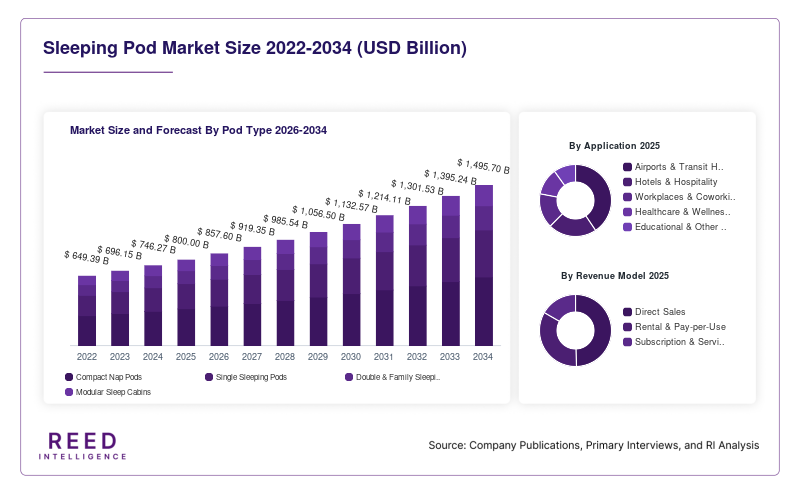
Single Sleeping Pods represent approximately 42% of the global market in 2025. They provide the strongest balance between privacy, floor-space efficiency and individual comfort. Airport operators particularly favor single-user cabins because the units can be deployed in small groups without requiring the larger footprint of conventional accommodation.
Compact Nap Pods account for approximately 31% and are commonly positioned around short-duration rest rather than overnight stays. MetroNaps' EnergyPod illustrates this format, with a reclining design intended for workplace power naps.
Modular Sleep Cabins represent approximately 19%, while Double & Family Sleeping Pods account for approximately 8%.
Modular Sleep Cabins are the fastest-growing pod type, with an estimated 8.5% CAGR. Their ability to be configured for airports, hotels, offices and other locations gives operators greater flexibility when adapting unused floor space.
By Application
Airports & Transit Hubs represent approximately 38% of the market in 2025, making them the largest application segment. Global airport traffic reached 9.8 billion passengers in 2025, creating a large addressable base for short-duration rest services.
Hotels & Hospitality account for approximately 25%, supported by capsule accommodation and short-stay airport hotels. YOTELAIR operates sleep cabins at Istanbul Airport and pod-style accommodation at London Gatwick.
Workplaces & Coworking Spaces represent approximately 19%, while Healthcare & Wellness Centers account for 11% and educational/other facilities 7%.
Workplaces & Coworking Spaces are the fastest-growing application, with approximately 8.6% CAGR, supported by corporate wellness programs and growing attention to sleep and employee recovery.
By Revenue Model
Direct Sales account for approximately 45% of the market in 2025. This model is common when offices, hotels, universities and other institutions purchase pods as permanent infrastructure.
Rental & Pay-per-Use represents approximately 37%. It is particularly relevant to airports and hospitality facilities where customers pay based on actual usage. Napcabs operates its airport cabins through a time-based pricing model.
Subscription & Service Contracts represent approximately 18%.
Rental & Pay-per-Use is the fastest-growing revenue model, with approximately 9.1% CAGR, because it lowers the upfront financial commitment for site operators while allowing pod providers to retain operational responsibility.
By End User
Travelers represent approximately 46% of the global market in 2025, reflecting the importance of airport and transit applications.
Employees account for approximately 27%, supported by workplace wellness and productivity initiatives. MetroNaps reports installations across corporate workplaces and other institutions.
Students account for approximately 15%, particularly across universities and educational campuses.
Patients & Wellness Users represent approximately 12%.
Employees are the fastest-growing end-user segment, with approximately 8.8% CAGR, as employers increasingly incorporate rest and recovery spaces into workplace amenities.
Regional Analysis
North America Sleeping Pod Market
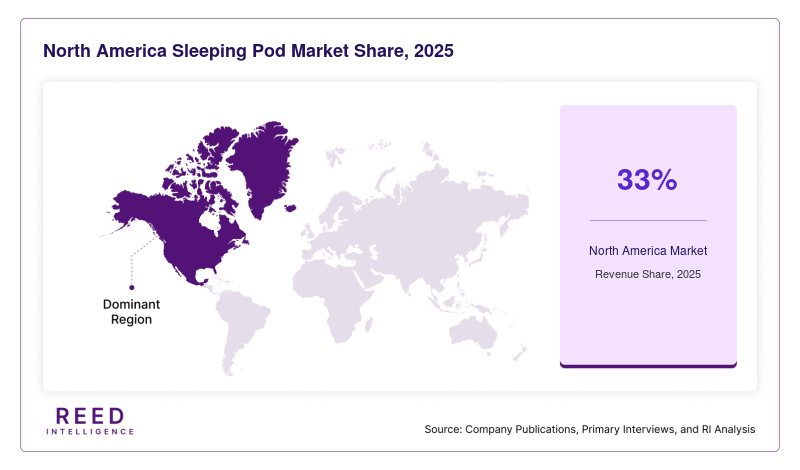
North America represents approximately 33% of the global Sleeping Pod Market in 2025, making it the largest regional market. The region has an established airport-hospitality ecosystem, large corporate workplace base and early adoption of dedicated nap-pod products.
MetroNaps has deployed EnergyPods in offices, hospitals, universities and fitness centers across multiple countries, with North America remaining a significant market for workplace and institutional applications.
Airport traffic also provides a large demand base. ACI's 2025 data places Atlanta, Dallas/Fort Worth, Chicago and Denver among the world's busiest airports by passenger volume.
The region is projected to grow at approximately 6.7% CAGR through 2034. Demand is increasingly split between airport rest facilities and workplace wellness. Corporate buyers can purchase pods outright, while airports increasingly use concession and pay-per-use models.
The main constraints are high real-estate costs in major terminals, competition from premium airport lounges and the need to demonstrate sufficient utilization.
Europe Sleeping Pod Market
Europe accounts for approximately 27% of the global market in 2025. The region has an established culture of compact hospitality, capsule accommodation and airport transit services.
Napcabs operates sleeping cabins at Munich, Frankfurt, Berlin and Stuttgart airports. Its cabins are positioned inside or near terminals and are designed for short-duration rest and work.
Frankfurt Airport currently lists NapCabs at Terminal 3, while Stuttgart Airport lists the service as a 24-hour passenger amenity.
Europe is expected to grow at approximately 6.8% CAGR. Demand is supported by dense international air connectivity, large transit hubs and established hospitality infrastructure.
The regional market is also influenced by sustainability and space-efficiency considerations. Compact pods can provide short-stay accommodation without the footprint of conventional rooms, although fire safety, accessibility and terminal-space requirements can limit deployment.
APAC Sleeping Pod Market
APAC represents approximately 24% of the global market in 2025 and is the fastest-growing region, with approximately 9.0% CAGR.
The region benefits from rapidly expanding air travel, dense metropolitan populations, major international transit hubs and growing interest in compact accommodation. ACI reported that Asia-Pacific passenger traffic increased 5.1% in 2025, while Shanghai Pudong and Guangzhou were among the world's fastest-growing major airports by passenger volume.
India is an important growth market. Airports Authority of India has actively pursued sleeping-pod facilities at Chennai and Amritsar, showing that airport operators are treating pods as a commercial passenger amenity rather than simply experimental furniture.
Japan, China, Singapore, South Korea and India also provide opportunities for capsule-style accommodation and compact hospitality.
APAC's growth is expected to be supported by new airport infrastructure, rising passenger traffic and increasing demand for short-stay accommodation. The main constraints include differences in airport regulations, fragmented operating models and uneven purchasing power across countries.
Middle East and Africa Sleeping Pod Market
Middle East and Africa represents approximately 7% of the global market in 2025 and is projected to expand at approximately 8.0% CAGR.
The region contains several major global transit hubs, including Dubai, Doha, Abu Dhabi and Istanbul's broader connecting market. ACI data shows Dubai International Airport handled more than 95 million passengers in 2025 and remained the world's busiest airport for international passengers.
These high-volume hubs provide a natural application for short-duration sleep facilities because passengers can experience long connection times between intercontinental flights.
Hospitality development also creates opportunities for compact sleep and rest concepts. Airport-linked hotels, lounges and premium terminals can use pods as an intermediate product between conventional seating and full hotel rooms.
The primary constraints are differences in airport concession structures, climate-control requirements, installation costs and competition from premium lounges and airport hotels.
LATAM Sleeping Pod Market
LATAM accounts for approximately 9% of the global market in 2025 and is expected to grow at approximately 7.8% CAGR.
The region's largest opportunities are concentrated around major international airports and dense urban business centers. São Paulo, Mexico City, Bogotá, Santiago and other major hubs provide potential demand for short-duration rest facilities.
Growing international connectivity increases the potential customer base, while workplace applications provide a second demand channel independent of aviation.
The market remains less developed than North America and Europe, leaving room for modular, low-capital deployment models. Operators can reduce barriers by using rental or revenue-sharing arrangements rather than requiring airports or employers to purchase complete pod installations.
Currency volatility, airport infrastructure differences and limited local specialist suppliers remain important constraints.
Competitive Landscape
The Sleeping Pod Market combines manufacturers, hospitality operators, airport concessionaires and workplace-wellness companies rather than being controlled by a single product category.
MetroNaps competes primarily in workplace and institutional applications through its EnergyPod. The company reports installations in offices, hospitals, universities and fitness centers across dozens of countries and four continents. Its product combines a reclined ergonomic design with programmed lighting, sound, vibration and usage tracking.
Napcabs has developed a specialized airport operating model. The company manufactures and operates its own cabins, rents terminal space, manages cleaning and maintenance, and charges travelers based on actual usage time. It currently operates across Munich, Frankfurt, Berlin and Stuttgart.
YOTELAIR competes through a hybrid hotel-and-cabin model. Its airport properties combine conventional rooms with compact sleep cabins, allowing it to serve both short-duration and overnight travelers. At Istanbul Airport, its sleep cabins can be booked for up to four hours.
Key Market Players
- MetroNaps
- Napcabs GmbH
- Sleepbox
- YOTEL / YOTELAIR
- Minute Suites
- GoSleep
- Sleep 'n Fly / Airport Dimensions
- ZzzleepandGo
- SnoozeCube
- Podtime
- Rest N Go
- EnergyPod
- Sleepovers
- JetQuay
Recent Market Developments
- September 2026 – Napcabs expanded at Stuttgart Airport. Four new sleeping cabins opened in Terminal 1's public departure area, extending the operator's airport network and demonstrating continued adoption of compact rest facilities outside traditional hotel spaces.
- 2025 – Hilton identified sleep-focused travel as a major hospitality trend. Its research found strong traveler interest in better sleep, sleep retreats and sleep-enhancing wellness services, supporting the broader hospitality demand environment for dedicated rest infrastructure.
Sleeping Pod Market Segments
By Pod Type
- Compact Nap Pods
- Single Sleeping Pods
- Double & Family Sleeping Pods
- Modular Sleep Cabins
By Application
- Airports & Transit Hubs
- Hotels & Hospitality
- Workplaces & Coworking Spaces
- Healthcare & Wellness Centers
- Educational & Other Facilities
By Revenue Model
- Direct Sales
- Rental & Pay-per-Use
- Subscription & Service Contracts
By End User
- Travelers
- Employees
- Students
- Patients & Wellness Users
By Region
- North America
- Europe
- APAC
- Middle East and Africa
- LATAM