Slideway Oil Market Size, Share & Demand Report By Product Type (Mineral-Based Slideway Oil, Synthetic Slideway Oil, Semi-Synthetic Slideway Oil), By Viscosity Grade (ISO VG 32, ISO VG 68, ISO VG 220, Other Viscosity Grades), By End-Use Industry (Automotive Manufacturing, Aerospace Equipment Manufacturing, Metal Fabrication, Heavy Engineering, Industrial Machinery, Others), By Region & Segment Forecasts, 2026–2034
USD 3950
Market Overview
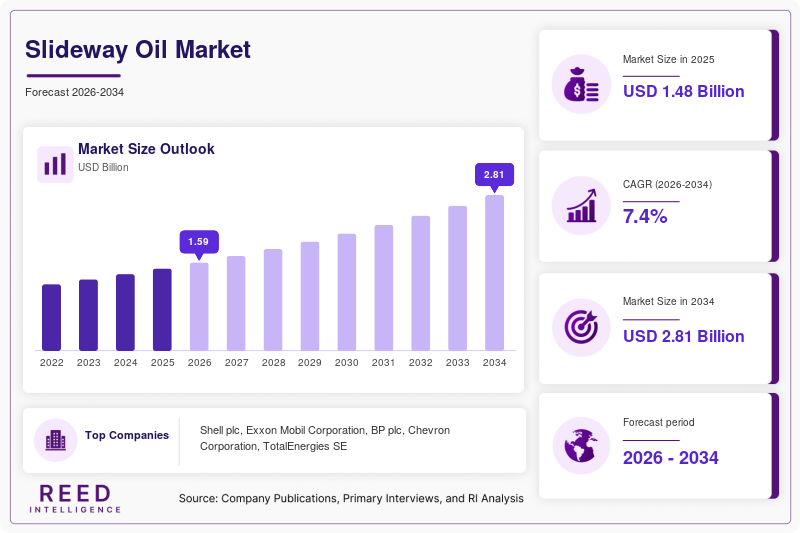
The global Slideway Oil Market size was valued at approximately USD 1.48 billion in 2026 and is projected to reach nearly USD 2.63 billion by 2034, expanding at a CAGR of 7.4% during the forecast period from 2026 to 2034. Slideway oils are widely used in industrial machinery to reduce stick-slip movement, improve lubrication efficiency, and protect machine tools from wear and corrosion. The market continues to benefit from the growing use of precision machining systems across automotive, aerospace, heavy engineering, and metal fabrication industries. Rising industrial automation and the increasing deployment of CNC machines have created sustained demand for high-performance lubricants capable of supporting productivity and equipment durability.
The growing emphasis on predictive maintenance and operational efficiency has also supported market expansion across developed and emerging economies. Manufacturers are increasingly investing in advanced lubricants that can extend equipment life, minimize downtime, and maintain machine accuracy during continuous industrial operations. In addition, rising investments in manufacturing infrastructure across Asia Pacific and Latin America are contributing to steady product consumption. Environmental compliance standards and the transition toward bio-based lubricants are further encouraging product innovation among leading lubricant suppliers.
Key Highlights
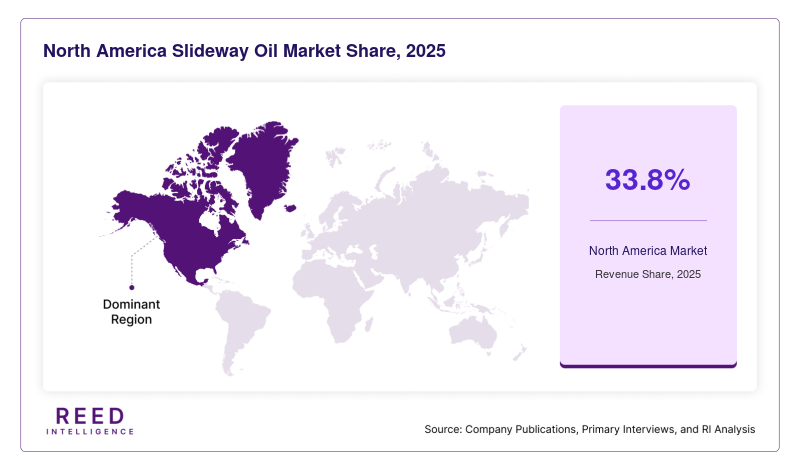
- North America dominated the market with a 33.8% share in 2025.
- Asia Pacific is expected to grow at the fastest CAGR of 9.1% during 2026–2034.
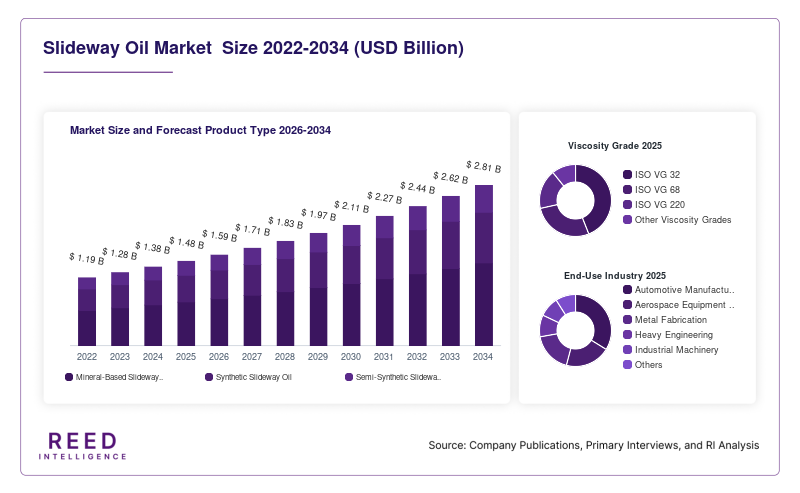
- By product type, mineral-based slideway oil accounted for the largest share of 58.4%.
- while synthetic slideway oil is projected to grow at a CAGR of 9.7%.
- By viscosity grade, ISO VG 68 led with a 36.2% share.
- whereas ISO VG 220 is expected to expand at a CAGR of 8.8%.
- By end-use industry, automotive manufacturing held a 31.6% share.
- while aerospace equipment manufacturing is anticipated to grow at a CAGR of 9.4%.
- The United States remained the dominant country, with market values of USD 372 million in 2024 and USD 401 million in 2025.
Market Trends
Rising Adoption of Synthetic and Bio-Based Lubricants
The increasing adoption of synthetic and bio-based slideway oils has emerged as a significant trend in the Slideway Oil Market. Industrial operators are shifting toward advanced lubricant formulations that provide higher thermal stability, better oxidation resistance, and longer service intervals. Synthetic slideway oils are gaining attention because they improve machine efficiency and reduce maintenance frequency in high-speed machining environments. Bio-based lubricants are also witnessing growing demand due to tightening environmental regulations and sustainability initiatives across manufacturing industries. Companies are developing eco-friendly lubricant products that minimize emissions and reduce contamination risks in industrial facilities. Demand for these products is especially strong in Europe and North America, where industrial operators are focusing on regulatory compliance and long-term sustainability targets. The transition toward cleaner industrial operations is expected to continue supporting innovation in advanced slideway oil formulations.
Expansion of Smart Manufacturing and CNC Machining Facilities
The rapid expansion of smart manufacturing and CNC machining operations is influencing purchasing patterns across the Slideway Oil Market. Manufacturers are investing in automated machining systems that require precise lubrication to maintain dimensional accuracy and equipment stability. Modern CNC systems operate at higher speeds and under demanding production conditions, increasing the need for premium slideway oils with enhanced anti-wear and anti-stick-slip properties. Industrial automation initiatives in Asia Pacific, particularly in China, India, Japan, and South Korea, are accelerating demand for machine tool lubricants. The integration of predictive maintenance technologies is also encouraging industrial users to select lubricants that support sensor-based equipment monitoring. As factories continue to modernize their production lines, lubricant suppliers are introducing specialized products designed for digitally connected manufacturing systems and high-performance industrial machinery.
Market Drivers
Growth in Global Manufacturing and Metal Processing Industries
The continued expansion of manufacturing and metal processing industries is a major factor driving the Slideway Oil Market. Industrial sectors such as automotive, heavy engineering, construction equipment, and industrial machinery rely heavily on machine tools that require effective lubrication for smooth operation. Slideway oils help reduce friction, improve positioning accuracy, and protect machine components from wear during continuous industrial usage. Rising production of automotive components and fabricated metal products has increased the deployment of CNC machines, lathes, milling systems, and grinding equipment across global manufacturing facilities. Emerging economies are also witnessing substantial investments in industrial parks and manufacturing plants, which is supporting lubricant consumption. Governments in countries such as India, Vietnam, and Mexico are promoting domestic manufacturing activities through infrastructure development and industrial incentives. These initiatives are creating favorable conditions for lubricant suppliers operating in the industrial machinery sector.
Increasing Focus on Equipment Maintenance and Operational Efficiency
Industrial companies are increasingly prioritizing preventive maintenance and operational efficiency, creating strong demand for high-quality slideway oils. Production downtime caused by machine wear and lubrication failure can significantly affect manufacturing productivity and operational costs. As a result, manufacturers are adopting advanced lubrication solutions that improve machine reliability and extend equipment lifespan. Slideway oils with anti-corrosion additives, water separation capability, and enhanced lubricity are becoming essential for industrial maintenance programs. Industries operating under continuous production schedules, including aerospace machining and precision engineering, are particularly focused on reducing machine failure risks. Lubricant manufacturers are responding by introducing products with longer drain intervals and improved thermal performance. The growing use of maintenance monitoring systems is also supporting demand for premium lubricants that can maintain stable performance under varying operating conditions.
Market Restraint
Volatility in Crude Oil Prices and Raw Material Costs
Fluctuations in crude oil prices and raw material costs remain a significant restraint for the Slideway Oil Market. Most conventional slideway oils are produced using mineral oil base stocks derived from petroleum refining processes. Changes in global crude oil supply, geopolitical tensions, and refining capacity disruptions can directly influence production costs for lubricant manufacturers. Rising additive prices and transportation expenses also create pricing pressure across the supply chain. Small and medium-sized lubricant producers often face challenges in maintaining stable profit margins during periods of raw material volatility. Industrial end users may delay lubricant replacement cycles or shift toward lower-cost alternatives when pricing uncertainty increases. In highly competitive markets, manufacturers are forced to balance product quality with pricing strategies, which can limit investment in research and product innovation. These factors may slow market expansion in price-sensitive industrial sectors and emerging economies.
Market Opportunities
Growing Industrialization Across Emerging Economies
Rapid industrialization across emerging economies is creating substantial opportunities for participants in the Slideway Oil Market. Countries in Asia Pacific, Latin America, and parts of Africa are investing heavily in manufacturing infrastructure, industrial automation, and export-oriented production facilities. These investments are increasing demand for machine tools, metalworking systems, and industrial equipment that rely on slideway lubrication products. The automotive and electronics manufacturing sectors are expanding significantly in countries such as India, Indonesia, Thailand, and Brazil. As industrial production capacity increases, demand for reliable machine lubricants is expected to rise steadily. International lubricant manufacturers are also expanding distribution partnerships and regional blending facilities to strengthen their presence in high-growth markets. Increasing awareness regarding preventive maintenance and machine efficiency among local manufacturers is expected to support long-term market growth.
Development of High-Performance Specialty Lubricants
The development of high-performance specialty lubricants presents another major opportunity for the Slideway Oil Market. Industrial customers are increasingly seeking customized lubricant formulations capable of supporting high-speed machining, precision engineering, and extreme operating temperatures. This trend is encouraging manufacturers to invest in research and development activities focused on synthetic technologies and multifunctional additives. Specialty slideway oils that combine lubrication, corrosion protection, and coolant compatibility are gaining traction in advanced manufacturing environments. Aerospace, medical device manufacturing, and semiconductor equipment industries are particularly demanding specialized lubricants that ensure precision and equipment cleanliness. The emergence of Industry 4.0 technologies is also creating opportunities for smart lubricants designed for predictive maintenance applications. Companies capable of offering technologically advanced and environmentally compliant products are expected to gain a competitive advantage in the evolving industrial lubricant landscape.
Segmental Analysis
By Product Type
Mineral-based slideway oil accounted for the largest share of the Slideway Oil Market in 2024, representing approximately 58.4% of total revenue. These lubricants remain widely used because of their cost-effectiveness, broad availability, and compatibility with conventional industrial machinery. Small and medium-sized manufacturing facilities continue to prefer mineral-based lubricants due to lower operating costs and established maintenance practices. Industries such as automotive components, metalworking, and general engineering rely heavily on these products for machine tool lubrication. Mineral-based oils also provide adequate anti-wear performance and stick-slip control for standard machining operations. Demand remains particularly strong in developing regions where industrial operators prioritize affordability and operational reliability over advanced lubricant technologies. Lubricant manufacturers are further improving additive formulations to enhance oxidation resistance and machine protection capabilities.
Synthetic slideway oil is projected to witness the fastest CAGR of 9.7% during the forecast period due to rising demand for high-performance lubrication solutions. Synthetic products offer improved thermal stability, extended drain intervals, superior lubrication efficiency, and enhanced resistance to oxidation under demanding operating conditions. These characteristics make them suitable for high-speed CNC machining centers and precision engineering applications. Industrial facilities focused on predictive maintenance and operational efficiency are increasingly adopting synthetic lubricants to reduce equipment wear and maintenance frequency. The aerospace, semiconductor, and medical equipment manufacturing sectors are among the fastest-growing users of synthetic slideway oils. Growing environmental concerns and stricter industrial regulations are also encouraging the development of synthetic lubricants with lower emissions and improved biodegradability.
By Viscosity Grade
ISO VG 68 emerged as the dominant viscosity grade segment in 2024, accounting for nearly 36.2% of the global Slideway Oil Market. This viscosity grade is extensively used in medium-duty machine tools because it provides balanced lubrication performance, effective stick-slip prevention, and reliable surface protection. ISO VG 68 oils are commonly applied in milling machines, grinders, and lathes operating under moderate load conditions. Their widespread acceptance across industrial sectors is supported by compatibility with a broad range of machine tool designs and operating temperatures. Manufacturing companies often prefer ISO VG 68 lubricants because they help maintain machining accuracy and improve equipment life without significantly increasing maintenance expenses. Industrial workshops and metal fabrication facilities continue to rely on this grade for daily machining operations.
ISO VG 220 is expected to expand at the fastest CAGR of 8.8% from 2026 to 2034 due to increasing demand for heavy-duty lubrication applications. This viscosity grade is particularly suitable for large industrial machines operating under high-load and high-pressure conditions. Heavy engineering, steel processing, and industrial equipment manufacturing sectors are increasingly adopting ISO VG 220 lubricants to improve machine durability and operational consistency. The growing use of automated heavy machinery and large-scale CNC systems is also contributing to segment growth. In addition, manufacturers are introducing advanced additive packages that enhance film strength, corrosion protection, and thermal performance in high-viscosity lubricant products. These technological improvements are expected to support wider adoption across industrial production environments.
By End-Use Industry
Automotive manufacturing represented the leading end-use industry segment in 2024 and accounted for approximately 31.6% of the Slideway Oil Market. Automotive production facilities depend heavily on machine tools, robotic machining systems, and metal cutting equipment for precision component manufacturing. Slideway oils play a critical role in reducing friction, maintaining machining accuracy, and preventing equipment wear in continuous production environments. The increasing production of electric vehicles and automotive components has further accelerated demand for high-performance industrial lubricants. Automotive manufacturers are also focusing on preventive maintenance programs to minimize production interruptions and improve manufacturing efficiency. Large-scale deployment of CNC systems in automotive machining operations continues to support lubricant consumption across both developed and emerging industrial markets.
Aerospace equipment manufacturing is anticipated to register the fastest CAGR of 9.4% during the forecast period due to increasing investments in precision machining and advanced engineering applications. Aerospace production requires extremely accurate machining operations for critical components such as turbine parts, structural assemblies, and engine systems. These operations depend on premium lubrication products capable of supporting high-speed machining while maintaining dimensional precision. Growing aircraft production and rising defense manufacturing activities are contributing to stronger lubricant demand across aerospace facilities. Manufacturers are increasingly selecting synthetic and specialty slideway oils that provide superior thermal stability and low contamination risks. The expansion of aerospace manufacturing hubs in North America, Europe, and Asia Pacific is expected to sustain long-term segment growth.
Regional Analysis
North America
North America accounted for approximately 33.8% of the global Slideway Oil Market in 2025 and maintained a leading position due to its advanced manufacturing infrastructure and strong industrial maintenance culture. The regional market is projected to expand at a CAGR of 6.5% through 2034. Demand for slideway oils remains high across automotive production, aerospace machining, industrial equipment manufacturing, and heavy engineering operations. The region also benefits from high adoption of CNC machining systems and precision metalworking technologies. Industrial facilities in the United States and Canada increasingly focus on minimizing equipment downtime through preventive maintenance and premium lubrication practices.
The United States remained the dominant country within the regional market due to the presence of large-scale industrial manufacturing and advanced aerospace production facilities. A unique growth factor supporting market expansion is the rapid adoption of automated machining technologies in defense and aerospace manufacturing. Manufacturers are increasingly investing in precision machining systems that require high-performance lubricants for operational consistency and dimensional accuracy. In addition, lubricant suppliers are introducing environmentally compliant synthetic formulations to meet evolving industrial sustainability targets across the country.
Europe
Europe represented nearly 26.4% of the global Slideway Oil Market in 2025 and is forecast to grow at a CAGR of 6.9% during the assessment period. The region continues to benefit from its established automotive, industrial machinery, and metal fabrication industries. Germany, Italy, France, and the United Kingdom remain important consumers of industrial lubricants due to the concentration of precision engineering companies and advanced manufacturing facilities. Environmental regulations in Europe are encouraging the adoption of low-emission and bio-based lubricants. This trend is driving innovation in synthetic slideway oils with improved oxidation stability and lower environmental impact.
Germany dominated the European market because of its strong industrial machinery manufacturing base and leadership in precision engineering technologies. A unique growth factor supporting the German market is the country’s focus on smart factory integration and advanced automation systems. Industrial companies are increasingly deploying digitally connected machining equipment that requires stable and long-lasting lubrication solutions. The growing presence of high-value automotive and aerospace component manufacturing facilities also contributes to strong demand for premium slideway oils across the country.
Asia Pacific
Asia Pacific held approximately 24.7% of the global Slideway Oil Market in 2025 and is expected to register the fastest CAGR of 9.1% between 2026 and 2034. The region is witnessing rapid industrialization, increasing investments in manufacturing facilities, and expanding metal processing activities. China, India, Japan, and South Korea remain key contributors to regional growth due to rising deployment of CNC machinery and automated production systems. Growing industrial exports and favorable government initiatives supporting domestic manufacturing are strengthening lubricant demand across industrial sectors. Increasing awareness regarding machine maintenance is also encouraging the use of high-quality slideway lubricants.
China emerged as the leading country in the Asia Pacific market due to its extensive manufacturing sector and strong presence in industrial equipment production. A unique growth factor driving the Chinese market is the ongoing modernization of machine tool manufacturing facilities under industrial upgrade programs. Chinese manufacturers are increasingly adopting advanced lubrication technologies to improve productivity and reduce operational inefficiencies. In addition, rising exports of industrial machinery and automotive components continue to create favorable conditions for lubricant consumption across the country.
Middle East & Africa
The Middle East & Africa region accounted for around 8.1% of the global Slideway Oil Market in 2025 and is anticipated to grow at a CAGR of 6.3% over the forecast period. Industrial diversification programs across Gulf countries are supporting demand for machinery lubricants in metal fabrication, construction equipment manufacturing, and industrial processing sectors. Investments in industrial parks and manufacturing hubs are creating opportunities for lubricant suppliers. The market also benefits from rising adoption of preventive maintenance practices in heavy industrial operations. However, varying industrial development levels across African economies continue to influence regional demand patterns.
Saudi Arabia remained the dominant market within the region due to expanding industrial infrastructure and increasing investments in non-oil manufacturing activities. A unique growth factor supporting market development is the country’s industrial diversification strategy, which encourages local manufacturing and machinery production. New industrial projects in metalworking, automotive assembly, and industrial processing are increasing demand for machine lubrication products. International lubricant manufacturers are also expanding regional distribution networks to strengthen product availability and customer support services.
Latin America
Latin America captured nearly 7.0% of the global Slideway Oil Market in 2025 and is expected to grow at a CAGR of 6.8% through 2034. Industrial recovery across Brazil, Mexico, and Argentina is supporting demand for industrial lubricants used in machine tools and manufacturing systems. Automotive component production and metal fabrication activities continue to contribute significantly to regional lubricant consumption. Governments across several countries are promoting industrial investments and export-oriented manufacturing, creating favorable opportunities for machinery and lubricant suppliers. Increasing replacement of aging industrial equipment is also contributing to market expansion.
Brazil dominated the Latin American market because of its extensive manufacturing base and growing industrial machinery sector. A unique growth factor supporting the Brazilian market is the expansion of domestic automotive and agricultural equipment manufacturing activities. Industrial companies are increasingly modernizing production facilities and implementing maintenance programs to improve operational efficiency. Rising adoption of CNC machining systems and industrial automation technologies is expected to sustain demand for high-performance slideway oils across the country during the forecast period.
Competitive Landscape
The Slideway Oil Market remains moderately consolidated, with global lubricant manufacturers competing through product innovation, distribution expansion, and strategic partnerships. Leading companies are focusing on synthetic lubricant development, sustainability initiatives, and industrial maintenance solutions to strengthen their market presence. Competition is particularly intense in North America, Europe, and Asia Pacific, where industrial automation and precision machining activities continue to expand. Companies are also increasing investments in research and development to introduce lubricants with improved anti-wear performance, corrosion resistance, and thermal stability.
Shell plc remained one of the leading participants in the market due to its extensive industrial lubricant portfolio and broad global distribution network. The company recently expanded its synthetic industrial lubricant production capacity to support rising demand from advanced manufacturing industries. Other major companies are emphasizing regional expansion strategies and collaborations with machine tool manufacturers to improve customer reach. Several lubricant suppliers are also investing in environmentally compliant and bio-based lubricant technologies to align with evolving industrial sustainability requirements and regulatory standards.
Key Players
- Shell plc
- Exxon Mobil Corporation
- BP plc
- Chevron Corporation
- TotalEnergies SE
- FUCHS Petrolub SE
- Idemitsu Kosan Co., Ltd.
- Indian Oil Corporation Ltd.
- Petro-Canada Lubricants Inc.
- ENEOS Corporation
- Klüber Lubrication
- Valvoline Inc.
- Phillips 66 Company
- Castrol Limited
- Sinopec Lubricant Company
Recent Developments
- In February 2026, Shell plc introduced a new synthetic slideway lubricant series designed for high-speed CNC machining systems and precision industrial equipment.
- In September 2025, FUCHS Petrolub SE expanded its industrial lubricant blending facility in Southeast Asia to strengthen supply capabilities for regional manufacturing customers.
- In June 2025, Exxon Mobil Corporation launched an advanced bio-based industrial lubricant platform focused on reducing carbon emissions in manufacturing operations.
- In January 2026, TotalEnergies SE partnered with machine tool manufacturers to develop customized lubrication solutions for smart factory environments.
Slideway Oil Market Segments
Product Type
- Mineral-Based Slideway Oil
- Synthetic Slideway Oil
- Semi-Synthetic Slideway Oil
Viscosity Grade
- ISO VG 32
- ISO VG 68
- ISO VG 220
- Other Viscosity Grades
End-Use Industry
- Automotive Manufacturing
- Aerospace Equipment Manufacturing
- Metal Fabrication
- Heavy Engineering
- Industrial Machinery
- Others
By Region
- North America
- Europe
- APAC
- Middle East and Africa
- LATAM