Slow Speed Shredding Machine Market Size, Share & Demand Report By Machine Type (Single Shaft Shredders, Dual Shaft Shredders), By Application (Municipal Solid Waste Processing, E-Waste Recycling, Construction and Demolition Waste, Tire Recycling, Metal Scrap Processing, Wood and Biomass Waste), By End Use (Waste Management Companies, Industrial Recycling Facilities) By Region & Segment Forecasts, 2026–2034
USD 3950
Market Overview
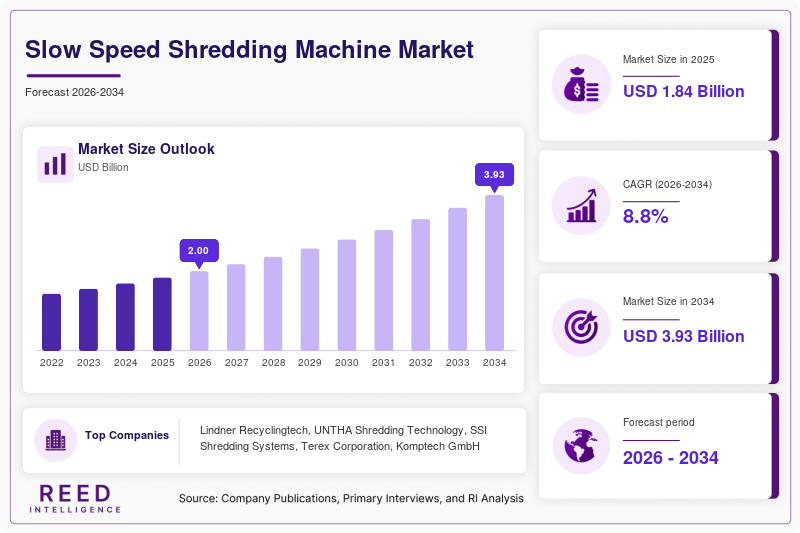
The global Slow Speed Shredding Machine Market size was valued at USD 1.84 billion in 2026 and is projected to reach USD 3.61 billion by 2034, expanding at a CAGR of 8.8% during the forecast period from 2026 to 2034. Slow speed shredding machines are widely used for processing municipal solid waste, industrial scrap, construction debris, electronic waste, plastic waste, wood residue, and metal components. These machines operate at lower rotational speeds while delivering high torque, enabling efficient material size reduction with reduced noise, lower dust generation, and controlled particle output. The growing emphasis on sustainable waste management practices and industrial recycling operations continues to support global market growth.
One of the major factors driving demand for slow speed shredding machines is the rapid expansion of recycling infrastructure across developed and emerging economies. Governments and private waste management companies are investing in advanced shredding systems to improve material recovery rates and reduce landfill dependency. In addition, industrial facilities are adopting energy-efficient shredding solutions to comply with environmental regulations and circular economy initiatives. The increasing generation of electronic waste and construction waste has further accelerated the deployment of robust shredding equipment capable of handling mixed and bulky materials with improved operational reliability.
Key Highlights
- North America dominated the market with a 35.1% share in 2025.
- while Asia Pacific is expected to grow at the fastest CAGR of 10.9% during 2026–2034.
- By machine type, dual shaft shredders accounted for the largest share of 42.6%.
- while mobile slow speed shredders are projected to grow at a CAGR of 11.4%.
- By application, municipal solid waste processing led with a 39.3% share, whereas e-waste recycling is expected to expand at a CAGR of 12.1%.
- By end use, waste management companies held the largest share of 44.8%, while industrial recycling facilities are anticipated to grow at a CAGR of 10.8%.
- The United States remained the dominant country, with market values of USD 472 million in 2024 and USD 518 million in 2025.
Market Trends
Integration of Smart Monitoring and Automation Systems
The integration of smart monitoring systems and automation technologies has become a major trend in the Slow Speed Shredding Machine Market. Manufacturers are increasingly equipping shredding machines with IoT-enabled sensors, remote diagnostics platforms, and automated feed control systems to improve operational efficiency. Real-time monitoring helps operators track blade wear, motor temperature, vibration levels, and fuel consumption, allowing predictive maintenance and reducing unexpected downtime. Waste management companies prefer these technologies because they lower repair costs and improve throughput consistency across large-scale recycling facilities.
Automation is also improving worker safety and machine adaptability. Modern shredders now include programmable logic controllers and intelligent sorting interfaces that optimize shredding performance based on material type and density. Mobile shredding systems with digital controls are gaining popularity in construction and demolition waste management applications. The trend is particularly strong in North America and Europe, where recycling operators prioritize productivity and labor efficiency. As industrial facilities continue to adopt digital waste processing systems, manufacturers are expected to increase investments in software-enabled shredding platforms and connected maintenance services.
Rising Adoption of Mobile and Hybrid Shredding Equipment
The market is witnessing increasing adoption of mobile and hybrid slow speed shredding machines due to the growing need for flexible waste processing operations. Mobile shredders enable waste processors to transport equipment directly to demolition sites, landfills, mining locations, and industrial facilities. This mobility reduces transportation expenses associated with moving bulky waste materials to centralized recycling centers. Construction and demolition contractors are particularly adopting mobile shredders for on-site waste reduction and improved material segregation.
Hybrid shredding equipment powered by diesel-electric systems is also gaining traction as industries focus on reducing fuel consumption and emissions. Hybrid systems provide lower operational costs while maintaining high torque output required for processing dense materials such as tires, metals, and wood waste. Several manufacturers are introducing compact mobile shredders suitable for urban waste management projects where space limitations and noise restrictions are critical considerations. The increasing emphasis on operational flexibility and environmental efficiency is expected to support long-term demand for portable and energy-efficient shredding systems across both developed and emerging markets.
Market Drivers
Expansion of Global Recycling and Waste Management Infrastructure
The expansion of recycling infrastructure and organized waste management systems is one of the strongest growth drivers for the Slow Speed Shredding Machine Market. Governments across multiple regions are implementing landfill reduction targets and recycling mandates to manage rising volumes of municipal and industrial waste. Slow speed shredding machines play a critical role in reducing waste size before sorting, transportation, or energy recovery processes. The growing focus on circular economy practices has encouraged recycling facilities to invest in advanced shredding equipment capable of handling mixed waste streams with higher efficiency.
Industries such as automotive, electronics, construction, and packaging are generating substantial volumes of recyclable materials that require efficient size reduction systems. Waste-to-energy plants are also deploying shredding machines to improve fuel preparation processes and combustion efficiency. Public-private partnerships in urban waste management projects have increased procurement of large-capacity shredders in developing economies. As environmental regulations become stricter and landfill costs continue to rise, demand for durable and energy-efficient shredding equipment is expected to remain strong throughout the forecast period.
Growing Demand for E-Waste and Industrial Scrap Processing
The rapid increase in electronic waste and industrial scrap generation is significantly driving the adoption of slow speed shredding machines worldwide. Consumer electronics replacement cycles have shortened considerably, leading to higher volumes of discarded devices such as computers, televisions, batteries, and communication equipment. Slow speed shredders are widely preferred for e-waste processing because they minimize dust generation and provide controlled material breakdown, which supports efficient recovery of valuable metals and reusable components.
Industrial manufacturing sectors are also increasing investments in scrap recycling systems to reduce raw material costs and improve sustainability performance. Metal fabrication facilities, automotive dismantling plants, and plastic processing industries use slow speed shredders for volume reduction and material separation. The ability of these machines to process heavy-duty and irregular waste materials without excessive wear makes them suitable for industrial recycling applications. In addition, rising awareness regarding hazardous waste disposal and resource conservation is encouraging both public authorities and private enterprises to modernize recycling operations with advanced shredding equipment.
Market Restraint
High Initial Investment and Maintenance Costs
High capital investment and maintenance expenses continue to restrain the broader adoption of slow speed shredding machines, particularly among small and medium-sized recycling operators. Advanced shredding systems equipped with hydraulic drives, automated control panels, and high-torque components require significant upfront spending. Large industrial shredders designed for processing mixed waste and heavy scrap materials often involve additional costs related to installation, transportation, and infrastructure upgrades. These financial barriers can limit purchasing decisions in developing regions where recycling infrastructure remains underfunded.
Maintenance costs also create operational challenges for end users. Shredding blades, cutting shafts, and wear-resistant liners require regular replacement when machines process abrasive materials such as metal scrap, concrete residue, and industrial waste. Downtime caused by component wear can reduce productivity and increase operational expenses. Fuel costs and skilled technician requirements further impact profitability for smaller recycling facilities. Some companies prefer renting or leasing equipment instead of purchasing new systems, which may slow the pace of direct equipment sales. Although technological advancements are improving machine durability and energy efficiency, the overall ownership cost remains a key concern for budget-sensitive waste processing operators.
Market Opportunities
Increasing Investments in Waste-to-Energy Projects
The growing number of waste-to-energy projects worldwide presents substantial opportunities for the Slow Speed Shredding Machine Market. Governments and utility companies are investing in alternative energy generation systems that convert municipal solid waste, biomass residue, and industrial waste into usable energy. Slow speed shredders are essential in preparing refuse-derived fuel by reducing waste into consistent particle sizes suitable for combustion and gasification processes. As countries focus on reducing landfill dependency and diversifying renewable energy sources, demand for shredding equipment in waste-to-energy facilities is expected to rise steadily.
Emerging economies in Asia Pacific, the Middle East, and Latin America are expanding investments in integrated waste treatment infrastructure to address urban waste accumulation challenges. Public sector funding and foreign investments are supporting the establishment of new waste processing plants that require advanced shredding systems. Manufacturers have opportunities to develop high-capacity shredders with improved fuel efficiency and automated material handling features tailored for waste-to-energy operations. Partnerships between equipment suppliers and energy developers are also expected to create long-term growth potential across industrial and municipal applications.
Expansion of Construction and Demolition Waste Recycling
The increasing volume of construction and demolition waste generated by urbanization and infrastructure development is creating favorable opportunities for slow speed shredding machine manufacturers. Large-scale residential, commercial, and transportation projects produce substantial quantities of wood, concrete, asphalt, plastics, and metal debris that require efficient processing before recycling or disposal. Slow speed shredders are widely used in demolition waste recycling because they can handle bulky and irregular materials while minimizing operational noise and dust emissions.
Governments are introducing stricter regulations for construction waste disposal and promoting recycling targets for infrastructure projects. This trend is encouraging contractors and waste management companies to invest in mobile shredding equipment for on-site processing. Demand for compact and portable shredders is increasing in urban redevelopment projects where transportation costs and landfill restrictions are major concerns. Equipment manufacturers also have opportunities to provide customized shredding solutions integrated with sorting and screening systems. The expansion of green building initiatives and sustainable infrastructure programs is expected to further strengthen demand for construction waste recycling technologies during the forecast period.
Segmental Analysis
By Machine Type
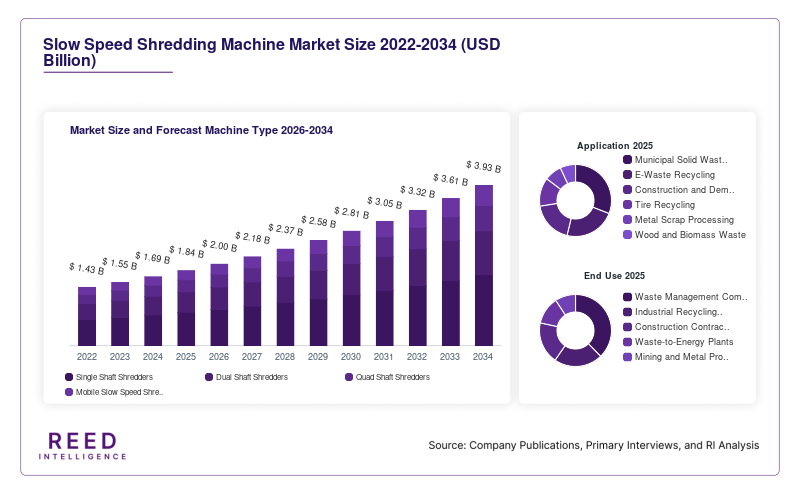
Dual shaft shredders accounted for the largest share of the Slow Speed Shredding Machine Market in 2024, representing 42.6% of global revenue. These machines are widely preferred because they can process bulky and mixed waste materials with high torque and stable output performance. Dual shaft systems are commonly used in municipal solid waste facilities, tire recycling plants, and industrial scrap processing centers. Their ability to handle difficult materials such as metals, plastics, wood, and construction debris makes them suitable for heavy-duty recycling operations. In addition, dual shaft shredders generate lower noise levels and reduced dust emissions compared to high-speed alternatives, supporting adoption in urban waste processing applications. Manufacturers are increasingly integrating automated reverse functions and wear-resistant blades to improve machine durability and operational efficiency.
Mobile slow speed shredders are projected to register the fastest CAGR of 11.4% during the forecast period. Demand for mobile units is increasing because waste processing companies and construction contractors require flexible equipment capable of operating across multiple project locations. Portable shredders reduce transportation costs associated with moving bulky waste to centralized facilities, making them cost-effective for demolition and infrastructure projects. Mobile systems equipped with diesel-electric drives are also gaining popularity because they improve fuel efficiency while maintaining high processing capacity. Rental service providers are expanding their fleets of mobile shredders to meet rising demand from short-term industrial projects. Additionally, urban redevelopment activities and disaster waste management operations are creating new opportunities for compact and transportable shredding equipment worldwide.
By Application
Municipal solid waste processing represented the leading application segment in 2024, accounting for 39.3% of the global market share. Growing urban populations and rising waste generation volumes have increased the need for efficient waste size reduction technologies. Slow speed shredders are extensively used in municipal waste facilities because they can process mixed household waste while minimizing operational noise and airborne dust. These systems support downstream recycling and waste-to-energy operations by producing consistent material sizes suitable for sorting and fuel preparation. Local governments and private waste management operators are investing in automated shredding lines to improve landfill diversion rates and meet sustainability targets. In addition, smart city initiatives and stricter waste segregation regulations are encouraging municipalities to modernize their recycling infrastructure with advanced shredding solutions.
E-waste recycling is expected to grow at the fastest CAGR of 12.1% during the forecast period due to increasing electronic device consumption and shorter product replacement cycles. Slow speed shredders are highly suitable for electronic waste processing because they allow controlled material breakdown and reduce the risk of hazardous particle dispersion. Recycling companies use these machines to process computers, batteries, communication devices, and consumer electronics before metal recovery and material separation. Governments are implementing stricter regulations regarding electronic waste disposal, which is accelerating investments in specialized recycling facilities. The growing recovery value of precious metals such as copper, gold, and aluminum from discarded electronics is also improving profitability within the e-waste recycling industry. Equipment manufacturers are responding by developing shredders with enhanced separation compatibility and advanced safety features.
By End Use
Waste management companies held the dominant share of 44.8% in the global Slow Speed Shredding Machine Market in 2024. These organizations rely on shredding equipment for municipal waste treatment, landfill diversion, biomass preparation, and recycling operations. Large waste management firms prefer high-capacity shredders capable of handling mixed and bulky waste streams with continuous operational performance. The growing emphasis on circular economy practices and resource recovery has encouraged service providers to modernize facilities with automated shredding technologies. Many operators are also investing in hybrid and energy-efficient shredders to reduce fuel costs and meet sustainability goals. Long-term municipal waste contracts and expanding urban populations continue to create stable demand for industrial shredding systems across developed and developing regions.
Industrial recycling facilities are anticipated to record the fastest CAGR of 10.8% through 2034. Manufacturing industries are increasingly adopting recycling solutions to reduce raw material expenses, improve operational sustainability, and comply with environmental regulations. Industrial facilities processing metals, plastics, rubber, textiles, and wood waste require durable shredding equipment capable of operating under demanding conditions. The expansion of automotive recycling, industrial scrap recovery, and packaging waste processing is contributing to strong demand for advanced shredding technologies. Companies are also adopting automated sorting and shredding systems integrated with digital monitoring tools to improve productivity and maintenance efficiency. In emerging economies, rapid industrialization and growing awareness regarding resource conservation are expected to accelerate investments in industrial recycling infrastructure and high-performance shredding equipment.
Regional Analysis
North America
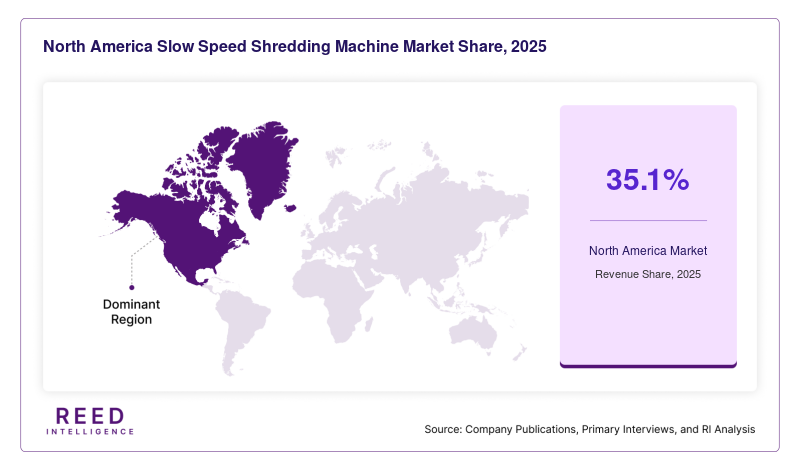
North America accounted for 35.1% of the global Slow Speed Shredding Machine Market share in 2025 and is expected to maintain a steady CAGR of 7.9% through 2034. The region benefits from advanced recycling infrastructure, strict environmental regulations, and high adoption of industrial waste processing technologies. Municipal waste management facilities across the United States and Canada are increasingly investing in high-capacity shredding systems to improve landfill diversion rates. Demand for mobile shredders is also increasing among construction and demolition contractors seeking efficient on-site waste processing solutions.
Europe
Europe represented 28.4% of the global market in 2025 and is projected to expand at a CAGR of 8.1% during the forecast period. The region has established some of the world’s most structured recycling policies, particularly related to electronic waste, industrial scrap, and municipal waste segregation. Countries across Western and Northern Europe continue to increase investments in circular economy programs and advanced material recovery systems. Demand for low-noise and energy-efficient shredding equipment is growing as industrial operators seek compliance with environmental emission standards and workplace safety regulations.
Asia Pacific
Asia Pacific held 23.7% of the global Slow Speed Shredding Machine Market share in 2025 and is expected to register the fastest CAGR of 10.9% through 2034. Rapid urbanization, rising industrialization, and growing waste generation are contributing significantly to market expansion across the region. Governments in countries such as China, India, Japan, and South Korea are investing heavily in organized waste management systems and recycling infrastructure. The increasing demand for affordable waste processing solutions has encouraged adoption of both stationary and mobile shredding machines across municipal and industrial applications.
Middle East & Africa
The Middle East & Africa market accounted for 6.5% of the global share in 2025 and is anticipated to grow at a CAGR of 8.4% during the forecast period. Waste management modernization projects and industrial diversification initiatives are supporting regional demand for slow speed shredding machines. Several Gulf countries are focusing on sustainable waste treatment infrastructure to reduce landfill dependence and improve resource recovery. Mining operations and industrial processing facilities are also investing in shredding equipment for material handling and waste reduction applications.
Latin America
Latin America captured 6.3% of the global market share in 2025 and is forecast to expand at a CAGR of 7.6% through 2034. The region is gradually improving waste collection systems and recycling infrastructure in response to increasing urban population growth and environmental concerns. Countries such as Brazil, Mexico, and Chile are investing in waste management modernization projects to address rising municipal solid waste volumes. Demand for mobile shredders is increasing among regional contractors and recycling operators due to the flexibility and lower transportation costs associated with portable equipment.
Competitive Landscape
The Slow Speed Shredding Machine Market is moderately fragmented, with global and regional manufacturers competing through product innovation, distribution expansion, and customized waste processing solutions. Leading companies are focusing on improving machine durability, fuel efficiency, and automation capabilities to strengthen their market positions. Demand for mobile shredders and hybrid-powered systems has encouraged manufacturers to invest in advanced engineering and digital monitoring technologies. Strategic collaborations with recycling operators and waste management companies are also becoming increasingly common across the industry.
Lindner Recyclingtech remained one of the leading participants in the market due to its broad product portfolio and strong presence in industrial recycling applications. The company recently introduced upgraded shredding systems with enhanced remote diagnostics and energy-efficient drive technologies to improve operational performance. Other major players are also expanding manufacturing capacity and strengthening after-sales service networks to support growing customer demand.
Key Players
- Lindner Recyclingtech
- UNTHA Shredding Technology
- SSI Shredding Systems
- Terex Corporation
- Komptech GmbH
- EDGE Innovate
- Vecoplan AG
- Doppstadt Umwelttechnik
- Metso Corporation
- Hammel Recyclingtechnik
- Weima Maschinenbau GmbH
- Genox Recycling Tech
- Fornnax Technology
- Eldan Recycling
- BCA Industries
Recent Developments
- In February 2025, UNTHA Shredding Technology launched a new high-capacity mobile slow speed shredder designed for construction and demolition waste applications with improved fuel efficiency and remote monitoring features.
- In September 2024, Terex Corporation expanded its recycling equipment manufacturing operations in Europe to support growing demand for mobile shredding and screening systems across municipal waste processing projects.
- In June 2025, Lindner Recyclingtech introduced an advanced predictive maintenance platform integrated with IoT-enabled shredding systems to improve uptime and operational reliability for industrial recycling operators.
Slow Speed Shredding Machine Market Segments
Machine Type
- Single Shaft Shredders
- Dual Shaft Shredders
- Quad Shaft Shredders
- Mobile Slow Speed Shredders
Application
- Municipal Solid Waste Processing
- E-Waste Recycling
- Construction and Demolition Waste
- Tire Recycling
- Metal Scrap Processing
- Wood and Biomass Waste
End Use
- Waste Management Companies
- Industrial Recycling Facilities
- Construction Contractors
- Waste-to-Energy Plants
- Mining and Metal Processing Industries
By Region
- North America
- Europe
- APAC
- Middle East and Africa
- LATAM