Slurry Valves Market Size, Share & Demand Report By Valve Type (Knife Gate Valves, Pinch Valves, Ball Valves), By Material Type (Cast Iron & Ductile Iron, Stainless Steel), By Actuation Type (Manual, Pneumatic, Hydraulic), By End-Use Industry (Mining & Mineral Processing, Water & Wastewater Treatment, Oil & Gas, Chemicals), By Distribution Channel (Direct Sales, Industrial Distributors, OEM Channels), By Region & Segment Forecasts, 2026–2034
USD 3950
Market Overview
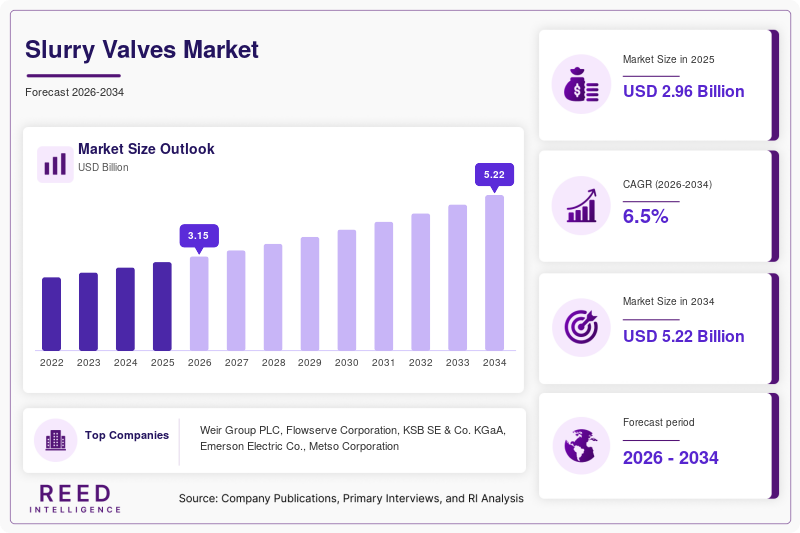
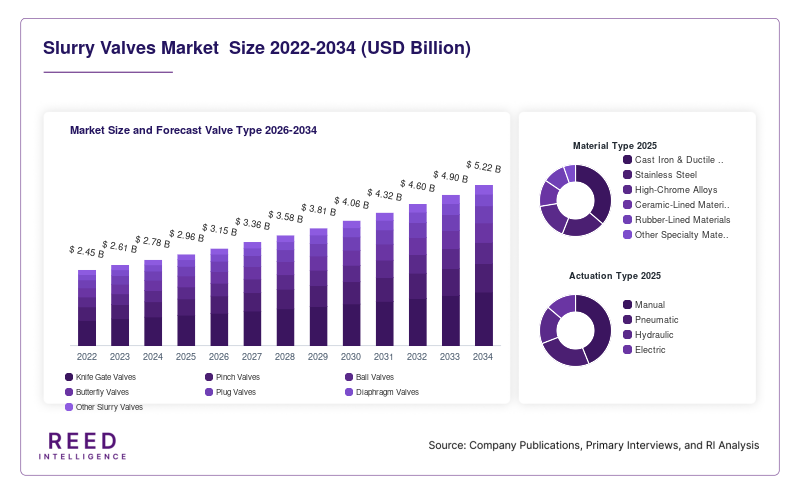
The Slurry Valves Market size was valued at USD 2.96 billion in 2026 and is projected to reach USD 4.89 billion by 2034, expanding at a CAGR of 6.5% during 2026–2034. The global Slurry Valves Market plays a critical role in industries that handle abrasive, corrosive, and high-density fluids, including mining, mineral processing, power generation, wastewater treatment, oil & gas, chemicals, and pulp & paper. Slurry valves are specifically designed to withstand severe operating conditions involving solid-laden liquids, making them essential components in industrial fluid control systems.
A major global factor supporting market growth has been the continuous expansion of mining and mineral processing activities worldwide. Rising demand for metals, rare earth elements, industrial minerals, and construction materials has increased investment in extraction and processing facilities. These operations require durable valve systems capable of maintaining reliability under highly abrasive conditions. Consequently, industrial operators are increasingly adopting advanced slurry valves that offer longer service life, reduced maintenance requirements, and improved operational efficiency.
Key Highlights
- Asia Pacific dominated the market with a 41.9% share in 2025.
- Middle East & Africa is expected to be the fastest-growing region, registering a CAGR of 7.8% during 2026–2034.
- By Valve Type, Knife Gate Valves held the leading 38.6% market share in 2025.
- By Valve Type, Pinch Valves are projected to grow at the fastest 7.6% CAGR through 2034.
- By Material Type, Cast Iron & Ductile Iron Valves accounted for 34.8% market share in 2025.
- By Material Type, High-Chrome Alloy Valves are expected to expand at a 7.9% CAGR.
- By End-Use Industry, Mining & Mineral Processing represented 44.5% share in 2025.
- By End-Use Industry, Water & Wastewater Treatment is forecast to register a 7.4% CAGR during the forecast period.
- China remained the dominant country market, valued at USD 372 million in 2024 and USD 395 million in 2025.
Market Trends
Increasing Adoption of Smart Valve Monitoring Technologies
One of the key trends shaping the Slurry Valves Market is the growing integration of digital monitoring solutions. Industrial operators are increasingly deploying sensors, predictive maintenance software, and remote monitoring platforms to track valve performance in real time.
Smart valve technologies help identify wear patterns, leakage risks, and operational inefficiencies before equipment failure occurs. These capabilities improve maintenance planning, reduce unplanned shutdowns, and enhance overall process reliability. As industrial facilities continue implementing Industry 4.0 initiatives, demand for digitally connected slurry valves is expected to increase steadily.
Growing Demand for Advanced Wear-Resistant Materials
Manufacturers are focusing on the development of highly durable valve materials capable of operating in severe abrasive environments. Advanced elastomers, ceramic-lined components, tungsten carbide coatings, and high-chrome alloys are increasingly being utilized to extend service life.
These material innovations reduce replacement frequency and lower maintenance costs for end users. Industries handling highly abrasive slurries are prioritizing lifecycle performance over initial procurement costs, creating strong demand for technologically advanced valve solutions.
Market Drivers
Expansion of Global Mining Operations
Increasing investments in mining activities continue to support market expansion. Rising demand for copper, lithium, iron ore, nickel, gold, and critical minerals has encouraged the development of new extraction and processing facilities worldwide.
Mining operations require reliable flow control systems capable of handling abrasive slurry mixtures throughout extraction, transportation, and processing stages. This sustained demand for durable fluid management infrastructure continues to drive adoption of slurry valves across mining environments.
Rising Industrial Process Automation
Industrial facilities are increasingly investing in automation technologies to improve productivity, process consistency, and operational safety. Automated slurry valve systems enable precise flow control and integration with centralized control platforms.
Automation initiatives reduce manual intervention while improving process efficiency. Growing adoption of automated process control systems across industrial sectors continues to strengthen demand for advanced slurry valve solutions.
Market Restraint
Complex Maintenance Requirements in Harsh Applications
A major restraint affecting the Slurry Valves Market is the demanding maintenance environment associated with abrasive and corrosive applications. Continuous exposure to solid particles can accelerate wear of internal components, increasing maintenance frequency.
Unexpected failures may result in operational disruptions and higher repair expenses. These challenges can affect purchasing decisions among cost-sensitive operators and create barriers to broader adoption in certain industrial segments.
Market Opportunities
Expansion of Water Reuse and Treatment Infrastructure
Increasing investment in water recycling and wastewater management projects presents substantial opportunities for slurry valve manufacturers. Treatment facilities require specialized flow control equipment capable of handling sludge, sediment, and abrasive waste streams.
As governments prioritize sustainable water management strategies, demand for high-performance slurry valves is expected to increase significantly across municipal and industrial treatment applications.
Development of Critical Mineral Processing Facilities
Growing demand for battery materials and strategic minerals is creating opportunities for new processing facilities worldwide. Lithium, cobalt, nickel, and rare earth projects require advanced slurry transportation and processing systems.
The construction of these facilities will create additional demand for specialized valve technologies capable of operating under chemically aggressive and abrasive conditions.
Segmental Analysis
By Valve Type
Knife Gate Valves
Knife gate valves dominated the market and accounted for 38.6% of revenue in 2025. Their ability to effectively handle dense slurries, suspended solids, and abrasive materials supported widespread adoption across mining and industrial applications.
Pinch Valves
Pinch valves are projected to grow at a 7.6% CAGR through 2034. Growth will be driven by their simple construction, excellent sealing performance, and suitability for highly abrasive slurry environments. Their ability to minimize internal wear will contribute to increasing adoption.
By Material Type
Cast Iron & Ductile Iron Valves
Cast iron and ductile iron valves represented 34.8% market share in 2025. These materials offered a balance between durability, affordability, and mechanical strength for a broad range of industrial applications.
High-Chrome Alloy Valves
High-chrome alloy valves will register a 7.9% CAGR during the forecast period. Increasing demand for enhanced wear resistance and extended operational lifespan in abrasive processing environments will support segment growth.
By Actuation Type
Manual Valves
Manual valves accounted for 46.1% market share in 2025. Their cost-effectiveness and suitability for standard industrial operations contributed to continued market leadership.
Electric Actuated Valves
Electric actuated valves are expected to expand at a 7.7% CAGR through 2034. Increasing integration with automated process control systems and remote operation capabilities will accelerate adoption across industrial facilities.
By End-Use Industry
Mining & Mineral Processing
Mining and mineral processing held 44.5% of market revenue in 2025. The segment maintained leadership due to extensive requirements for slurry transportation, flotation systems, tailings management, and ore processing operations.
Water & Wastewater Treatment
Water and wastewater treatment is projected to grow at a 7.4% CAGR. Expanding treatment infrastructure and increasing sludge management requirements will drive future demand for specialized slurry valve solutions.
By Distribution Channel
Direct Sales
Direct sales captured 63.7% market share in 2025. Industrial customers preferred direct procurement arrangements to obtain customized technical specifications and long-term maintenance support.
Industrial Distributors
Industrial distributors are forecast to register a 6.9% CAGR through 2034. Expansion of regional distribution networks and improved product availability will support future market growth.
Regional Analysis
North America
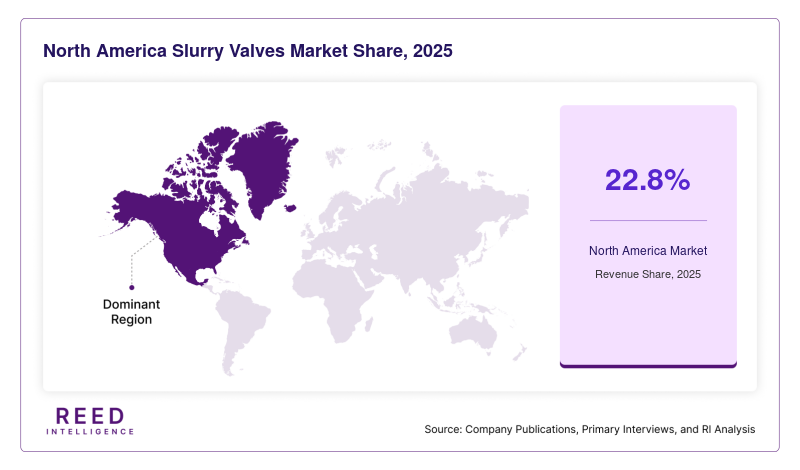
North America accounted for 22.8% of the global Slurry Valves Market share in 2025. The region benefited from established mining operations, industrial modernization initiatives, and increasing adoption of automation technologies. The market will expand at a CAGR of 5.9% during 2026–2034.
The United States remained the dominant country market due to ongoing investments in industrial process optimization and modernization of fluid handling systems. Demand from mining, chemicals, and wastewater treatment sectors continues to support regional growth.
Europe
Europe held 19.7% market share in 2025. The region benefited from advanced manufacturing capabilities, environmental compliance requirements, and modernization of industrial infrastructure. The market will grow at a CAGR of 5.6% through 2034.
Germany emerged as the leading country due to its strong industrial equipment manufacturing sector and extensive deployment of advanced process technologies. Investments in industrial efficiency improvements continue to support market expansion.
Asia Pacific
Asia Pacific represented 41.9% of global revenue in 2025, making it the largest regional market. The region is expected to register a CAGR of 7.1% between 2026 and 2034.
China dominated regional revenue generation owing to extensive mining operations, industrial expansion, and large-scale infrastructure development. Continuous investment in mineral processing facilities and industrial production capacity remains a major contributor to regional demand.
Middle East & Africa
The Middle East & Africa accounted for 8.6% market share in 2025. The region will grow at a CAGR of 7.8% during the forecast period, making it the fastest-growing regional market.
Saudi Arabia remained the dominant country due to increasing investments in mining diversification initiatives and industrial development projects. Expansion of mineral processing operations and industrial infrastructure continues to create demand for slurry handling equipment.
Latin America
Latin America captured 7.0% of global revenue in 2025 and is forecast to expand at a CAGR of 6.3% through 2034.
Chile led the regional market because of its extensive copper mining industry and ongoing investments in mineral extraction infrastructure. Continuous expansion of processing facilities supports demand for reliable slurry control systems.
Competitive Landscape
The Slurry Valves Market is moderately fragmented, with manufacturers competing through product durability, material innovation, customization capabilities, and service support. Companies are increasingly focusing on wear-resistant technologies, automation compatibility, and lifecycle cost reduction.
Weir Group PLC maintained a leading market position through its extensive portfolio of mining and mineral processing equipment. The company recently expanded its range of high-performance slurry handling solutions featuring enhanced wear-resistant materials designed to improve operational reliability in demanding environments.
Flowserve Corporation continues strengthening its presence through advanced industrial valve technologies and digital monitoring solutions.
KSB SE & Co. KGaA focuses on engineered fluid handling systems designed for abrasive process applications.
Emerson Electric Co. remains active in automation-integrated valve technologies and intelligent process control solutions.
Metso Corporation continues investing in mining-focused flow control equipment designed to improve operational efficiency and equipment lifespan.
Key Players List
- Weir Group PLC
- Flowserve Corporation
- KSB SE & Co. KGaA
- Emerson Electric Co.
- Metso Corporation
- Bray International Inc.
- Velan Inc.
- AVK Holding A/S
- Orbinox Valves International
- SchuF Group
- Red Valve Company
- DeZURIK Inc.
- ITT Inc.
- Crane Company
- KITZ Corporation
Slurry Valves Market Segments
Valve Type
- Knife Gate Valves
- Pinch Valves
- Ball Valves
- Butterfly Valves
- Plug Valves
- Diaphragm Valves
- Other Slurry Valves
Material Type
- Cast Iron & Ductile Iron
- Stainless Steel
- High-Chrome Alloys
- Ceramic-Lined Materials
- Rubber-Lined Materials
- Other Specialty Materials
Actuation Type
- Manual
- Pneumatic
- Hydraulic
- Electric
End-Use Industry
- Mining & Mineral Processing
- Water & Wastewater Treatment
- Oil & Gas
- Chemicals
- Power Generation
- Pulp & Paper
- Other Industrial Applications
Distribution Channel
- Direct Sales
- Industrial Distributors
- OEM Channels
- Online Procurement Platforms
By Region
- North America
- Europe
- APAC
- Middle East and Africa
- LATAM