Small Kitchen Appliances Market Size, Share & Trends Analysis Report By Product Type (Food Preparation Appliances, Cooking Appliances, Beverage Appliances), By Function (Blending & Processing, Cooking & Frying, Coffee & Beverage Preparation), By Distribution Channel (Offline Retail, Online Retail, Specialty Stores, Direct-to-Consumer), By End User (Residential, Commercial & Hospitality) and By Region (North America, Europe, APAC, Middle East and Africa, LATAM) Forecasts, 2026–2034
USD 3950
Small Kitchen Appliances Market Size
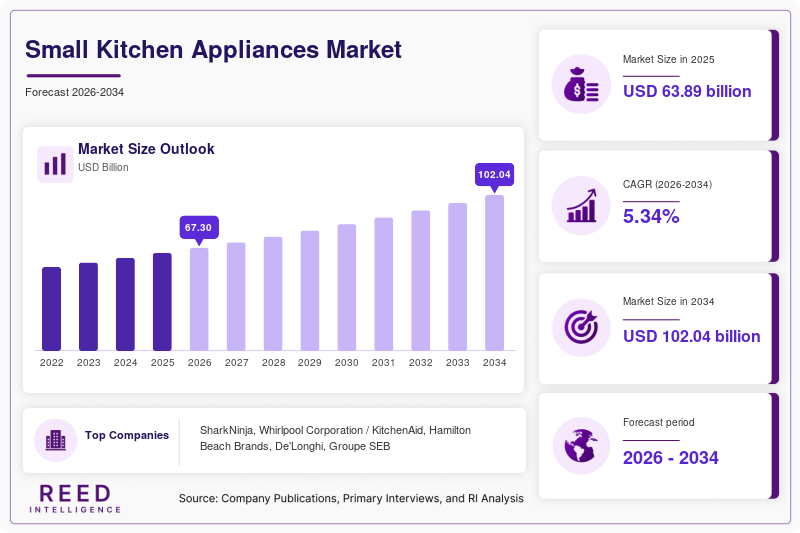
The global Small Kitchen Appliances Market size was valued at USD 63.89 billion in 2025 and is projected to grow from USD 67.30 billion in 2026 to USD 102.04 billion by 2034, registering a CAGR of 5.34% during the forecast period from 2026 to 2034.
The Small Kitchen Appliances Market includes compact electrical appliances used for food preparation, cooking, beverage preparation, baking, toasting and related household kitchen activities. Major categories include blenders, food processors, mixers, coffee makers, espresso machines, air fryers, toaster ovens, kettles, juicers, rice cookers and other countertop appliances.
Current industry activity shows that growth is increasingly being generated by product innovation and category expansion rather than simple household replacement. SharkNinja reported 2025 net sales of USD 6.40 billion, up 15.7%, with food-preparation appliance sales increasing 31.6% and cooking and beverage appliances increasing 5.7%. The company attributed food-preparation growth largely to its frozen-drinks category and cooking/beverage growth to products including the Ninja Luxe Café espresso machine and Ninja Crispi.
Whirlpool's Small Domestic Appliances business also recorded 9% net sales growth in 2025, with momentum in espresso, blenders, cordless countertop appliances and other food-preparation categories.
The category is therefore moving toward multifunctionality, premiumization, compact formats and digitally enabled products. At the same time, energy efficiency, repairability and product durability are becoming more important in regulated markets. The European Commission's ecodesign framework increasingly incorporates energy performance, resource efficiency, repair information and spare-parts availability across household appliance categories.
Small Kitchen Appliances Market Drivers
Convenience-Oriented Cooking Is Increasing Demand for Countertop Appliances
Small kitchen appliances allow consumers to perform specific cooking tasks faster and with less preparation than conventional kitchen equipment. Air fryers, blenders, food processors, espresso machines, multicookers and compact ovens can shorten cooking time while allowing households to prepare restaurant-style or specialized foods at home.
The commercial effect is visible in company-level sales. SharkNinja's food-preparation appliance revenue increased 31.6% in 2025, driven by strong frozen-drinks products, while its cooking and beverage category increased 5.7%. The company also described Ninja as the best-selling small kitchen appliance brand in the U.S. based on dollars sold for the period ending January 3, 2026.
Hamilton Beach's 2025 annual report similarly lists air fryers, blenders, coffee makers, food processors, juicers, mixers, slow cookers, toasters and toaster ovens across its small-appliance portfolio. The company reported that its product pipeline remained focused on high-growth categories including blender systems and single-serve coffee.
This creates a recurring replacement and upgrade cycle because consumers can add several appliances rather than replacing one multifunctional appliance. The counterbalance is category saturation in mature households, where new purchases increasingly require a clear performance, design or convenience advantage.
Premium Coffee, Beverage and Food-Preparation Appliances Are Expanding the Value Pool
Premiumization is changing the economics of the small-appliance category. Consumers are increasingly purchasing appliances that reproduce specialist foodservice experiences at home, particularly espresso, specialty coffee, frozen drinks and high-performance blending.
De'Longhi launched the PrimaDonna Aromatic in April 2026 with intelligent bean-to-cup adaptation designed to personalize coffee preparation. The company described the product as its next-generation home espresso platform.
Whirlpool's KitchenAid business also expanded its premium small-appliance portfolio in 2025, including espresso products, the KitchenAid Go cordless suite and the Pure Power Blender. The company reported that its small domestic appliance business achieved 9% net sales growth and a 16% EBIT margin in 2025.
The mechanism is higher average selling prices and a greater willingness to upgrade existing products for better extraction, speed, automation, aesthetics and personalization. Premium categories can also create recurring accessory and consumable demand, particularly in coffee.
Online and Direct-to-Consumer Channels Are Increasing Product Discovery
Small appliances are well suited to online purchasing because consumers can compare specifications, recipes, demonstrations, reviews and prices without physically testing the products. Social-media content and creator demonstrations further support discovery of visually demonstrable products such as air fryers, blenders, espresso machines and food processors.
Hamilton Beach reported that Walmart and Amazon accounted for approximately 29% and 19%, respectively, of its 2025 revenue, demonstrating the importance of major retail and e-commerce platforms in the small-appliance distribution structure.
Whirlpool also identified continued expansion of its online presence as one of the drivers of its Small Domestic Appliances performance.
This changes competition because brands can launch products internationally without building an equally large physical-store network. However, online price comparison can also increase promotional pressure and make differentiation more difficult.
Small Kitchen Appliances Market Restraints
Discretionary Spending and Product Saturation Can Slow Replacement Demand
Small kitchen appliances are generally discretionary purchases, particularly premium espresso machines, specialized blenders, beverage appliances and multifunctional cooking products. Consumers can postpone replacement when household budgets are under pressure.
Hamilton Beach reported that its core business remained stable in 2025 but noted that retailer purchasing patterns were normalizing after a challenging period. Its annual report also highlights exposure to retailer inventory decisions and consumer demand.
European appliance demand demonstrates the broader pressure. APPLiA reported that European home-appliance sales ended 2025 at roughly 170 million units, with volumes returning to levels last seen around 2015.
The effect on small appliances is that premium upgrades must demonstrate clear consumer value. Manufacturers therefore increasingly use multifunctionality, convenience, aesthetics, connected features and differentiated performance to justify replacement.
Raw-Material, Tariff and Compliance Costs Can Pressure Margins
Small appliances depend on plastics, metals, motors, heating elements, electronics, semiconductors, packaging and logistics. Changes in material prices, freight costs and tariffs can therefore affect manufacturer margins.
Whirlpool reported navigating tariff pressures in 2025 through pricing actions and cost reductions, while maintaining a pipeline of new products. SharkNinja also reported that tariffs partially offset gross-margin improvements in 2025.
Regulatory requirements create another cost layer. European ecodesign rules increasingly address energy consumption, durability, repairability, spare-parts availability and product information. These requirements can raise development and compliance costs but also create opportunities for manufacturers with stronger engineering and service infrastructure.
Small Kitchen Appliances Market Opportunities
Smart and Connected Small Kitchen Appliances
Connected appliances provide an opportunity to move small kitchen products beyond mechanical convenience into guided cooking and personalized preparation. De'Longhi's connected-product policy provides a clear example: the company supports connected appliances through software and mobile applications, while its newer espresso machines incorporate intelligent brewing functions.
The opportunity extends across coffee machines, air fryers, multicookers, ovens, blenders and food processors. App-based recipes, remote controls, personalized settings, maintenance alerts and automatic programs can create differentiation in categories where basic functionality has become commoditized.
The commercial limitation is that connectivity must provide a tangible benefit. Consumers are less likely to pay a premium for an appliance simply because it has Wi-Fi; automated cooking, personalization and measurable convenience provide a stronger value proposition.
Multifunctional and Space-Efficient Appliances
Smaller kitchens and multifunctional lifestyles create demand for appliances that combine several functions. KitchenAid's 3-in-1 pasta attachment, Pure Power Blender and cordless KitchenAid Go products demonstrate how manufacturers are using modularity and multifunctionality to expand appliance utility.
SharkNinja similarly uses category expansion to introduce new consumer solutions rather than relying on traditional appliance formats. Its 2025 results show strong performance from food preparation and new cooking products.
The opportunity is particularly relevant to apartments, urban households and consumers who want fewer large appliances. Compact products can also open premium niches where design, storage efficiency and portability command higher prices.
Energy-Efficient and Repairable Product Designs
Energy efficiency and repairability are becoming stronger product attributes in Europe. The European Commission's 2025–2030 ecodesign working plan emphasizes sustainable products, durability, repairability, resource efficiency and consumer information.
Although many small kitchen appliances are outside the direct scope of individual appliance energy-labeling rules, the broader policy direction influences manufacturers and consumers. Product designers are increasingly required to consider standby consumption, component life, spare parts and repair access.
Manufacturers that design durable motors, replaceable components, longer-lived electronics and recyclable materials can use these attributes as product differentiators while reducing warranty and replacement costs.
Segmental Analysis
By Product Type
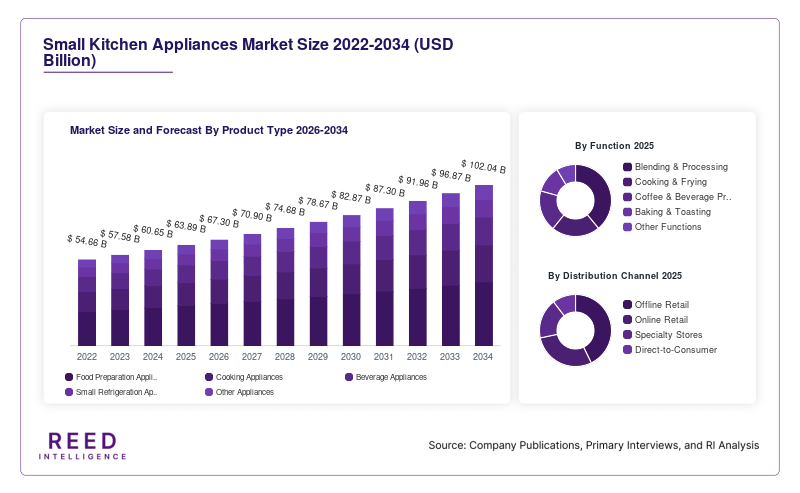
Food Preparation Appliances represent approximately 31% of the global market in 2025, making them the largest product category. Blenders, food processors, mixers, juicers and related products address frequent cooking tasks and benefit from consumer demand for homemade food, beverages and convenience.
SharkNinja provides a direct commercial signal: food-preparation appliance revenue increased 31.6% in 2025 to USD 1.55 billion, driven primarily by its frozen-drinks category.
Cooking Appliances account for approximately 29%, supported by air fryers, multicookers, countertop ovens and indoor grills.
Beverage Appliances represent approximately 23%, including coffee makers, espresso machines, kettles and other beverage-preparation products.
Small Refrigeration Appliances and other products account for approximately 9% and 8%, respectively.
Food Preparation Appliances are also the fastest-growing product category, with approximately 7.4% CAGR, supported by new product launches, multifunctional designs and high-performance beverage and frozen-food preparation.
By Function
Blending & Processing represents approximately 30% of the market in 2025. Blenders and food processors have broad household penetration because they serve multiple recipes rather than one narrowly defined task.
Cooking & Frying accounts for approximately 29%, supported by air fryers and countertop cooking products.
Coffee & Beverage Preparation represents approximately 24%, with premium espresso and specialty coffee equipment supporting value growth.
Baking & Toasting accounts for approximately 10%, while other functions represent approximately 7%.
Coffee & Beverage Preparation is the fastest-growing function, with approximately 7.8% CAGR. De'Longhi's 2026 PrimaDonna Aromatic launch and KitchenAid's continuing investment in espresso demonstrate the premiumization mechanism within this category.
By Distribution Channel
Offline Retail represents approximately 48% of the global market in 2025. Physical retailers remain important because consumers can compare appliance sizes, finishes, controls and accessories in-store, while large retailers provide promotional visibility.
Online Retail accounts for approximately 34%, supported by broad product assortment, consumer reviews, demonstrations and price comparison.
Specialty Stores represent approximately 11%, particularly for premium coffee, baking and professional-style kitchen products.
Direct-to-Consumer represents approximately 7%.
Online Retail is the fastest-growing distribution channel, with approximately 8.2% CAGR. Whirlpool reported that continued online expansion contributed to its 2025 Small Domestic Appliances performance, while Hamilton Beach's revenue concentration with Amazon demonstrates the importance of digital marketplaces.
By End User
Residential users account for approximately 91% of the market in 2025. Small kitchen appliances are primarily purchased for household cooking, beverage preparation and food processing, with multiple-appliance ownership supporting recurring replacement and upgrade demand.
Commercial & Hospitality users represent approximately 9% and include cafés, hotels, restaurants, offices, institutional kitchens and other foodservice locations.
Commercial & Hospitality is the fastest-growing end-user segment, with approximately 6.6% CAGR. Hamilton Beach's commercial business includes products for restaurants, fast-food chains, bars and hotels, while its 2025 commercial business represented approximately 10% of total revenue.
Regional Analysis
North America Small Kitchen Appliances Market
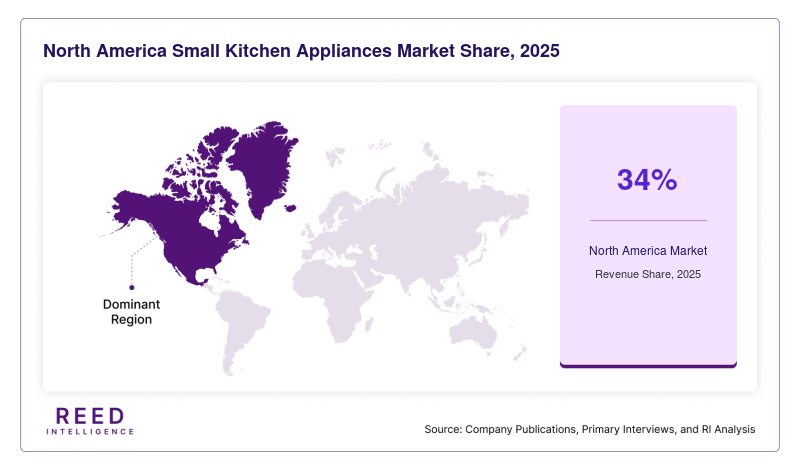
North America represents approximately 34% of the global Small Kitchen Appliances Market in 2025, supported by high appliance penetration, strong branded-product awareness, extensive retail infrastructure and a large premium-appliance customer base.
The U.S. is particularly important for innovation because manufacturers frequently use the market to introduce new product formats. SharkNinja reported that Ninja was the best-selling small kitchen appliance brand in the U.S. based on dollars sold for the period ending January 3, 2026. Hamilton Beach also identifies North America as its core consumer market and reported that its brand ranked second nationally by units sold and fourth by dollars sold among small kitchen appliances.
The region's product mix increasingly emphasizes premium coffee, air frying, high-performance blending, food preparation and multifunctional appliances. Online retail is also well established, with Amazon representing approximately 19% of Hamilton Beach's 2025 revenue.
North America is projected to grow at approximately 4.8% CAGR through 2034. Mature household penetration creates a replacement-cycle constraint, but premiumization and frequent new product launches support continued value growth.
Europe Small Kitchen Appliances Market
Europe accounts for approximately 28% of the global market in 2025. The region has mature household appliance penetration and a strong consumer emphasis on energy efficiency, durability, design and repairability.
APPLiA reported that European home-appliance sales reached approximately 170 million units in 2025, but volumes returned to levels last seen around 2015. This indicates a challenging replacement environment for the wider appliance industry.
At the same time, the regulatory environment is pushing manufacturers toward higher efficiency and resource performance. The European Commission's ecodesign framework covers multiple household appliance categories and incorporates energy performance, repairability, spare-parts availability and resource efficiency.
European consumers also provide a strong premium segment for coffee machines and countertop cooking appliances. De'Longhi's 2026 intelligent espresso launch illustrates the continued investment in premium beverage preparation.
Europe is expected to grow at approximately 4.7% CAGR through 2034. Product longevity, repairability and energy efficiency will remain important competitive factors alongside design and functionality.
APAC Small Kitchen Appliances Market
APAC represents approximately 25% of the global market in 2025 and is the fastest-growing region, with approximately 7.3% CAGR.
The region benefits from expanding middle-class consumption, urbanization, e-commerce penetration and increasing adoption of countertop cooking and beverage appliances. China, India, Japan, South Korea and Southeast Asia have different product preferences, but all provide opportunities for compact cooking and food-preparation equipment.
Regional demand also benefits from local manufacturing and supply-chain capabilities. Whirlpool identifies Asia as an important appliance market, while its KitchenAid small-appliance strategy is increasingly global.
India provides a particularly strong opportunity for mixer grinders, blenders, air fryers, electric kettles, rice cookers and compact cooking products because appliances can address both traditional food preparation and newer convenience-oriented cooking habits.
E-commerce is especially important in the region because it gives consumers in secondary cities access to a broader product range than traditional specialty retail can provide.
APAC's principal constraints include significant differences in household income, voltage standards, cooking preferences and brand awareness. Manufacturers therefore need localized product specifications rather than simply exporting Western appliance formats.
Middle East and Africa Small Kitchen Appliances Market
Middle East and Africa represents approximately 6% of the global market in 2025 and is projected to expand at approximately 6.2% CAGR.
Demand is supported by urban household formation, hospitality development, modern retail and increasing availability of international appliance brands. Coffee preparation is particularly relevant in Gulf markets, while blenders, food processors and cooking appliances benefit from household and hospitality demand.
The hospitality industry provides an additional commercial channel. Hotels, cafés, serviced apartments and restaurants require compact beverage and food-preparation appliances, creating demand beyond individual households.
The primary constraints are income disparities, import dependence and currency volatility. Premium imported appliances can carry significant price premiums, increasing the importance of regional distributors and locally adapted product portfolios.
LATAM Small Kitchen Appliances Market
LATAM accounts for approximately 7% of the global market in 2025 and is expected to grow at approximately 6.0% CAGR.
Brazil and Mexico are the major demand centers because of their large consumer populations, established appliance distribution networks and domestic manufacturing capabilities.
Whirlpool's 2025 business illustrates the importance of the region, with brands including Brastemp and Consul operating across Latin America and the company maintaining a significant regional appliance presence.
Demand is concentrated in practical, multipurpose appliances such as blenders, mixers, coffee makers, air fryers and countertop cooking products. Consumers often prioritize durability and value, which gives established brands and affordable multifunctional products an advantage.
LATAM's key constraints include currency volatility, import costs and variable consumer purchasing power. Online channels are expanding the assortment available to consumers, but physical retailers remain important for financing, demonstrations and after-sales support.
Competitive Landscape
The Small Kitchen Appliances Market is highly fragmented by product category, with global brands competing alongside regional manufacturers, private-label suppliers and specialist appliance companies. Competition is centered on innovation speed, brand recognition, product performance, price architecture, distribution reach and premium features.
SharkNinja has established a broad category-expansion model through Shark and Ninja. Its 2025 revenue increased 15.7% to USD 6.40 billion, while food-preparation appliances increased 31.6%. The company describes its strategy as continuous product innovation designed to enter and reshape appliance categories.
Whirlpool Corporation competes in small appliances primarily through KitchenAid. Its Small Domestic Appliances business delivered 9% net sales growth in 2025 and a 16% EBIT margin, with growth extending beyond stand mixers into espresso, blenders and other food-preparation products.
Key Market Players
Recent Market Developments
- September 2026 – APPLiA reported continued pressure across the European home-appliance market. European appliance sales ended 2025 at roughly 170 million units, while the proportion of appliances manufactured in Europe for European consumers fell to 71%. The development highlights the importance of manufacturing efficiency, product differentiation and supply-chain resilience.
- April 2026 – De'Longhi launched PrimaDonna Aromatic. The new premium espresso machine introduced intelligent bean-to-cup adaptation designed to personalize brewing. The launch strengthens the premiumization of the beverage-appliance category.
Small Kitchen Appliances Market Segments
By Product Type
- Food Preparation Appliances
- Cooking Appliances
- Beverage Appliances
- Small Refrigeration Appliances
- Other Appliances
By Function
- Blending & Processing
- Cooking & Frying
- Coffee & Beverage Preparation
- Baking & Toasting
- Other Functions
By Distribution Channel
- Offline Retail
- Online Retail
- Specialty Stores
- Direct-to-Consumer
By End User
- Residential
- Commercial & Hospitality
By Region
- North America
- Europe
- APAC
- Middle East and Africa
- LATAM