Smart Aquarium Devices Market Size, Share, Demand Report By Device Type (Smart Sensors, Automated Feeders, Smart Lighting Systems, AI-Based Aquarium Management Software), By Application (Residential Aquariums, Commercial Aquaculture, Public Aquariums, Research Institutions), By End Use (Household Consumers, Aquaculture Enterprises, Aquatic Research Centers, Hospitality Sector), By Region & Segment Forecasts, 2026–2034
USD 3950
Market Overview
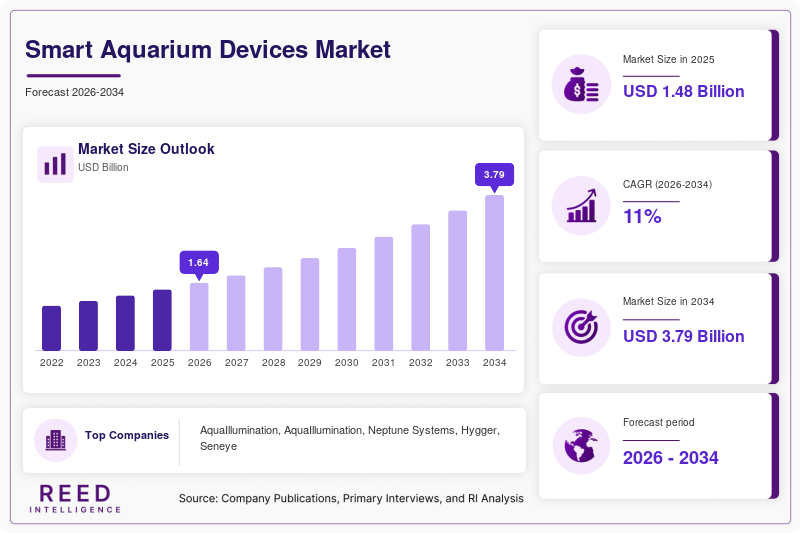
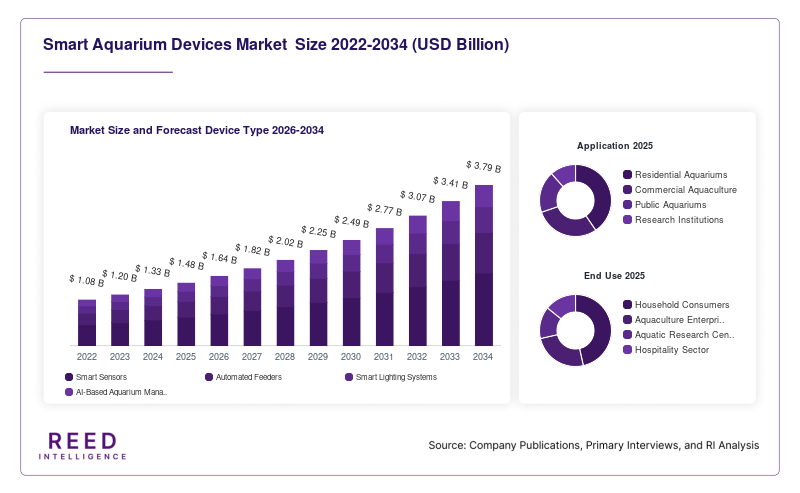
The global Smart Aquarium Devices Market size was valued at approximately USD 1.48 billion in 2026 and is projected to reach nearly USD 3.42 billion by 2034, expanding at a CAGR of 11.0% during the forecast period from 2026 to 2034. The market continues to gain momentum as consumers increasingly adopt connected home ecosystems and automated pet care technologies. Smart aquarium devices include automated feeders, intelligent lighting systems, water quality monitoring sensors, filtration controllers, temperature regulation equipment, and mobile application-based management platforms designed to improve aquarium maintenance efficiency and fish health management.
The rising popularity of ornamental fish keeping and aquascaping across urban households has created strong demand for technologically advanced aquarium solutions. Consumers are showing greater interest in systems that minimize manual intervention while ensuring stable aquatic conditions. Integration of artificial intelligence, IoT connectivity, and cloud-based monitoring capabilities has transformed traditional aquarium management into a digitally controlled environment. The growing influence of smart homes and remote monitoring technologies also supports product adoption among both residential and commercial aquarium operators.
Key Highlights
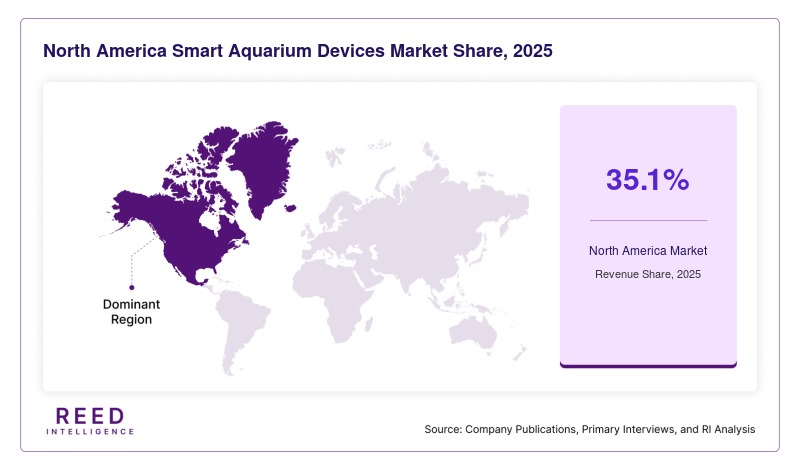
- North America dominated the market with a 35.1% share in 2025, while Asia Pacific is expected to grow at the fastest CAGR of 12.6% during 2026–2034.
- By product type, smart monitoring systems accounted for the largest share of 36.8%, while automated feeding systems are projected to grow at a CAGR of 13.1%.
- By application, residential aquariums led with a 58.4% share, whereas commercial aquariums are expected to expand at a CAGR of 12.2%.
- By connectivity, Wi‑Fi enabled devices held the dominant share of 44.9%, while cloud-integrated platforms are projected to grow at a CAGR of 13.5%.
- The United States remained the dominant country, with market values of USD 420 million in 2024 and USD 468 million in 2025.
Market Trends
Expansion of AI-Integrated Water Quality Monitoring Systems
The Smart Aquarium Devices Market is witnessing increased adoption of AI-powered monitoring systems capable of analyzing water chemistry and fish behavior in real time. Advanced devices equipped with machine learning algorithms can monitor oxygen levels, pH balance, salinity, ammonia concentration, and water temperature while providing automated recommendations through mobile applications. Consumers are increasingly attracted to predictive alert systems that help prevent fish diseases and sudden water condition changes. This trend is particularly visible among premium aquarium hobbyists and commercial aquarium operators who prioritize consistent aquatic conditions. Manufacturers are also integrating voice assistant compatibility and cloud analytics into their platforms, allowing users to remotely manage multiple aquariums through centralized dashboards. The ability to reduce fish mortality and improve operational convenience continues to accelerate adoption across residential and institutional applications.
Growing Demand for Smart Aquascaping and Energy-Efficient Equipment
Energy-efficient aquarium automation solutions are becoming an important trend across global markets. Consumers are shifting toward intelligent LED lighting systems, programmable filtration units, and automated feeding devices that reduce electricity usage and maintenance costs. Smart aquascaping technologies that simulate natural aquatic environments through synchronized lighting and environmental controls are gaining traction among urban consumers seeking decorative indoor ecosystems. Manufacturers are focusing on compact designs, modular compatibility, and low-noise operations to attract apartment dwellers and younger hobbyists. The integration of smartphone-controlled ecosystems has also strengthened customer engagement, as users increasingly prefer remote customization and scheduling features. Rising environmental awareness and demand for sustainable aquatic care solutions are expected to encourage additional investments in energy-efficient smart aquarium technologies over the coming years.
Market Drivers
Rising Popularity of Connected Pet Care Technologies
The increasing adoption of connected pet care devices is one of the primary factors driving the Smart Aquarium Devices Market. Consumers are becoming more comfortable with automated systems that simplify routine care responsibilities for pets and aquatic species. Smart aquarium products offer convenience through automated feeding schedules, water quality notifications, and real-time environmental monitoring. Busy urban professionals and frequent travelers are especially drawn to these technologies because they reduce dependency on manual maintenance. Growing smartphone penetration and consumer familiarity with IoT-enabled home devices are also supporting the transition toward digitally connected aquarium ecosystems. Manufacturers continue to introduce user-friendly mobile applications and integrated control platforms that improve accessibility for beginner aquarium owners. As consumer spending on pet wellness and home décor continues to rise globally, demand for intelligent aquarium solutions is expected to maintain steady growth.
Increasing Commercial Adoption Across Hospitality and Healthcare Sectors
Commercial demand for smart aquarium installations is expanding across hotels, restaurants, hospitals, wellness centers, and corporate offices. Businesses are using visually appealing aquarium displays to improve customer experience and create relaxing interior environments. Smart devices allow facility managers to maintain large aquariums efficiently through automated monitoring and remote maintenance alerts. Healthcare facilities are increasingly incorporating aquariums into patient waiting areas and therapy spaces because aquatic environments are associated with stress reduction and psychological comfort. Hospitality operators are investing in premium aquascaping installations supported by intelligent filtration and lighting systems that reduce operational complexity. In addition, advancements in cloud-connected management systems enable service providers to monitor multiple commercial aquariums simultaneously, improving maintenance efficiency and reducing downtime. These commercial applications continue to create long-term revenue opportunities for device manufacturers and aquarium automation service providers.
Market Restraint
High Initial Equipment Costs and Technical Complexity
The relatively high upfront cost associated with advanced smart aquarium systems remains a major restraint for broader market penetration. Premium devices equipped with AI analytics, cloud connectivity, automated monitoring, and integrated control platforms often require substantial investment compared to traditional aquarium equipment. Entry-level consumers and small aquarium hobbyists may hesitate to adopt fully automated systems because of budget limitations and concerns about long-term maintenance expenses. In addition, technical complexity can discourage first-time users who lack experience with connected devices and water parameter management.
Compatibility issues between products from different manufacturers also create operational challenges for consumers attempting to build integrated aquarium ecosystems. Software updates, connectivity failures, and sensor calibration requirements may increase maintenance burdens for some users. In emerging economies, limited awareness regarding smart aquarium technologies further slows adoption rates. Smaller retailers may also face inventory management difficulties due to rapidly evolving product specifications and changing consumer preferences. Although manufacturers are introducing affordable entry-level models, the premium positioning of many advanced products continues to limit accessibility among price-sensitive customer segments.
Market Opportunities
Rising Penetration of Smart Home Ecosystems in Emerging Economies
The rapid expansion of smart home infrastructure in emerging economies presents significant opportunities for the Smart Aquarium Devices Market. Countries across Asia Pacific, Latin America, and the Middle East are witnessing increased consumer adoption of connected appliances, home automation platforms, and mobile-based monitoring systems. As internet accessibility and smartphone usage continue to rise, consumers are becoming more receptive to integrated lifestyle technologies that enhance convenience and efficiency. Smart aquarium devices can benefit from this broader ecosystem expansion by offering compatibility with voice assistants, centralized smart home applications, and cloud-connected monitoring platforms.
Manufacturers are increasingly targeting middle-income households through affordable product bundles and subscription-based monitoring services. Growing urbanization and apartment living trends are also encouraging interest in compact decorative aquariums equipped with intelligent maintenance systems. Local distributors and e-commerce platforms are helping international brands expand their reach within emerging consumer markets. As awareness of aquarium wellness technologies improves, demand for connected aquatic care solutions is expected to accelerate significantly.
Expansion of Subscription-Based Monitoring and Maintenance Services
Service-oriented business models are creating new growth opportunities within the Smart Aquarium Devices Market. Manufacturers and aquarium service providers are introducing subscription-based monitoring platforms that offer predictive maintenance alerts, automated consumable replacement reminders, and remote technical support. These services help consumers maintain stable aquatic conditions while reducing the complexity associated with aquarium management. Commercial clients, including hotels and healthcare facilities, are increasingly interested in outsourced aquarium management services supported by cloud-connected monitoring systems.
Data analytics capabilities also enable service providers to identify equipment performance trends and proactively address maintenance requirements before system failures occur. Subscription models create recurring revenue streams for manufacturers while improving long-term customer retention. In addition, integration with mobile applications allows users to receive real-time updates regarding water conditions, feeding schedules, and filtration performance. The growing acceptance of subscription-based digital services across consumer electronics markets is expected to support the expansion of similar models within the aquarium automation industry.
Segmental Analysis
By Product Type
Smart monitoring systems accounted for the largest share of the Smart Aquarium Devices Market in 2024, representing approximately 36.8% of total revenue. These systems are widely adopted because they provide real-time insights into water quality, temperature stability, oxygen concentration, and filtration performance. Consumers increasingly prioritize preventive monitoring technologies that reduce the risk of fish mortality and maintain healthy aquatic environments. Commercial aquarium operators, including hotels and public aquariums, rely heavily on automated monitoring systems to ensure operational consistency and reduce maintenance costs. The integration of mobile applications and cloud-based analytics has further strengthened demand for intelligent monitoring equipment. Manufacturers continue to improve sensor accuracy, connectivity range, and predictive maintenance capabilities to differentiate their products within a highly competitive environment. Strong consumer demand for automated aquarium management continues to support the dominant market position of this segment.
Automated feeding systems are projected to witness the fastest CAGR of 13.1% during the forecast period due to rising demand for convenient pet care solutions. Consumers increasingly prefer programmable feeding devices that allow remote scheduling and portion control through smartphone applications. These systems are particularly attractive for busy professionals, frequent travelers, and commercial aquarium operators seeking consistent feeding routines. Advancements in battery efficiency, app integration, and multi-compartment feeding mechanisms are further improving product functionality. Manufacturers are also introducing AI-enabled feeding systems capable of adjusting feeding schedules based on fish behavior and environmental conditions. Growing awareness regarding overfeeding risks and water contamination issues is encouraging consumers to adopt automated feeding technologies. The combination of convenience, precision, and remote accessibility is expected to drive continued expansion of this subsegment over the coming years.
By Application
Residential aquariums held the largest share of the Smart Aquarium Devices Market in 2024, accounting for approximately 58.4% of global revenue. Rising interest in home décor enhancement and stress-relieving indoor environments has encouraged consumers to install decorative aquariums within apartments and urban households. Smart devices help homeowners simplify aquarium maintenance through automated filtration control, water quality monitoring, and feeding management. Younger consumers are particularly attracted to compact smart aquariums integrated with smartphone applications and customizable lighting systems. The expansion of social media communities focused on aquascaping and ornamental fish keeping has also contributed to increasing product visibility. Manufacturers continue to target residential customers through aesthetically designed devices with simplified user interfaces and energy-efficient operations. The growing connection between smart homes and connected pet care ecosystems continues to strengthen demand within this dominant application segment.
Commercial aquariums are expected to register the fastest CAGR of 12.2% during the forecast period due to increasing installations across hospitality, healthcare, and corporate environments. Businesses are using advanced aquarium systems to create visually engaging interior spaces that improve customer experience and employee satisfaction. Smart devices allow commercial operators to manage large aquariums efficiently through automated monitoring, predictive maintenance alerts, and centralized control platforms. Hospitals and wellness centers increasingly integrate aquariums into waiting areas because aquatic environments are associated with reduced stress and improved emotional comfort. Luxury hotels and restaurants are also investing in custom aquascaping installations supported by intelligent lighting and filtration technologies. As commercial establishments continue to prioritize experiential interior design and operational efficiency, demand for smart aquarium solutions in non-residential applications is expected to expand steadily.
By Connectivity
Wi‑Fi enabled devices represented the largest share of the Smart Aquarium Devices Market in 2024, accounting for nearly 44.9% of total revenue. These devices remain highly popular because they provide seamless remote access through mobile applications and home internet networks. Consumers prefer Wi‑Fi connectivity because it enables real-time monitoring, cloud synchronization, and instant alert notifications without requiring complex installation procedures. Smart aquarium ecosystems that integrate with voice assistants and centralized smart home platforms are becoming increasingly common among technology-oriented consumers. Manufacturers continue to improve network stability, cybersecurity protections, and user interface design to enhance customer experience. Commercial operators also benefit from Wi‑Fi enabled systems because they can monitor multiple aquarium installations from centralized locations. The combination of convenience, scalability, and compatibility with connected home ecosystems continues to support the leading position of this connectivity segment.
Cloud-integrated platforms are anticipated to expand at the fastest CAGR of 13.5% throughout the forecast period due to growing demand for advanced analytics and remote aquarium management services. These platforms allow users to store historical performance data, receive predictive maintenance recommendations, and manage multiple devices through centralized dashboards. Commercial aquarium service providers increasingly rely on cloud-based systems to monitor installations across geographically dispersed locations. Integration of AI-driven analytics and automated alerts also improves operational efficiency and reduces equipment failure risks. Consumers are becoming more interested in subscription-based ecosystem management services that provide remote diagnostics and software updates through cloud platforms. The increasing adoption of smart homes, combined with rising consumer trust in cloud-based technologies, is expected to accelerate demand for advanced connected aquarium ecosystems during the forecast period.
Regional Analysis
North America
North America accounted for approximately 35.1% of the global Smart Aquarium Devices Market share in 2025 and continues to maintain a leading position due to strong consumer spending on pet care technologies and home automation products. The region is projected to expand at a CAGR of 10.4% during the forecast period. Demand remains particularly strong among urban households seeking automated aquarium management systems that simplify maintenance responsibilities. High adoption of IoT-enabled home devices and increasing awareness regarding aquatic wellness technologies are contributing to regional market growth.
The United States remains the dominant country within the North American market due to its well-established aquarium hobby community and strong presence of premium device manufacturers. Commercial adoption across hotels, corporate offices, and healthcare facilities is also supporting market expansion. The growing popularity of smart home integration platforms has encouraged manufacturers to develop aquarium devices compatible with voice assistants and centralized home management systems. Rising demand for energy-efficient lighting and intelligent filtration equipment further supports long-term growth across the country.
Europe
Europe represented nearly 24.6% of the global Smart Aquarium Devices Market in 2025 and is anticipated to register a CAGR of 9.8% through 2034. Consumers across the region increasingly prefer sustainable and energy-efficient aquarium equipment that aligns with environmental awareness initiatives. Smart LED lighting systems, automated water monitoring sensors, and programmable filtration units are gaining popularity among hobbyists and commercial aquarium operators. The region also benefits from strong demand for decorative indoor aquascaping solutions across residential and hospitality applications.
Germany remains the dominant market within Europe due to its advanced consumer electronics industry and established aquarium equipment manufacturing ecosystem. The country has a strong base of aquascaping enthusiasts who actively adopt technologically advanced maintenance solutions. Regulatory emphasis on energy efficiency has also encouraged manufacturers to develop environmentally optimized aquarium devices. In addition, the growing presence of specialty aquarium retail chains and online distribution platforms is improving product accessibility for consumers across both urban and suburban areas.
Asia Pacific
Asia Pacific held approximately 22.8% of the Smart Aquarium Devices Market share in 2025 and is projected to witness the fastest CAGR of 12.6% during the forecast period. Rapid urbanization, increasing disposable income, and expanding middle-class populations are supporting regional demand for connected aquarium technologies. Consumers in major metropolitan areas are increasingly purchasing compact smart aquariums as decorative home elements. E-commerce growth and improved access to imported aquarium products have also accelerated market expansion throughout the region.
China remains the dominant country in the Asia Pacific market due to its large consumer electronics manufacturing base and rapidly growing smart home industry. Rising interest in ornamental fish keeping among younger consumers is supporting demand for automated feeding systems and mobile-connected monitoring devices. Local manufacturers are introducing competitively priced products that cater to price-sensitive customers while expanding technological capabilities. In addition, strong investments in IoT infrastructure and app-based consumer ecosystems continue to create favorable conditions for smart aquarium device adoption.
Middle East & Africa
The Middle East & Africa region accounted for approximately 8.3% of the global Smart Aquarium Devices Market in 2025 and is expected to expand at a CAGR of 9.1% during the forecast period. Increasing investments in luxury hospitality infrastructure and premium commercial interior design projects are contributing to regional market development. Smart aquarium installations are becoming increasingly common in hotels, shopping centers, and healthcare facilities seeking visually engaging decorative environments. Growing interest in high-end residential décor solutions is also supporting product adoption.
The United Arab Emirates remains the leading country within the regional market due to strong luxury consumer spending and rapid expansion of hospitality projects. Commercial establishments increasingly utilize large smart aquarium systems to improve customer experience and brand positioning. High smartphone penetration and advanced digital infrastructure also support adoption of cloud-connected aquarium management platforms. In addition, regional demand for low-maintenance decorative installations is encouraging businesses and homeowners to invest in automated aquatic care technologies.
Latin America
Latin America captured nearly 9.2% of the global Smart Aquarium Devices Market share in 2025 and is forecast to grow at a CAGR of 9.5% through 2034. Rising urban populations and increasing consumer interest in home décor products are supporting demand for modern aquarium systems across the region. Consumers are gradually adopting intelligent aquarium technologies that simplify maintenance and improve fish health management. E-commerce channels are also playing an important role in expanding access to imported smart aquarium products in developing economies.
Brazil dominates the Latin American market due to its large pet care industry and growing aquarium hobby community. Demand for automated feeding systems and intelligent filtration solutions is increasing among middle-income households seeking convenient aquatic maintenance options. The expansion of digital payment infrastructure and online retail platforms has improved accessibility to premium aquarium technologies. Additionally, growing awareness regarding ornamental fish care and water quality management is expected to support continued market growth in the country.
Competitive Landscape
The Smart Aquarium Devices Market is characterized by moderate competition with the presence of established aquarium equipment manufacturers, smart home technology providers, and specialized aquatic automation companies. Market participants are focusing on product innovation, IoT integration, and mobile application development to strengthen competitive positioning. Companies are increasingly investing in AI-powered monitoring systems, energy-efficient lighting technologies, and cloud-connected ecosystem management platforms to address evolving consumer expectations.
Neptune Systems remains one of the leading companies in the market due to its strong portfolio of advanced aquarium controllers and monitoring solutions. The company continues to expand its connected ecosystem capabilities through software upgrades and integrated device compatibility. Innovative Marine, Hydros, and EcoTech Marine are also strengthening their market positions through premium smart aquarium product offerings designed for hobbyists and commercial operators.
Key Players
- Neptune Systems
- EcoTech Marine
- Hydros
- Innovative Marine
- Aqua Illumination
- EHEIM GmbH & Co. KG
- Fluval
- Red Sea Aquatics
- AquaEL
- SENEYE
- Reef Factory
- Hygger
- GHL Advanced Technology
- Current USA
- Jebao
Recent Developments
- Neptune Systems introduced an upgraded AI-enabled aquarium controller platform in 2025 featuring predictive maintenance alerts and enhanced cloud synchronization capabilities.
- EcoTech Marine expanded its smart LED lighting portfolio in 2025 with energy-efficient modules designed for commercial aquascaping applications.
- Reef Factory launched a subscription-based remote monitoring service in 2024 that provides real-time aquarium diagnostics and automated maintenance recommendations.
- Hydros announced integration support for major smart home ecosystems in 2025, allowing users to manage aquarium devices through centralized home automation platforms.
- Fluval introduced compact smart aquarium starter kits in 2024 targeting first-time aquarium hobbyists and apartment-based consumers.
Smart Aquarium Devices Market Segments
Device Type
- Smart Sensors
- Automated Feeders
- Smart Lighting Systems
- AI-Based Aquarium Management Software
Application
- Residential Aquariums
- Commercial Aquaculture
- Public Aquariums
- Research Institutions
End Use
- Household Consumers
- Aquaculture Enterprises
- Aquatic Research Centers
- Hospitality Sector
By Region
- North America
- Europe
- APAC
- Middle East and Africa
- LATAM