Smart AudioBook Player Market Size, Share & Demand Report By Platform Type (Mobile Application-Based Players, Web-Based AudioBook Players), By Content Type (Fiction AudioBooks, Non-Fiction AudioBooks), By Subscription Model (Monthly Subscription, Annual Subscription), By End User (Individual Consumers, Students), By Distribution Channel (App Stores, Online Direct Platforms, Third-Party Digital Marketplaces), By Region & Segment Forecasts, 2026–2034
USD 3950
Market Overview
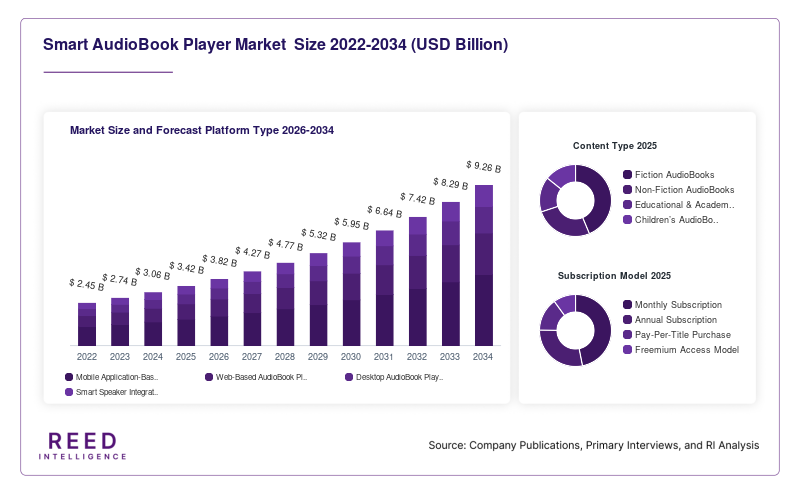
The Smart AudioBook Player Market was valued at USD 3.42 billion in 2026 and is projected to reach USD 8.26 billion by 2034, expanding at a CAGR of 11.7% during the forecast period (2026–2034). The market is experiencing robust growth as consumers increasingly adopt digital audio content for education, entertainment, professional development, and language learning. Smart audiobook players, including dedicated applications, cloud-enabled platforms, AI-powered listening systems, and integrated audiobook ecosystems, have become an important component of the digital media landscape. Rising smartphone penetration, expanding internet connectivity, and increasing demand for on-the-go content consumption continue to support market expansion globally.
A major global factor supporting market growth has been the rapid digitalization of media consumption habits. Consumers increasingly prefer audio-based content that can be accessed while commuting, exercising, traveling, or multitasking. The growing popularity of subscription-based digital content platforms has accelerated audiobook adoption among both existing readers and new audiences. Content publishers, technology providers, and streaming platforms continue to invest in advanced listening experiences, personalized recommendations, and multilingual audiobook libraries to attract wider user bases.
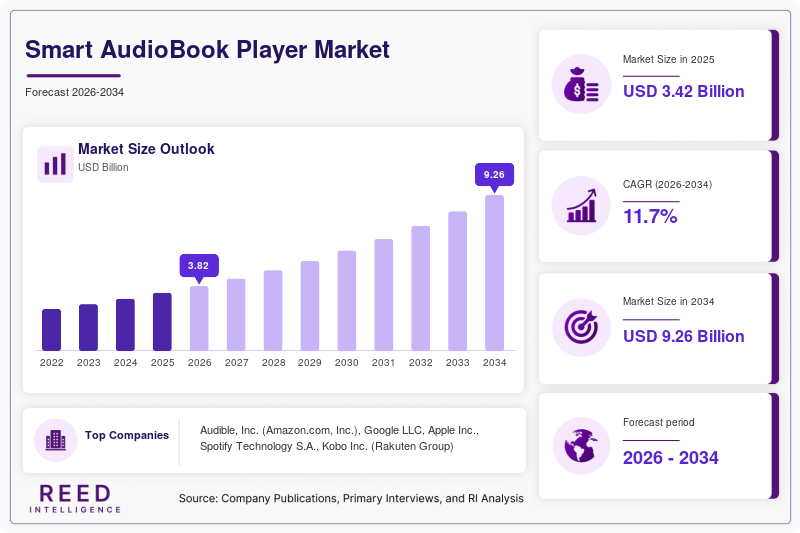
Key Highlights
- North America dominated the market with 38.4% share in 2025, while Asia Pacific is expected to register the fastest CAGR of 13.8% during 2026–2034.
- By Platform Type, Mobile Application-Based Players accounted for 56.8% share in 2025, while AI-Integrated Smart Players are projected to grow at a CAGR of 15.2%.
- By Content Type, Fiction Audiobooks held 47.2% share in 2025, whereas Educational & Professional Audiobooks are forecast to expand at a CAGR of 14.1%.
- By Business Model, Subscription-Based Services represented 52.9% share in 2025, while Freemium Platforms are expected to grow at a CAGR of 13.6%.
- By End User, Individual Consumers accounted for 71.5% share in 2025, whereas Educational Institutions are projected to grow at a CAGR of 14.4%.
- The United States, the dominant country market, recorded a value of USD 1.02 billion in 2024, increasing to USD 1.16 billion in 2025.
Market Trends
Integration of Artificial Intelligence for Personalized Listening
Artificial intelligence is increasingly transforming audiobook consumption experiences. Smart audiobook platforms are incorporating AI-driven recommendation engines that analyze listening behavior, genre preferences, session duration, and content engagement patterns. These systems provide personalized content suggestions and adaptive listening experiences that improve user retention. AI-generated summaries, intelligent search capabilities, and contextual content discovery tools are further enhancing platform functionality. As AI technologies mature, audiobook platforms are expected to offer increasingly customized user experiences.
Growth of Multi-Device and Cloud-Synchronized Listening Ecosystems
Consumers increasingly expect seamless access to audiobook content across smartphones, tablets, smart speakers, wearable devices, and connected vehicles. Cloud synchronization technologies enable users to continue listening across multiple devices without interruption. This trend has encouraged platform providers to invest in integrated ecosystems that support uninterrupted playback, synchronized bookmarks, and personalized libraries. Growing adoption of connected consumer devices is expected to strengthen demand for cloud-enabled audiobook platforms.
Market Drivers
Increasing Consumer Preference for Audio-Based Learning
Audio learning has emerged as an effective and convenient educational format for students, professionals, and lifelong learners. Audiobooks allow users to consume educational content while performing other activities, improving learning flexibility. Increasing demand for self-improvement, skill development, language acquisition, and professional certification content continues to support audiobook adoption across diverse demographic groups.
Expansion of Subscription-Based Digital Content Services
Subscription models have transformed digital media consumption by providing cost-effective access to extensive content libraries. Consumers increasingly prefer unlimited content access rather than purchasing individual titles. Subscription-based audiobook services provide predictable revenue streams for platform providers while offering users greater content variety. The continued expansion of digital subscription ecosystems remains a significant driver for market growth.
Market Restraint
Content Licensing and Intellectual Property Challenges
The audiobook industry faces challenges related to content licensing agreements, royalty structures, and intellectual property management. Negotiations between publishers, authors, narrators, and platform providers can increase operational complexity and content acquisition costs. These factors may affect platform profitability and limit the availability of certain audiobook titles across specific markets.
Market Opportunities
Expansion of Regional Language Audiobook Libraries
Demand for localized audio content is increasing rapidly across emerging economies. Consumers increasingly seek audiobook content in regional and native languages. Publishers and platform operators have opportunities to expand multilingual libraries and reach underserved audiences through localized content strategies.
Integration with Connected Vehicle Entertainment Systems
Automotive infotainment systems are becoming increasingly connected and personalized. Integration of audiobook platforms within connected vehicles presents significant opportunities for content providers. Enhanced in-car listening experiences, voice-controlled playback, and seamless synchronization with personal accounts are expected to create new revenue streams for market participants.
Segmental Analysis
By Platform Type
Mobile Application-Based Players
Mobile application-based players accounted for 56.8% of market share in 2025. These platforms maintained leadership because smartphones remain the primary device for audiobook consumption. Their accessibility, convenience, and integration with digital payment systems supported widespread adoption.
AI-Integrated Smart Players
AI-integrated smart players are projected to grow at a CAGR of 15.2% through 2034. Growth will be driven by advanced personalization features, intelligent content recommendations, and enhanced user engagement capabilities. These technologies will improve content discovery and listening experiences.
By Content Type
Fiction Audiobooks
Fiction audiobooks represented 47.2% share in 2025. This segment remained dominant due to strong consumer demand for entertainment-focused content across genres such as mystery, fantasy, romance, and science fiction. Extensive title availability supported continued market leadership.
Educational & Professional Audiobooks
Educational and professional audiobooks are expected to expand at a CAGR of 14.1% during the forecast period. Increasing emphasis on continuous learning and workforce development will encourage adoption among students and professionals seeking flexible educational resources.
By Business Model
Subscription-Based Services
Subscription-based services held 52.9% market share in 2025. Consumers increasingly preferred recurring access models that provide extensive content libraries at predictable monthly costs. These services generated stable revenue streams and encouraged long-term platform engagement.
Freemium Platforms
Freemium platforms are forecast to grow at a CAGR of 13.6% through 2034. Growth will be supported by expanding user acquisition strategies that allow consumers to access basic services before upgrading to premium content offerings.
By End User
Individual Consumers
Individual consumers accounted for 71.5% share in 2025. The segment dominated due to widespread audiobook adoption for entertainment, education, and personal development purposes. Growing digital content consumption habits supported strong demand.
Educational Institutions
Educational institutions are projected to grow at a CAGR of 14.4% during the forecast period. Expansion will be supported by increasing integration of audio learning tools into digital education programs and remote learning environments.
By Device Compatibility
Smartphones
Smartphones represented 61.4% market share in 2025. Their portability, connectivity, and extensive application ecosystems supported widespread audiobook consumption across diverse user groups.
Smart Speakers
Smart speakers are expected to grow at a CAGR of 13.9% through 2034. Increasing adoption of voice-controlled home entertainment systems will create favorable conditions for audiobook playback through smart speaker platforms.
Regional Analysis
North America
North America accounted for 38.4% of the Smart AudioBook Player Market share in 2025 and is expected to grow at a CAGR of 10.5% through 2034. The region benefited from high digital content consumption rates, mature subscription service adoption, and strong audiobook publishing ecosystems. The United States dominated the regional market due to extensive audiobook production capabilities and widespread consumer acceptance of digital entertainment subscriptions.
Europe
Europe represented 26.8% market share in 2025 and is projected to expand at a CAGR of 10.9% during the forecast period. Growth was supported by increasing audiobook consumption across educational and leisure segments. The United Kingdom emerged as the leading country due to a well-established publishing industry and growing adoption of digital learning content among consumers.
Asia Pacific
Asia Pacific held 22.6% share in 2025 and is forecast to witness the fastest CAGR of 13.8% from 2026 to 2034. Rising smartphone ownership, expanding digital payment infrastructure, and increasing internet accessibility supported market development. China dominated the regional market due to large digital content audiences and rapid growth in online educational platforms incorporating audiobook services.
Middle East & Africa
The Middle East & Africa accounted for 6.1% market share in 2025 and is anticipated to register a CAGR of 11.6% during the forecast period. Expanding mobile internet usage and increasing investment in digital education initiatives contributed to regional growth. The United Arab Emirates led the market owing to strong digital infrastructure and growing demand for premium audio content services.
Latin America
Latin America captured 6.1% market share in 2025 and is expected to grow at a CAGR of 11.1% through 2034. Increasing smartphone penetration and growing adoption of digital subscription services supported market expansion. Brazil remained the dominant country due to expanding audiobook availability and rising consumer engagement with mobile entertainment platforms.

Competitive Landscape
The Smart AudioBook Player Market is characterized by technological innovation, content expansion strategies, platform integration, and subscription model development. Market participants compete through exclusive content partnerships, advanced personalization technologies, multilingual libraries, and seamless cross-device experiences.
Audible Inc.
Audible remains the market leader due to its extensive audiobook catalog, strong subscription ecosystem, and continuous investment in original audio content. A recent development involved expansion of AI-assisted content recommendation capabilities to improve user engagement and content discovery.
Spotify Technology S.A.
Spotify has expanded its audiobook portfolio by integrating premium audiobook content into its broader digital audio ecosystem. The company continues investing in personalized listening experiences and content partnerships.
Google LLC
Google supports audiobook distribution through its digital content ecosystem and cloud-based services. The company focuses on improving audiobook accessibility through voice-enabled technologies and intelligent search functions.
Apple Inc.
Apple offers audiobook services through its digital media platform and benefits from strong integration across its ecosystem of consumer devices. Continuous platform enhancements support user convenience and engagement.
Storytel AB
Storytel specializes in subscription-based audiobook streaming services and continues expanding multilingual content libraries across international markets. The company focuses on regional content localization and market expansion initiatives.
Key Players List
- Audible Inc.
- Spotify Technology S.A.
- Google LLC
- Apple Inc.
- Storytel AB
- Rakuten Kobo Inc.
- Scribd Inc.
- Audiobooks.com
- BookBeat AB
- Chirp Books
- Downpour.com
- Barnes & Noble, Inc.
- Pocket FM
- Kuku FM
- Tencent Holdings Ltd.
Recent Developments
- In 2025, major audiobook platforms introduced AI-powered recommendation engines to improve content personalization.
- In 2025, several providers expanded multilingual audiobook libraries to support regional language audiences.
- In 2024, audiobook streaming services increased integration with connected vehicle infotainment systems.
- In 2025, cloud synchronization capabilities were enhanced to provide seamless cross-device listening experiences.
- In 2024, educational content publishers expanded audiobook offerings targeting professional certification and skill-development programs.
- In 2025, voice assistant compatibility was strengthened across smart speaker ecosystems to improve hands-free audiobook access.
- In 2025, digital content platforms introduced advanced analytics tools to help publishers understand listener engagement patterns.
Smart AudioBook Player Market Segments
Platform Type
- Mobile Application-Based Players
- Web-Based AudioBook Players
- Desktop AudioBook Players
- Smart Speaker Integrated Players
Content Type
- Fiction AudioBooks
- Non-Fiction AudioBooks
- Educational & Academic AudioBooks
- Children’s AudioBooks
Subscription Model
- Monthly Subscription
- Annual Subscription
- Pay-Per-Title Purchase
- Freemium Access Model
End User
- Individual Consumers
- Students
- Educational Institutions
- Corporate Users
Distribution Channel
- App Stores
- Online Direct Platforms
- Third-Party Digital Marketplaces
- Telecom & Media Bundling Platforms
By Region
- North America
- Europe
- APAC
- Middle East and Africa
- LATAM