Smart Bicycle Accessories Market Size, Share & Demand Report By Product Type (Smart Bike Lights, GPS Bike Computers, Smart Locks, Wireless Sensors, Rear-View Radar Systems), By Connectivity (Bluetooth-Enabled Accessories, Wi-Fi Connected Accessories, Cloud-Connected Accessories, ANT+ Enabled Accessories), By Distribution Channel (Offline Retail Stores, Online Platforms) By Region & Segment Forecasts, 2026–2034
USD 3950
Market Overview
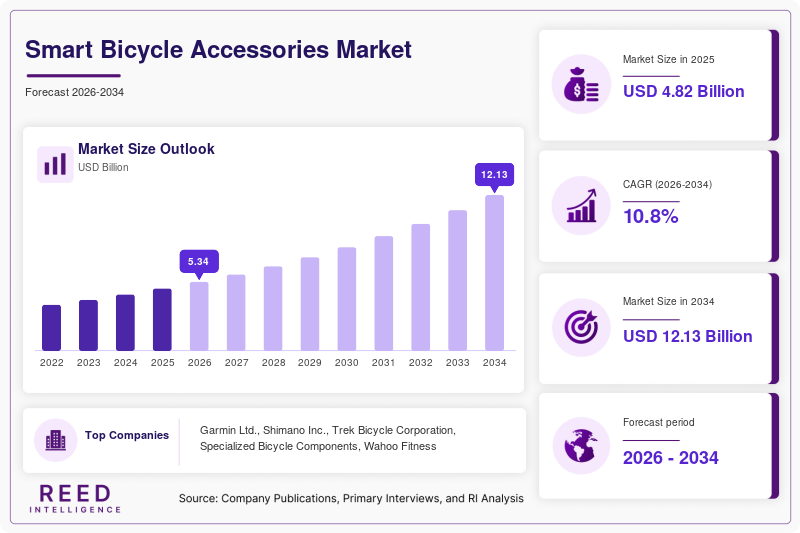
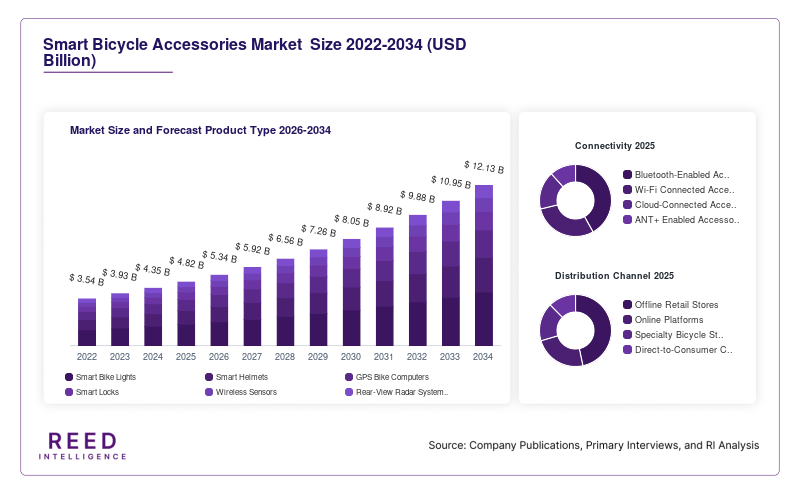
The global Smart Bicycle Accessories Market size was valued at USD 4.82 billion in 2026 and is projected to reach USD 10.96 billion by 2034, expanding at a CAGR of 10.8% during 2026–2034. The market is experiencing stable growth due to the increasing adoption of connected mobility solutions, urban cycling culture, and technology-enabled commuter safety systems. Smart bicycle accessories include connected lighting systems, GPS-enabled bike computers, smart helmets, anti-theft trackers, wireless sensors, and performance monitoring devices that improve rider convenience, navigation, safety, and fitness tracking. The integration of IoT, AI-powered analytics, Bluetooth connectivity, and mobile application ecosystems has significantly transformed conventional cycling equipment into intelligent mobility products.
Growing environmental awareness and the shift toward sustainable transportation solutions have supported demand for bicycles and associated smart accessories across urban regions. Governments in several countries are investing in cycling infrastructure, dedicated bike lanes, and public bike-sharing programs, creating favorable conditions for connected cycling products. The rising popularity of electric bicycles has also expanded opportunities for premium smart accessories such as integrated displays, battery monitoring devices, and adaptive lighting systems. Increasing participation in recreational cycling, endurance sports, and smart fitness activities has further strengthened product demand among consumers seeking real-time performance insights and digital connectivity.
Key Highlights
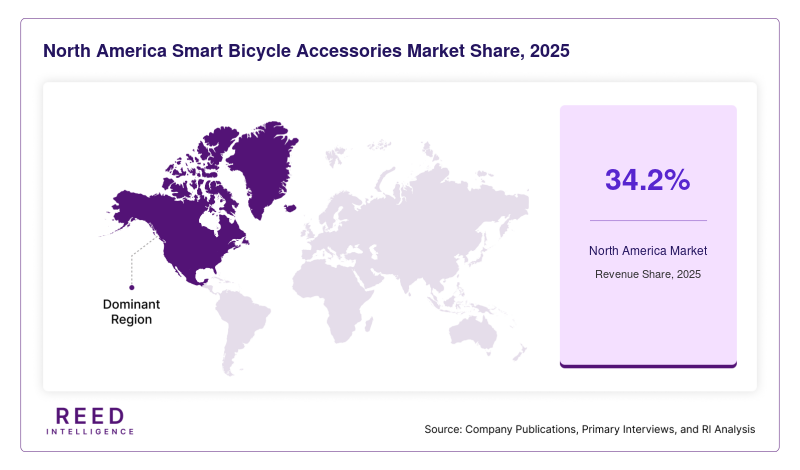
- North America dominated the market with a 34.2% share in 2025.
- Asia Pacific is expected to grow at the fastest CAGR of 12.1% during 2026–2034.
- By product type, smart bike lights accounted for the largest share of 31.4%.
- while smart helmets are projected to grow at a CAGR of 13.2%.
- By connectivity, Bluetooth-enabled accessories led with a 44.8% share.
- whereas cloud-connected accessories are expected to expand at a CAGR of 12.7%.
- The United States remained the dominant country, with market values of USD 1.21 billion in 2024 and USD 1.34 billion in 2025.
Market Trends
Expansion of Connected Cycling Ecosystems
The Smart Bicycle Accessories Market is witnessing increasing integration of connected ecosystems that combine multiple cycling functions within unified mobile platforms. Consumers are increasingly adopting smart accessories capable of synchronizing with smartphones, smartwatches, and cloud-based fitness applications. Connected bike computers now offer route optimization, live traffic monitoring, accident alerts, weather updates, and ride analytics within a single interface. This trend is reshaping customer expectations by creating seamless digital cycling experiences across recreational and urban commuting segments. Companies are developing interoperable platforms that connect lighting systems, security trackers, cadence sensors, and navigation tools to centralized applications. The adoption of 5G networks and edge computing technologies is further enhancing real-time data transmission and rider communication. Cycling communities are also using social connectivity features integrated into smart accessories, increasing user engagement and brand loyalty across global markets.
Growing Demand for Safety-Oriented Smart Accessories
Consumer preference for advanced rider safety technologies is significantly influencing product innovation in the Smart Bicycle Accessories Market. Urban congestion, increasing road accidents, and nighttime cycling concerns have accelerated demand for intelligent safety accessories. Smart helmets equipped with crash detection sensors, emergency SOS alerts, integrated communication systems, and LED visibility features are gaining popularity among commuters and sports cyclists. Adaptive lighting systems capable of adjusting brightness according to environmental conditions are also becoming widely adopted. Manufacturers are integrating AI-based obstacle detection and rear-view radar technologies into cycling accessories to improve situational awareness. Insurance companies and mobility organizations are increasingly promoting smart safety devices as part of accident prevention initiatives. This trend is particularly visible in developed urban markets where consumers prioritize connected safety solutions that reduce collision risks and improve rider confidence during daily commuting and long-distance cycling activities.
Market Drivers
Rising Urban Commuting and Sustainable Transportation Adoption
The increasing shift toward environmentally sustainable transportation systems is driving demand for smart bicycle accessories globally. Urban populations are adopting bicycles as an alternative to fuel-powered transportation due to rising traffic congestion, fuel price volatility, and environmental concerns. Governments across Europe, North America, and Asia Pacific are investing heavily in cycling infrastructure, including smart traffic systems and dedicated bicycle lanes, which is encouraging cycling adoption. Smart accessories improve commuter convenience by offering navigation, anti-theft protection, battery management, and route optimization capabilities. Consumers are increasingly investing in connected accessories to improve efficiency and safety during urban travel. The growth of bicycle-sharing programs and electric bike adoption has further accelerated the need for digitally connected accessories. As smart city initiatives continue expanding worldwide, demand for intelligent cycling solutions is expected to strengthen significantly throughout the forecast period.
Increasing Consumer Interest in Fitness and Outdoor Recreation
The growing popularity of fitness tracking and outdoor recreational activities is contributing to market expansion. Consumers are increasingly participating in cycling as a fitness activity due to rising health awareness and lifestyle changes. Smart bicycle accessories provide riders with real-time performance monitoring features such as heart rate tracking, cadence analysis, calorie measurement, and distance monitoring. Sports enthusiasts and professional cyclists are adopting advanced sensors and smart wearables to improve training outcomes and performance analytics. Integration with fitness applications and cloud-based performance dashboards is increasing the appeal of connected cycling products among younger demographics. The growth of organized cycling events, endurance races, and adventure tourism activities has also increased demand for premium smart accessories. Manufacturers are launching products specifically designed for sports cyclists, further supporting industry growth across recreational and professional cycling segments.
Market Restraint
High Product Costs and Compatibility Challenges
The relatively high cost of technologically advanced cycling accessories remains a significant challenge for broader market penetration, particularly in price-sensitive economies. Premium smart helmets, connected navigation systems, and AI-enabled safety devices often require substantial investment compared to conventional bicycle accessories. Many consumers in developing countries continue to prioritize affordable cycling equipment over connected technologies due to limited purchasing power. Compatibility limitations between different operating systems, mobile applications, and hardware ecosystems also create adoption barriers. Some smart accessories require continuous software updates, stable internet connectivity, and smartphone synchronization, which can affect user experience. Battery life limitations and concerns regarding device durability during harsh weather conditions further impact consumer confidence. Small bicycle retailers may also face inventory management challenges due to rapidly evolving technology cycles. These factors collectively slow adoption rates among casual cyclists and lower-income consumers, particularly in emerging markets where cycling infrastructure and digital ecosystems are still developing gradually.
Market Opportunities
Expansion of Smart E-Bike Ecosystems
The rapid growth of electric bicycles is creating substantial opportunities for smart accessory manufacturers. E-bikes require integrated monitoring systems, digital dashboards, battery analytics, navigation tools, and connected safety features that support enhanced riding experiences. Consumers purchasing premium electric bicycles are increasingly willing to invest in complementary smart accessories that improve performance and convenience. Manufacturers are developing accessories specifically optimized for electric bicycles, including wireless charging mounts, battery management applications, and AI-powered route optimization systems. The increasing use of subscription-based mobility platforms is also opening opportunities for recurring revenue through connected cycling services. Partnerships between e-bike manufacturers and consumer electronics companies are expected to accelerate product innovation. Emerging economies are witnessing increasing demand for affordable electric mobility solutions, further strengthening opportunities for intelligent bicycle accessories designed for urban commuting and last-mile transportation applications.
Integration of Artificial Intelligence and Predictive Analytics
Artificial intelligence and predictive analytics technologies are expected to create new growth opportunities within the Smart Bicycle Accessories Market. AI-powered systems can analyze rider behavior, traffic conditions, weather patterns, and equipment performance to deliver personalized cycling experiences. Smart accessories equipped with predictive maintenance capabilities can notify users about component wear, battery performance issues, and repair requirements before failures occur. Manufacturers are also exploring AI-driven accident detection systems capable of automatically contacting emergency services during collisions. Real-time analytics platforms are helping cyclists optimize training performance and route efficiency using machine learning algorithms. Cloud-connected cycling ecosystems can collect large datasets that support advanced consumer insights and product customization. As AI technology becomes more accessible and cost-efficient, manufacturers are expected to introduce affordable intelligent accessories targeting both recreational and professional cycling segments across global markets.
Segmental Analysis
By Product Type
Smart bike lights represented the dominant product type segment and accounted for 31.4% of the global market share in 2024. Rising safety concerns associated with urban commuting and nighttime cycling have significantly increased adoption of intelligent lighting systems equipped with motion sensors, adaptive brightness controls, and smartphone synchronization capabilities. Consumers are increasingly prioritizing visibility-enhancing products that improve road safety during low-light conditions. Manufacturers are introducing energy-efficient LED technologies and rechargeable battery systems to improve product functionality and operational lifespan. Smart bike lights integrated with automatic hazard alerts and braking indicators are gaining traction among commuters and sports cyclists. The growing popularity of electric bicycles has also strengthened demand for advanced lighting systems compatible with connected mobility ecosystems. Retail expansion through e-commerce platforms and sports equipment outlets continues to support segment growth globally.
Smart helmets are expected to register the fastest CAGR of 13.2% during the forecast period due to increasing demand for rider protection and connected communication technologies. These helmets incorporate crash detection sensors, Bluetooth communication systems, voice-assisted navigation, and emergency alert functions that improve rider safety and convenience. Rising awareness regarding cycling-related injuries has encouraged consumers to invest in technologically advanced protective equipment. Manufacturers are integrating AI-powered impact analysis systems and augmented reality displays into premium helmet models targeting professional cyclists and urban commuters. The increasing popularity of long-distance cycling events and adventure sports is also supporting segment expansion. Partnerships between helmet manufacturers and mobile application developers are enabling improved data synchronization and personalized user experiences, further accelerating market growth across developed and emerging economies.
By Connectivity
Bluetooth-enabled accessories dominated the connectivity segment with a 44.8% market share in 2024 due to their affordability, convenience, and compatibility with smartphones and wearable devices. Bluetooth connectivity enables seamless synchronization between cycling accessories and mobile applications used for navigation, performance analytics, and communication. Consumers prefer Bluetooth-enabled products because they require lower power consumption and provide stable short-range connectivity during cycling activities. Smart bike computers, wireless cadence sensors, and connected lighting systems commonly rely on Bluetooth technology to deliver real-time data transmission. Manufacturers are increasingly developing compact and energy-efficient Bluetooth modules to improve device performance and battery life. The expansion of smartphone-based cycling ecosystems and fitness applications is further strengthening demand for Bluetooth-enabled accessories across recreational and commuter cycling segments worldwide.
Cloud-connected accessories are projected to witness the fastest CAGR of 12.7% during 2026–2034 due to growing demand for advanced analytics and remote data management capabilities. These accessories enable users to store cycling performance data, route histories, and maintenance records on cloud platforms accessible through multiple devices. Cloud integration also supports predictive maintenance alerts, theft recovery tracking, and AI-based ride optimization features. Professional cyclists and fitness enthusiasts are increasingly adopting cloud-enabled systems to monitor training progress and share performance data across social platforms. Manufacturers are investing in cybersecurity features and data encryption technologies to improve consumer confidence regarding cloud-based services. Expanding internet connectivity and rising consumer familiarity with subscription-based digital services are expected to support long-term segment growth globally.
By Distribution Channel
Offline retail stores accounted for the largest share of the Smart Bicycle Accessories Market in 2024 due to strong consumer preference for physical product evaluation before purchase. Specialty cycling stores and sports equipment retailers allow customers to test smart accessories, evaluate compatibility, and receive professional guidance regarding installation and usage. Premium cycling accessories often require technical demonstrations and after-sales support, which encourages consumers to purchase through offline channels. Retail stores also provide immediate product availability and maintenance services that improve customer satisfaction. Manufacturers continue to expand partnerships with sports retailers and bicycle dealerships to strengthen product visibility and regional market penetration. In-store promotional campaigns and bundled product offerings are further supporting the dominance of offline distribution channels across developed and emerging economies.
Online distribution channels are expected to expand at the fastest CAGR of 13.5% during the forecast period due to rapid e-commerce growth and increasing consumer preference for digital shopping platforms. Online marketplaces offer wider product selections, competitive pricing, and convenient comparison tools that attract technology-focused consumers. Manufacturers are increasingly using direct-to-consumer strategies through branded websites and mobile applications to improve customer engagement and profit margins. Digital platforms also enable access to consumer reviews, product tutorials, and subscription-based software services associated with smart accessories. Expanding internet penetration and smartphone usage in developing economies are accelerating online sales growth. Logistics improvements and secure payment systems are further encouraging consumers to purchase technologically advanced cycling accessories through digital retail platforms worldwide.
Regional Analysis
North America
North America accounted for 34.2% of the global Smart Bicycle Accessories Market share in 2025 and is expected to maintain a steady CAGR of 9.8% through 2034. Strong adoption of connected fitness devices, increasing cycling participation, and established smart mobility infrastructure are supporting regional growth. Consumers in the region are increasingly investing in advanced cycling technologies such as GPS bike computers, smart helmets, and adaptive lighting systems. Growing environmental awareness and urban congestion management initiatives are also encouraging bicycle commuting across major metropolitan areas. The presence of advanced digital ecosystems and strong consumer purchasing power further supports market expansion.
The United States remained the dominant regional market due to rising adoption of connected mobility technologies and expanding e-bike usage. The country recorded market values of USD 1.21 billion in 2024 and USD 1.34 billion in 2025. Increasing investment in smart city projects and cycling-friendly urban infrastructure is driving accessory demand. Consumer preference for performance analytics and safety-focused cycling equipment has encouraged manufacturers to introduce premium products with AI-enabled features. Growing participation in endurance cycling events and outdoor recreational activities is also contributing to sustained product adoption throughout the country.
Europe
Europe represented a significant portion of the Smart Bicycle Accessories Market in 2025 and is projected to grow at a CAGR of 10.1% during the forecast period. The region benefits from extensive cycling infrastructure, government support for low-emission transportation, and high environmental awareness among consumers. Countries across Western Europe are promoting bicycle commuting through subsidies, dedicated bike lanes, and integrated public transportation systems. Smart bicycle accessories are increasingly used for urban mobility management, safety enhancement, and fitness monitoring. Demand for connected navigation systems and anti-theft devices is particularly strong in densely populated urban centers.
Germany dominated the European market due to strong e-bike penetration and widespread adoption of advanced cycling technologies. The country continues to invest heavily in sustainable urban mobility and intelligent transportation systems. German consumers demonstrate high demand for premium cycling accessories featuring GPS tracking, cloud synchronization, and advanced safety technologies. Local manufacturers are also collaborating with technology firms to develop integrated cycling ecosystems. The rising popularity of bicycle tourism and cross-country cycling routes is further increasing demand for durable and connected bicycle accessories across the nation.
Asia Pacific
Asia Pacific is anticipated to register the fastest CAGR of 12.1% during 2026–2034 due to rapid urbanization, rising disposable income, and expanding smart mobility initiatives. Governments across the region are promoting eco-friendly transportation solutions to reduce urban pollution and traffic congestion. Increasing adoption of electric bicycles and shared mobility systems is creating favorable conditions for smart accessory demand. Consumers are increasingly adopting connected cycling technologies for navigation, safety, and performance monitoring. Expanding smartphone penetration and affordable internet connectivity are also supporting the adoption of app-based cycling ecosystems across emerging economies.
China remained the dominant market within Asia Pacific due to large-scale bicycle manufacturing capabilities and rapid electric bicycle adoption. The country is witnessing growing demand for connected anti-theft systems, digital displays, and smart battery monitoring accessories. Urban consumers are increasingly investing in intelligent cycling products that improve convenience and security during daily commuting. Domestic technology companies are actively developing AI-enabled cycling applications and cloud-connected accessories targeting younger consumers. Government policies encouraging sustainable transportation and reduced carbon emissions are also strengthening long-term market growth across major Chinese cities.
Middle East & Africa
The Middle East & Africa Smart Bicycle Accessories Market is experiencing gradual growth supported by urban development projects and increasing interest in fitness-oriented lifestyles. The region is projected to expand at a CAGR of 8.7% during the forecast period. Several Gulf countries are investing in cycling infrastructure as part of broader sustainability initiatives and tourism development programs. Smart cycling accessories are increasingly adopted by urban fitness enthusiasts and recreational cyclists. Demand for GPS-enabled devices and advanced lighting systems is growing steadily, particularly in premium consumer segments within metropolitan areas.
The United Arab Emirates emerged as the dominant country in the regional market due to ongoing investment in smart transportation infrastructure and sports tourism. Cycling events, recreational riding communities, and wellness-focused initiatives are contributing to product demand. Consumers in the country are showing increasing preference for connected safety equipment and premium performance-monitoring accessories. Luxury retail channels and advanced e-commerce platforms are also supporting wider availability of technologically advanced cycling products. Growing government initiatives promoting active lifestyles are expected to further strengthen market growth throughout the forecast period.
Latin America
Latin America is projected to witness stable growth in the Smart Bicycle Accessories Market with a CAGR of 9.1% during 2026–2034. Urban traffic congestion and increasing fuel prices are encouraging bicycle commuting across major cities within the region. Governments are gradually expanding cycling infrastructure and public mobility programs to support sustainable transportation initiatives. Demand for smart locks, GPS tracking devices, and connected lighting systems is increasing among urban commuters seeking improved security and convenience. E-commerce growth is also enabling wider consumer access to smart cycling products across regional markets.
Brazil dominated the Latin American market due to expanding urban cycling culture and rising consumer interest in connected fitness devices. Major cities are investing in bicycle-sharing systems and dedicated cycling lanes to reduce congestion and improve urban mobility. Brazilian consumers are increasingly adopting smartphone-integrated accessories that support navigation and ride analytics. Local distributors are partnering with international manufacturers to introduce affordable connected cycling products targeting middle-income consumers. The growth of recreational cycling communities and organized sports activities is also contributing to increasing market demand across the country.
Competitive Landscape
The Smart Bicycle Accessories Market is characterized by moderate competition with the presence of global electronics manufacturers, cycling equipment companies, and emerging mobility technology startups. Companies are focusing on product innovation, wireless connectivity, AI-enabled safety features, and mobile application integration to strengthen market positioning. Strategic collaborations with e-bike manufacturers and sports technology firms are becoming increasingly common across the industry. Market participants are also investing in lightweight materials, enhanced battery performance, and cloud-based analytics platforms to improve customer experience and product differentiation.
Garmin Ltd. emerged as one of the leading companies in the market due to its strong portfolio of GPS-enabled cycling computers, smart sensors, and connected fitness devices. The company continues to expand its cycling ecosystem through software integration and advanced navigation technologies. Shimano Inc., Trek Bicycle Corporation, Specialized Bicycle Components, and Wahoo Fitness are also maintaining significant market presence through continuous product innovation and global retail expansion.
A notable recent development involved Garmin introducing an upgraded AI-assisted cycling computer with advanced hazard alerts and real-time route optimization features designed for urban commuters and professional cyclists. Several companies are also integrating voice control technologies and cloud synchronization features into smart accessories to improve user engagement and subscription-based service opportunities.
Key Players
- Garmin Ltd.
- Shimano Inc.
- Trek Bicycle Corporation
- Specialized Bicycle Components
- Wahoo Fitness
- CatEye Co., Ltd.
- Giant Manufacturing Co. Ltd.
- Lezyne USA Inc.
- Sigma Sport
- Bosch eBike Systems
- Hammerhead Systems
- Bryton Inc.
- Livall Tech Co., Ltd.
- Sena Technologies Inc.
- Knog Pty Ltd.
Recent Developments
- Garmin launched an AI-enabled cycling computer platform featuring predictive navigation and advanced crash detection capabilities for urban cyclists.
- Shimano introduced an integrated smart drivetrain monitoring solution compatible with connected electric bicycles and cloud-based maintenance platforms.
- Specialized Bicycle Components expanded its connected accessory portfolio with adaptive lighting systems designed for long-distance commuter safety.
Smart Bicycle Accessories Market Segments
Product Type
- Smart Bike Lights
- Smart Helmets
- GPS Bike Computers
- Smart Locks
- Wireless Sensors
- Rear-View Radar Systems
Connectivity
- Bluetooth-Enabled Accessories
- Wi-Fi Connected Accessories
- Cloud-Connected Accessories
- ANT+ Enabled Accessories
Distribution Channel
- Offline Retail Stores
- Online Platforms
- Specialty Bicycle Stores
- Direct-to-Consumer Channels
By Region
- North America
- Europe
- APAC
- Middle East and Africa
- LATAM