Smart Flooring Market Size, Share Demand Report By Type (Pressure-Sensitive Flooring, Energy-Harvesting Flooring, Temperature-Sensing Flooring), By Application (Commercial Buildings, Healthcare Facilities, Industrial Spaces, Residential Buildings), By End-Use (Commercial, Residential, Industrial) & Segment Forecasts, 2025–2034
USD 3950
Market Overview
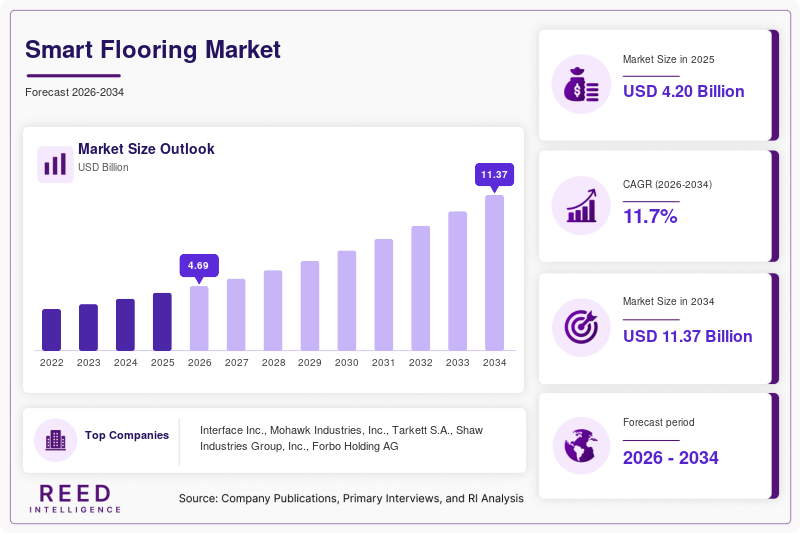
The Smart Flooring Market size is witnessing steady expansion, driven by increasing adoption of intelligent building solutions and connected infrastructure. The market size was estimated at USD 4.2 billion in 2025 and is projected to reach USD 4.8 billion in 2026. With continuous advancements in sensor integration and IoT-enabled systems, the market is expected to grow significantly, reaching approximately USD 11.6 billion by 2034. This reflects a compound annual growth rate (CAGR) of 11.7% during the forecast period from 2025 to 2034.
Smart flooring refers to technologically enhanced flooring systems embedded with sensors, connectivity modules, and responsive materials that enable real-time monitoring, energy efficiency, and user interaction. These solutions are widely used in healthcare facilities, commercial buildings, smart homes, and industrial environments. The increasing demand for automation and safety in built environments is accelerating the adoption of smart flooring technologies globally.
Key Highlights
- Market size reached USD 4.2 billion in 2025 and is projected to hit USD 11.6 billion by 2034
- CAGR of 11.7% from 2025 to 2034
- Increasing adoption in healthcare and smart buildings
- Strong growth driven by IoT integration and energy efficiency solutions
Market Trends
Integration of IoT and Data Analytics in Flooring Systems
The integration of Internet of Things (IoT) technologies into flooring systems is transforming traditional surfaces into intelligent data platforms. Smart flooring equipped with embedded sensors can collect real-time data related to foot traffic, occupancy, and environmental conditions. This data is increasingly being used for predictive maintenance, energy optimization, and space utilization in commercial buildings. Facility managers can analyze movement patterns to improve layout efficiency and reduce operational costs. The trend is particularly prominent in airports, retail spaces, and office environments, where real-time insights provide measurable business value. As data analytics platforms evolve, the demand for connected flooring solutions is expected to grow further.
Adoption of Energy-Harvesting Flooring Technologies
Energy-harvesting flooring is gaining traction as sustainability becomes a core focus in construction and infrastructure development. These systems convert kinetic energy from human movement into usable electrical energy, which can power lighting systems or contribute to building energy grids. This trend is especially relevant in high-traffic areas such as transportation hubs, shopping centers, and public buildings. The growing emphasis on green building certifications and carbon footprint reduction is encouraging developers to adopt such innovative solutions. Technological advancements are improving energy conversion efficiency, making these systems more commercially viable. As a result, energy-harvesting smart flooring is expected to play a significant role in future smart city initiatives.
Market Drivers
Growing Demand for Smart Infrastructure and Urbanization
Rapid urbanization and the expansion of smart city projects are driving the demand for advanced infrastructure solutions, including smart flooring. Governments and private developers are investing in intelligent building systems to enhance operational efficiency, safety, and sustainability. Smart flooring plays a crucial role by enabling features such as occupancy detection, energy management, and interactive environments. In commercial real estate, these systems help optimize space utilization and reduce energy consumption. The increasing focus on digital transformation in construction and infrastructure sectors is further accelerating adoption. As cities continue to evolve into connected ecosystems, the demand for smart flooring solutions is expected to increase steadily.
Rising Adoption in Healthcare for Patient Monitoring
The healthcare sector is increasingly adopting smart flooring solutions to improve patient safety and monitoring. These systems can detect falls, track movement patterns, and provide real-time alerts to caregivers. This is particularly beneficial in elderly care facilities and hospitals, where patient safety is a priority. Smart flooring eliminates the need for wearable devices, offering a non-intrusive monitoring solution. Additionally, the ability to collect and analyze data helps healthcare providers improve care delivery and operational efficiency. With the growing aging population and increasing healthcare expenditure, the demand for smart flooring in medical facilities is expected to rise significantly.
Market Restraint
High Installation and Implementation Costs
One of the major challenges facing the Smart Flooring Market is the high cost associated with installation and implementation. Smart flooring systems require advanced materials, embedded sensors, and integration with IoT platforms, which significantly increases upfront costs compared to traditional flooring solutions. This cost barrier can limit adoption, particularly in developing regions and small-scale projects. Additionally, retrofitting existing buildings with smart flooring systems can be complex and expensive, further restricting market growth. Maintenance and system upgrades also add to the overall lifecycle cost, making it less attractive for budget-conscious consumers.
The impact of high costs is particularly evident in residential applications, where consumers may prioritize affordability over advanced features. For example, a mid-sized commercial building may face substantial investment requirements to implement smart flooring across multiple floors, including hardware, software, and integration services. This can delay adoption despite the long-term benefits. As a result, manufacturers are focusing on cost optimization and modular solutions to improve affordability and expand market reach.
Market Opportunities
Expansion in Smart Cities and Public Infrastructure Projects
The rapid development of smart cities presents a significant opportunity for the Smart Flooring Market. Governments across various regions are investing in advanced infrastructure to improve urban living standards. Smart flooring can be integrated into public spaces such as transportation hubs, walkways, and government buildings to enhance safety, energy efficiency, and data collection. These systems can support crowd management, energy harvesting, and environmental monitoring, making them valuable components of smart city ecosystems. As public infrastructure projects continue to expand, the demand for scalable and durable smart flooring solutions is expected to grow, creating new revenue opportunities for market players.
Technological Advancements and Product Innovation
Continuous innovation in materials science and sensor technology is creating new opportunities in the Smart Flooring Market. Manufacturers are developing more efficient, durable, and cost-effective solutions to meet diverse application needs. For instance, advancements in flexible sensors and wireless communication are enabling easier installation and improved performance. Integration with artificial intelligence and machine learning is also enhancing the functionality of smart flooring systems, allowing predictive analytics and automated responses. These innovations are expanding the range of applications, from residential homes to industrial facilities. As technology continues to evolve, companies that invest in research and development are likely to gain a competitive advantage in the market.
Segmental Analysis
By Type
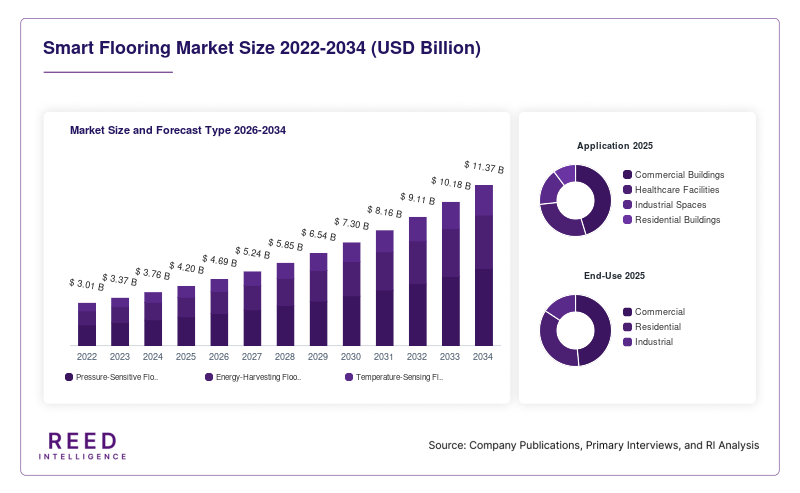
The pressure-sensitive flooring segment dominated the market in 2024, accounting for approximately 42% of the total share. These systems are widely used in healthcare and security applications due to their ability to detect movement and monitor activity. Pressure-sensitive flooring is particularly effective in elderly care facilities, where it helps prevent accidents and ensures patient safety. The technology is also used in commercial spaces to analyze foot traffic and optimize layouts. Its reliability and versatility make it a preferred choice across multiple industries, contributing to its dominant market position.
Energy-harvesting flooring is expected to be the fastest-growing segment, with a projected CAGR of 13.5% during the forecast period. The growth is driven by increasing demand for sustainable energy solutions and green building practices. These systems convert kinetic energy into electricity, making them suitable for high-traffic areas. Advancements in energy conversion technology are improving efficiency and reducing costs, further supporting adoption. As sustainability becomes a priority, the demand for energy-harvesting flooring is expected to increase significantly.
By Application
Commercial buildings accounted for the largest market share in 2024, representing around 48% of total revenue. The adoption of smart flooring in offices, retail spaces, and public infrastructure is driven by the need for efficient space utilization and energy management. These systems provide valuable data on occupancy and movement patterns, enabling better decision-making. The integration of smart flooring with building management systems enhances operational efficiency and reduces costs, making it a key component of modern commercial infrastructure.
Healthcare facilities are expected to be the fastest-growing application segment, with a CAGR of 12.8% during the forecast period. The increasing focus on patient safety and monitoring is driving demand for smart flooring solutions in hospitals and elderly care centers. These systems provide real-time data and alerts, improving care quality and reducing risks. The growing aging population and rising healthcare expenditure are further supporting market growth in this segment.
By End-Use
The commercial end-use segment dominated the market in 2024, accounting for approximately 50% of the total share. Businesses are increasingly adopting smart flooring to improve efficiency and enhance user experience. These systems help optimize energy usage, monitor foot traffic, and support data-driven decision-making. The demand is particularly strong in retail, hospitality, and office spaces, where advanced technologies are used to improve operations and customer engagement.
The residential segment is expected to be the fastest-growing end-use category, with a CAGR of 12.3% during the forecast period. The growth is driven by increasing adoption of smart home technologies and rising consumer awareness. Smart flooring systems are being integrated into modern homes to enhance comfort, safety, and energy efficiency. Technological advancements and decreasing costs are making these solutions more accessible, supporting growth in the residential segment.
Regional Analysis
North America
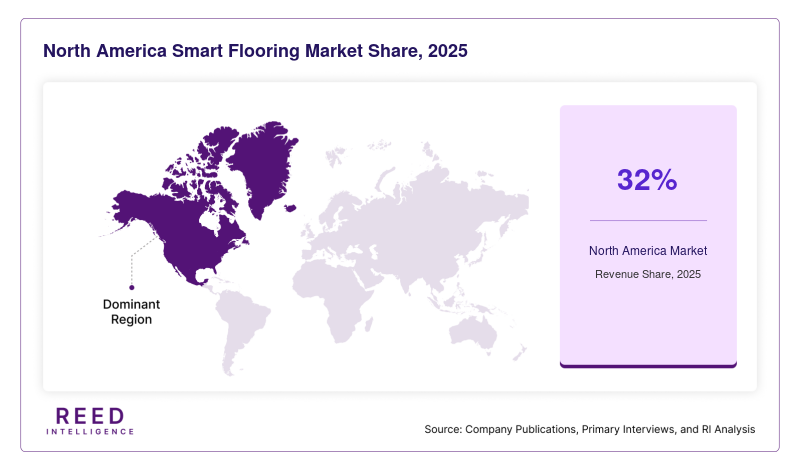
North America accounted for approximately 32% of the Smart Flooring Market share in 2025 and is expected to maintain steady growth with a CAGR of 10.8% during the forecast period. The region benefits from strong adoption of smart building technologies and high investment in infrastructure modernization. The presence of advanced IoT ecosystems and favorable regulatory frameworks further supports market expansion. Demand is particularly strong in commercial real estate and healthcare sectors, where smart flooring solutions are increasingly integrated into building management systems.
The United States dominates the regional market due to its advanced construction industry and high adoption of smart technologies. A key growth factor is the increasing focus on energy-efficient buildings and sustainability initiatives. Government incentives and green building certifications are encouraging the adoption of innovative solutions such as energy-harvesting flooring. Additionally, the presence of leading technology providers supports continuous innovation and market growth.
Europe
Europe held around 26% of the market share in 2025 and is projected to grow at a CAGR of 10.5% through 2034. The region’s strong emphasis on sustainability and energy efficiency is driving the adoption of smart flooring solutions. Strict environmental regulations and the push for carbon neutrality are encouraging the use of advanced building technologies. Smart flooring is increasingly being used in commercial and public infrastructure projects across the region.
Germany leads the European market due to its robust industrial base and focus on smart manufacturing. A unique growth factor is the integration of smart flooring in industrial automation systems. These systems help monitor worker movement and improve safety in manufacturing facilities. The country’s commitment to Industry 4.0 initiatives is further supporting the adoption of intelligent flooring solutions.
Asia Pacific
Asia Pacific accounted for approximately 28% of the market share in 2025 and is expected to grow at the highest CAGR of 13.2% during the forecast period. Rapid urbanization and infrastructure development are key drivers in the region. Increasing investments in smart city projects and commercial real estate are boosting demand for smart flooring solutions. The growing middle-class population is also contributing to the adoption of smart home technologies.
China dominates the regional market due to its large-scale construction activities and government support for smart city initiatives. A significant growth factor is the expansion of urban infrastructure projects, including transportation hubs and commercial complexes. The integration of smart flooring in these projects enhances efficiency and supports data-driven decision-making, contributing to market growth.
Middle East & Africa
The Middle East & Africa region held around 8% of the market share in 2025 and is projected to grow at a CAGR of 11.2% through 2034. The region is witnessing increasing investments in smart infrastructure and large-scale construction projects. Smart flooring is gaining traction in commercial and hospitality sectors, where advanced technologies are used to enhance customer experience and operational efficiency.
The United Arab Emirates leads the regional market due to its focus on smart city development and innovative construction practices. A key growth factor is the adoption of smart technologies in luxury real estate and hospitality projects. These applications require advanced solutions to improve energy efficiency and user experience, driving demand for smart flooring systems.
Latin America
Latin America accounted for approximately 6% of the market share in 2025 and is expected to grow at a CAGR of 10.1% during the forecast period. The region is gradually adopting smart building technologies, driven by urbanization and infrastructure development. Governments are investing in modernization projects, creating opportunities for smart flooring solutions in public and commercial spaces.
Brazil dominates the regional market due to its growing construction sector and increasing adoption of smart technologies. A unique growth factor is the rising demand for energy-efficient solutions in commercial buildings. Businesses are focusing on reducing operational costs and improving sustainability, which is driving the adoption of smart flooring systems.
Competitive Landscape
The Smart Flooring Market is moderately competitive, with several global and regional players focusing on innovation and product development. Key companies are investing in research and development to enhance functionality and reduce costs. Partnerships and collaborations with technology providers are also common strategies to expand market presence.
Among the leading players, Interface Inc. is recognized as a market leader due to its strong product portfolio and focus on sustainable flooring solutions. The company has recently introduced advanced modular flooring systems with integrated sensor technology, enhancing its competitive position. Other major players are also focusing on expanding their product offerings and entering new markets to strengthen their market share.
Key Players
- Interface Inc.
- Mohawk Industries, Inc.
- Tarkett S.A.
- Shaw Industries Group, Inc.
- Forbo Holding AG
- Gerflor Group
- Polyflor Ltd
- Milliken & Company
- Nora Systems GmbH
- LG Hausys Ltd.
- Responsive Surface Technology LLC
- Pavegen Systems Ltd
- SensFloor GmbH
- Smart Floor Technologies
- Future Shape GmbH
Recent Developments
- A leading flooring manufacturer launched a new IoT-enabled smart flooring system designed for healthcare facilities, enhancing patient monitoring capabilities.
- A technology company partnered with a construction firm to integrate energy-harvesting flooring in a major airport project.
- A global player introduced modular smart flooring tiles with improved sensor accuracy and easier installation features.
Smart Flooring Market Segments
Type
- Pressure-Sensitive Flooring
- Energy-Harvesting Flooring
- Temperature-Sensing Flooring
Application
- Commercial Buildings
- Healthcare Facilities
- Industrial Spaces
- Residential Buildings
End-Use
- Commercial
- Residential
- Industrial
By Region
- North America
- Europe
- APAC
- Middle East and Africa
- LATAM