Smart Payment Terminal Market Size, Share Demand Report By Type (Portable Smart POS Terminals, Countertop Smart POS Terminals, Biometric Smart Terminals), By Application (Retail, Hospitality, Healthcare, Transportation, Others), By Connectivity (Wired, Wireless), By End-Use Industry (Retail, BFSI, Healthcare, Transportation, Hospitality) By Region & Segment Forecasts, 2025–2034
USD 3950
Market Overview
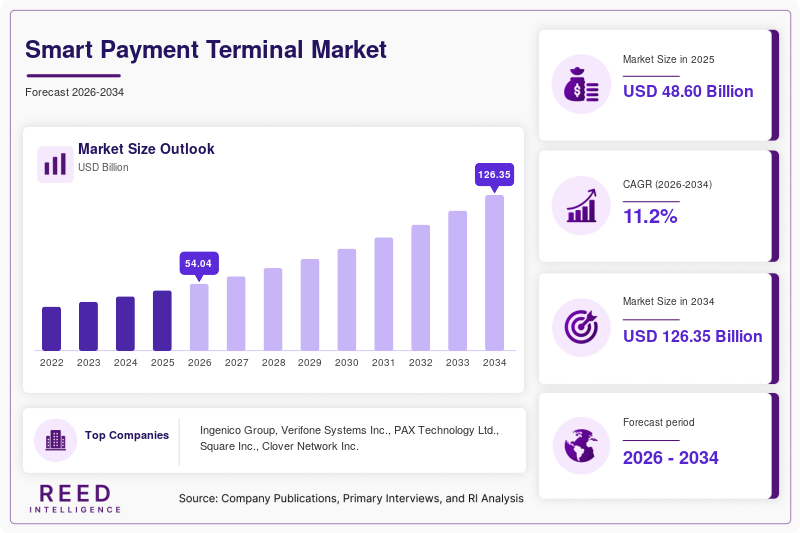
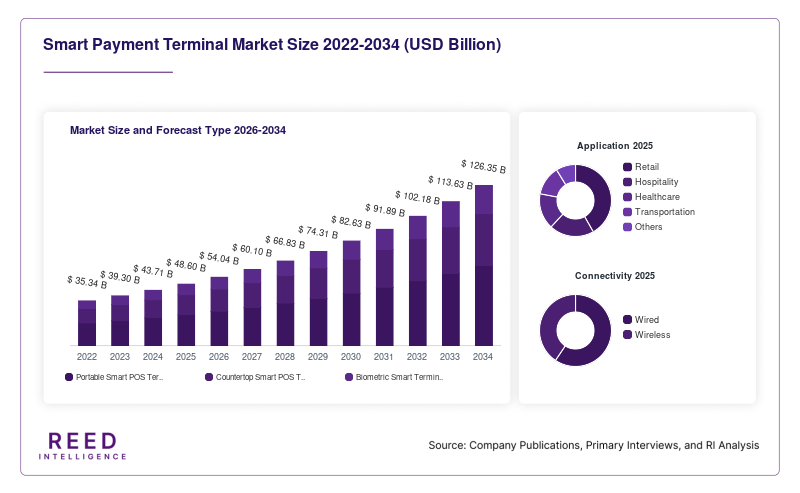
The global Smart Payment Terminal Market size was valued at approximately USD 48.6 billion in 2025 and is projected to reach around USD 126.4 billion by 2034, expanding at a CAGR of 11.2% during the forecast period (2025–2034). The market has experienced consistent expansion driven by the global transition toward cashless economies and increasing penetration of digital payment ecosystems across both developed and emerging regions.
A key global factor supporting the growth of the Smart Payment Terminal Market is the rapid adoption of contactless and mobile payment technologies. Consumers increasingly prefer secure, fast, and convenient payment methods, which has pushed retailers, financial institutions, and service providers to deploy advanced smart terminals integrated with NFC, QR code scanning, biometric authentication, and cloud-based payment processing systems.
Key Highlights:
- Asia Pacific dominated the market with 36.8% share in 2025, while Latin America is projected to grow at the fastest CAGR of 13.4%.
- Portable smart POS terminals accounted for the leading share among types at 52.3% in 2024, while biometric-enabled terminals are expected to grow at a CAGR of 14.1%.
- Retail applications led with 41.6% share in 2024, while healthcare applications are projected to expand at 12.8% CAGR.
- The United States remained the dominant country, with market values of USD 11.2 billion in 2024 and USD 12.4 billion in 2025.
Market Trends
Integration of AI and Cloud-Based Payment Solutions
The Smart Payment Terminal Market is witnessing increasing integration of artificial intelligence and cloud computing technologies. Smart terminals are now capable of processing real-time transaction data, detecting fraud patterns, and offering predictive analytics for businesses. Cloud connectivity allows seamless software updates, remote monitoring, and scalability, making these terminals more efficient and cost-effective for enterprises. This trend is especially relevant for multi-location retailers seeking centralized control over operations.
Rise of Contactless and Biometric Payments
Contactless payment technologies such as NFC and QR codes have become mainstream, supported by growing smartphone penetration and digital wallets. Additionally, biometric authentication features such as fingerprint and facial recognition are gaining traction to enhance transaction security. These innovations not only improve user convenience but also address security concerns, thereby strengthening consumer confidence. As regulatory frameworks continue to support secure digital transactions, the adoption of advanced smart payment terminals is expected to accelerate further.
Market Drivers
Expansion of Digital Payment Infrastructure
Governments and financial institutions across the globe are investing heavily in digital payment infrastructure to reduce reliance on cash transactions. Initiatives promoting financial inclusion, combined with the expansion of internet connectivity and mobile banking services, are encouraging merchants to adopt smart payment terminals. This infrastructure development has created a favorable environment for the Smart Payment Terminal Market to expand across urban and rural areas.
Growth in Retail and E-commerce Integration
The convergence of physical retail and e-commerce platforms has increased the need for unified payment solutions. Smart payment terminals enable seamless integration between online and offline sales channels, allowing businesses to manage transactions, inventory, and customer data efficiently. Retailers are increasingly deploying advanced POS systems to enhance customer experience, reduce checkout time, and support omnichannel strategies, thereby driving market growth.
Market Restraint
High Initial Investment and Maintenance Costs
Despite the benefits offered by smart payment terminals, high upfront costs associated with hardware procurement, software integration, and system upgrades remain a significant barrier for small and medium-sized enterprises. Additionally, ongoing maintenance expenses, cybersecurity requirements, and the need for periodic software updates add to the total cost of ownership. These factors can limit adoption, particularly in cost-sensitive markets where traditional payment methods still dominate. Furthermore, concerns regarding data security and compliance with evolving regulatory standards may discourage some businesses from transitioning to advanced payment systems.
Market Opportunities
Penetration in Emerging Economies
Emerging markets present significant growth opportunities for the Smart Payment Terminal Market due to increasing urbanization, rising disposable incomes, and expanding digital payment ecosystems. Governments in these regions are actively promoting cashless transactions, creating a conducive environment for market expansion. The adoption of affordable and portable smart terminals tailored to small merchants is expected to accelerate growth.
Integration with Value-Added Services
Smart payment terminals are increasingly being integrated with value-added services such as loyalty programs, customer analytics, and inventory management. These multifunctional capabilities provide businesses with enhanced operational efficiency and improved customer engagement. Vendors offering bundled solutions that combine payment processing with business intelligence tools are likely to gain a competitive advantage, opening new revenue streams in the market.
Segmental Analysis
By Type
Portable smart POS terminals dominated the segment, accounting for 52.3% share in 2024. Their flexibility, ease of use, and suitability for small and medium businesses contributed to their widespread adoption. These devices enable businesses to accept payments anywhere, making them ideal for retail, hospitality, and delivery services.
Biometric-enabled smart terminals are expected to be the fastest-growing subsegment, with a projected CAGR of 14.1%. The increasing need for secure authentication and fraud prevention will drive their adoption. Integration of fingerprint and facial recognition technologies will enhance transaction security and improve user trust.
By Application
Retail applications held the largest share of 41.6% in 2024, driven by the high volume of transactions and the need for efficient checkout systems. Smart payment terminals have become essential tools for retailers to manage sales, inventory, and customer data effectively.
Healthcare applications are projected to grow at a CAGR of 12.8%. The increasing digitization of healthcare services and the need for secure payment processing will drive adoption. Smart terminals enable seamless billing and improve patient experience.
By Connectivity
Wired connectivity dominated the segment with a 57.4% share in 2024, as it provides stable and reliable transaction processing. Many large retail establishments prefer wired systems for their consistency and security.
Wireless connectivity is expected to grow at a CAGR of 13.2%, driven by the demand for mobility and flexibility. The adoption of 4G/5G-enabled terminals will support real-time transactions and expand usage in remote locations.
By End-Use Industry
The retail sector accounted for the largest share of 39.8% in 2024, reflecting the extensive use of smart payment terminals in stores and supermarkets. The need for efficient transaction management and customer engagement tools has driven adoption.
The transportation sector is anticipated to grow at a CAGR of 12.5%, supported by the increasing implementation of digital ticketing and contactless payment systems. Smart terminals will enable seamless fare collection and enhance commuter convenience.
Regional Analysis
North America
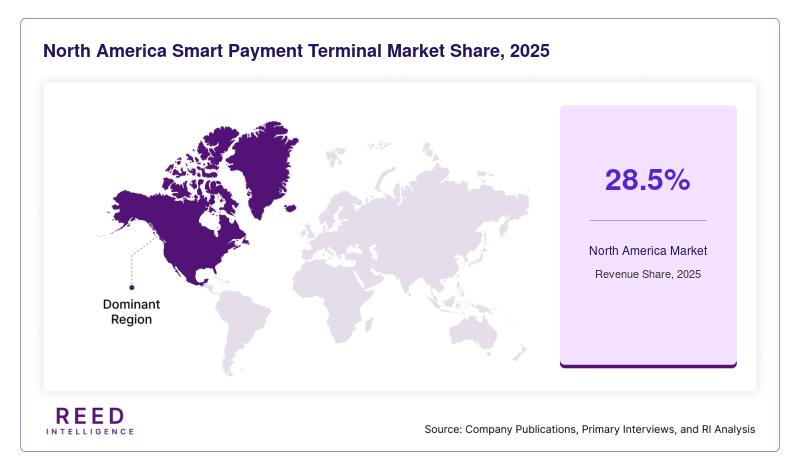
North America accounted for 28.5% of the Smart Payment Terminal Market share in 2025 and is expected to grow at a CAGR of 10.1% during the forecast period. The region’s mature digital payment ecosystem and widespread adoption of advanced technologies have supported steady market expansion.
The United States dominated the regional market due to strong demand for integrated payment solutions across retail and hospitality sectors. The presence of established financial institutions and high consumer preference for contactless payments has driven the adoption of smart terminals.
Europe
Europe held a 24.2% share in 2025 and will expand at a CAGR of 9.8% through 2034. The region has seen strong regulatory support for digital payments and secure transaction systems.
Germany emerged as the dominant country, driven by increasing adoption of cashless payment methods and strong demand from small and medium-sized enterprises. The emphasis on secure and compliant payment infrastructure has contributed to steady growth.
Asia Pacific
Asia Pacific led the Smart Payment Terminal Market with a 36.8% share in 2025 and is projected to grow at a CAGR of 12.6%. Rapid urbanization, increasing smartphone usage, and government initiatives promoting digital payments have fueled market growth.
China dominated the region, supported by widespread adoption of mobile wallets and QR code-based payments. The strong presence of fintech companies and high consumer acceptance of digital transactions have accelerated the deployment of smart terminals.
Middle East & Africa
The Middle East & Africa accounted for 6.1% of the market share in 2025 and is expected to grow at a CAGR of 11.5%. The region is witnessing gradual adoption of digital payment systems driven by economic diversification efforts. The United Arab Emirates led the market due to its advanced financial infrastructure and focus on smart city initiatives. Increasing tourism and retail development have further supported demand for smart payment terminals.
Latin America
Latin America captured 4.4% of the Smart Payment Terminal Market share in 2025 and is projected to grow at the fastest CAGR of 13.4%. The region is experiencing rapid growth in digital payment adoption and financial inclusion initiatives.
Brazil dominated the regional market, driven by increasing smartphone penetration and government-led programs promoting electronic payments. The expansion of fintech ecosystems has significantly contributed to market growth.
Competitive Landscape
The Smart Payment Terminal Market is characterized by intense competition, with key players focusing on innovation, partnerships, and expansion strategies. Companies are investing in advanced technologies such as AI, cloud computing, and biometric authentication to enhance their product offerings.
The market leader, Ingenico Group, has strengthened its position by launching next-generation smart terminals with enhanced security features and cloud integration capabilities. The company continues to expand its global footprint through strategic collaborations.
Key Players
- Ingenico Group
- Verifone Systems Inc.
- PAX Technology Ltd.
- Square Inc.
- Clover Network Inc.
- First Data Corporation
- Newland Payment Technology
- BBPOS Limited
- Castles Technology
- Sunmi Technology
Recent Developments
- 2024: A leading player introduced AI-enabled smart terminals with real-time analytics capabilities.
- 2024: Strategic partnerships between fintech companies and terminal manufacturers expanded product distribution networks.
- 2025: Several companies launched 5G-enabled payment terminals to enhance transaction speed and connectivity.
- 2025: Increased investment in biometric authentication technology improved security features in smart payment devices.
Smart Payment Terminal Market Segments
Type
- Portable Smart POS Terminals
- Countertop Smart POS Terminals
- Biometric Smart Terminals
Application
- Retail
- Hospitality
- Healthcare
- Transportation
- Others
Connectivity
- Wired
- Wireless
End-Use Industry
- Retail
- BFSI
- Healthcare
- Transportation
- Hospitality
By Region
- North America
- Europe
- APAC
- Middle East and Africa
- LATAM