Smart Pills Market Size, Share & Demand Report By Type (Capsule Endoscopy, Patient Monitoring, Drug Delivery), By Application (Gastrointestinal Diagnostics, Drug Delivery, Neurological Monitoring), By End-Use (Hospitals, Diagnostic Centers, Home Healthcare), By Component (Sensors, Camera, Battery, Software & Analytics), By Region & Segment Forecasts, 2025–2034
USD 3950
Market Overview
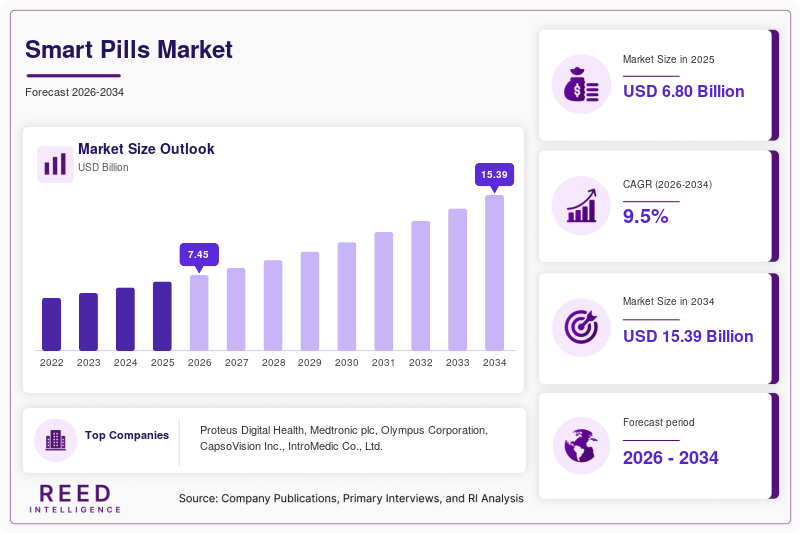
The Smart Pills Market size was valued at approximately USD 6.8 billion in 2025 and is projected to reach USD 15.4 billion by 2034, expanding at a compound annual growth rate (CAGR) of 9.5% from 2025 to 2034. The market growth is primarily driven by the increasing demand for non-invasive diagnostic and monitoring solutions in healthcare systems worldwide. Smart pills, also known as ingestible sensors or digital pills, are transforming patient care through real-time data transmission and improved disease management.
One major global factor supporting the growth of the Smart Pills Market is the rising burden of chronic diseases such as gastrointestinal disorders, neurological conditions, and cardiovascular diseases. Healthcare providers are increasingly adopting smart pill technologies for early diagnosis, remote monitoring, and improved treatment adherence. Additionally, advancements in microelectronics, wireless communication, and biocompatible materials have enhanced the efficiency and safety of these devices.
Key Highlights:
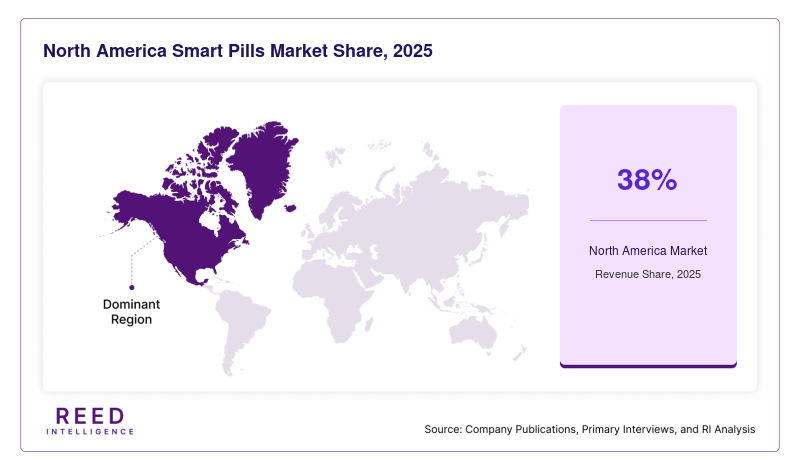
- North America dominated the market with a 38% share in 2025, while Asia Pacific is expected to register the fastest CAGR of 11.2% during the forecast period.
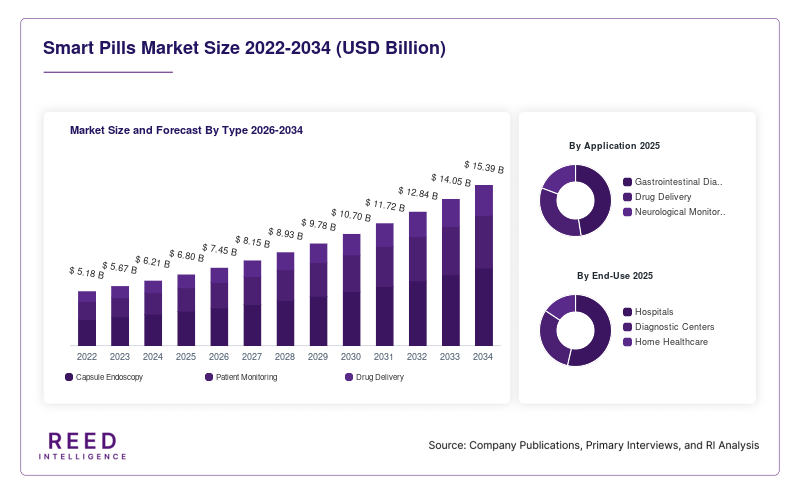
- Capsule endoscopy emerged as the leading segment with a 45% share, whereas patient monitoring smart pills are projected to grow fastest at a CAGR of 10.8%.
- Among applications, gastrointestinal diagnostics led with a 50% share, while drug delivery applications are expected to expand at a CAGR of 10.5%.
- The United States remained the dominant country, with market values of USD 2.3 billion in 2025 and USD 2.5 billion in 2026.
Market Trends
Integration of AI and Data Analytics in Smart Pills
A prominent trend shaping the Smart Pills Market is the integration of artificial intelligence (AI) and advanced data analytics. Smart pills are increasingly equipped with sensors capable of transmitting real-time physiological data. AI-driven platforms analyze this data to provide actionable insights for clinicians, improving diagnostic accuracy and enabling predictive healthcare. This integration supports personalized treatment plans and enhances patient outcomes, particularly in chronic disease management.
Expansion of Digital Therapeutics and Remote Monitoring
Another key trend is the growing adoption of digital therapeutics combined with remote patient monitoring systems. Smart pills are being used alongside mobile health applications and cloud-based platforms to monitor medication adherence and disease progression. This trend has gained momentum due to the increasing need for home-based healthcare solutions and reduced hospital visits. Healthcare providers are leveraging these technologies to optimize care delivery while reducing operational costs.
Market Drivers
Rising Demand for Minimally Invasive Diagnostics
The increasing preference for minimally invasive diagnostic procedures is a major driver of the Smart Pills Market. Traditional diagnostic methods often involve discomfort and higher risks, whereas smart pills provide a patient-friendly alternative. Capsule endoscopy, for instance, allows visualization of the gastrointestinal tract without invasive procedures. This has led to widespread adoption in hospitals and diagnostic centers.
Growth in Aging Population and Chronic Diseases
The global rise in the aging population has significantly contributed to the demand for advanced healthcare solutions. Older individuals are more susceptible to chronic conditions that require continuous monitoring and diagnosis. Smart pills offer efficient disease tracking and medication adherence monitoring, making them a valuable tool in geriatric care. This demographic shift is expected to sustain long-term market growth.
Market Restraint
High Cost and Limited Reimbursement Policies
One of the primary restraints affecting the Smart Pills Market is the high cost associated with smart pill technologies and limited reimbursement frameworks. These devices involve advanced components such as sensors, cameras, and wireless transmitters, making them expensive compared to conventional diagnostic tools. In many regions, healthcare systems do not fully cover the cost of smart pills, limiting patient access.
Additionally, the lack of standardized reimbursement policies creates uncertainty for healthcare providers and patients. This restricts adoption, particularly in developing economies where affordability remains a critical concern. The cost barrier also impacts small healthcare facilities that may not have the financial resources to invest in advanced technologies. As a result, despite strong demand, the overall market growth faces challenges related to pricing and accessibility.
Market Opportunities
Emerging Applications in Drug Delivery Systems
The development of smart pills for targeted drug delivery presents a significant growth opportunity. These advanced systems enable precise drug release at specific locations within the body, improving treatment efficacy and reducing side effects. Pharmaceutical companies are investing in research to integrate drug delivery capabilities with ingestible sensors, opening new avenues for personalized medicine.
Expansion in Emerging Healthcare Markets
Emerging economies in Asia Pacific, Latin America, and the Middle East are witnessing rapid improvements in healthcare infrastructure. Increasing investments in digital health technologies and growing awareness of advanced diagnostic tools are creating favorable conditions for market expansion. As healthcare systems in these regions continue to modernize, the adoption of smart pills is expected to increase significantly, providing new growth opportunities for industry participants.
Segmental Analysis
By Type
Capsule endoscopy dominated the Smart Pills Market with a 45% share in 2025. This segment has gained widespread acceptance due to its effectiveness in diagnosing gastrointestinal disorders. The ability to capture high-resolution images of the digestive tract has made it a preferred choice among healthcare professionals.
Patient monitoring smart pills are expected to grow at the fastest CAGR of 10.8% during the forecast period. These devices will gain traction due to their ability to track medication adherence and transmit real-time data, supporting improved patient outcomes.
By Application
Gastrointestinal diagnostics held the largest share of 50% in 2025. The high prevalence of digestive disorders and the need for accurate diagnostic tools have driven the demand for smart pills in this segment.
Drug delivery applications are projected to grow at a CAGR of 10.5%. The increasing focus on targeted therapies and personalized medicine will drive the adoption of smart pill-based drug delivery systems.
By End-Use
Hospitals accounted for the largest share of 48% in 2025, as they are the primary centers for advanced diagnostic procedures. The availability of skilled professionals and advanced infrastructure has supported segment dominance.
Home healthcare is expected to be the fastest-growing segment with a CAGR of 10.9%. The shift toward remote patient monitoring and home-based care will accelerate the adoption of smart pills in this segment.
By Component
Sensors dominated the market with a 40% share in 2025, as they are the core components enabling data collection and transmission. Their role in ensuring accurate diagnostics has made them essential in smart pill systems.
Software and data analytics components are expected to grow at a CAGR of 11.0%. The increasing importance of data-driven healthcare solutions will drive demand for advanced analytics platforms integrated with smart pills.
Regional Analysis
North America
North America accounted for 38% of the Smart Pills Market share in 2025 and will expand at a CAGR of 8.8% through 2034. The region’s growth is supported by advanced healthcare infrastructure and strong adoption of digital health technologies.
The United States dominated the regional market due to its high healthcare expenditure and early adoption of innovative medical devices. The presence of established technology providers and ongoing research in ingestible sensors has contributed to sustained market growth.
Europe
Europe held approximately 27% of the market share in 2025 and is expected to grow at a CAGR of 9.0% during the forecast period. The region benefits from increasing awareness of minimally invasive diagnostic solutions.
Germany emerged as the leading country, driven by its strong medical device industry and emphasis on research and development. Government support for digital healthcare initiatives has further strengthened market expansion.
Asia Pacific
Asia Pacific represented 20% of the market share in 2025 and will register the fastest CAGR of 11.2% through 2034. Rapid urbanization and growing healthcare investments are key factors driving growth.
China led the regional market due to its expanding healthcare infrastructure and large patient population. Increasing adoption of advanced diagnostic technologies has accelerated the demand for smart pills in the country.
Middle East & Africa
The Middle East & Africa accounted for 8% of the market share in 2025 and is projected to grow at a CAGR of 9.3%. The region is gradually adopting modern healthcare technologies.
Saudi Arabia dominated the market due to its investments in healthcare modernization and focus on improving diagnostic capabilities. Government initiatives aimed at enhancing healthcare quality are supporting market growth.
Latin America
Latin America held around 7% of the market share in 2025 and is expected to grow at a CAGR of 9.1% during the forecast period. The region is experiencing steady improvements in healthcare access.
Brazil emerged as the leading country, supported by increasing healthcare spending and rising awareness of advanced diagnostic tools. Efforts to improve healthcare infrastructure are driving the adoption of smart pill technologies.
Competitive Landscape
The Smart Pills Market is moderately competitive, with key players focusing on technological innovation and strategic collaborations. Leading companies are investing in research and development to enhance product capabilities and expand their market presence.
Proteus Digital Health is recognized as a market leader, known for its advancements in ingestible sensor technology. The company recently introduced an upgraded digital pill system with enhanced data tracking features, strengthening its position in the market.
Other major players are focusing on partnerships with healthcare providers and pharmaceutical companies to accelerate adoption. Continuous innovation and product development remain central strategies for maintaining competitive advantage in this evolving market.
Key Players List
- Proteus Digital Health
- Medtronic plc
- Olympus Corporation
- CapsoVision Inc.
- IntroMedic Co., Ltd.
- Check-Cap Ltd.
- Medisafe
- Otsuka Pharmaceutical Co., Ltd.
- Philips Healthcare
- GE Healthcare
- BodyCap
- Bio-Images Research Limited
- Given Imaging Ltd.
- Jinshan Science & Technology
- RF Co., Ltd.
Recent Developments
- In January 2026, researchers at MIT developed an advanced smart pill capable of wirelessly confirming medication ingestion using biodegradable radio-frequency components, improving medication adherence monitoring.
- In June 2025, scientists introduced a next-generation ingestible capsule (PillTrek) equipped with electrochemical sensors to monitor gut biomarkers such as pH, temperature, and neurotransmitters, enhancing diagnostic precision.
- In May 2025, AnX Robotica received FDA 510(k) clearance for MotiliCap™ along with MotiliScan software, enabling improved gastrointestinal motility monitoring solutions.
- In January 2025, CapsoVision obtained FDA approval for its CapsoCam Plus capsule for pediatric use, expanding the application of capsule endoscopy in younger patient populations.
Smart Pills Market Segments
By Type
- Capsule Endoscopy
- Patient Monitoring
- Drug Delivery
By Application
- Gastrointestinal Diagnostics
- Drug Delivery
- Neurological Monitoring
By End-Use
- Hospitals
- Diagnostic Centers
- Home Healthcare
By Component
- Sensors
- Camera
- Battery
- Software & Analytics
By Region
- North America
- Europe
- APAC
- Middle East and Africa
- LATAM