Smart Vent Market Size, Share & Demand Report By Type (Wireless Smart Vents, Sensor-Integrated Smart Vents), By Application (Residential, Commercial), By End-Use (HVAC System Integration, Smart Home Integration), By Region & Segment Forecasts, 2026–2034
USD 3950
Market Overview
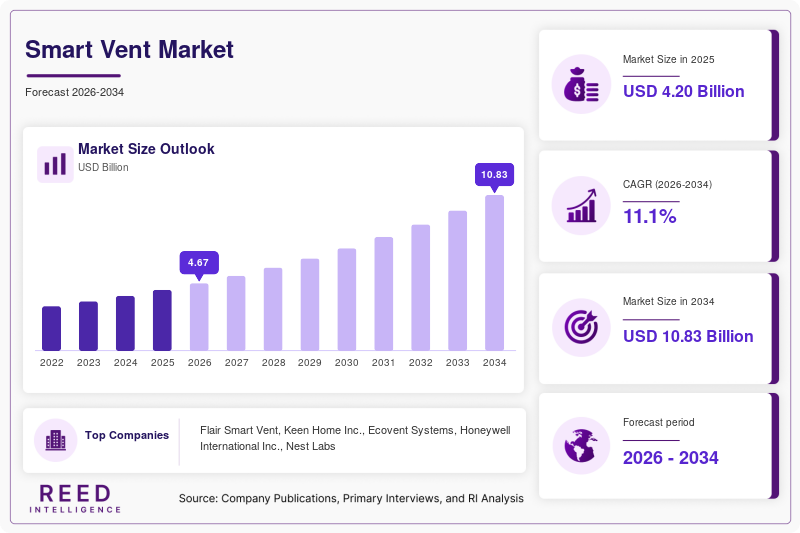
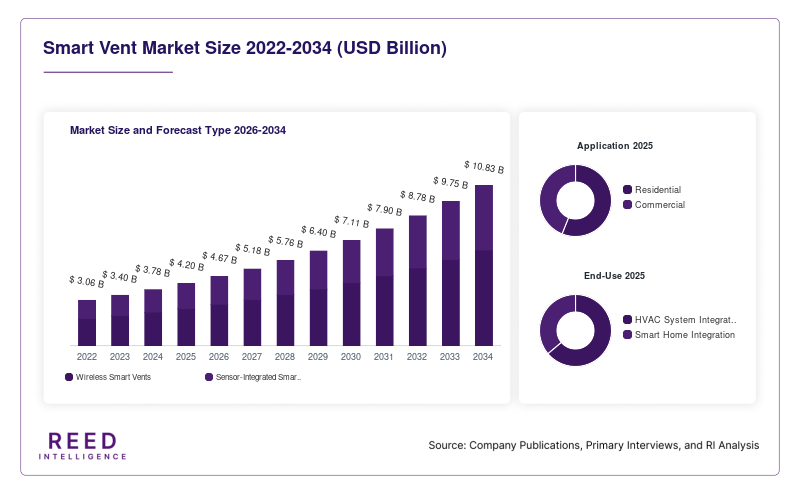
The Smart Vent Market size was valued at approximately USD 4.2 billion in 2026 and is projected to reach USD 9.8 billion by 2034, expanding at a CAGR of 11.1% during the forecast period (2026–2034). The market is witnessing consistent growth as demand for energy-efficient HVAC systems continues to rise across residential and commercial sectors. Smart vents, which automatically regulate airflow using sensors and connected technologies, are gaining adoption as part of broader smart home ecosystems.
A key global factor supporting market expansion is the increasing emphasis on energy conservation and sustainability. Governments and regulatory bodies are introducing stringent energy efficiency standards for buildings, encouraging the deployment of intelligent HVAC solutions. Smart vents help optimize airflow distribution, reduce energy waste, and improve indoor comfort levels, aligning with these regulatory goals. In addition, the integration of Internet of Things (IoT) technologies into home automation systems has further enhanced the appeal of smart vents among tech-savvy consumers.
Key Highlights
- North America dominated the market with a 36.4% share in 2025,.
- Asia Pacific is expected to grow at the fastest CAGR of 12.3% during 2026–2034.
- By type, wireless smart vents accounted for the largest share of 44.7%, while sensor-integrated vents are projected to grow at a CAGR of 13.1%.
- By application, residential use led with a 52.8% share, whereas commercial buildings are expected to expand at a CAGR of 11.9%.
- The United States remained the dominant country, with market values of USD 1.05 billion in 2024 and USD 1.18 billion in 2025.
Market Trends
Increasing integration with smart home ecosystems
The market is experiencing a shift toward seamless integration with smart home platforms. Smart vents are no longer standalone devices; they are becoming part of interconnected systems that include thermostats, lighting, and security solutions. Consumers prefer devices that can be controlled via a single interface or mobile application. This trend is driving manufacturers to develop products compatible with popular voice assistants and home automation hubs.
Such integration enhances user convenience by enabling centralized control of indoor environments. For example, smart vents can automatically adjust airflow based on occupancy data or temperature preferences. This not only improves comfort but also contributes to energy savings. The growing adoption of smart homes in developed regions and the increasing availability of affordable automation solutions in emerging markets are further accelerating this trend.
Growing demand for energy-efficient HVAC solutions
Energy efficiency remains a key focus across residential and commercial sectors, leading to increased adoption of smart vents. These devices help optimize airflow distribution, ensuring that conditioned air reaches only occupied spaces. This reduces the overall energy consumption of HVAC systems, making them more efficient.
Consumers are becoming more aware of energy costs and environmental impact, prompting them to invest in technologies that offer long-term savings. Smart vents play a crucial role in reducing utility bills by minimizing unnecessary heating or cooling. Additionally, building owners are incorporating these solutions to meet green building certifications and sustainability goals. The trend is expected to gain further momentum as governments continue to implement stricter energy efficiency regulations worldwide.
Market Drivers
Rising adoption of smart home technologies
The increasing penetration of smart home technologies is a major driver of the Smart Vent Market. Consumers are adopting connected devices that enhance convenience, security, and energy efficiency. Smart vents align well with this trend, offering automated airflow control and remote accessibility through mobile applications.
The proliferation of IoT-enabled devices has created a conducive environment for the growth of smart vents. As more households adopt smart thermostats and home automation systems, the demand for complementary devices such as smart vents is rising. This integration allows users to create customized climate control settings, improving comfort and reducing energy consumption. Furthermore, advancements in wireless communication technologies have made these devices more reliable and easier to install, further driving market growth.
Increasing focus on energy conservation and cost savings
Energy conservation is becoming a priority for both consumers and businesses, driving the adoption of smart vents. These devices help optimize HVAC performance by directing airflow to occupied areas, reducing energy wastage. This results in lower energy bills and improved system efficiency.
Governments and regulatory bodies are promoting energy-efficient technologies through incentives and regulations. Building owners are increasingly investing in solutions that comply with these standards while also reducing operational costs. Smart vents offer a practical solution by enhancing the performance of existing HVAC systems without requiring major infrastructure changes. This cost-effective approach is encouraging widespread adoption across various end-use sectors, including residential, commercial, and industrial applications.
Market Restraint
High initial installation costs and compatibility challenges
One of the primary challenges facing the Smart Vent Market is the high initial cost associated with installation and integration. While smart vents offer long-term energy savings, the upfront investment can be a barrier for many consumers, particularly in price-sensitive markets. The cost of purchasing multiple units for a single property, along with installation expenses, may deter potential buyers.
Compatibility issues with existing HVAC systems also pose a challenge. Not all smart vents are designed to work seamlessly with older systems, which may require additional upgrades or modifications. This can increase the overall cost and complexity of adoption. In commercial settings, integrating smart vents into large-scale HVAC systems can be particularly challenging, requiring specialized expertise and additional infrastructure. These factors can slow down market penetration, especially in regions with limited awareness or technical support.
Market Opportunities
Expansion in emerging economies
Emerging economies present significant growth opportunities for the Smart Vent Market. Rapid urbanization and increasing construction activities in countries across Asia Pacific, Latin America, and the Middle East are driving demand for modern building solutions. Developers are incorporating smart technologies into new projects to enhance efficiency and appeal to tech-savvy consumers.
The rising middle-class population in these regions is also contributing to market growth. As disposable incomes increase, consumers are more willing to invest in smart home solutions that improve comfort and reduce energy costs. Governments in these regions are promoting energy-efficient building practices, further supporting the adoption of smart vents. Manufacturers are focusing on offering cost-effective solutions tailored to these markets, creating new growth avenues.
Advancements in AI and predictive analytics
Technological advancements in artificial intelligence and predictive analytics are opening new opportunities in the Smart Vent Market. These technologies enable smart vents to learn user preferences and adapt to changing conditions, providing a more personalized experience. Predictive analytics can anticipate occupancy patterns and adjust airflow accordingly, optimizing energy usage.
The integration of AI also enhances system efficiency by identifying inefficiencies and recommending adjustments. This not only improves performance but also extends the lifespan of HVAC systems. As these technologies continue to evolve, smart vents are expected to become more intelligent and capable, attracting a broader customer base. Companies investing in innovation and product development are likely to gain a competitive edge in the market.
Segmental Analysis
By Type
Wireless smart vents dominated the market in 2024, accounting for a share of approximately 44.7%. These vents are preferred due to their ease of installation and compatibility with existing HVAC systems. They eliminate the need for complex wiring, making them suitable for both new constructions and retrofitting projects. The growing adoption of wireless communication technologies has further enhanced their appeal.
Sensor-integrated vents are expected to grow at the fastest CAGR of 13.1% during the forecast period. These vents use advanced sensors to monitor temperature, humidity, and occupancy, enabling precise airflow control. The increasing demand for personalized comfort and energy efficiency is driving the adoption of sensor-integrated solutions.
By Application
Residential applications accounted for the largest share of 52.8% in 2024, driven by the increasing adoption of smart home technologies. Homeowners are investing in smart vents to improve comfort and reduce energy costs. The availability of user-friendly devices and mobile applications has further supported adoption in this segment.
Commercial applications are projected to grow at a CAGR of 11.9% during the forecast period. Businesses are focusing on optimizing energy usage and reducing operational costs. Smart vents help improve HVAC efficiency in offices, retail spaces, and hospitality establishments, driving their adoption in the commercial sector.
By End-Use
The HVAC system integration segment dominated the market in 2024, accounting for a significant share. Smart vents are increasingly being integrated into HVAC systems to enhance performance and efficiency. This integration allows for better control over airflow distribution, improving overall system effectiveness.
The smart home integration segment is expected to grow at the fastest CAGR of 12.7%. The increasing adoption of home automation systems is driving demand for smart vents that can be seamlessly integrated into these ecosystems. Consumers are seeking solutions that offer convenience, energy savings, and enhanced comfort, supporting growth in this segment.
Regional Analysis
North America
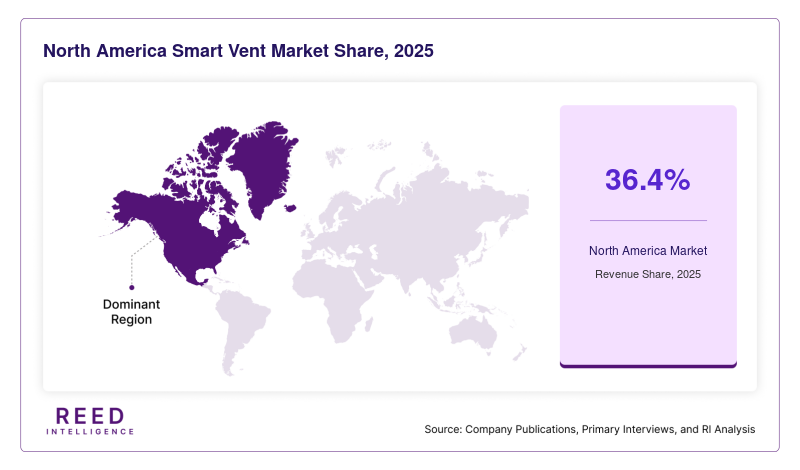
North America accounted for a market share of approximately 36.4% in 2025 and is expected to maintain steady growth at a CAGR of 10.8% during the forecast period. The region’s strong adoption of smart home technologies and high consumer awareness are key factors driving market growth. Additionally, stringent energy efficiency regulations and the presence of established players contribute to the region’s dominance.
The United States remains the leading country in this region, driven by widespread adoption of smart home devices and advanced HVAC systems. A unique growth factor is the increasing focus on retrofitting existing buildings with energy-efficient solutions. Homeowners are investing in smart vents to upgrade their HVAC systems without significant structural changes, supporting market expansion.
Europe
Europe held a significant share of around 24.7% in 2025 and is projected to grow at a CAGR of 10.5% through 2034. The region’s focus on sustainability and energy efficiency is a major driver of market growth. Regulatory frameworks promoting green building practices are encouraging the adoption of smart vents in residential and commercial spaces.
Germany leads the European market, supported by strong industrial infrastructure and high adoption of smart technologies. A unique growth factor is the emphasis on reducing carbon emissions in buildings. Smart vents help optimize energy usage, aligning with the region’s environmental goals and boosting their adoption.
Asia Pacific
Asia Pacific is expected to register the fastest CAGR of 12.3% during the forecast period, with a market share of 21.8% in 2025. Rapid urbanization, increasing construction activities, and rising disposable incomes are key factors driving growth in this region. The adoption of smart home technologies is also gaining momentum.
China dominates the regional market due to its large population and expanding construction sector. A unique growth factor is the integration of smart technologies in new residential developments. Builders are incorporating smart vents as part of comprehensive home automation systems, enhancing their appeal to modern consumers.
Middle East & Africa
The Middle East & Africa region accounted for a market share of 9.6% in 2025 and is expected to grow at a CAGR of 10.2% during the forecast period. Increasing investments in infrastructure and smart city projects are driving the adoption of smart vents in this region.
The United Arab Emirates leads the market, supported by large-scale construction projects and smart city initiatives. A unique growth factor is the need for efficient cooling solutions in extreme climates. Smart vents help optimize airflow and reduce energy consumption, making them highly suitable for the region.
Latin America
Latin America held a market share of 7.5% in 2025 and is projected to grow at a CAGR of 10.0% through 2034. The region is witnessing gradual adoption of smart home technologies, supported by increasing urbanization and improving economic conditions.
Brazil is the dominant country in this region, driven by growing awareness of energy-efficient solutions. A unique growth factor is the rising demand for cost-effective HVAC optimization solutions. Smart vents offer an affordable way to improve system efficiency, making them attractive to consumers.
Competitive Landscape
The Smart Vent Market is characterized by moderate competition, with several established players and emerging companies focusing on innovation and product development. Key companies are investing in research and development to enhance product functionality and improve user experience. The market is also witnessing strategic partnerships and collaborations aimed at expanding product portfolios and market reach.
Flair Smart Vent is considered a leading player in the market, known for its advanced product offerings and strong presence in North America. The company has recently introduced new AI-enabled features that enhance airflow optimization and energy efficiency. Other major players are focusing on expanding their distribution networks and improving compatibility with various smart home platforms. The competitive landscape is expected to intensify as new entrants introduce innovative solutions and existing players continue to enhance their offerings.
Key Players
- Flair Smart Vent
- Keen Home Inc.
- Ecovent Systems
- Honeywell International Inc.
- Nest Labs
- Schneider Electric
- Johnson Controls
- Carrier Global Corporation
- Siemens AG
- Tado GmbH
- Vent-Miser
- Airflow Developments Ltd.
- Panasonic Corporation
- Lennox International Inc.
- Resideo Technologies Inc
Recent Developments
- Flair Smart Vent launched an upgraded product line with enhanced AI-based airflow optimization features in 2025.
- Honeywell International Inc. introduced a new range of smart vents compatible with multiple home automation platforms in 2024.
- Siemens AG partnered with a leading smart home provider to integrate smart vent solutions into building management systems in 2025.
Smart Vent Market Segments
Type
- Wireless Smart Vents
- Sensor-Integrated Smart Vents
Application
- Residential
- Commercial
End-Use
- HVAC System Integration
- Smart Home Integration
By Region
- North America
- Europe
- APAC
- Middle East and Africa
- LATAM