Smartphone Repair Market Size, Share & Trends Analysis Report By Repair Type (Screen Replacement, Battery Replacement, Charging Port Repair, Camera & Sensor Repair, Motherboard & IC Repair, Software & Other Repairs), By Device Platform (Android, iOS), By Service Channel (Independent Repair Shops, Authorized Service Centers, Retail & Express Repair Chains, Mail-In & At-Home Repair) and By Region (North America, Europe, APAC, Middle East and Africa, LATAM) Forecasts, 2026–2034
USD 3950
Smartphone Repair Market Size
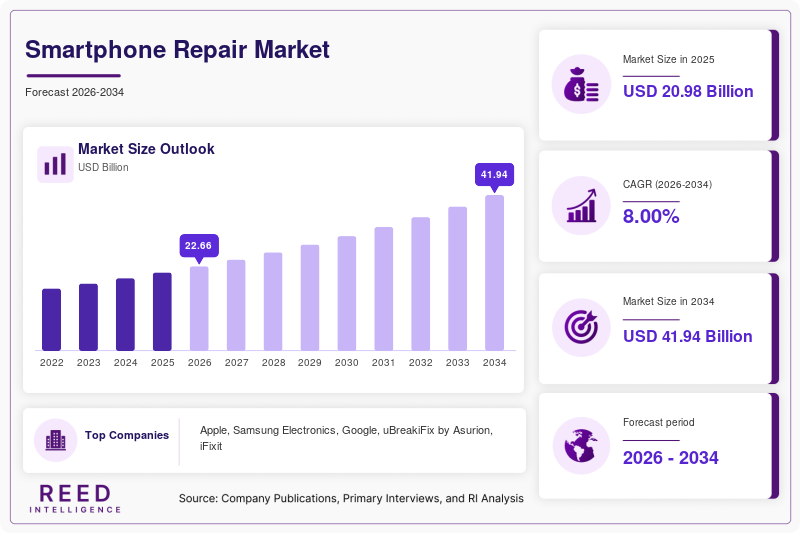
The global smartphone repair market is valued at USD 20.98 Billion in 2025 and USD 22.66 Billion in 2026. The market is projected to reach USD 41.94 Billion by 2034, registering an 8.00% CAGR during the forecast period.
The smartphone repair market comprises professional and self-service activities used to restore smartphones following physical damage, component failure, battery degradation, liquid exposure, software malfunction or other operational problems. The ecosystem includes OEM-authorized service centers, independent repair businesses, retail repair chains, mail-in services, doorstep technicians, component distributors, refurbishment companies and do-it-yourself repair programs.
The largest repair workloads typically involve displays, batteries, charging ports, cameras, speakers, microphones and other replaceable components. More complex work includes motherboard diagnostics, integrated-circuit repair, biometric-component replacement and software restoration. Apple, Samsung and Google all maintain formal repair ecosystems spanning professional service and, to differing degrees, self-repair. Apple provides genuine parts, tools, diagnostics and repair manuals through Self Service Repair, while Samsung provides genuine parts, manuals and tools for supported devices and Google directs Pixel owners to genuine parts and repair guides supplied through iFixit.
Smartphone Repair Market Drivers
Longer device lifecycles are increasing the economic importance of repair
Smartphone users are keeping devices in service longer, creating more opportunities for component replacement and refurbishment. GSMA's June 2026 circularity research identifies longer device retention and increased consumer interest in refurbished phones as important trends.
The available installed base is enormous. GSMA estimates more than five billion used mobile phones are currently sitting unused in homes and offices globally. Bringing even a portion of these devices back into productive use requires testing, battery replacement, screen repair, cosmetic restoration, data wiping and grading.
The economic mechanism is straightforward: when consumers delay a new-device purchase, the value of restoring an existing handset rises. This supports independent repair, authorized servicing and organized refurbishment simultaneously.
Repairability regulation is increasing spare-part availability and professional service opportunities
EU ecodesign requirements have changed the commercial environment for smartphone repair. Manufacturers placing covered smartphones on the EU market must make specified spare parts available for extended periods, provide repair information and meet defined disassembly requirements.
The rules create a more predictable parts pipeline for professional repairers. They also encourage manufacturers to design around accessible fasteners and serviceable components.
For repair businesses, this can improve access to legitimate parts and documentation while creating demand for technicians who understand model-specific disassembly, diagnostics and post-repair procedures.
Higher smartphone replacement costs can make repair financially more attractive
IDC forecasts a 16.7% decline in global smartphone shipments in 2026 while also forecasting a 27.6% increase in average smartphone selling prices to USD 581. Memory costs are a major contributor to the change.
When replacement devices become more expensive, consumers and enterprises have stronger incentives to repair cracked displays, replace aging batteries or restore charging functionality.
The effect is particularly important for premium smartphones because the replacement value is higher. It also benefits repair providers that can restore higher-priced devices economically and provide warranties that reduce consumer risk.
Smartphone Repair Market Restraints
Advanced smartphone designs can increase repair complexity and diagnostic requirements
Modern smartphones integrate tightly packed batteries, displays, cameras, sensors, biometric components, adhesives and system boards. Repairs can require specialized tools, heating equipment, calibration and software configuration.
Apple's Self Service Repair process, for example, requires model-specific manuals and may require Repair Assistant or System Configuration after a repair. Samsung notes that some components may require calibration after replacement. Google likewise recommends self-repair only for users with relevant technical experience.
This raises technician-skill requirements and increases the equipment investment needed for higher-complexity repairs.
Parts authenticity, quality differences and warranty considerations can fragment customer choice
The repair market contains OEM-authorized parts, genuine parts sold through independent channels, aftermarket components and used or harvested parts. Performance, warranty treatment and compatibility can differ across these categories.
Apple's repair program distinguishes authorized and independent repair providers and states that independent, non-authorized repairs are not covered by Apple warranties or AppleCare unless required by law. Samsung similarly warns that damage caused by non-authorized repair can fall outside warranty coverage.
This can make customers more cautious about independent repairs and increases the importance of transparent warranties and documented parts provenance.
Smartphone Repair Market Opportunities
Refurbishment and repair can converge into an integrated circular-device business
Repair providers can increasingly capture value beyond the individual repair transaction by combining diagnosis, component replacement, grading, trade-in, resale and recycling.
Cashify's 2026 research illustrates this model in India. The company reports 250+ branded stores and an organized recommerce ecosystem, while 54.6% of its traded-in devices are now 5G-enabled. It also states that its operations include IMEI verification, refurbishment and resale.
GSMA's circularity targets likewise encourage operators to ensure collected used mobile devices are repaired, reused or transferred to controlled recycling organizations.
This creates opportunities for repair businesses to become full lifecycle operators rather than simply repair shops.
OEM-independent repair networks can expand as manufacturers widen authorized access
Apple's Independent Repair Provider program is currently accepting applications in India, allowing qualifying businesses to access genuine parts, tools, training, diagnostics and resources for supported out-of-warranty iPhone repairs.
iFixit also states that it sells parts from Samsung, Google, Motorola and Fairphone and supports repair professionals with parts, tools and resources.
This creates opportunities for independent service companies that can meet certification and quality requirements while offering local convenience and price transparency.
Doorstep, express and digitally managed repairs can capture convenience-focused customers
Consumers increasingly expect repair to be managed through digital scheduling, status tracking, pickup and delivery, or fast in-store service.
Samsung India's current service infrastructure includes online appointments, repair-status tracking, doorstep pickup and drop-off options, while Google promotes express repair centers and uBreakiFix emphasizes same-day service. repair providers can therefore differentiate through logistics and customer experience in addition to technical capability.
Repair Type Analysis
Screen Replacement remains the dominant repair type because display damage is one of the most visible and economically compelling failures
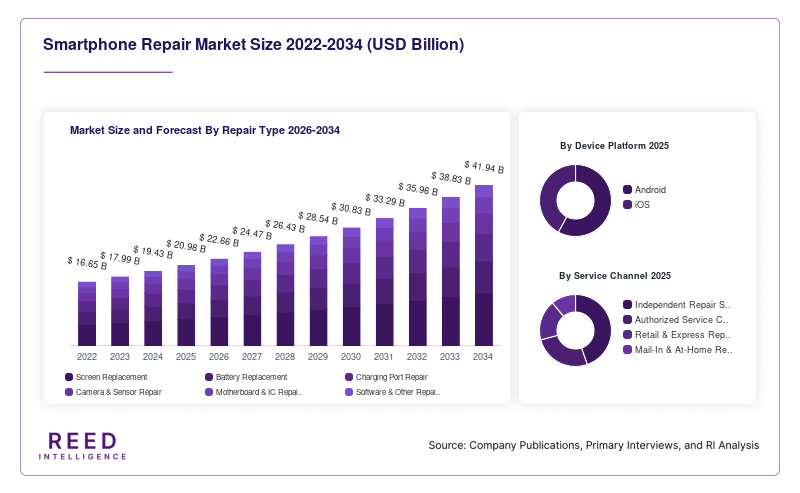
The Screen Replacement segment accounts for 43% of the global market in 2026 and is projected to register a 7.70% CAGR.
Modern smartphones depend on large glass displays, making cracks, touch failures and display damage among the most common reasons for professional repair. Apple, Google and Samsung all maintain dedicated repair workflows involving display replacement and related components.
The financial case for screen repair is strongest for premium phones where replacement handset costs are substantially greater than a component-level repair.
Battery Replacement is the fastest-growing major repair category as devices are retained longer
The Battery Replacement segment accounts for 24% of the global market in 2026 and is projected to register a 9.20% CAGR, making it the fastest-growing major repair type.
Battery degradation becomes increasingly relevant as phones remain in use for additional years. EU ecodesign rules specifically require covered manufacturers to make batteries available to professional repairers and end users under defined conditions and require covered batteries to meet durability requirements.
Apple, Samsung and Google all provide battery-replacement routes through professional or self-repair channels.
Charging Port Repair continues to benefit from heavy daily device use
The segment is projected to register an 8.10% CAGR.
USB-C and other charging interfaces experience repeated insertion, contamination and mechanical stress. EU regulations include external charging ports within the spare parts covered by smartphone repair requirements.
Device Platform Analysis
Android remains the dominant device platform because of its much broader global device base
The Android segment accounts for 71% of the global market in 2026 and is projected to register a 7.70% CAGR.
Android represents a highly fragmented installed base spanning Samsung, Xiaomi, OPPO, vivo, Motorola, Google, OnePlus and numerous regional brands.
IDC's Q2 2026 smartphone data illustrates this breadth: Samsung, Xiaomi, OPPO and vivo were among the five largest global vendors, while Huawei also posted growth in China during the quarter.
The diversity of Android hardware creates broad demand for independent repair expertise and third-party parts distribution.
iOS is the fastest-growing major device platform as premium-device economics support repair and longer retention
The iOS segment accounts for 29% of the global market in 2026 and is projected to register a 8.80% CAGR, making it the fastest-growing major platform category.
Apple's premium positioning means that repairing an existing iPhone can remain economically attractive relative to immediate replacement, particularly for display and battery repairs.
Apple has also expanded access to genuine parts and independent repair resources. Its Independent Repair Provider program currently accepts applications in India, while the company maintains a broad professional service network and Self Service Repair infrastructure.
Service Channel Analysis
Independent Repair Shops remain the dominant service channel because local convenience and price flexibility support high-volume consumer repair
The Independent Repair Shops segment accounts for 43% of the global market in 2026 and is projected to register a 7.60% CAGR.
Independent providers compete through proximity, flexible pricing, fast turnaround and the ability to repair a wide range of device generations and manufacturers.
Apple's current Independent Repair Provider program and iFixit's repair-professional network demonstrate how the boundary between OEM and independent repair is gradually becoming more structured.
Authorized Service Centers are the fastest-growing major service channel as OEM repair ecosystems expand
The Authorized Service Centers segment accounts for 31% of the global market in 2026 and is projected to register a 9.10% CAGR, making it the fastest-growing major service channel.
OEM-backed providers differentiate through genuine parts, certified technicians, manufacturer diagnostics, warranty support and access to model-specific technical information.
Samsung currently states that it has more than 2,000 service locations offering same-day service in the U.S., while Apple operates Authorized Service Providers and Independent Repair Providers, and Google offers dedicated repair-center infrastructure.
Smartphone Repair Market Regional Analysis
APAC Smartphone Repair Market
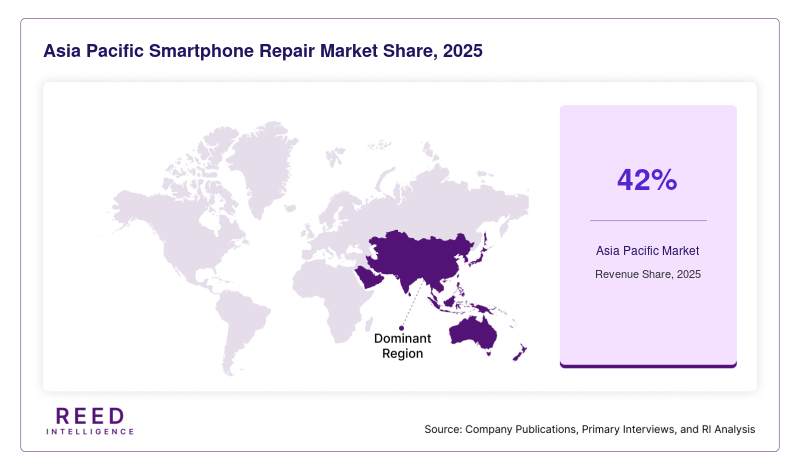
APAC remains the dominant regional market because it combines enormous smartphone manufacturing volumes, a large installed user base, rapidly expanding digital services and a substantial independent repair ecosystem.
The APAC region accounts for 42% of the global market in 2026 and is projected to register a 9.00% CAGR.
China, India, Japan, South Korea and Southeast Asia collectively represent major smartphone manufacturing and consumption centers. IDC's Q2 2026 data shows the scale of the regional supply base, with Samsung, Xiaomi, OPPO and vivo among the largest global manufacturers and Huawei recording strong growth in China.
India is also developing a more organized repair and recommerce market. Cashify reported 250+ branded stores across 70+ cities and a growing refurbishment ecosystem, while Apple is accepting applications for Independent Repair Providers in India.
The region's combination of high smartphone ownership, price-sensitive consumers and strong electronics-service skills provides a broad foundation for repair growth.
Europe Smartphone Repair Market
Europe is the fastest-growing regional market as repairability regulation, sustainability policies and longer device lifecycles reshape consumer and manufacturer behavior.
The Europe region accounts for 23% of the global market in 2026 and is projected to register a 10.20% CAGR, making it the fastest-growing regional market.
EU smartphone ecodesign rules require spare-part availability, repair information, disassembly standards and repairability scoring. The Commission expects the measures to extend product lifetimes and support the development of local repair activity. Fairphone provides an additional example of the region's repair-oriented product model. Its Gen. 6 smartphone has an A repairability index, 12 user-replaceable spare parts and spare-part availability through 2033 under the company's stated program.
North America Smartphone Repair Market
North America is projected to register a 7.60% CAGR, supported by a mature smartphone installed base, extensive authorized and independent repair networks and strong consumer awareness of repair options.
uBreakiFix by Asurion's more than 700 stores illustrate the scale of organized independent repair, while Apple and Samsung maintain extensive authorized repair ecosystems.
The region is also important for DIY repair because Apple, Samsung and Google all provide self-repair resources for supported products. Middle East and Africa Smartphone Repair Market
The Middle East and Africa market is projected to register a 7.30% CAGR, supported by a large installed base of Android devices, growing smartphone adoption and continued reliance on independent service providers.
Repair demand is particularly relevant where replacement-device affordability remains a constraint and consumers seek to extend device lifetimes.
The development of organized service networks and increasing access to genuine parts can gradually shift fragmented repair toward more standardized service models.
LATAM
LATAM is projected to register a 8.10% CAGR, supported by smartphone penetration, large Android installed bases, price-sensitive replacement decisions and the growth of organized recommerce.
Mexico and Brazil provide significant consumer markets and electronics-service ecosystems. Increased smartphone prices and longer retention cycles can further strengthen the economic rationale for component-level repair.
Smartphone Repair Market Competitive Landscape
The smartphone repair market is characterized by competition between OEM service networks, independent repair chains, specialist technicians, component distributors, refurbishment businesses and DIY repair ecosystems.
Apple has developed one of the most structured repair ecosystems in the market. Its service model includes Apple Stores, Authorized Service Providers, Independent Repair Providers, mail-in repairs and Self Service Repair. The company states that more than 10,000 Independent Repair Providers and Authorized Service Providers have access to genuine parts, tools and training, and its Independent Repair Provider program is currently accepting applications in India.
Samsung operates professional repair centers and self-repair programs. Its U.S. Self-Repair program currently includes Galaxy S25-series manuals and genuine parts, while Samsung says its repair network exceeds 2,000 locations offering same-day service.
Key Market Players
Recent Developments
September 2026 – Apple introduced the iPhone 18 Pro and iPhone 18 Pro Max, expanding the installed base of a new generation of premium devices entering the repair ecosystem. The new models feature a 48MP Fusion Main camera with variable aperture, an A20 Pro chip, a next-generation vapor chamber and upgraded battery performance. Apple also continues to provide AppleCare repair coverage and its wider repair network for iPhone owners.
September 2026 – Samsung's Self-Repair program currently includes Galaxy S25-series repair manuals and genuine replacement parts. Samsung's current U.S. program also states that customers and unaffiliated repair businesses can access supported repair parts, tools and documentation, while its broader repair network exceeds 2,000 locations.
Smartphone Repair Market Segments
By Repair Type
- Screen Replacement
- Battery Replacement
- Charging Port Repair
- Camera & Sensor Repair
- Motherboard & IC Repair
- Software & Other Repairs
By Device Platform
- Android
- iOS
By Service Channel
- Independent Repair Shops
- Authorized Service Centers
- Retail & Express Repair Chains
- Mail-In & At-Home Repair
By Region
- North America
- Europe
- APAC
- Middle East and Africa
- LATAM