Sodium Bisulfite Market Size, Share & Demand Report By Application (Water Treatment, Food Processing, Pharmaceutical Processing, Pulp & Paper, Chemical Manufacturing, Textile Processing, Others), By Form (Liquid Sodium Bisulfite, Powder Sodium Bisulfite), By End-Use Industry (Municipal Utilities, Food & Beverage, Pharmaceuticals & Healthcare, Chemicals, Pulp & Paper, Textile Industry, Mining, Others), By Region & Segment Forecasts, 2026–2034
USD 3950
Market Overview
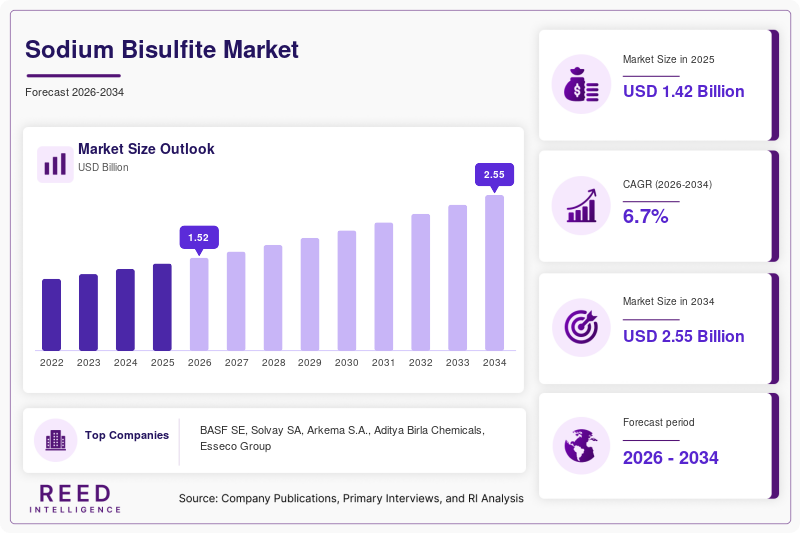
The global Sodium Bisulfite Market size was valued at approximately USD 1.42 billion in 2026 and is projected to reach USD 2.38 billion by 2034, expanding at a CAGR of 6.7% during 2026–2034. The market continues to gain momentum due to the growing utilization of sodium bisulfite across water treatment, food processing, pulp and paper manufacturing, pharmaceuticals, and chemical processing industries. As industries increasingly focus on process efficiency, product preservation, and environmental compliance, demand for sodium bisulfite has expanded across both developed and emerging economies.
One of the major global factors supporting market growth is the increasing emphasis on industrial water treatment and wastewater management. Governments and industrial operators are investing heavily in water purification infrastructure to address water scarcity concerns and comply with stricter environmental regulations. Sodium bisulfite plays a critical role in dechlorination processes, making it an essential chemical in municipal and industrial water treatment facilities. Additionally, rising food preservation requirements and growing demand for processed foods are contributing to broader product adoption across multiple applications.
Key Highlights
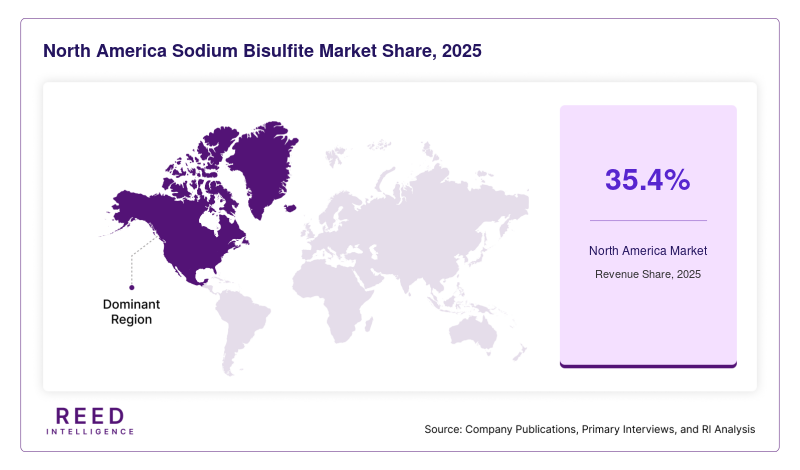
- North America dominated the market with a 35.4% share in 2025.
- while Asia Pacific is expected to grow at the fastest CAGR of 8.3% during 2026–2034.
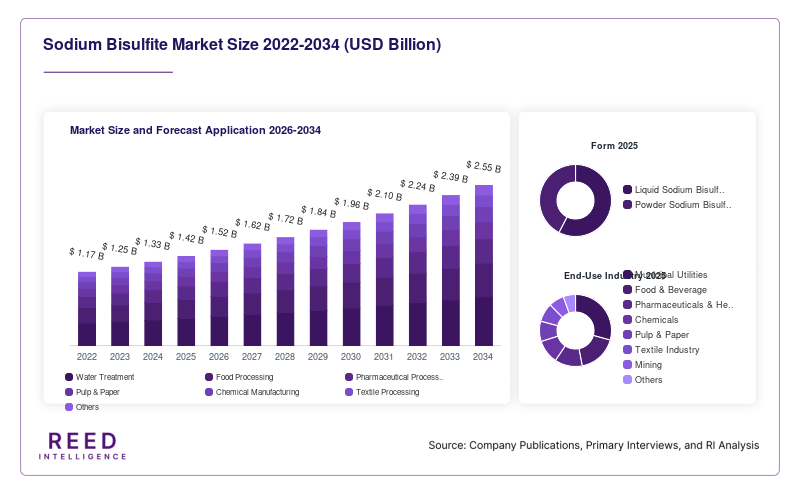
- By application, water treatment accounted for the largest share of 39.1%.
- while pharmaceutical processing is projected to grow at a CAGR of 8.9%.
- By form, liquid sodium bisulfite held the leading share of 58.2%.
- whereas powder sodium bisulfite is anticipated to expand at a CAGR of 7.8%.
- By end-use industry, municipal utilities represented the largest share of 31.7%.
- while the healthcare and pharmaceutical sector is forecast to grow at a CAGR of 9.1%.
- The United States remained the dominant country, with market values of approximately USD 412 million in 2024 and USD 448 million in 2025.
Market Trends
Growing Adoption in Sustainable Water Treatment Operations
The increasing focus on sustainable water management practices has emerged as a significant trend shaping the sodium bisulfite market. Industrial facilities, municipalities, and utility operators are investing in advanced water treatment technologies to improve water quality and reduce environmental impacts. Sodium bisulfite is widely utilized for chlorine removal before wastewater discharge, making it a preferred chemical in environmental compliance programs. Rising industrialization in developing regions has increased wastewater generation, creating stronger demand for effective treatment solutions. Additionally, aging water infrastructure in developed countries is driving modernization projects that require reliable dechlorination chemicals. The trend is further supported by public awareness regarding water conservation and stricter discharge regulations. As industries continue prioritizing sustainability objectives, sodium bisulfite consumption is expected to increase steadily across water treatment applications.
Expansion of Processed Food and Pharmaceutical Manufacturing
The continued growth of food processing and pharmaceutical manufacturing industries is creating favorable conditions for sodium bisulfite demand. Food manufacturers use sodium bisulfite as a preservative and antioxidant agent to maintain product quality and extend shelf life. Growing urban populations and changing consumer lifestyles have increased consumption of packaged and convenience foods globally. Simultaneously, pharmaceutical production is expanding due to rising healthcare expenditure and growing demand for medicines in emerging economies. Sodium bisulfite serves important functions in pharmaceutical formulations and manufacturing processes. Investments in new production facilities, particularly across Asia Pacific and Latin America, are strengthening demand from these industries. As manufacturers focus on quality control, product stability, and regulatory compliance, sodium bisulfite continues to gain importance within industrial production systems.
Market Drivers
Rising Demand for Industrial and Municipal Water Treatment
Growing concerns regarding water scarcity, environmental protection, and wastewater management are driving significant demand for sodium bisulfite. Municipal authorities and industrial operators increasingly rely on dechlorination chemicals to ensure compliance with environmental standards governing water discharge. Sodium bisulfite effectively removes residual chlorine from treated water, preventing harmful environmental effects on aquatic ecosystems. Rapid urbanization and industrial growth have increased wastewater generation worldwide, creating greater demand for treatment chemicals. Governments are also investing in large-scale water infrastructure projects to improve water accessibility and sanitation services. These developments are generating substantial opportunities for sodium bisulfite suppliers. As environmental regulations become more stringent and water quality standards continue evolving, demand from water treatment facilities is expected to remain a major growth driver throughout the forecast period.
Expansion of Chemical Processing and Manufacturing Activities
Industrial manufacturing growth across sectors such as pulp and paper, textiles, chemicals, mining, and pharmaceuticals is supporting sodium bisulfite market expansion. The compound is widely used as a reducing agent, bleaching agent, and processing chemical in various industrial applications. Emerging economies continue to attract manufacturing investments due to favorable labor costs, infrastructure development, and growing domestic consumption. Increased industrial output has consequently boosted demand for specialty chemicals that improve production efficiency and product quality. Furthermore, manufacturers are increasingly adopting advanced processing techniques that require consistent chemical inputs. The versatility of sodium bisulfite across multiple industrial processes strengthens its market position and reduces dependency on a single end-use sector. Continued industrialization and production capacity expansion are expected to sustain market growth over the coming years.
Market Restraint
Regulatory Challenges and Raw Material Price Volatility
Despite favorable growth prospects, the sodium bisulfite market faces challenges associated with regulatory compliance requirements and fluctuating raw material costs. Production depends on sulfur-based feedstocks and related chemical inputs, which can experience price volatility due to supply chain disruptions, geopolitical developments, and changes in global commodity markets. These fluctuations may affect manufacturing margins and create pricing uncertainties for end users. Additionally, handling and transportation of sodium bisulfite require adherence to strict safety and environmental regulations. Compliance costs can be significant, particularly for small and medium-sized manufacturers operating in highly regulated markets. Some industries are also exploring alternative treatment chemicals and preservation solutions, increasing competitive pressure. For example, water treatment operators may evaluate alternative dechlorination agents when cost considerations become critical. Such factors can influence purchasing decisions and create short-term challenges for market participants. Nevertheless, strong application diversity and ongoing industrial demand continue to provide long-term market stability despite these constraints.
Market Opportunities
Emerging Infrastructure Investments Across Developing Economies
Large-scale infrastructure development projects in emerging economies present substantial opportunities for sodium bisulfite manufacturers. Governments across Asia Pacific, the Middle East, Africa, and Latin America are investing heavily in water treatment facilities, industrial zones, healthcare infrastructure, and urban development programs. These projects require significant volumes of treatment chemicals and industrial processing agents. Rising population levels and urban expansion are creating greater demand for safe water supplies and effective wastewater management systems. Sodium bisulfite suppliers can benefit by expanding regional distribution networks and establishing local production capabilities. Strategic partnerships with municipal authorities and engineering contractors may further strengthen market penetration. As infrastructure spending continues increasing, demand for sodium bisulfite is expected to rise steadily across multiple application sectors.
Increasing Demand from Pharmaceutical and Healthcare Industries
The growing global healthcare sector represents an attractive opportunity for market participants. Pharmaceutical manufacturers increasingly utilize sodium bisulfite in formulations, stabilization processes, and production operations. Rising healthcare expenditure, expanding access to medical services, and growing demand for generic medicines are driving pharmaceutical manufacturing growth worldwide. Emerging markets are becoming important production hubs due to favorable investment conditions and increasing domestic demand. Additionally, biotechnology and specialty pharmaceutical segments are expanding rapidly, creating new application possibilities. Manufacturers that focus on high-purity sodium bisulfite products and regulatory compliance standards may benefit from increasing adoption within pharmaceutical production environments. Continued innovation in healthcare products and drug development activities is expected to generate sustained demand throughout the forecast period.
Segmental Analysis
By Application
Water treatment emerged as the dominant application segment, accounting for approximately 39.1% of the global market share in 2024. The segment benefits from widespread adoption across municipal water utilities, industrial wastewater treatment facilities, and desalination plants. Sodium bisulfite plays a critical role in dechlorination processes by removing residual chlorine before treated water is discharged into the environment. Growing regulatory scrutiny regarding water quality standards has encouraged increased use of treatment chemicals. Municipal authorities and industrial operators continue investing in infrastructure upgrades to enhance treatment efficiency and comply with environmental requirements. The segment also benefits from rising urban populations and expanding industrial activities that generate larger volumes of wastewater requiring treatment before disposal or reuse.
Pharmaceutical processing is projected to be the fastest-growing application segment, registering a CAGR of approximately 8.9% during the forecast period. Increasing global healthcare expenditure and rising pharmaceutical production volumes are key growth drivers. Sodium bisulfite is utilized in drug formulations, manufacturing operations, and stabilization processes that support product quality and shelf-life requirements. Expansion of generic drug production and growing investment in biotechnology research are creating additional opportunities for suppliers. Pharmaceutical manufacturers increasingly require high-purity chemical inputs that meet strict regulatory standards. As healthcare demand continues rising across both developed and emerging economies, pharmaceutical applications are expected to contribute significantly to future market growth.
By Form
Liquid sodium bisulfite represented the leading form segment, accounting for around 58.2% of total market revenue in 2024. The dominance of this segment is attributed to its ease of handling, efficient storage characteristics, and widespread use in water treatment applications. Industrial operators often prefer liquid formulations because they can be integrated directly into automated dosing systems, improving operational efficiency and reducing labor requirements. Municipal water treatment facilities, chemical processing plants, and food manufacturing operations commonly utilize liquid sodium bisulfite due to its consistent performance and convenient application. Strong demand from large-scale industrial users continues to support segment leadership across major regional markets.
Powder sodium bisulfite is expected to record the fastest growth, expanding at a CAGR of approximately 7.8% through 2034. Demand growth is supported by increasing use in pharmaceutical manufacturing, specialty chemical production, and smaller-scale industrial operations where transportation and storage flexibility are important considerations. Powder formulations typically offer longer shelf life and reduced transportation costs compared with liquid alternatives. Manufacturers are also introducing improved packaging solutions that enhance product stability and handling convenience. Growing adoption across emerging markets, where transportation infrastructure may present logistical challenges, is expected to further strengthen demand for powder sodium bisulfite products over the forecast period.
By End-Use Industry
Municipal utilities held the largest share of the sodium bisulfite market, accounting for approximately 31.7% of total revenue in 2024. This leadership position reflects the essential role of sodium bisulfite in public water treatment and wastewater management systems. Municipal authorities rely on the chemical for dechlorination processes that ensure regulatory compliance and environmental protection. Population growth and urbanization continue increasing demand for reliable water treatment infrastructure. Governments worldwide are investing in modernization projects to improve service quality and expand treatment capacity. These investments support steady demand for sodium bisulfite across municipal utility operations and reinforce the segment's dominant market position.
The healthcare and pharmaceutical sector is forecast to achieve the fastest CAGR of approximately 9.1% during 2026–2034. Rising healthcare spending, growing pharmaceutical production, and expanding biotechnology activities are key contributors to segment growth. Sodium bisulfite is used in various pharmaceutical manufacturing processes where product stability and quality control are critical. Increasing demand for generic medicines and specialized therapies is encouraging capacity expansion among pharmaceutical producers. Furthermore, stricter regulatory requirements regarding manufacturing quality are supporting adoption of high-purity chemical inputs. These factors collectively position the healthcare and pharmaceutical sector as a major growth engine for the sodium bisulfite market throughout the forecast period.
Regional Analysis
North America
North America accounted for approximately 35.4% of the global sodium bisulfite market in 2025, maintaining its position as the leading regional market. The region is projected to register a CAGR of around 5.8% through 2034. Strong demand from municipal water treatment facilities, food processing industries, and chemical manufacturing operations continues to support market expansion. Regulatory requirements concerning wastewater treatment and environmental protection have encouraged consistent utilization of sodium bisulfite across industrial and public infrastructure applications. Furthermore, advanced manufacturing capabilities and established distribution networks contribute to regional market stability.
The United States remains the dominant contributor within North America. A key growth factor is the ongoing modernization of water treatment infrastructure across municipal and industrial sectors. Aging facilities are being upgraded to improve operational efficiency and regulatory compliance. The country's extensive food processing industry also contributes substantially to sodium bisulfite consumption. Investments in pharmaceutical manufacturing and industrial production capacity expansion continue creating favorable conditions for sustained market growth.
North America also benefits from a mature chemical industry ecosystem that supports efficient supply chain management and product innovation. Major manufacturers maintain strong production capacities and long-term supply agreements with industrial customers. Growing environmental awareness among industries is encouraging wider adoption of advanced treatment chemicals. These factors collectively reinforce the region's position as a stable and significant revenue contributor throughout the forecast period.
The region is also witnessing increasing investments in sustainable industrial practices. Companies are implementing water recycling systems and advanced wastewater treatment technologies that require reliable dechlorination agents. Such initiatives are expected to support continued sodium bisulfite demand while strengthening long-term market opportunities across North America.
Europe
Europe represented approximately 27.1% of the global market share in 2025 and is anticipated to expand at a CAGR of 5.9% during the forecast period. Demand is supported by strict environmental regulations governing industrial emissions and wastewater treatment processes. Countries throughout the region continue prioritizing sustainable industrial operations, creating consistent demand for dechlorination chemicals and processing agents. Growth in pharmaceutical manufacturing and food preservation applications further contributes to market expansion.
Germany remains the dominant country within the European sodium bisulfite market. A major growth factor is the country's strong industrial manufacturing base, particularly in chemicals, pharmaceuticals, and specialty materials. German industries emphasize operational efficiency and environmental compliance, supporting stable demand for sodium bisulfite. Continuous investments in industrial modernization and production technology improvements are expected to sustain consumption levels over the forecast period.
The European market also benefits from established regulatory frameworks that encourage the use of approved chemical treatment solutions. Industrial operators increasingly adopt advanced water treatment systems to meet sustainability goals and reduce environmental impacts. This trend has strengthened demand for sodium bisulfite across multiple sectors, including pulp and paper, food processing, and municipal water management.
Furthermore, the region's focus on circular economy initiatives is creating opportunities for chemical suppliers. Industries are investing in resource optimization and wastewater recycling programs that require effective treatment chemicals. As sustainability objectives continue gaining importance, sodium bisulfite adoption is expected to remain strong throughout Europe.
Asia Pacific
Asia Pacific held nearly 24.6% of the global sodium bisulfite market in 2025 and is projected to record the fastest CAGR of approximately 8.3% between 2026 and 2034. Rapid industrialization, urbanization, and infrastructure development are major contributors to regional growth. Expanding manufacturing activities, increasing wastewater treatment requirements, and rising consumption of processed foods are generating substantial demand. Governments across the region are also investing heavily in environmental management and public utility projects.
China dominates the Asia Pacific market due to its extensive industrial production capacity and large-scale manufacturing ecosystem. A unique growth factor is the country's significant investment in industrial wastewater treatment infrastructure. Regulatory initiatives aimed at improving environmental quality have encouraged industries to adopt advanced treatment chemicals. The expansion of pharmaceutical manufacturing and food processing industries further strengthens sodium bisulfite demand across the country.
The broader regional market benefits from increasing foreign direct investment and industrial development programs. Countries such as India, Indonesia, Vietnam, and Thailand are expanding manufacturing capabilities across chemical, pharmaceutical, and food processing sectors. Rising urban populations are also increasing demand for water treatment solutions and public utility services.
In addition, Asia Pacific is emerging as a major production hub for specialty chemicals. Competitive manufacturing costs and growing domestic demand support capacity expansion among regional producers. These factors position Asia Pacific as the most dynamic growth region for the sodium bisulfite market during the forecast period.
Middle East & Africa
The Middle East & Africa accounted for approximately 7.1% of the global market in 2025 and is expected to achieve a CAGR of 6.4% through 2034. Growing investments in water desalination, wastewater treatment, and industrial infrastructure are supporting market development. Water scarcity challenges across several countries have increased the importance of effective treatment chemicals. Industrial diversification strategies are also contributing to broader chemical consumption across the region.
Saudi Arabia remains the leading market within the region. A major growth factor is the country's substantial investment in water desalination and wastewater treatment infrastructure. Government initiatives aimed at supporting industrial growth and environmental sustainability have encouraged the adoption of treatment chemicals. Expanding petrochemical and manufacturing industries further contribute to sodium bisulfite demand across multiple applications.
The region's industrial landscape is evolving as governments pursue economic diversification programs. New industrial projects and infrastructure investments are increasing demand for specialty chemicals used in processing and treatment operations. These developments are creating opportunities for both domestic and international suppliers.
Additionally, growing awareness of water resource management is encouraging adoption of advanced treatment technologies. Municipal authorities and industrial operators are focusing on efficient water utilization and environmental compliance. This trend is expected to support steady market growth throughout the forecast horizon.
Latin America
Latin America captured approximately 5.8% of the global sodium bisulfite market share in 2025 and is forecast to expand at a CAGR of 6.1% between 2026 and 2034. Increasing industrial activity, infrastructure investment, and urban development projects are driving market growth. Water treatment requirements continue to rise as governments work to improve public utility services and environmental management systems. Food processing and mining industries also represent important demand sources.
Brazil dominates the regional market due to its large industrial base and growing investments in environmental infrastructure. A key growth factor is the expansion of municipal wastewater treatment projects designed to improve sanitation coverage and water quality. Industrial modernization initiatives across food processing, chemicals, and mining sectors are also contributing to sodium bisulfite consumption growth.
Regional economic development programs are encouraging investment in manufacturing and public infrastructure. As industrial activity expands, demand for processing chemicals and treatment solutions is expected to increase steadily. Government support for environmental improvement projects further strengthens market prospects.
The growing emphasis on sustainable resource management is another important factor supporting regional growth. Municipalities and industrial facilities are adopting more advanced treatment systems to address environmental concerns. These initiatives are likely to generate additional opportunities for sodium bisulfite suppliers across Latin America.
Competitive Landscape
The sodium bisulfite market is moderately consolidated, with leading companies focusing on capacity expansion, product quality enhancement, and regional distribution network development. Market participants compete through pricing strategies, long-term supply agreements, production efficiency improvements, and customized product offerings tailored to specific industrial applications. Companies are increasingly investing in sustainable manufacturing processes and advanced production technologies to strengthen competitiveness and address evolving environmental expectations.
Among the leading participants, BASF SE maintains a strong market position due to its extensive global production network, diversified chemical portfolio, and established customer relationships. The company continues investing in operational efficiency initiatives and specialty chemical development. Other major participants are expanding regional footprints to capitalize on growing demand across Asia Pacific and emerging economies.
A recent industry development involved several leading manufacturers increasing production capacities to address growing demand from water treatment and pharmaceutical sectors. Strategic collaborations with municipal utilities and industrial customers have also become more common as suppliers seek to secure long-term revenue streams. Product innovation, regulatory compliance expertise, and supply chain resilience remain critical competitive differentiators across the global market.
Key Players
- BASF SE
- Solvay SA
- Arkema S.A.
- Aditya Birla Chemicals
- Esseco Group
- Hydrite Chemical Co.
- INEOS Group
- Merck KGaA
- Shandong Kailong Chemical Technology
- Hawkins Inc.
- Chemtrade Logistics Inc.
- Rongcheng Chemical General Factory
- GHC Gerling, Holz & Co.
- Grillo-Werke AG
- Gujarat Alkalies and Chemicals Limited
Recent Developments
- BASF SE expanded specialty chemical production capacity to support increasing demand from water treatment and pharmaceutical applications.
- Solvay SA introduced enhanced process optimization initiatives aimed at improving production efficiency and reducing operational emissions across selected manufacturing facilities.
- Chemtrade Logistics Inc. strengthened its distribution network through regional infrastructure investments designed to improve supply reliability for municipal and industrial customers.
- Aditya Birla Chemicals increased production capabilities in Asia to address rising demand from water treatment and industrial processing sectors.
- Several leading manufacturers announced long-term supply agreements with municipal utilities to secure chemical availability for large-scale water treatment projects.
Sodium Bisulfite Market Segments
Application
- Water Treatment
- Food Processing
- Pharmaceutical Processing
- Pulp & Paper
- Chemical Manufacturing
- Textile Processing
- Others
Form
- Liquid Sodium Bisulfite
- Powder Sodium Bisulfite
End-Use Industry
- Municipal Utilities
- Food & Beverage
- Pharmaceuticals & Healthcare
- Chemicals
- Pulp & Paper
- Textile Industry
- Mining
- Others
By Region
- North America
- Europe
- APAC
- Middle East and Africa
- LATAM