Sodium Citrate Market Size, Share & Demand Report By Type (Trisodium Citrate, Disodium Citrate, Monosodium Citrate), By Application (Food & Beverages, Pharmaceuticals, Personal Care, Industrial Applications), By End-Use Industry (Food Processing, Healthcare, Cosmetics & Personal Care, Chemical Industry), By Form (Powder, Liquid), By Region & Segment Forecasts, 2025–2034
USD 3950
Market Overview
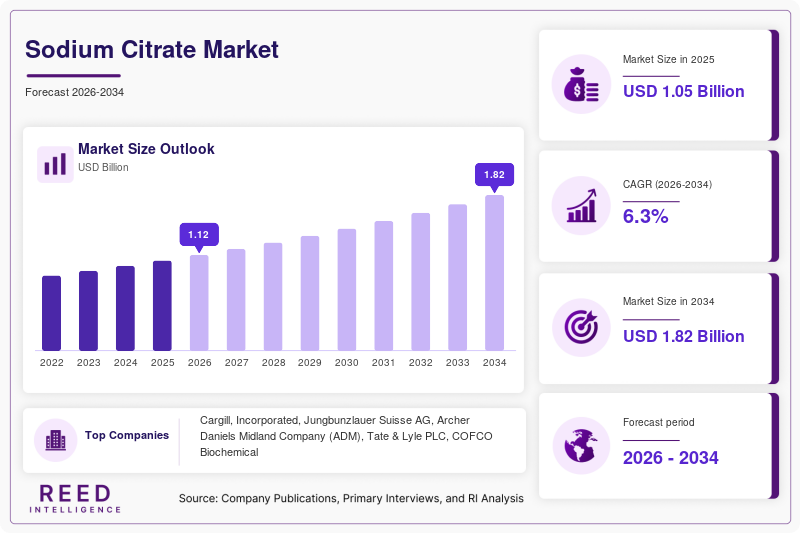
The global Sodium Citrate Market size was valued at approximately USD 1.05 billion in 2025 and is projected to reach USD 1.82 billion by 2034, expanding at a CAGR of 6.3% during the forecast period (2025–2034). The market has experienced steady expansion due to its wide applicability across food & beverages, pharmaceuticals, and industrial processes. Sodium citrate, a sodium salt of citric acid, is extensively used as a buffering agent, emulsifier, preservative, and anticoagulant, making it a versatile compound across multiple end-use industries.
A major global factor supporting the growth of the Sodium Citrate Market is the increasing demand for processed and convenience foods, particularly in emerging economies. The compound plays a crucial role in enhancing flavor stability, regulating acidity, and extending shelf life, thereby aligning with modern consumer preferences for packaged food products. Additionally, its adoption in pharmaceutical formulations for treating metabolic acidosis and as an anticoagulant in blood transfusions has strengthened its demand globally.
Key Highlights
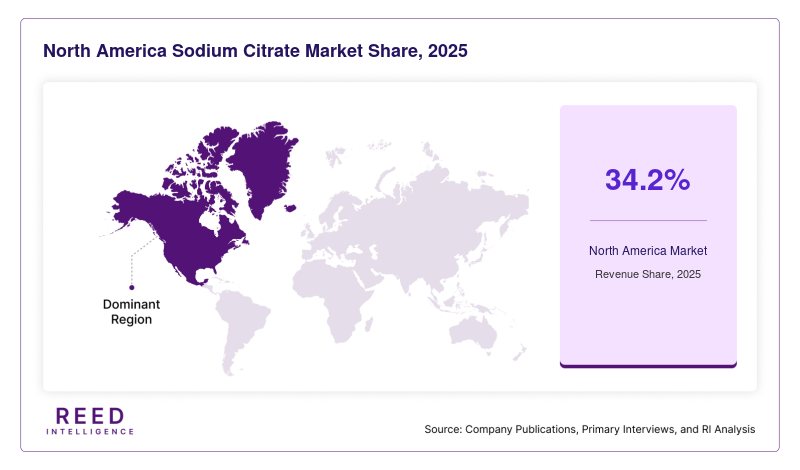
- North America dominated the market with a 34.2% share in 2025, while Asia Pacific is expected to register the fastest growth at a CAGR of 7.5%.
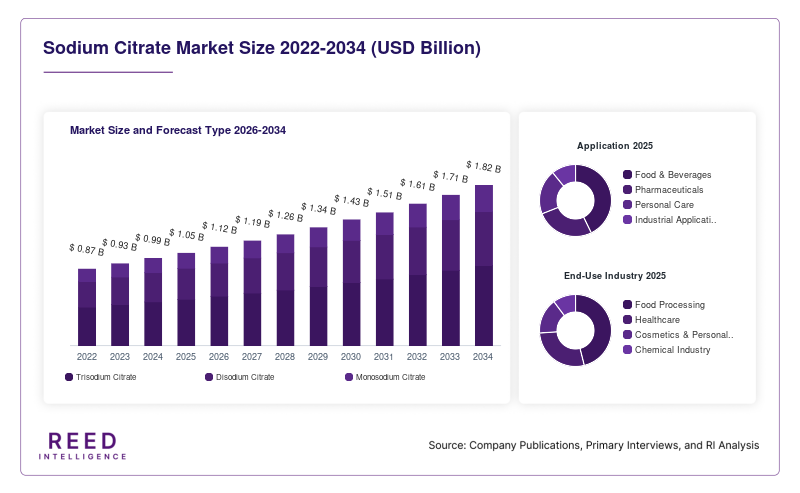
- The food & beverage application segment led with a 41.6% share, whereas the pharmaceutical segment is projected to grow fastest at a CAGR of 7.1%.
- Among types, trisodium citrate held the largest share, while disodium citrate is expected to grow at a CAGR of 6.8%.
- The United States remained the dominant country with a market value of USD 310 million in 2025, expected to reach USD 329 million in 2026.
Market Trends
Rising Preference for Clean-Label Food Additives
The Sodium Citrate Market is witnessing a shift toward clean-label and naturally derived additives. Consumers are increasingly scrutinizing ingredient lists, prompting manufacturers to incorporate recognizable and safe compounds. Sodium citrate, derived from citric acid, is perceived as a relatively safer additive compared to synthetic alternatives. This trend has encouraged food producers to reformulate products using sodium citrate for pH control and flavor enhancement, especially in dairy, beverages, and processed cheese applications.
Expansion of Pharmaceutical Applications
Another notable trend shaping the Sodium Citrate Market is the expanding use in pharmaceutical and clinical applications. Sodium citrate is widely used as an anticoagulant in blood storage and as an alkalizing agent in medications. The increasing prevalence of chronic conditions requiring intravenous therapies and dialysis has boosted demand. Additionally, research into citrate-based formulations for drug delivery systems is contributing to its adoption. This trend is further supported by the growing healthcare infrastructure in developing regions, where demand for cost-effective and reliable pharmaceutical excipients continues to rise.
Market Drivers
Growth in Processed Food Consumption
The rapid rise in consumption of processed and packaged food products has been a key driver for the Sodium Citrate Market. Urbanization, changing lifestyles, and increased disposable income have significantly influenced dietary habits worldwide. Sodium citrate is widely used as a preservative and acidity regulator in ready-to-eat meals, beverages, and dairy products. Its ability to maintain flavor consistency and extend product shelf life has made it indispensable for food manufacturers, thereby driving market expansion.
Increasing Demand from Healthcare Sector
The growing demand for sodium citrate in medical and pharmaceutical applications is another major growth driver. It is extensively used in blood transfusions as an anticoagulant and in oral rehydration solutions. The rising incidence of kidney disorders and metabolic conditions has further increased its usage in medical treatments. Additionally, the expansion of healthcare services and improved access to medical facilities in developing countries have contributed to the increasing demand for sodium citrate-based formulations.
Market Restraint
Regulatory and Quality Compliance Challenges
One of the primary restraints affecting the Sodium Citrate Market is the stringent regulatory framework governing food additives and pharmaceutical excipients. Regulatory bodies across regions impose strict guidelines regarding the permissible levels and quality standards of sodium citrate in various applications. Compliance with these standards often requires significant investment in quality control, testing, and certification processes.
Moreover, variations in regulatory policies across different countries create complexities for manufacturers operating in multiple regions. This can lead to delays in product approvals and increased operational costs. Additionally, concerns related to excessive consumption of sodium-based additives and their potential health implications have led to cautious usage in certain applications. These factors collectively limit the growth potential of the Sodium Citrate Market, particularly for small and medium-sized manufacturers that may lack the resources to meet stringent compliance requirements.
Market Opportunities
Growth in Functional Beverages
The increasing demand for functional and fortified beverages presents a significant opportunity for the Sodium Citrate Market. Sodium citrate is widely used to regulate acidity and enhance flavor in sports drinks, energy beverages, and health-focused formulations. As consumers become more health-conscious, the demand for electrolyte-balanced beverages is expected to rise, creating new growth avenues for sodium citrate manufacturers.
Expansion in Emerging Markets
Emerging economies in Asia Pacific, Latin America, and Africa offer substantial growth opportunities due to rising industrialization and urbanization. The growing middle-class population and increasing demand for processed foods and pharmaceuticals in these regions are expected to drive the Sodium Citrate Market. Additionally, improvements in distribution networks and the establishment of local manufacturing facilities are likely to enhance market penetration and accessibility.
Segmental Analysis
By Type
The trisodium citrate segment dominated the Sodium Citrate Market in 2025, accounting for approximately 52.3% of the total share. Its widespread use as an emulsifier and buffering agent in food and beverages has contributed to its leading position. Trisodium citrate is particularly preferred in processed cheese and carbonated beverages due to its stability and effectiveness in maintaining pH balance.
The disodium citrate segment is expected to witness the fastest growth, expanding at a CAGR of 6.8% during the forecast period. Its increasing adoption in pharmaceutical formulations and personal care products will drive this growth. Disodium citrate’s compatibility with various active ingredients and its role in enhancing product stability will further boost its demand.
By Application
The food & beverage segment held the largest share of the Sodium Citrate Market in 2025, accounting for 41.6%. The segment’s dominance can be attributed to the extensive use of sodium citrate as a preservative, flavor enhancer, and acidity regulator in processed foods and beverages.
The pharmaceutical segment is projected to grow at the fastest rate, with a CAGR of 7.1%. The increasing use of sodium citrate in medical treatments, including anticoagulants and alkalizing agents, will support this growth. The expansion of healthcare services and the rising prevalence of chronic diseases will further drive demand.
By End-Use Industry
The food processing industry emerged as the dominant end-use segment, capturing 45.2% of the Sodium Citrate Market share in 2025. The growing demand for packaged and ready-to-eat food products has driven the adoption of sodium citrate in this sector.
The healthcare industry is expected to be the fastest-growing segment, with a CAGR of 7.3%. The increasing use of sodium citrate in clinical and pharmaceutical applications, coupled with advancements in medical treatments, will contribute to this growth.
By Form
The powder form segment dominated the market in 2025, accounting for 63.5% of the total share. Its ease of handling, longer shelf life, and widespread use in dry food formulations have contributed to its dominance.
The liquid form segment is anticipated to grow at a CAGR of 6.9%, driven by its increasing use in beverages and pharmaceutical solutions. Its convenience in formulation and rapid solubility will support its adoption.
Regional Analysis
North America
North America accounted for 34.2% of the Sodium Citrate Market share in 2025 and is expected to grow at a CAGR of 5.8% during the forecast period. The region’s mature food processing and pharmaceutical industries have contributed significantly to market growth.
The United States dominated the regional market due to its well-established food manufacturing sector and advanced healthcare infrastructure. The strong presence of processed food manufacturers and the high demand for convenience foods have driven the consumption of sodium citrate. Additionally, the country’s focus on product innovation and formulation efficiency has supported steady market growth.
Europe
Europe held approximately 27.5% of the Sodium Citrate Market share in 2025 and is projected to expand at a CAGR of 5.6% through 2034. The region’s stringent food safety standards and emphasis on high-quality additives have influenced market dynamics.
Germany emerged as the dominant country, driven by its robust food processing and pharmaceutical industries. The country’s focus on sustainable and compliant manufacturing practices has encouraged the adoption of sodium citrate as a reliable additive. Furthermore, the demand for clean-label products has contributed to market expansion.
Asia Pacific
Asia Pacific captured around 23.8% of the Sodium Citrate Market share in 2025 and is anticipated to grow at the fastest CAGR of 7.5%. Rapid urbanization and industrial growth have fueled demand across multiple applications.
China led the regional market, supported by its large-scale food processing industry and expanding pharmaceutical sector. The country’s growing population and increasing consumption of packaged foods have significantly contributed to market growth. Additionally, the availability of raw materials and cost-effective production capabilities have strengthened its position.
Middle East & Africa
The Middle East & Africa region accounted for 7.1% of the Sodium Citrate Market share in 2025 and is expected to grow at a CAGR of 6.2%. The market has been driven by increasing investments in food processing and healthcare infrastructure.
Saudi Arabia dominated the region, with growth supported by government initiatives aimed at diversifying the economy and boosting local manufacturing. The rising demand for processed food products and improved healthcare services have contributed to the increasing adoption of sodium citrate.
Latin America
Latin America held approximately 7.4% of the Sodium Citrate Market share in 2025 and is projected to grow at a CAGR of 6.4%. The region’s expanding food and beverage industry has played a key role in market development.
Brazil emerged as the leading country, driven by its large consumer base and growing demand for processed foods. The country’s focus on enhancing food production capabilities and improving supply chains has supported the growth of the Sodium Citrate Market.
Competitive Landscape
The Sodium Citrate Market is characterized by the presence of several global and regional players competing on product quality, pricing, and innovation. Key companies are focusing on expanding production capacities and enhancing product portfolios to strengthen their market position.
Cargill, Incorporated is recognized as a leading player in the market, leveraging its extensive distribution network and diversified product offerings. The company has recently invested in expanding its food ingredient portfolio to meet the growing demand for clean-label additives.
Other prominent players include Jungbunzlauer Suisse AG, ADM, Tate & Lyle PLC, and COFCO Biochemical. These companies are actively engaged in strategic collaborations and product innovations to maintain their competitive edge. The increasing focus on sustainable production practices and compliance with regulatory standards is expected to shape the competitive landscape in the coming years.
Key Players List
- Cargill, Incorporated
- Jungbunzlauer Suisse AG
- Archer Daniels Midland Company (ADM)
- Tate & Lyle PLC
- COFCO Biochemical
- Gadot Biochemical Industries Ltd.
- Pan Chem Corporation
- S.A. Citrique Belge N.V.
- RZBC Group Co., Ltd.
- Huangshi Xinghua Biochemical Co., Ltd.
- Weifang Ensign Industry Co., Ltd.
- ATP Group
- FBC Industries, Inc.
- Hawkins, Inc.
- Foodchem International Corporation
Recent Developments
- In 2024, leading manufacturers increased investments in sustainable production technologies to reduce carbon emissions in sodium citrate manufacturing.
- In early 2025, several companies expanded their product lines to include high-purity sodium citrate for pharmaceutical applications.
- Strategic partnerships between ingredient suppliers and beverage manufacturers have been established to develop customized formulations.
- New production facilities were announced in Asia Pacific to meet rising regional demand.
Sodium Citrate Market Segments
Type
- Trisodium Citrate
- Disodium Citrate
- Monosodium Citrate
Application
- Food & Beverages
- Pharmaceuticals
- Personal Care
- Industrial Applications
End-Use Industry
- Food Processing
- Healthcare
- Cosmetics & Personal Care
- Chemical Industry
Form
- Powder
- Liquid
By Region
- North America
- Europe
- APAC
- Middle East and Africa
- LATAM