Sodium Cocoyl Isethionate Market Size, Share Demand Report By Form (Powder, Granules, Flakes), By Application (Skin Cleansing Products, Haircare Products, Baby Care Products), By End Use (Personal Care Manufacturers, Artisanal & Indie Brands), By Distribution Channel (Direct B2B Sales, Specialty Distributors), By Region & Segment Forecasts, 2026–2034
USD 3950
Market Overview
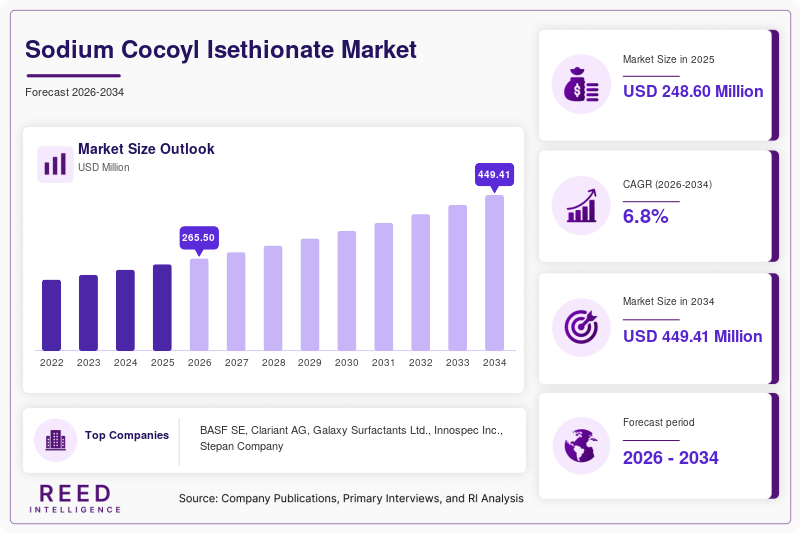
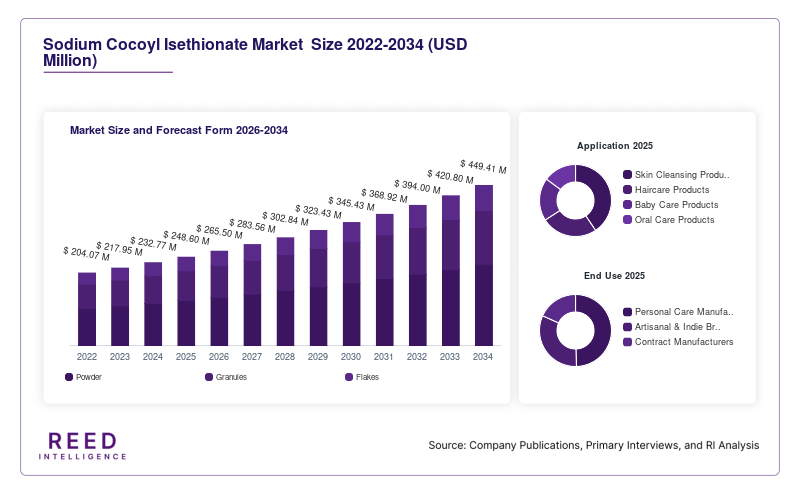
The global Sodium Cocoyl Isethionate Market size was valued at USD 248.6 million in 2026 and is projected to reach USD 421.9 million by 2034, expanding at a CAGR of 6.8% from 2026 to 2034. Sodium cocoyl isethionate (SCI) is a mild surfactant widely used in personal care and cleansing formulations, especially in sulfate-free bars, shampoos, face cleansers, and baby care products. The market gained momentum due to the rising global shift toward gentle skincare ingredients and solid-format cleansing products that reduce plastic packaging waste.
Consumer demand for skin-friendly formulations, combined with the growing preference for naturally derived surfactants, has supported the expansion of the Sodium Cocoyl Isethionate Market. Manufacturers have increased production capacity to meet demand from cosmetics brands launching premium cleansing bars, facial washes, and sulfate-free haircare lines. The ingredient’s ability to generate rich foam while maintaining skin softness has strengthened its role in modern formulation systems.
Key Highlights
- North America dominated the market with 34.7% share in 2025, while Asia Pacific is expected to register the fastest CAGR of 8.1% during 2026–2034.
- By Form, Powder led with 46.2% share in 2025, while Granules will grow fastest at 7.4% CAGR.
- By Application, Skin Cleansing Products accounted for 39.5% share in 2025, while Haircare Products will expand fastest at 7.6% CAGR.
- By End Use, Personal Care Manufacturers held 58.1% share in 2025, while Artisanal & Indie Brands will rise at 8.3% CAGR.
- The U.S. market stood at USD 71.4 million in 2024 and increased to USD 76.2 million in 2025.
Market Trends
Rise of Waterless Beauty Products
The shift toward waterless and concentrated beauty formats has increased demand for SCI in cleansing bars, powder cleansers, and shampoo bars. Brands are using Sodium Cocoyl Isethionate to create compact products that require less packaging and lower transportation costs.
Premiumization of Sensitive Skin Care
Consumers are paying more for products formulated for dry, reactive, or sensitive skin. SCI has become a preferred ingredient in premium face cleansers and baby wash products because of its low irritation profile and creamy lather.
Market Drivers
Growing Demand for Sulfate-Free Cleansers
Consumers increasingly avoid harsh surfactants such as SLS and SLES. This shift has encouraged brands to adopt SCI in facial cleansers, body bars, and shampoos. Its mildness and foam quality make it a practical replacement ingredient.
Expansion of Personal Care Manufacturing in Emerging Economies
Production of skincare and hygiene products has expanded in countries such as India, Vietnam, Indonesia, and Brazil. This manufacturing growth has increased demand for specialty surfactants, supporting the Sodium Cocoyl Isethionate Market.
Market Restraint
Higher Raw Material and Processing Cost
SCI often costs more than conventional surfactants due to feedstock sourcing, purification, and specialized production processes. Cost-sensitive brands may limit adoption in low-price product categories.
Market Opportunities
Growth in Men’s Grooming Products
Brands are introducing facial bars, beard cleansers, and scalp care products for male consumers. SCI offers mild cleansing suitable for daily grooming routines, creating a new growth avenue.
Private Label Expansion in Retail Chains
Retailers are launching private-label natural and sulfate-free care products. This trend is expected to generate higher procurement volumes for SCI suppliers serving contract manufacturers.
Segmental Analysis
By Form
Powder: Powder was the dominant subsegment and held 46.2% share in 2025. Powder SCI remained widely used because it blends efficiently into cleansing bars and powdered formulations.
Granules:Granules will grow at the fastest 7.4% CAGR through 2034. Their reduced dust generation and easier handling in automated production lines will support demand among large manufacturers.
Flakes: Flakes served mid-scale processors seeking balanced solubility and handling convenience for batch production systems.
By Application
Skin Cleansing Products: Skin cleansing products dominated with 39.5% share in 2025. Facial cleansers, syndet bars, and body wash bars drove high ingredient consumption.
Haircare Products: Haircare products will expand at 7.6% CAGR. Growth will come from shampoo bars and sulfate-free scalp cleansers as consumers seek gentle alternatives.
Baby Care Products: Baby care remained an important niche due to SCI’s mild surfactant profile and suitability for tear-free formulas.
Oral Care Products: SCI also gained selective use in toothpaste and cleansing tablets where foam quality is desired.
By End Use
Personal Care Manufacturers: Personal care manufacturers accounted for 58.1% share in 2025. Large FMCG and cosmetic firms purchased SCI in bulk for branded product lines.
Artisanal & Indie Brands: Artisanal and indie brands are projected to grow at 8.3% CAGR. Small brands increasingly launch handmade bars and eco-friendly cleansers using SCI.
Contract Manufacturers: Contract manufacturers continued to support regional and private-label demand through flexible batch production.
By Distribution Channel
Direct B2B Sales: Direct B2B sales led with 63.8% share in 2025. Major brands sourced SCI directly from chemical suppliers for pricing stability and supply security.
Online Ingredient Platforms: Online ingredient platforms will witness 7.9% CAGR. Digital procurement systems are helping small brands source specialty surfactants efficiently.
Specialty Distributors: Specialty distributors remained important for regional logistics and smaller-volume buyers.
Regional Analysis
North America
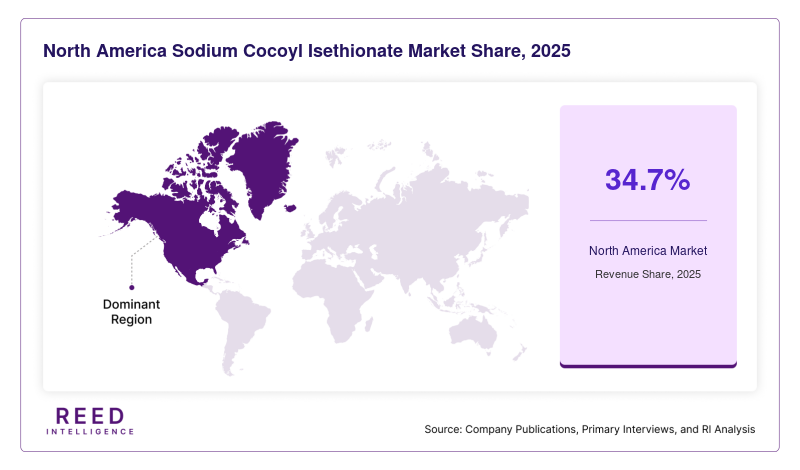
North America accounted for 34.7% market share in 2025 and will grow at a 6.1% CAGR through 2034. The U.S. remained the dominant country due to strong demand for dermatologist-tested skincare products. Consumers in the region favored fragrance-free and sensitive-skin formulations, supporting SCI usage.
Europe
Europe held 27.9% share in 2025 and will expand at a 6.4% CAGR. Germany led the region due to its established cosmetics manufacturing base and strong regulatory focus on ingredient safety. Sustainable solid beauty products gained traction across Western Europe.
Asia Pacific
Asia Pacific represented 24.8% share in 2025 and will register the fastest 8.1% CAGR during the forecast period. China led regional demand because of large-scale personal care production and rapid growth of domestic skincare brands. Rising disposable income also supported premium cleanser sales.
Middle East & Africa
Middle East & Africa captured 6.5% share in 2025 and will grow at a 5.8% CAGR. The UAE led the region through strong retail distribution networks and increasing demand for imported skincare products designed for dry climates.
Latin America
Latin America accounted for 6.1% share in 2025 and will rise at a 6.0% CAGR through 2034. Brazil dominated the region due to its extensive beauty and personal hygiene sector. Local brands increasingly introduced sulfate-free cleansing formats.
Competitive Landscape
The Sodium Cocoyl Isethionate Market remains moderately consolidated, with global surfactant producers and specialty ingredient suppliers competing on purity, formulation support, and supply reliability. Leading players focus on expanding mild surfactant portfolios, improving production efficiency, and serving fast-growing personal care brands.
BASF SE remains a market leader due to its broad personal care ingredient portfolio and global distribution presence. The company recently expanded its sulfate-free cleansing ingredient solutions for premium skincare applications. Innospec Inc. has strengthened its mild surfactant offerings for shampoo bars and solid cleansers. Clariant AG focuses on naturally derived ingredients aligned with sustainable beauty trends. Galaxy Surfactants Ltd. has expanded in Asia through partnerships with cosmetic manufacturers. Stepan Company continues to develop specialty surfactants tailored for skin compatibility.
Competition is expected to intensify as indie beauty brands and private-label manufacturers seek reliable SCI supply in customized forms such as powders, granules, and flakes.
Key Players List
- BASF SE
- Clariant AG
- Galaxy Surfactants Ltd.
- Innospec Inc.
- Stepan Company
- Solvay SA
- Evonik Industries AG
- Kao Corporation
- Taiwan NJC Corporation
- Colonial Chemical Inc.
- Nouryon
- Oxiteno SA
- Zanyu Technology Group
- Pilot Chemical Company
- Sino Lion USA
Recent Developments
- BASF SE introduced new mild cleansing ingredient blends for sulfate-free skincare formulations in 2025.
- Galaxy Surfactants Ltd. expanded surfactant production capacity in Asia to support rising personal care demand.
- Clariant AG launched sustainable formulation support programs for solid beauty brands.
- Innospec Inc. enhanced its SCI product grades for easier processing in shampoo bars.
- Stepan Company invested in R&D for low-irritation surfactant systems for facial cleansing products.
Sodium Cocoyl Isethionate Market Segments
Form
- Powder
- Granules
- Flakes
Application
- Skin Cleansing Products
- Haircare Products
- Baby Care Products
- Oral Care Products
End Use
- Personal Care Manufacturers
- Artisanal & Indie Brands
- Contract Manufacturers
Distribution Channel
- Direct B2B Sales
- Specialty Distributors
- Online Ingredient Platforms
By Region
- North America
- Europe
- APAC
- Middle East and Africa
- LATAM