Sodium Dodecyl Sulphate Polyacrylamide Gel Electrophoresis Market Size, Share & Demand Report By Type (Gel Electrophoresis Systems, Precast Gels, Reagents & Buffers), By Application (Protein Analysis, Drug Development, Clinical Diagnostics), By End-Use (Academic & Research Institutes, Pharmaceutical & Biotechnology Companies, Clinical Laboratories), By Region & Segment Forecasts, 2025–2034
USD 3950
Market Overview
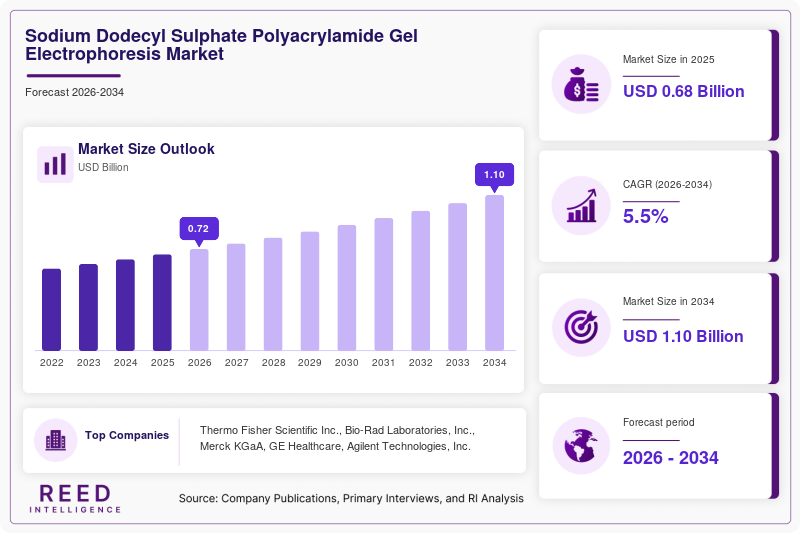
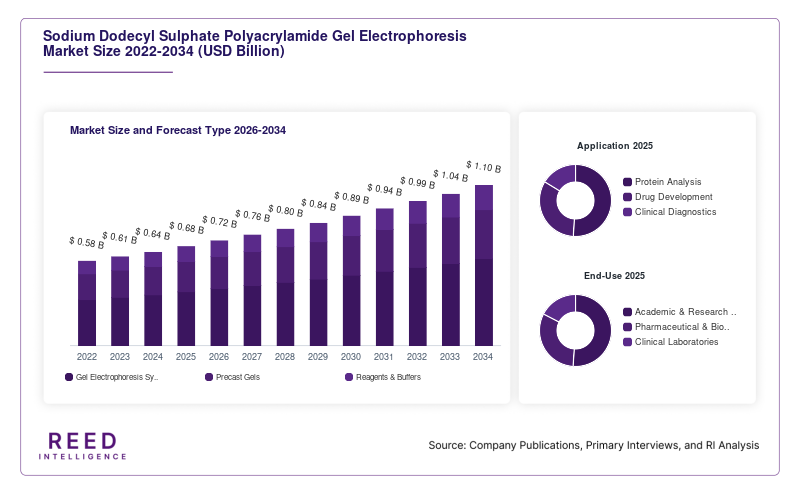
The Sodium Dodecyl Sulphate Polyacrylamide Gel Electrophoresis Market size is estimated at USD 0.68 billion and is projected to reach approximately USD 0.73 billion in 2026. By 2034, the market is forecasted to attain USD 1.18 billion, growing at a CAGR of 5.5% from 2025 to 2034. This growth reflects increasing demand for accurate protein analysis tools across academic, pharmaceutical, and biotechnology sectors.
One of the primary growth factors is the rising focus on proteomics research, which requires precise protein separation and characterization methods. SDS-PAGE remains a standard technique due to its reliability, reproducibility, and cost efficiency. Additionally, increasing investments in drug discovery and development are driving the adoption of advanced electrophoresis systems for protein analysis. Pharmaceutical companies rely on SDS-PAGE for quality control, biomarker identification, and therapeutic protein analysis.
Key Highlights
- North America dominated the market with a share of approximately 39% in 2025, supported by strong presence of pharmaceutical and biotechnology companies and advanced research infrastructure.
- Asia Pacific is expected to be the fastest-growing region, registering a CAGR of around 7.2% from 2025 to 2034 due to increasing investments in life sciences research and expanding biotech sector.
- By product type, reagents and consumables held the largest share of about 48% in 2025 owing to their recurring use in proteomics and drug discovery workflows.
Market Trends
Increasing Adoption of Precast Gel Systems
A notable trend in the Sodium Dodecyl Sulphate Polyacrylamide Gel Electrophoresis Market is the rising adoption of precast gel systems. Laboratories are shifting from traditional hand-cast gels to ready-to-use precast gels due to their convenience, consistency, and time-saving benefits. These gels reduce preparation time and minimize variability between experiments, which is critical in research environments that demand reproducibility. Precast gels also improve safety by reducing exposure to toxic reagents. As research labs aim to optimize workflows and enhance productivity, the demand for precast gels is expected to grow steadily, especially in high-throughput environments.
Integration of Automation and Digital Imaging
Another emerging trend is the integration of automation and digital imaging technologies in electrophoresis workflows. Automated SDS-PAGE systems combined with imaging software allow for real-time monitoring, accurate protein quantification, and data storage. These systems reduce manual intervention and improve reproducibility, which is essential for clinical and pharmaceutical applications. Digital imaging solutions also support advanced data analysis, enabling researchers to interpret results more efficiently. As laboratories increasingly adopt digital transformation strategies, the integration of automated electrophoresis systems is expected to accelerate, contributing to overall market growth.
Market Drivers
Growing Demand for Proteomics and Biomarker Research
The increasing focus on proteomics and biomarker discovery is a major driver of the Sodium Dodecyl Sulphate Polyacrylamide Gel Electrophoresis Market. Proteomics research involves studying protein structures, functions, and interactions, which requires reliable separation techniques like SDS-PAGE. The growing need to identify disease biomarkers for early diagnosis and personalized medicine is further boosting demand. Academic institutions, research organizations, and pharmaceutical companies are investing heavily in proteomics research, driving the adoption of SDS-PAGE systems. This trend is expected to continue as precision medicine becomes more prominent in healthcare.
Expansion of Pharmaceutical and Biotechnology Industries
The rapid expansion of pharmaceutical and biotechnology industries is another key driver. These industries rely on SDS-PAGE for protein analysis, drug development, and quality control processes. With increasing R&D investments and the development of biologics, there is a growing need for accurate protein characterization techniques. SDS-PAGE plays a crucial role in ensuring product quality and regulatory compliance. Additionally, the rise of contract research organizations (CROs) and contract manufacturing organizations (CMOs) is further supporting market growth, as these entities require advanced analytical tools for their operations.
Market Restraint
Availability of Alternative Protein Analysis Techniques
One of the primary restraints affecting the Sodium Dodecyl Sulphate Polyacrylamide Gel Electrophoresis Market is the availability of alternative protein analysis techniques such as capillary electrophoresis, mass spectrometry, and chromatography. These advanced methods offer higher sensitivity, automation, and faster analysis times compared to traditional SDS-PAGE. As laboratories increasingly adopt these technologies for complex protein analysis, the reliance on SDS-PAGE may decline in certain applications.
The impact of this restraint is particularly evident in high-end research and clinical laboratories where precision and speed are critical. For example, mass spectrometry provides detailed protein identification and quantification, making it a preferred choice for advanced proteomics studies. While SDS-PAGE remains widely used due to its cost-effectiveness, the growing preference for more advanced techniques may limit its market growth over the long term. However, its simplicity and affordability continue to support its use in routine applications.
Market Opportunities
Growth in Emerging Markets
Emerging markets present significant opportunities for the Sodium Dodecyl Sulphate Polyacrylamide Gel Electrophoresis Market. Countries in Asia Pacific, Latin America, and parts of Africa are investing in healthcare infrastructure and research capabilities. Governments and private organizations are increasing funding for life sciences research, leading to higher demand for laboratory equipment and consumables. SDS-PAGE systems are cost-effective and relatively easy to use, making them suitable for laboratories in developing regions. As research activities expand in these markets, the demand for SDS-PAGE products is expected to rise substantially.
Advancements in Gel Chemistry and Reagents
Advancements in gel chemistry and reagent formulations offer another growth opportunity. Manufacturers are developing improved gel compositions that enhance resolution, reduce run times, and increase protein separation efficiency. Innovations such as gradient gels and stain-free technologies are gaining traction among researchers. These advancements improve the accuracy and efficiency of protein analysis, making SDS-PAGE more competitive with alternative techniques. As companies continue to invest in product innovation, the market is likely to benefit from increased adoption of advanced SDS-PAGE solutions.
Segmental Analysis
By Type
The gel electrophoresis systems segment dominated the Sodium Dodecyl Sulphate Polyacrylamide Gel Electrophoresis Market in 2024, accounting for approximately 45% of the total market share. These systems are widely used due to their reliability and ability to deliver consistent results in protein separation. Laboratories prefer these systems for routine analysis, as they offer ease of use and compatibility with various gel types. The demand for gel electrophoresis systems is particularly strong in academic and research institutions, where cost-effective solutions are essential. Additionally, continuous improvements in system design and functionality are enhancing their performance.
Precast gels are expected to be the fastest-growing subsegment, with a projected CAGR of 6.5% during the forecast period. The growth is driven by the convenience and reproducibility offered by these gels. Precast gels eliminate the need for manual preparation, reducing errors and saving time. They are increasingly adopted in high-throughput laboratories that require consistent results. The growing focus on workflow optimization and laboratory efficiency is further supporting the adoption of precast gels.
By Application
Protein analysis remains the dominant application segment, holding a market share of around 52% in 2024. SDS-PAGE is widely used for protein separation, identification, and characterization, making it an essential tool in molecular biology and biochemistry research. The increasing demand for protein-based therapeutics and biomarker discovery is driving the growth of this segment. Academic institutions and research organizations rely heavily on SDS-PAGE for various applications, including protein purification and analysis.
Drug development is the fastest-growing application segment, with a CAGR of 6.7% during the forecast period. The growth is attributed to the increasing focus on biologics and biosimilars, which require extensive protein analysis. SDS-PAGE plays a crucial role in quality control and regulatory compliance during drug development. The expansion of pharmaceutical R&D activities and the rise of personalized medicine are further contributing to the growth of this segment.
By End-Use
Academic and research institutes dominated the market in 2024, accounting for approximately 48% of the total share. These institutions are major users of SDS-PAGE systems for teaching and research purposes. The availability of funding for research activities and the increasing number of life sciences programs are driving demand in this segment. Additionally, the need for cost-effective and reliable analytical tools makes SDS-PAGE a preferred choice in academic settings.
Pharmaceutical and biotechnology companies are expected to be the fastest-growing end-use segment, with a CAGR of 6.3% during the forecast period. The growth is driven by increasing investments in drug discovery and development. These companies require advanced analytical techniques for protein characterization and quality control. The rise of biologics and biosimilars is further boosting demand for SDS-PAGE systems in this segment.
Regional Analysis
North America
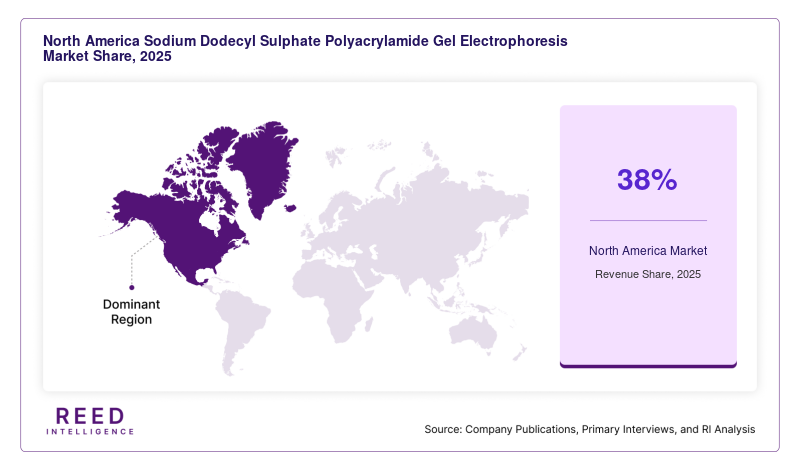
North America accounted for approximately 38% of the Sodium Dodecyl Sulphate Polyacrylamide Gel Electrophoresis Market share in 2025, making it the leading regional market. The region is expected to grow at a CAGR of 4.8% through 2034. The strong presence of pharmaceutical and biotechnology companies, along with advanced research infrastructure, supports market growth. Additionally, high healthcare expenditure and government funding for research contribute to the widespread adoption of SDS-PAGE systems.
The United States dominates the North American market due to its extensive research ecosystem and strong focus on drug development. A unique growth factor in this region is the increasing adoption of automated laboratory technologies, which enhances efficiency and reduces operational costs. This trend is driving the integration of advanced SDS-PAGE systems in research and clinical laboratories.
Europe
Europe held a market share of around 27% in 2025 and is projected to grow at a CAGR of 5.0% during the forecast period. The region benefits from strong academic research institutions and increasing investments in life sciences. Regulatory support for research activities and the presence of established pharmaceutical companies further contribute to market growth.
Germany leads the European market, supported by its robust biotechnology sector and research capabilities. A unique growth factor is the emphasis on collaborative research initiatives across universities and industry players. These collaborations are driving the adoption of advanced analytical techniques, including SDS-PAGE, for protein analysis.
Asia Pacific
Asia Pacific accounted for approximately 22% of the market share in 2025 and is expected to register the fastest CAGR of 6.8% through 2034. Rapid economic development, increasing healthcare investments, and expanding research activities are key factors driving growth in this region.
China dominates the Asia Pacific market due to its large-scale investments in biotechnology and pharmaceutical research. A unique growth factor is the expansion of domestic biopharmaceutical manufacturing, which requires reliable protein analysis techniques. This is boosting the demand for SDS-PAGE systems and consumables.
Middle East & Africa
The Middle East & Africa region held a market share of about 7% in 2025 and is expected to grow at a CAGR of 5.2% during the forecast period. The market is supported by improving healthcare infrastructure and increasing research activities in select countries.
South Africa is a key contributor to the regional market. A unique growth factor is the rising focus on infectious disease research, which requires protein analysis tools like SDS-PAGE. This is driving demand for laboratory equipment and consumables in the region.
Latin America
Latin America accounted for around 6% of the market share in 2025 and is projected to grow at a CAGR of 5.4% through 2034. The region is witnessing gradual growth due to increasing investments in healthcare and research infrastructure.
Brazil dominates the Latin American market, supported by its expanding biotechnology sector. A unique growth factor is the growing presence of academic research institutions focusing on molecular biology studies. This is contributing to the adoption of SDS-PAGE systems in the region.
Competitive Landscape
The Sodium Dodecyl Sulphate Polyacrylamide Gel Electrophoresis Market is moderately competitive, with several global and regional players operating in the industry. Companies focus on product innovation, strategic partnerships, and mergers to strengthen their market position. Leading players are investing in research and development to introduce advanced electrophoresis systems and reagents that improve efficiency and accuracy.
A key market leader is Thermo Fisher Scientific, which offers a wide range of electrophoresis products and solutions. The company has recently introduced advanced precast gel systems designed to enhance reproducibility and reduce processing time. Other major players are also focusing on expanding their product portfolios and improving distribution networks to reach a broader customer base. The competitive landscape is expected to evolve with increasing technological advancements and growing demand for protein analysis tools.
Key Players List
- Thermo Fisher Scientific Inc.
- Bio-Rad Laboratories, Inc.
- Merck KGaA
- GE Healthcare
- Agilent Technologies, Inc.
- Danaher Corporation
- Lonza Group AG
- PerkinElmer, Inc.
- Takara Bio Inc.
- Promega Corporation
- Cleaver Scientific Ltd
- Hoefer Inc.
- Analytik Jena AG
- Helena Laboratories Corporation
- SERVA Electrophoresis GmbH
Recent Developments
- In 2024, a leading manufacturer launched a new range of stain-free precast gels designed to improve protein visualization and reduce processing time.
- In 2025, a biotechnology company introduced an automated SDS-PAGE system integrated with digital imaging software to enhance workflow efficiency.
- In 2025, a major industry player expanded its production facility to increase the supply of electrophoresis reagents and consumables to meet rising global demand.
Sodium Dodecyl Sulphate Polyacrylamide Gel Electrophoresis Market Segments
Type
- Gel Electrophoresis Systems
- Precast Gels
- Reagents & Buffers
Application
- Protein Analysis
- Drug Development
- Clinical Diagnostics
End-Use
- Academic & Research Institutes
- Pharmaceutical & Biotechnology Companies
- Clinical Laboratories
By Region
- North America
- Europe
- APAC
- Middle East and Africa
- LATAM