Sodium Ferrocyanide Market Size, Share, Demand Report By Grade (Food Grade, Industrial Grade), By Application (Food Additive, Water Treatment, Chemical Processing, Pigments & Dyes), By End-Use Industry (Food & Beverage, Chemical, Metallurgy, Environmental), By Form (Powder, Granular), By Region & Segment Forecasts, 2025–2034
USD 3950
Market Overview
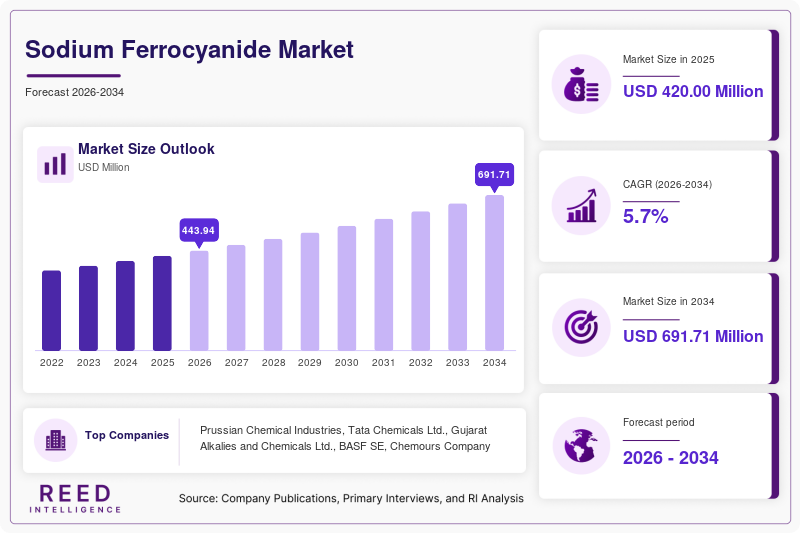
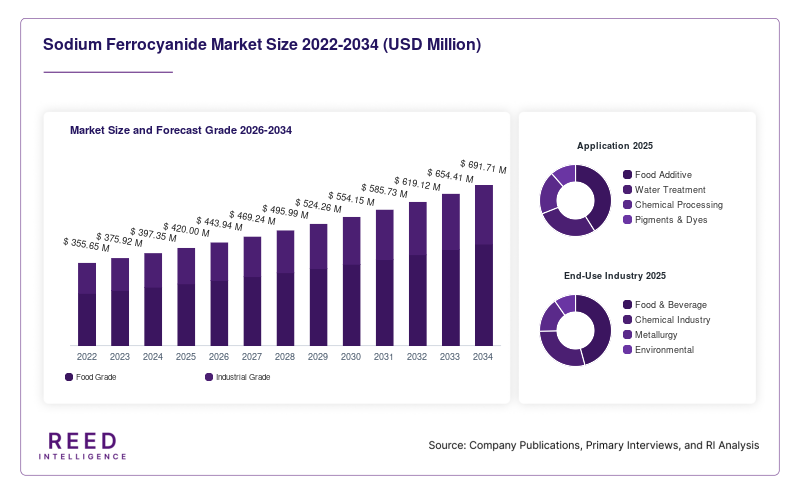
The global Sodium Ferrocyanide Market size was valued at approximately USD 420 million in 2025 and is projected to reach USD 690 million by 2034, expanding at a CAGR of 5.7% during the forecast period (2025–2034). The market growth is primarily driven by the increasing demand for anti-caking agents in food processing and industrial applications such as metallurgy, pigments, and water treatment. Sodium ferrocyanide is widely used due to its stability, cost-effectiveness, and compatibility with large-scale industrial processes.
A significant global factor supporting market expansion is the steady growth of the processed food industry, particularly salt consumption in packaged and preserved foods. Sodium ferrocyanide is commonly added to table salt to prevent clumping, ensuring smooth flow and usability. The rise in urbanization and changing dietary habits have further boosted demand for processed salt products, thereby strengthening the overall market outlook.
Key Highlights
- Asia Pacific dominated the market with a 38.5% share in 2025, while it is expected to grow at the fastest CAGR of 6.4%.
- The food-grade segment led with a 52.3% share, while industrial-grade is projected to grow at a CAGR of 6.1%.
- The food additive application segment dominated with 48.7%, whereas water treatment is expected to expand at a CAGR of 6.6%.
- China remained the dominant country with a market size of USD 110 million in 2025 and is projected to reach USD 117 million in 2026.
Market Trends
Rising Demand for Food-Grade Anti-Caking Agents
The increasing consumption of packaged and processed foods has significantly influenced the Sodium Ferrocyanide Market. As salt remains a staple ingredient across food industries, maintaining its quality and flowability has become essential. Sodium ferrocyanide is widely used as an anti-caking agent due to its effectiveness at low concentrations. Food manufacturers are focusing on improving product shelf life and consistency, leading to higher adoption rates. This trend is particularly evident in urban regions where convenience foods dominate consumption patterns.
Expanding Use in Environmental and Industrial Applications
Another notable trend shaping the Sodium Ferrocyanide Market is its growing use in wastewater treatment and industrial chemical processes. The compound is increasingly applied in removing heavy metals from industrial effluents, aligning with stricter environmental regulations. Additionally, its role in metal surface treatment and pigment production is gaining traction. Industries are gradually shifting toward efficient and cost-effective chemical solutions, which supports the broader adoption of sodium ferrocyanide in industrial applications.
Market Drivers
Growth in Processed Food Industry
The rapid expansion of the global processed food sector has been a key driver for the Sodium Ferrocyanide Market. With increasing demand for packaged foods, particularly in developing economies, the need for stable and high-quality salt products has risen. Sodium ferrocyanide plays a crucial role in maintaining the free-flowing nature of salt, making it indispensable for food manufacturers. The shift toward convenience foods and longer shelf-life products continues to drive consistent demand.
Industrial Demand for Chemical Processing Applications
Another major driver is the growing utilization of sodium ferrocyanide in industrial processes such as metal treatment, pigment manufacturing, and chemical synthesis. Its chemical stability and efficiency make it suitable for a wide range of applications. Industries are focusing on improving production efficiency and reducing costs, which has increased the adoption of multifunctional compounds like sodium ferrocyanide. This trend is particularly strong in regions with expanding manufacturing sectors.
Market Restraint
Regulatory and Safety Concerns Regarding Cyanide Compounds
Despite its wide range of applications, the Sodium Ferrocyanide Market faces challenges due to regulatory scrutiny associated with cyanide-based compounds. Although sodium ferrocyanide is considered relatively stable and safe under controlled conditions, concerns regarding its potential decomposition into toxic substances under extreme conditions have led to strict regulations in several countries. Food safety authorities impose limits on its usage, particularly in food-grade applications.
These regulations can create barriers for market expansion, especially in regions with stringent compliance standards. Manufacturers must adhere to complex regulatory frameworks, which can increase operational costs and limit product availability. Additionally, consumer awareness regarding chemical additives in food products has led to cautious adoption in some markets. These factors collectively act as a restraint, slowing down the overall growth potential of the market.
Market Opportunities
Increasing Demand in Emerging Economies
Emerging economies present significant growth opportunities for the Sodium Ferrocyanide Market. Rapid industrialization, urbanization, and population growth in regions such as Asia Pacific and Latin America are driving demand for processed foods and industrial chemicals. As these economies continue to develop, the need for efficient food preservation and industrial processing solutions is expected to rise, creating favorable conditions for market expansion.
Advancements in Water Treatment Technologies
The growing focus on sustainable water management has opened new avenues for sodium ferrocyanide applications. Its ability to remove heavy metals from wastewater makes it valuable in modern water treatment systems. With increasing environmental concerns and stricter regulations, industries are investing in advanced treatment technologies. This shift is expected to create new opportunities for sodium ferrocyanide manufacturers, particularly in developed regions where environmental compliance is a priority.
Segmental Analysis
By Grade
The food-grade segment dominated the Sodium Ferrocyanide Market in 2025, accounting for 52.3% of the total share. This dominance was attributed to its widespread use as an anti-caking agent in salt production. Food manufacturers relied heavily on food-grade sodium ferrocyanide to maintain product quality and consistency, particularly in large-scale processing operations.
The industrial-grade segment is projected to grow at the fastest CAGR of 6.1% during the forecast period. This growth will be driven by increasing applications in chemical processing, metallurgy, and water treatment. Industrial users are expected to adopt sodium ferrocyanide due to its efficiency and cost advantages in various manufacturing processes.
By Application
The food additive segment held the largest share of 48.7% in 2025. Its dominance was driven by the extensive use of sodium ferrocyanide in preventing salt clumping. The growing demand for packaged food products contributed significantly to this segment’s expansion.
The water treatment segment is anticipated to grow at the fastest CAGR of 6.6%. This growth will be supported by increasing environmental concerns and the need for effective wastewater treatment solutions. Sodium ferrocyanide’s ability to remove heavy metals will play a key role in its adoption in this segment.
By End-Use Industry
The food and beverage industry dominated the market with a share of 44.9% in 2025. The segment’s growth was driven by the increasing demand for processed and packaged food products. Sodium ferrocyanide played a crucial role in maintaining the quality of salt used in food production.
The chemical industry is expected to grow at the fastest CAGR of 6.2%. This growth will be driven by the rising demand for chemical compounds in industrial processes. Sodium ferrocyanide’s versatility will support its adoption across various chemical applications.
By Form
The powder form segment dominated the market with a share of 61.5% in 2025. This dominance was due to its ease of handling and compatibility with industrial processes. Powdered sodium ferrocyanide was widely used in both food and industrial applications.
The granular form segment is projected to grow at a CAGR of 5.9%. Its growth will be driven by increasing demand for uniform particle size and improved handling properties in industrial applications.
Regional Analysis
North America
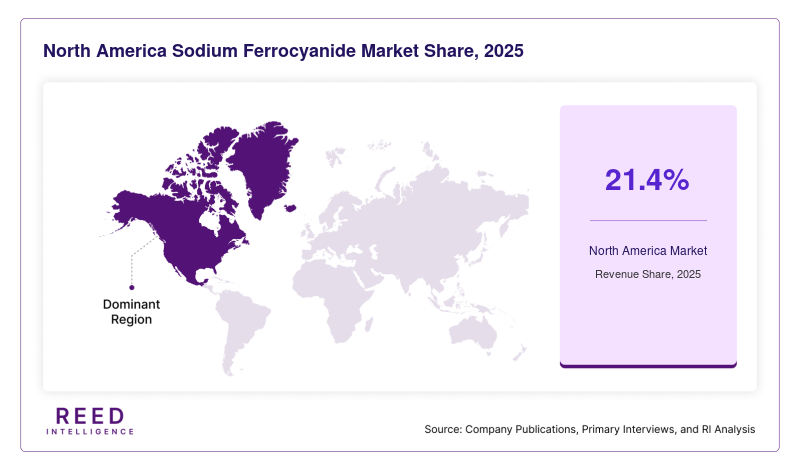
North America accounted for approximately 21.4% of the Sodium Ferrocyanide Market share in 2025 and is projected to grow at a CAGR of 5.1% during the forecast period. The region’s growth will be supported by steady demand from the food processing and chemical industries. Strict regulatory frameworks will continue to shape product usage, particularly in food-grade applications.
The United States dominated the regional market due to its advanced food processing industry. A key growth factor has been the increasing demand for high-quality packaged foods, which require effective anti-caking agents. Additionally, the country’s focus on wastewater treatment has supported the adoption of sodium ferrocyanide in environmental applications.
Europe
Europe held a market share of 24.2% in 2025 and is expected to grow at a CAGR of 5.3%. The region’s growth will be driven by strong regulatory compliance and demand for food-grade additives. Sustainability initiatives will also influence market dynamics.
Germany emerged as the leading country due to its well-established chemical and food industries. The country’s emphasis on quality standards and environmental protection has encouraged the use of efficient chemical compounds like sodium ferrocyanide in industrial processes.
Asia Pacific
Asia Pacific dominated the Sodium Ferrocyanide Market with a 38.5% share in 2025 and is anticipated to grow at the fastest CAGR of 6.4%. Rapid industrialization and increasing food consumption will continue to drive demand in this region.
China led the regional market due to its large-scale chemical manufacturing sector. The country’s growth factor lies in its expanding industrial base and rising demand for processed food products. Government initiatives supporting industrial development have further strengthened market growth.
Middle East & Africa
The Middle East & Africa accounted for 8.1% of the market share in 2025 and is expected to grow at a CAGR of 5.6%. The region’s growth will be supported by increasing industrial activities and infrastructure development.
Saudi Arabia dominated the region due to its expanding chemical and industrial sectors. The country’s investment in industrial diversification has contributed to the rising demand for chemical compounds, including sodium ferrocyanide.
Latin America
Latin America held a 7.8% share in 2025 and is projected to grow at a CAGR of 5.8%. The region’s growth will be driven by increasing food processing activities and industrial development.
Brazil emerged as the dominant country due to its growing food industry. The demand for processed and packaged foods has led to increased use of anti-caking agents, supporting market expansion.
Competitive Landscape
The Sodium Ferrocyanide Market is moderately fragmented, with several regional and global players competing based on product quality, pricing, and application expertise. Key companies focus on expanding their production capacities and enhancing their product portfolios to meet diverse industry requirements.
A leading player in the market is Prussian Chemical Industries, which has established a strong presence through its extensive distribution network and consistent product quality. The company recently announced an expansion in its manufacturing facility to cater to rising demand from the food and water treatment sectors.
Other prominent players are investing in research and development to improve product efficiency and comply with evolving regulatory standards. Strategic partnerships and regional expansions remain key strategies adopted by market participants to strengthen their market position.
Key Players List
- Prussian Chemical Industries
- Tata Chemicals Ltd.
- Gujarat Alkalies and Chemicals Ltd.
- BASF SE
- Chemours Company
- Kanto Chemical Co., Inc.
- Honeywell International Inc.
- Merck KGaA
- Arkema Group
- Solvay S.A.
- Lanxess AG
- Eastman Chemical Company
- Loba Chemie Pvt. Ltd.
- Thermo Fisher Scientific Inc.
- Noah Technologies Corporation
Recent Developments
- In 2024, Tata Chemicals Ltd. expanded its specialty chemical portfolio, including sodium ferrocyanide production capacity.
- In 2024, BASF SE introduced enhanced-grade sodium ferrocyanide for industrial applications.
- In 2025, Merck KGaA launched a high-purity variant targeting laboratory and specialty uses.
- In 2025, Gujarat Alkalies and Chemicals Ltd. increased exports to Asia Pacific markets.
- In 2025, Solvay S.A. invested in sustainable chemical processing technologies involving ferrocyanide compounds
Sodium Ferrocyanide Market Segments
Grade
- Food Grade
- Industrial Grade
Application
- Food Additive
- Water Treatment
- Chemical Processing
- Pigments & Dyes
End-Use Industry
- Food & Beverage
- Chemical Industry
- Metallurgy
- Environmental
Form
- Powder
- Granular
By Region
- North America
- Europe
- APAC
- Middle East and Africa
- LATAM