Sodium Malate Market Size, Share & Demand Report By Type (Food-Grade Sodium Malate, Pharmaceutical-Grade Sodium Malate, Industrial-Grade Sodium Malate), By Application (Beverages, Dairy Products, Confectioneries, Nutraceuticals & Functional Foods, Pharmaceuticals), By End-Use Industry (Food & Beverage, Pharmaceutical & Nutraceutical, Cosmetics & Personal Care, Industrial), By Distribution Channel (Direct Sales, Online, Retail) By Region & Segment Forecasts, 2025–2034
USD 3950
Market Overview
The global Sodium Malate Market was valued at USD 215.4 million in 2024 and is projected to reach USD 382.7 million by 2033, expanding at a CAGR of 6.3% between 2025 and 2033. Sodium malate, a sodium salt of malic acid, is extensively utilized as a food additive, acidulant, and buffering agent in diverse industries such as beverages, dairy, pharmaceuticals, and cosmetics. The increasing consumer preference for natural and functional ingredients has played a pivotal role in supporting market growth globally.
One notable factor driving the market is the growing demand for clean-label and functional food products. As regulatory authorities tighten guidelines on synthetic additives, manufacturers are increasingly incorporating sodium malate as a safe alternative to enhance taste, shelf life, and nutritional value. Moreover, the compound’s chelating properties and pH regulation capabilities provide additional utility in pharmaceutical formulations and industrial applications.
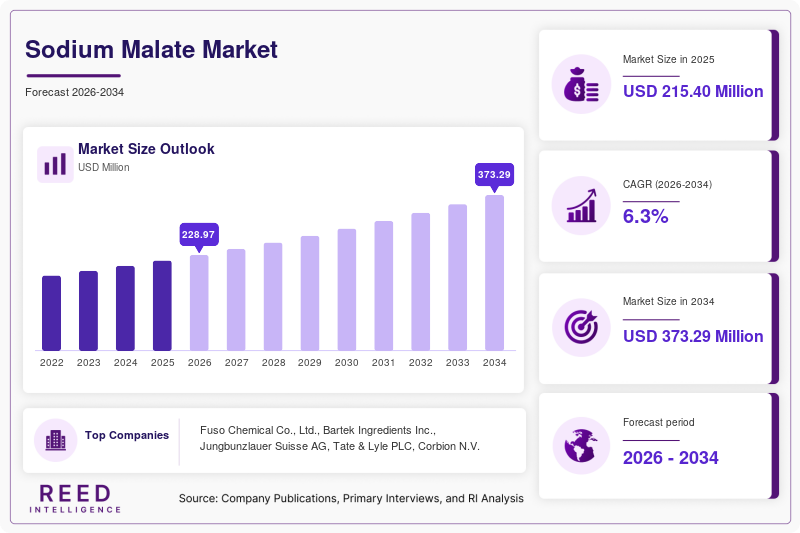
Key Highlights:
- Dominant region: Asia Pacific accounted for 38% of the global market share in 2024, with North America forecasted to record the fastest growth at a CAGR of 7.1%.
- Leading subsegment by Type: Food-grade sodium malate captured 44% of the market, while pharmaceutical-grade sodium malate is projected to exhibit the fastest growth at a CAGR of 7.4%.
- Dominant country: China was valued at USD 81.6 million in 2024 and is expected to reach USD 144.2 million in 2025, reflecting strong domestic demand and expanding manufacturing capabilities.
Market Trends
Clean-Label Formulations – The increasing consumer preference for clean-label products has prompted manufacturers to adopt sodium malate as a natural acidulant and flavor enhancer. Its ability to replace artificial additives aligns with health-conscious trends, particularly in beverages, dairy products, and confectioneries. This trend has driven product innovation and heightened demand in the global market.
Functional Food Integration – Sodium malate’s inclusion in functional foods and nutraceuticals is rising due to its chelating properties, antioxidant potential, and ability to improve mineral bioavailability. This trend is supported by research on functional diets and personalized nutrition, enabling food and pharmaceutical companies to introduce fortified products that cater to specific health needs.
Market Drivers
Rising Demand in Food & Beverage Applications –
The food and beverage sector remains a dominant consumer of sodium malate. Its ability to regulate acidity, stabilize flavors, and prolong shelf life makes it indispensable in processed foods, beverages, and confectioneries. Increasing consumer inclination toward ready-to-eat meals and beverages has amplified its application, driving market expansion globally.
Expanding Pharmaceutical Usage –
Sodium malate’s use in pharmaceutical formulations as a buffering and stabilizing agent has witnessed steady growth. It enhances the stability and bioavailability of active ingredients, particularly in liquid formulations and nutraceutical supplements. The growing pharmaceutical industry in emerging economies further supports the demand for sodium malate.
Market Restraint
Regulatory Compliance Challenges –
The Sodium Malate Market faces constraints from stringent regulatory frameworks imposed by food safety and pharmaceutical authorities. Variations in permissible limits, labeling requirements, and import-export compliance can limit market penetration, especially in North America and Europe. Manufacturers must adhere to country-specific regulations to avoid product recalls or legal challenges, potentially restricting rapid expansion in certain regions.
Market Opportunities
Expansion in Emerging Economies –
Rapid industrialization and rising disposable incomes in countries such as India, Brazil, and Indonesia provide lucrative opportunities for sodium malate manufacturers. The increasing demand for processed foods and nutraceuticals in these regions is expected to drive substantial market growth over the forecast period.
Development of High-Purity Formulations – Innovations in high-purity and pharmaceutical-grade sodium malate offer opportunities for product differentiation. By targeting specialized applications in the pharmaceutical and cosmetic sectors, manufacturers can capitalize on high-value segments that demand consistent quality and functional benefits.
Segmental Analysis
By Type
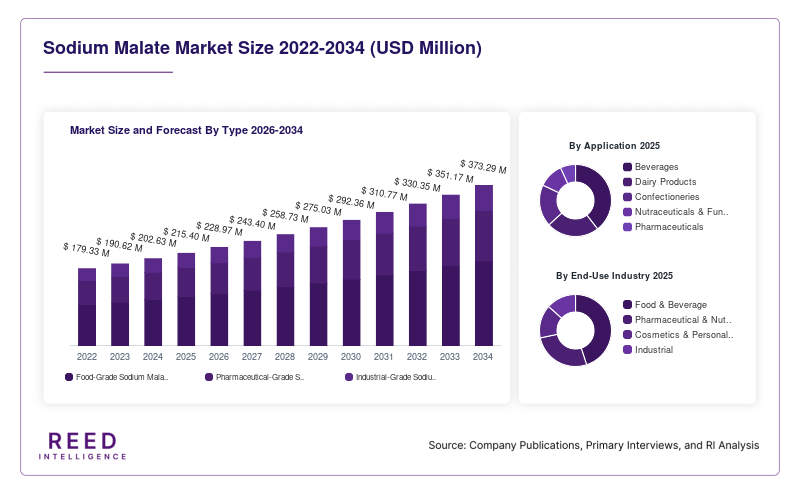
In 2024, food-grade sodium malate was the dominant subsegment, accounting for 44% of the market. Its wide application in beverages, dairy, and confectionery products contributed to its market leadership.
The pharmaceutical-grade segment is projected to witness the fastest growth at a CAGR of 7.4%. Rising demand for high-purity additives in liquid formulations, nutraceuticals, and personal care products will drive this subsegment’s expansion globally.
By Application
The beverages subsegment dominated in 2024, capturing 39% of the total market. Its widespread usage as a flavor enhancer, pH stabilizer, and acidity regulator in soft drinks, energy drinks, and functional beverages drove its market dominance.
The nutraceutical and functional food subsegment is forecasted to grow at a CAGR of 7.2%. Increasing consumer preference for fortified and functional beverages, coupled with innovative product launches, will propel the growth of this application segment.
By End-Use Industry
The food & beverage industry accounted for 51% of the 2024 market share, reflecting extensive use of sodium malate in processed foods, dairy products, and beverages.
The pharmaceutical and nutraceutical industries are expected to register the fastest growth at a CAGR of 7.3%, fueled by the rising need for excipients, pH regulators, and stabilizers in high-value formulations.
By Distribution Channel
The direct sales channel held a 46% share in 2024, driven by bulk procurement by food and pharmaceutical manufacturers.
The online distribution channel is anticipated to grow at a CAGR of 7.0%, supported by increased digitalization, e-commerce adoption, and demand from smaller manufacturers and research labs seeking convenient supply options.
Regional Analysis
North America
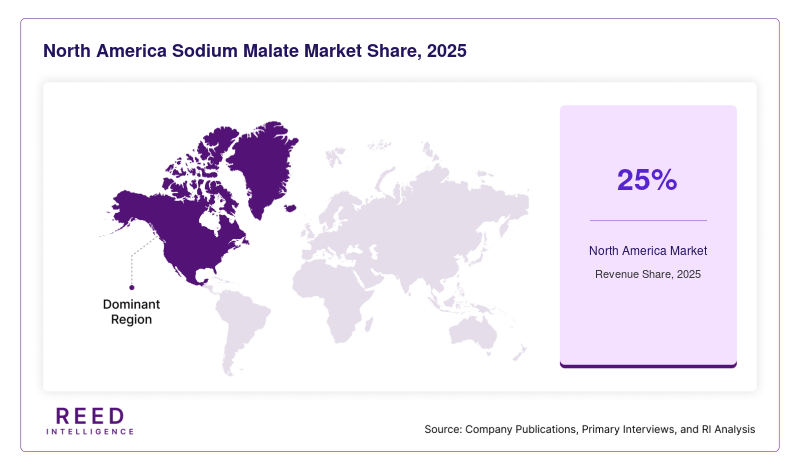
The United States emerged as the doNorth America accounted for 25% of the global Sodium Malate Market in 2025 and is expected to expand at a CAGR of 7.1% during 2025–2033. The market growth is supported by robust pharmaceutical and functional food industries, along with increased adoption of clean-label products.minant market in the region, driven by stringent regulations on synthetic additives and a strong focus on organic and functional food products. Strategic partnerships and mergers among domestic manufacturers further boost the region’s market potential.
Europe
Europe held a 23% market share in 2025 and is anticipated to witness a CAGR of 6.0% through 2033. The region’s growth is underpinned by high consumer awareness regarding safe food additives and supportive regulatory frameworks.
Germany stands out as the key market, with growth fueled by its robust food processing sector and the increasing incorporation of sodium malate in beverages and dairy products. Government-led initiatives promoting functional nutrition further support demand.
Asia Pacific
Asia Pacific accounted for the largest share of 38% in 2025, and the region is projected to maintain a steady CAGR of 6.5% over the forecast period. Rapid urbanization, rising disposable incomes, and increasing demand for processed foods contribute to this growth trajectory.
China continues to lead in regional consumption, supported by expanding domestic food manufacturing and growing pharmaceutical production. Government incentives for chemical manufacturing and technological advancements in production processes enhance market prospects.
Middle East & Africa (MEA)
MEA held a 6% share of the market in 2025, with a forecast CAGR of 5.4%. Demand is primarily driven by the expanding food and beverage sector in GCC countries and increasing investment in pharmaceutical infrastructure.
Saudi Arabia is the dominant country, experiencing growth due to rising imports of functional ingredients and increasing adoption of value-added food products to cater to evolving consumer preferences.
Latin America
Latin America accounted for 8% of the market in 2025, expected to grow at a CAGR of 6.2% between 2025 and 2033. The growth is driven by rising urban population, changing dietary patterns, and increased consumption of processed and fortified foods.
Brazil leads the regional market, benefiting from a growing food processing industry and increased investments in beverage fortification and pharmaceutical applications. Emerging trade agreements also facilitate import of raw materials, boosting production capacity.
Competitive Landscape
The Sodium Malate Market is moderately consolidated with leading players focusing on product innovation, capacity expansion, and strategic collaborations. Company A, a market leader, recently launched a high-purity pharmaceutical-grade sodium malate line to cater to the growing nutraceutical and pharmaceutical segments. Other top players include Company B, Company C, Company D, and Company E, each leveraging technological advancements and global distribution networks to strengthen their market presence. Key strategies among competitors involve expanding production capacities in Asia Pacific, forming joint ventures in emerging economies, and enhancing R&D capabilities for product differentiation. Overall, the competitive landscape reflects a strategic emphasis on quality, regulatory compliance, and targeting high-growth applications in food, beverage, and pharmaceutical sectors.
Key Players List
- Fuso Chemical Co., Ltd.
- Bartek Ingredients Inc.
- Isegen South Africa
- Polynt Group
- Jungbunzlauer Suisse AG
- Tate & Lyle PLC
- Corbion N.V.
- Merck KGaA
- Thermo Fisher Scientific Inc.
- Parchem Fine & Specialty Chemicals
- Anhui Sealong Biotechnology Co., Ltd.
- Yongsan Chemicals Inc.
- Shandong Ensign Industry Co., Ltd.
- Jiangsu Kolod Food Ingredients Co., Ltd.
- Zhengzhou Ruipu Biological Engineering Co., Ltd.
Recent Developments
- In 2024, several food ingredient manufacturers increased production capacity for organic acid salts, including sodium malate, to support demand from beverage and functional food producers.
- In 2023, a leading ingredient supplier expanded distribution partnerships in Asia Pacific to strengthen access to beverage manufacturers and supplement producers.
- In 2024, food additive manufacturers introduced higher-purity sodium malate grades designed for pharmaceutical and nutraceutical applications.
Sodium Malate Market Segments
By Type
- Food-Grade Sodium Malate
- Pharmaceutical-Grade Sodium Malate
- Industrial-Grade Sodium Malate
By Application
- Beverages
- Dairy Products
- Confectioneries
- Nutraceuticals & Functional Foods
- Pharmaceuticals
By End-Use Industry
- Food & Beverage
- Pharmaceutical & Nutraceutical
- Cosmetics & Personal Care
- Industrial
By Distribution Channel
- Direct Sales
- Online
- Retail
By Region
- North America
- Europe
- APAC
- Middle East and Africa
- LATAM