Sodium Nickel Chloride Battery Market Size, Share & Demand Report By Application (Grid Energy Storage, Electric Vehicles, Industrial Backup Power), By End-Use (Utilities, Industrial, Commercial), By Type (Stationary Batteries, Mobile Batteries), By Capacity (Below 10 kWh, 10–100 kWh, Above 100 kWh), By Region & Segment Forecasts, 2025–2034
USD 3950
Market Overview
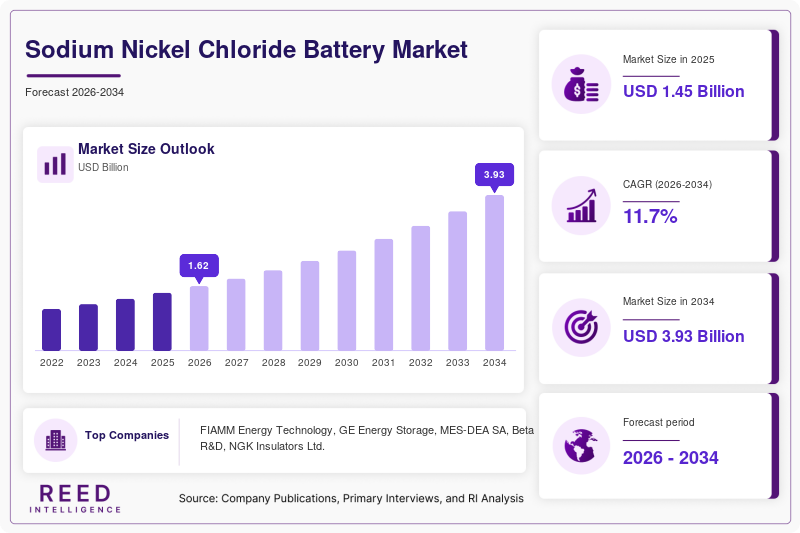
The Sodium Nickel Chloride Battery Market size was valued at approximately USD 1.45 billion in 2025 and is projected to reach USD 3.92 billion by 2034, expanding at a CAGR of 11.7% during 2025–2034. The market is gaining traction as industries seek reliable, high-temperature battery systems that offer long cycle life, safety, and stable performance in demanding environments.
A key global factor supporting market growth is the accelerating shift toward grid-scale energy storage and electrification of transportation, particularly in regions prioritizing renewable integration. Sodium nickel chloride batteries, often referred to as ZEBRA batteries, are increasingly recognized for their ability to operate efficiently in extreme temperatures and provide consistent energy output, making them suitable for stationary storage and specialty electric vehicles.
Key Highlights
- Europe dominated the market with a 36.2% share in 2025, while Asia Pacific is projected to be the fastest-growing region at a CAGR of 13.4%
- By application, grid energy storage led with 41.5% share, while electric commercial vehicles are expected to grow at a CAGR of 14.1%
- By end-use, utilities dominated, whereas industrial energy storage is the fastest-growing segment at 13.8% CAGR
- Germany led the market with USD 310 million in 2025 and is expected to reach USD 345 million in 2026
Market Trends
Integration with Renewable Energy Systems
The Sodium Nickel Chloride Battery Market is witnessing increased integration with renewable energy systems such as solar and wind. These batteries provide stable energy storage for intermittent power generation, enabling utilities to balance supply and demand efficiently. Their long lifespan and resistance to degradation make them suitable for long-duration storage applications, supporting grid reliability in renewable-heavy energy systems.
Expansion in Commercial Electric Mobility
Another notable trend is the growing adoption of sodium nickel chloride batteries in commercial electric vehicles, including buses, trucks, and fleet vehicles. Their ability to operate in high-temperature environments without complex cooling systems reduces maintenance requirements. This makes them attractive for logistics and public transportation sectors where reliability and durability are critical.
Market Drivers
Rising Demand for High-Temperature Battery Solutions
Industries operating in harsh environments require energy storage systems that maintain performance under extreme conditions. Sodium nickel chloride batteries are inherently suited for high-temperature operations, making them ideal for industrial applications and remote installations. This demand is significantly contributing to the expansion of the Sodium Nickel Chloride Battery Market.
Increasing Focus on Energy Storage Diversification
The global push to diversify battery technologies beyond lithium-ion is driving investments in alternative chemistries. Sodium nickel chloride batteries offer advantages such as enhanced safety, stable supply chains, and recyclability. These factors are encouraging governments and private entities to support their development and deployment across various applications.
Market Restraints
High Operating Temperature Requirements
A major limitation of the Sodium Nickel Chloride Battery Market is the requirement for high operating temperatures, typically around 270–350°C. Maintaining such temperatures requires additional insulation and heating mechanisms, which can increase system complexity and energy consumption. This factor limits adoption in applications where energy efficiency and compact design are critical.
Additionally, the initial cost of deployment can be higher compared to conventional battery systems due to specialized materials and thermal management systems. While long-term performance benefits often offset these costs, the upfront investment can deter small-scale users and emerging markets.
Market Opportunities
Growth in Grid-Scale Energy Storage Projects
The expansion of renewable energy infrastructure globally presents a strong opportunity for sodium nickel chloride batteries. Their long cycle life and stability make them suitable for large-scale energy storage systems, particularly in regions transitioning toward clean energy grids.
Emerging Markets Adoption
Developing economies are increasingly investing in energy storage to support electrification and infrastructure development. Sodium nickel chloride batteries offer a cost-effective and durable solution for these markets, especially in areas with extreme climatic conditions. This trend is expected to create new growth avenues for manufacturers.
Segmental Analysis
By Application
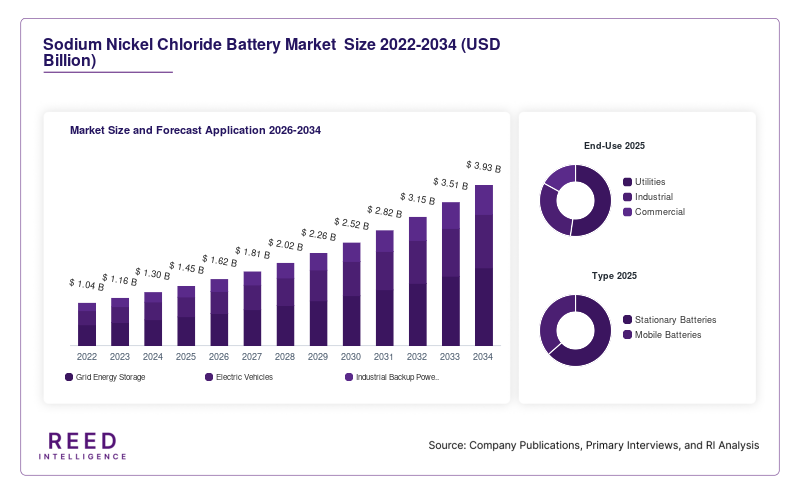
Grid energy storage dominated the Sodium Nickel Chloride Battery Market with a 41.5% share in 2025. This dominance was attributed to the increasing need for stable and long-duration energy storage systems that support renewable energy integration. Utilities and grid operators preferred sodium nickel chloride batteries for their reliability and long operational life.
Electric commercial vehicles are projected to be the fastest-growing subsegment, with a CAGR of 14.1%. Growth will be driven by the demand for durable battery systems capable of operating under high-load conditions. These batteries will gain traction due to reduced maintenance requirements and enhanced safety features.
By End-Use
Utilities accounted for the largest share of 38.7% in 2025, driven by large-scale deployment in grid stabilization and energy storage projects. Their ability to provide consistent energy output made them suitable for utility-scale applications.
Industrial energy storage is expected to grow at a CAGR of 13.8%, supported by increasing adoption in manufacturing and heavy industries. These sectors will utilize sodium nickel chloride batteries for backup power and operational efficiency in energy-intensive processes.
By Type
Stationary batteries held the dominant share of 63.4% in 2025, primarily due to their widespread use in grid and industrial applications. Their design and performance characteristics made them ideal for long-term energy storage.
Mobile batteries are anticipated to grow at a CAGR of 12.9%, driven by their application in electric vehicles and transport systems. The ability to operate in varying environmental conditions will support their adoption.
By Capacity
Batteries with capacity above 100 kWh dominated with a 47.2% share in 2025, reflecting strong demand for large-scale energy storage systems. These batteries were widely used in utilities and industrial sectors.
The 10–100 kWh segment is expected to grow at a CAGR of 13.2%, supported by increasing adoption in commercial and small-scale industrial applications. Their flexibility and scalability will drive demand.
Regional Analysis
North America
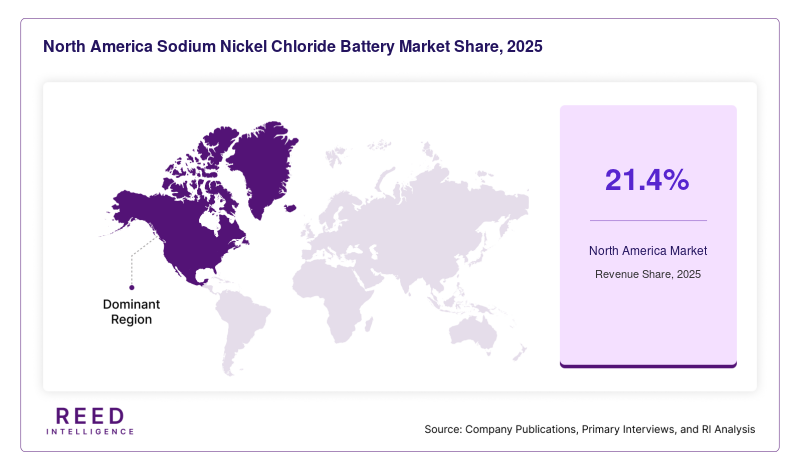
North America accounted for 21.4% of the Sodium Nickel Chloride Battery Market share in 2025 and is expected to grow at a CAGR of 10.8% during the forecast period. The region demonstrated steady adoption driven by increasing investments in energy storage infrastructure and electrification initiatives.
The United States dominated the regional market due to its expanding grid modernization efforts. A key growth factor is the integration of sodium nickel chloride batteries into remote and off-grid energy systems, particularly in rural and industrial zones where reliability is essential.
Europe
Europe held the largest share at 36.2% in 2025 and is projected to grow at a CAGR of 11.2% through 2034. The region’s leadership was supported by strong policy frameworks promoting alternative energy storage technologies and sustainability goals.
Germany emerged as the dominant country, driven by its focus on renewable energy integration and advanced manufacturing capabilities. The country’s emphasis on energy transition and decentralized storage systems significantly contributed to market expansion.
Asia Pacific
Asia Pacific represented 27.8% of the market in 2025 and is anticipated to grow at the fastest CAGR of 13.4%. Rapid industrialization and increasing energy demand supported the adoption of advanced battery technologies across the region.
China led the regional market, with growth driven by large-scale infrastructure projects and increasing investments in energy storage systems. The country’s focus on expanding its energy capacity and reducing carbon emissions played a key role in market growth.
Middle East & Africa
The Middle East & Africa region accounted for 8.1% of the market share in 2025 and is expected to grow at a CAGR of 12.1%. The region’s growth was supported by the need for reliable energy storage solutions in extreme climatic conditions.
Saudi Arabia dominated the region due to its investments in renewable energy projects and grid stability initiatives. The adoption of durable battery technologies capable of operating in high temperatures was a significant growth factor.
Latin America
Latin America held 6.5% of the market share in 2025 and is projected to grow at a CAGR of 11.5%. The region experienced increasing demand for energy storage systems to support expanding renewable energy capacity.
Brazil led the regional market, driven by its focus on improving energy infrastructure and integrating renewable energy sources. The country’s efforts to enhance grid reliability contributed to the adoption of sodium nickel chloride batteries.
Competitive Landscape
The Sodium Nickel Chloride Battery Market is moderately consolidated, with key players focusing on innovation and strategic collaborations. Leading companies are investing in advanced manufacturing processes and expanding their product portfolios to strengthen their market presence.
The market leader, FIAMM Energy Technology, has been actively developing high-performance battery systems and expanding its global footprint. A recent development includes the introduction of enhanced battery modules designed for grid-scale applications.
Other prominent players are focusing on partnerships and technological advancements to gain a competitive edge and address evolving market demands.
Key Players
- FIAMM Energy Technology
- GE Energy Storage
- MES-DEA SA
- Beta R&D
- NGK Insulators Ltd.
- EaglePicher Technologies
- ZAF Energy Systems
- Faradion Limited
- Amte Power Plc
- Svolt Energy Technology
- HiNa Battery Technology
- Natron Energy
- Altris AB
- Tiamat Energy
- Saft Groupe SA
Recent Developments
- FIAMM Energy Technology launched advanced sodium nickel chloride battery modules for grid storage applications.
- NGK Insulators expanded its production capacity for alternative battery technologies.
- MES-DEA SA entered partnerships to develop next-generation energy storage systems.
- ZAF Energy Systems focused on enhancing battery efficiency through material innovation.
- Several companies increased R&D investments to improve performance and reduce operating costs.
Sodium Nickel Chloride Battery Market Segments
Application
- Grid Energy Storage
- Electric Vehicles
- Industrial Backup Power
End-Use
- Utilities
- Industrial
- Commercial
Type
- Stationary Batteries
- Mobile Batteries
Capacity
- Below 10 kWh
- 10–100 kWh
- Above 100 kWh
By Region
- North America
- Europe
- APAC
- Middle East and Africa
- LATAM