Soft Touch Laminating Films Market Size, Share & Demand Report By Film Type (BOPP Soft Touch Laminating Films, PET Soft Touch Laminating Films, PVC Soft Touch Laminating Films, Bio-Based Soft Touch Laminating Films), By Application (Premium Packaging, Commercial Printing, Publishing, Labels and Tags, E-Commerce Packaging), By End-Use Industry (Consumer Goods Packaging, Food and Beverage, Cosmetics and Personal Care, Pharmaceuticals, Electronics, Retail and Luxury Goods) By Region & Segment Forec
USD 3950
Market Overview
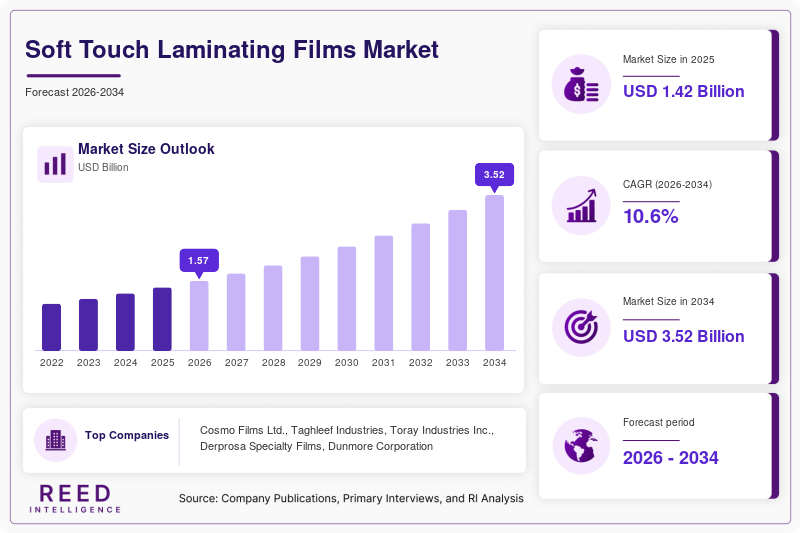
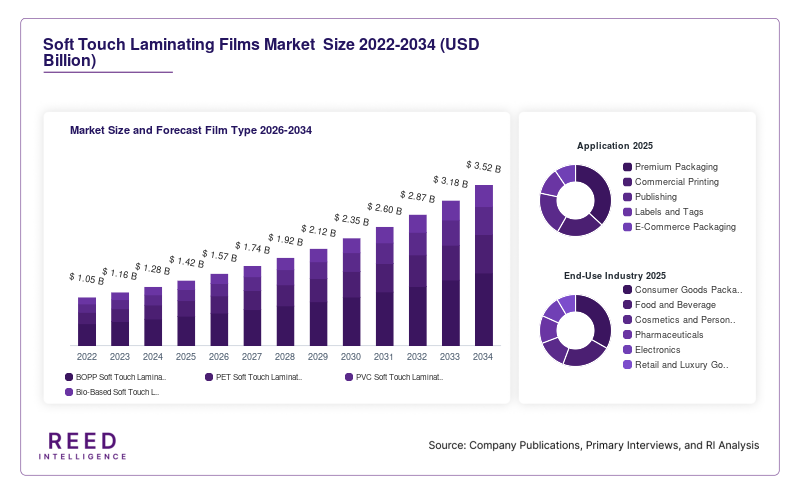
The global Soft Touch Laminating Films Market size was valued at USD 1.42 billion in 2026 and is projected to reach USD 3.18 billion by 2034, expanding at a CAGR of 10.6% during 2026–2034. Soft touch laminating films are widely used across premium packaging, publishing, labeling, luxury retail products, and commercial printing applications due to their distinctive tactile finish, enhanced durability, and premium visual appeal. The market continues to benefit from increasing demand for value-added packaging solutions that improve product differentiation and consumer engagement.
One of the most significant global factors supporting market expansion is the steady growth of premium consumer goods packaging. Brand owners across cosmetics, electronics, food products, pharmaceuticals, and personal care categories are investing in advanced packaging formats that strengthen shelf visibility and brand perception. Soft touch laminating films provide a velvet-like texture while improving scratch resistance and print quality, making them a preferred solution for high-end packaging applications. In addition, advancements in biodegradable and recyclable film technologies are encouraging adoption among manufacturers seeking compliance with evolving sustainability requirements. Rising e-commerce shipments, growing investments in packaging automation, and increased consumption of luxury consumer products are further supporting market growth across developed and emerging economies.
Key Highlights
- North America dominated the market with a 35.1% share in 2025, while Asia Pacific is expected to grow at the fastest CAGR of 11.8% during 2026–2034.
- By film type, BOPP soft touch laminating films accounted for the largest share of 44.3%, while bio-based soft touch films are projected to grow at a CAGR of 12.7%.
- By application, premium packaging led with a 47.6% share, whereas e-commerce packaging is expected to expand at a CAGR of 12.2%.
- By end-use industry, consumer goods packaging held the largest share of 39.4%, while the cosmetics and personal care segment is forecast to grow at a CAGR of 12.5%.
- The United States remained the dominant country, with market values of USD 392 million in 2024 and USD 428 million in 2025.
Market Trends
Rising Adoption of Sustainable Soft Touch Film Technologies
Sustainability has become a defining trend across the Soft Touch Laminating Films Market. Packaging converters and brand owners are increasingly adopting recyclable, biodegradable, and low-emission laminating materials to align with environmental objectives and regulatory requirements. Manufacturers are introducing advanced film formulations that preserve the premium tactile characteristics of conventional products while reducing environmental impact. The trend is particularly visible in food packaging, cosmetics, and premium consumer goods sectors where sustainability influences purchasing decisions. Growing investments in circular packaging systems, combined with increasing consumer awareness regarding packaging waste, are encouraging the development of eco-friendly soft touch film solutions. As regulatory pressure continues to intensify across major economies, demand for sustainable laminating technologies is expected to accelerate throughout the forecast period.
Growing Preference for Premium and Luxury Packaging Formats
The increasing focus on product differentiation is driving strong demand for premium packaging materials. Soft touch laminating films provide a distinctive sensory experience that enhances brand identity and perceived product value. Luxury goods manufacturers, cosmetics companies, electronics brands, and specialty food producers are increasingly incorporating these films into packaging designs to strengthen customer engagement. The trend is further supported by the growth of direct-to-consumer sales channels, where packaging quality plays a critical role in customer experience. Improvements in digital printing compatibility and decorative finishing technologies are also expanding application possibilities. As competition among consumer brands intensifies, demand for premium packaging aesthetics is expected to remain a significant contributor to market growth.
Market Drivers
Expanding Demand for High-Quality Packaging Solutions
The growing need for visually appealing and durable packaging is a major driver of the Soft Touch Laminating Films Market. Companies across multiple industries are focusing on packaging innovation to attract consumers and strengthen brand recognition. Soft touch laminating films offer advantages such as enhanced surface finish, improved resistance to scratches, and superior print presentation. These features help products stand out in crowded retail environments while protecting packaging integrity during transportation and storage. Increasing consumption of packaged goods, particularly in urban areas, is creating sustained demand for advanced packaging materials. As businesses continue investing in premium branding strategies, the use of soft touch laminating films is expected to expand across a broad range of applications.
Growth of E-Commerce and Digital Retail Channels
The rapid expansion of e-commerce platforms is creating favorable conditions for market growth. Online retailers and consumer brands increasingly recognize packaging as an important element of customer satisfaction and brand communication. Soft touch laminating films help create premium unboxing experiences while providing additional protection during shipping. The growing volume of parcel deliveries worldwide is encouraging packaging manufacturers to adopt materials that combine durability with visual appeal. Furthermore, digital retail brands often rely on distinctive packaging to establish customer loyalty and differentiate themselves from competitors. The continuous growth of online shopping activity across developed and emerging markets is expected to support long-term demand for soft touch laminating film products.
Market Restraint
Volatility in Raw Material Costs and Production Expenses
Fluctuations in the prices of petroleum-based raw materials remain a notable challenge for the Soft Touch Laminating Films Market. Many laminating film products depend on polymer feedstocks that are directly influenced by global energy prices and supply chain dynamics. Sudden increases in raw material costs can affect manufacturing margins and lead to higher product prices for converters and end users. Smaller manufacturers may face additional difficulties in maintaining profitability during periods of price instability. The challenge is further amplified by transportation costs, currency fluctuations, and evolving environmental compliance requirements. For example, packaging converters operating in cost-sensitive industries may delay adoption of premium soft touch films when conventional laminating alternatives offer lower upfront costs. Although technological improvements and supply chain optimization efforts are helping mitigate these pressures, raw material volatility continues to influence purchasing decisions and investment strategies across the industry.
Market Opportunities
Increasing Penetration in Cosmetics and Personal Care Packaging
The cosmetics and personal care industry presents significant opportunities for market participants. Product presentation is a critical purchasing factor within this sector, encouraging brands to adopt premium packaging solutions that communicate quality and exclusivity. Soft touch laminating films offer an elegant finish that enhances visual appeal while creating a distinctive tactile experience. As consumer spending on beauty products continues to increase across Asia Pacific, North America, and Europe, packaging manufacturers are expanding their use of advanced laminating materials. The growing popularity of luxury skincare, fragrance products, and premium cosmetics is creating additional opportunities for film suppliers. Continuous product innovation and brand differentiation efforts are expected to support strong demand from this application area.
Development of Bio-Based and Recyclable Film Products
Emerging opportunities are also linked to the development of environmentally responsible laminating technologies. Brand owners are increasingly seeking packaging materials that align with sustainability commitments without compromising product aesthetics. This demand is encouraging manufacturers to invest in bio-based polymers, recyclable structures, and solvent-free production processes. Technological advancements are making it possible to achieve premium soft touch effects while reducing environmental impact. Governments and regulatory agencies are also supporting the transition toward sustainable packaging solutions through stricter waste management policies. As adoption of green packaging accelerates across industries, suppliers capable of offering innovative eco-friendly laminating films are expected to gain a competitive advantage and unlock new revenue streams.
Segmental Analysis
By Film Type
BOPP soft touch laminating films represented the dominant subsegment, accounting for approximately 44.3% market share in 2024. Their leadership position is supported by an effective balance of performance, cost efficiency, and compatibility with a wide range of printing processes. BOPP-based films provide excellent clarity, scratch resistance, and tactile characteristics that appeal to packaging converters and brand owners. These films are widely utilized in consumer goods packaging, publishing applications, promotional materials, and retail products. Manufacturers favor BOPP solutions because they support high-volume production while maintaining consistent quality standards. The widespread availability of raw materials and established production infrastructure further contribute to the segment’s strong market position.
Bio-based soft touch laminating films are expected to emerge as the fastest-growing subsegment, registering a CAGR of 12.7% during the forecast period. Growth is primarily driven by increasing sustainability requirements across packaging value chains. Companies are seeking alternatives that reduce environmental impact while preserving premium visual and tactile qualities. Regulatory pressure regarding plastic waste management and corporate sustainability commitments are accelerating investment in renewable material technologies. Improvements in bio-polymer performance have enhanced product durability and print compatibility, making adoption more practical for commercial applications. As environmental considerations become increasingly important in purchasing decisions, bio-based soft touch films are expected to gain substantial market traction across multiple industries.
By Application
Premium packaging remained the leading application segment and accounted for approximately 47.6% of market share in 2024. The segment benefits from strong demand among luxury consumer goods manufacturers seeking packaging solutions that improve product perception and shelf appeal. Soft touch laminating films are frequently used for cosmetic boxes, electronics packaging, premium food products, and specialty retail items. Their ability to create a distinctive tactile experience helps brands communicate quality and exclusivity. Growing competition among consumer brands is encouraging investment in advanced packaging aesthetics. As businesses continue focusing on customer engagement and premium presentation, demand from the premium packaging segment remains a primary contributor to overall market revenue.
E-commerce packaging is projected to register the fastest growth, advancing at a CAGR of 12.2% through 2034. Online retailers increasingly recognize packaging as an extension of the customer experience. Soft touch laminating films help create visually appealing packaging while improving resistance to wear and handling during transportation. The rapid growth of direct-to-consumer business models has increased demand for packaging formats that enhance brand recognition and encourage repeat purchases. Social media influence and unboxing culture have also elevated the importance of packaging design. These factors, combined with rising global parcel volumes, are expected to drive strong adoption of soft touch laminating films within e-commerce packaging applications.
By End-Use Industry
The consumer goods packaging segment accounted for the largest share of approximately 39.4% in 2024. Demand is supported by high production volumes across food products, household goods, electronics accessories, and lifestyle products. Manufacturers use soft touch laminating films to improve visual appeal, increase durability, and strengthen product differentiation. The segment also benefits from growing consumer expectations regarding packaging quality and aesthetics. Retail competition has encouraged companies to adopt premium finishing solutions that enhance brand identity and customer perception. As packaged consumer goods continue to represent a substantial portion of global retail sales, this segment remains the largest contributor to market revenue.
The cosmetics and personal care industry is forecast to grow at the fastest CAGR of 12.5% during 2026–2034. The sector places significant emphasis on packaging appearance because visual presentation directly influences purchasing behavior. Soft touch laminating films provide an elegant finish that aligns with premium brand positioning and luxury product categories. Increasing demand for skincare products, fragrances, and beauty solutions is generating additional packaging requirements. Furthermore, emerging beauty brands are investing heavily in differentiated packaging designs to establish market presence. The combination of rising consumer spending, product innovation, and premiumization trends is expected to support robust growth within this end-use segment.
Regional Analysis
North America
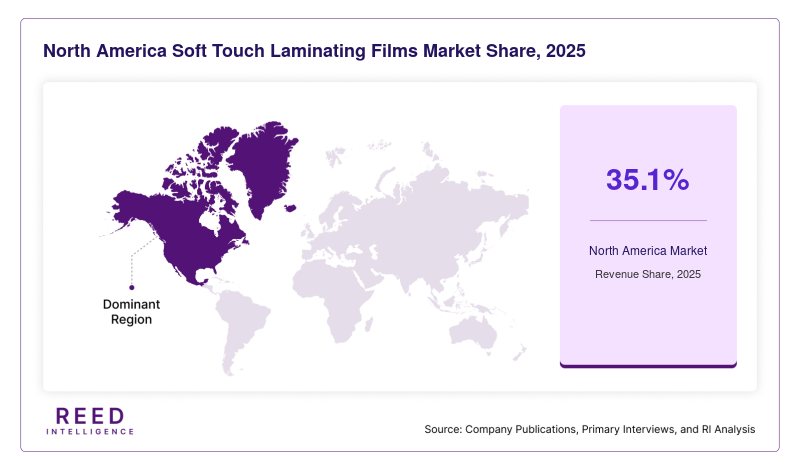
North America accounted for approximately 35.1% of the Soft Touch Laminating Films Market in 2025 and maintained its position as the largest regional market. The region benefits from strong demand for premium packaging across consumer goods, food products, healthcare, and personal care industries. High levels of packaging innovation, advanced manufacturing infrastructure, and widespread adoption of value-added printing technologies continue to support market expansion. The regional market is projected to grow at a CAGR of 9.4% through 2034.
The United States represents the dominant country within the region. A key growth factor is the increasing emphasis on premium branding strategies among consumer product manufacturers. Companies are investing heavily in packaging formats that enhance product visibility and consumer engagement. The expansion of direct-to-consumer business models and growing investments in sustainable packaging technologies are further strengthening market demand across the country.
Europe
Europe captured approximately 27.8% of the global market in 2025 and remains an important hub for packaging innovation. The region benefits from strong demand for luxury packaging, premium publishing products, and high-quality labeling applications. Manufacturers continue to invest in advanced laminating solutions that meet strict environmental standards while maintaining premium aesthetics. The market is anticipated to expand at a CAGR of 9.8% during the forecast period.
Germany remains the leading national market in Europe. A unique growth factor is the country's strong industrial printing and packaging ecosystem, which supports rapid adoption of advanced finishing technologies. German manufacturers are increasingly introducing recyclable laminating film solutions to address sustainability targets, creating favorable conditions for continued market development and product innovation.
Asia Pacific
Asia Pacific held nearly 24.6% of the Soft Touch Laminating Films Market in 2025 and is projected to record the fastest growth rate. Rising disposable incomes, rapid urbanization, expanding consumer goods production, and growing packaging investments are supporting demand across the region. Packaging converters are increasingly adopting premium laminating solutions to meet evolving consumer preferences. The regional market is forecast to advance at a CAGR of 11.8% through 2034.
China dominates the Asia Pacific market due to its extensive manufacturing base and large consumer population. One important growth factor is the rapid expansion of e-commerce activity, which continues to drive demand for attractive and durable packaging solutions. The presence of large-scale packaging production facilities and ongoing investments in printing technologies further strengthen regional growth prospects.
Middle East & Africa
The Middle East & Africa represented approximately 6.4% of the global market in 2025. Although comparatively smaller than other regions, the market is experiencing steady development due to rising demand for packaged consumer products and increasing investments in retail infrastructure. Packaging companies are gradually incorporating premium laminating materials to enhance product presentation and support branding initiatives. The region is expected to grow at a CAGR of 8.9% over the forecast period.
The United Arab Emirates serves as the dominant country market within the region. A unique growth factor is the country's position as a regional trade and logistics hub, which supports demand for premium packaging across imported and locally manufactured products. Growing luxury retail activity and expansion of high-end consumer brands are also contributing to increased adoption of soft touch laminating films.
Latin America
Latin America accounted for around 6.1% of the Soft Touch Laminating Films Market in 2025. The region is benefiting from rising demand for packaged food products, personal care items, and commercial printing applications. Manufacturers are increasingly focusing on packaging differentiation as consumer competition intensifies. Continued investments in packaging modernization and production efficiency are expected to support a CAGR of 9.1% through 2034.
Brazil remains the largest market in Latin America. A significant growth factor is the expansion of domestic consumer goods manufacturing, which has increased demand for premium packaging materials. Local brands are adopting advanced laminating solutions to improve shelf appeal and strengthen brand identity, creating new opportunities for film suppliers and packaging converters.
Competitive Landscape
The Soft Touch Laminating Films Market is characterized by moderate competition, with established global manufacturers competing through product innovation, sustainability initiatives, geographic expansion, and strategic partnerships. Companies are increasingly focusing on recyclable and bio-based film technologies to address changing customer requirements and regulatory expectations. Investment in advanced coating technologies and high-performance laminating solutions remains a central competitive strategy.
Cosmo Films Ltd. is widely recognized as a market leader due to its broad product portfolio, extensive distribution network, and continuous innovation in specialty films. The company recently expanded its premium packaging film offerings to support growing demand for sustainable solutions. Other notable participants include Taghleef Industries, Dunmore Corporation, Toray Industries, and Derprosa Specialty Films, all of which continue to strengthen their market presence through capacity expansion and product development initiatives. Competitive intensity is expected to increase as manufacturers introduce environmentally responsible products and target high-growth packaging applications across emerging economies.
Key Players
- Cosmo Films Ltd.
- Taghleef Industries
- Toray Industries Inc.
- Derprosa Specialty Films
- Dunmore Corporation
- Jindal Poly Films Ltd.
- FlexFilm Ltd.
- Polinas
- Uflex Limited
- Transilwrap Company
- Mondi Group
- Avery Dennison Corporation
- SRF Limited
- Celplast Metallized Products
- Innovia Films
Recent Developments
- In 2025, a leading soft touch laminating film manufacturer expanded its specialty coating production capacity to meet increasing demand from premium packaging and luxury consumer goods applications.
- In 2025, several packaging material producers launched recyclable soft touch laminating film solutions designed to support sustainability initiatives while maintaining premium tactile and visual properties.
- In 2024, a major film producer introduced an advanced bio-based soft touch laminating film aimed at reducing environmental impact across cosmetics, personal care, and retail packaging applications.
- In 2024, manufacturers increased investments in research and development programs focused on improving scratch resistance, print compatibility, and durability of next-generation soft touch laminating films.
- In 2025, strategic collaborations between laminating film suppliers and packaging converters accelerated the commercialization of sustainable premium packaging solutions for e-commerce and consumer goods markets.
Soft Touch Laminating Films Market Segments
Film Type
- BOPP Soft Touch Laminating Films
- PET Soft Touch Laminating Films
- PVC Soft Touch Laminating Films
- Bio-Based Soft Touch Laminating Films
Application
- Premium Packaging
- Commercial Printing
- Publishing
- Labels and Tags
- E-Commerce Packaging
End-Use Industry
- Consumer Goods Packaging
- Food and Beverage
- Cosmetics and Personal Care
- Pharmaceuticals
- Electronics
- Retail and Luxury Goods
By Region
- North America
- Europe
- APAC
- Middle East and Africa
- LATAM