Solar Chimney Market Size, Share, Demand Report by Type (Natural Draft Solar Chimney Systems, Hybrid Solar Chimney Systems, Building-Integrated Solar Chimneys), By Application (Power Generation, Ventilation & Cooling, Industrial Waste Heat Recovery), By End-Use (Utilities, Commercial Buildings, Industrial Facilities), and Regional Forecasts, 2026–2034
USD 3950
Market Overview
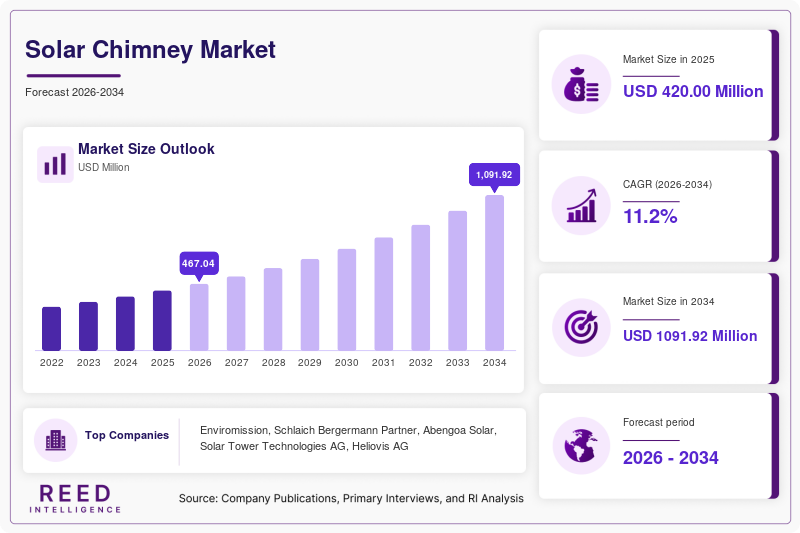
The global Solar Chimney Market is valued at USD 420 million in 2026 and is projected to reach USD 980 million by 2034, expanding at a CAGR of 11.2% during the forecast period (2026–2034). The market is gaining structured momentum as governments and private energy developers increasingly invest in low-carbon power generation technologies that can operate with minimal fuel input and reduced operational emissions. Solar chimney systems, which utilize solar-induced air convection to generate electricity or enhance natural ventilation, are becoming an important part of hybrid renewable infrastructure projects across multiple regions.
A key global factor supporting market expansion is the rising emphasis on decentralized renewable energy systems. As energy demand increases in remote and semi-urban areas, solar chimney technology is being integrated into sustainable infrastructure designs to support grid independence and reduce reliance on fossil fuel-based generation. The technology’s ability to provide continuous airflow-driven energy conversion, particularly in arid and high-solar-irradiation regions, is further strengthening its adoption potential.
Key Highlights
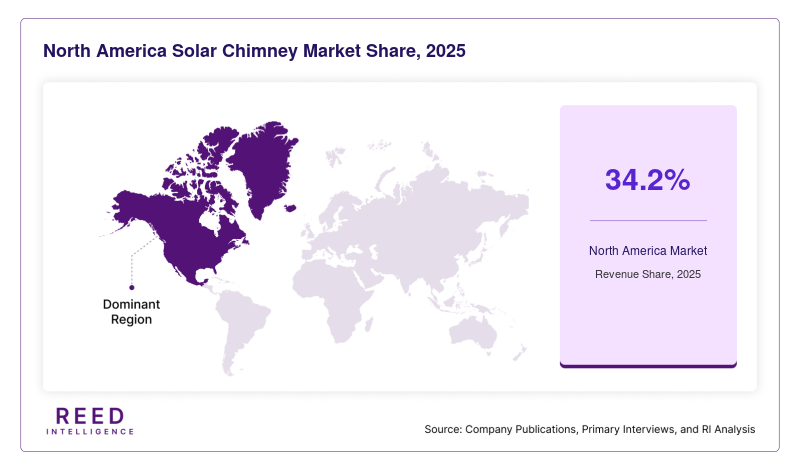
- North America dominated the market with a 34.2% share in 2025.
- Asia Pacific is expected to grow at the fastest CAGR of 12.8% during 2026–2034.
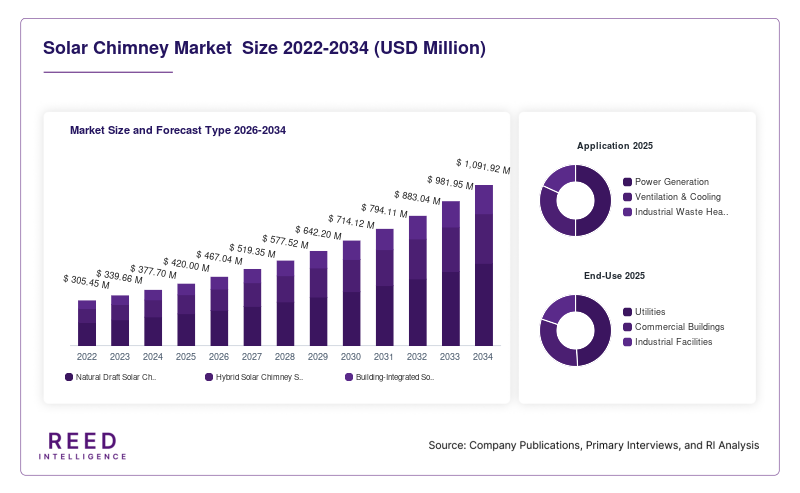
- By type, natural draft solar chimney systems accounted for the largest share of 39.1%.
- hybrid solar chimney systems are projected to grow at a CAGR of 13.1%.
- By application, power generation led with a 44.3% share, whereas ventilation-based cooling applications are expected to expand at a CAGR of 12.5%.
- The United States remained the dominant country, with market values of USD 160 million in 2024 and USD 178 million in 2025.
Market Trends
Integration of Hybrid Renewable Energy Systems
One of the most significant trends shaping the Solar Chimney Market is the integration of hybrid renewable energy systems, where solar chimneys are combined with photovoltaic panels, wind turbines, or thermal energy storage units. This integration enhances energy efficiency and ensures more stable output across varying climatic conditions. Hybrid systems are particularly useful in regions with fluctuating solar irradiance, as the chimney-based convection process can continue generating airflow even when direct sunlight is partially reduced. Energy developers are increasingly focusing on multi-technology renewable parks that optimize land usage and improve long-term energy yield. Additionally, government-backed pilot projects in desert regions are demonstrating improved cost efficiency when solar chimneys are paired with auxiliary renewable systems, making this trend a long-term growth driver.
Advancements in High-Efficiency Chimney Design Materials
Another key trend is the development of advanced construction materials and optimized structural designs for solar chimneys. Manufacturers are adopting high-performance glass, lightweight composite materials, and thermally resistant coatings to improve heat absorption and airflow efficiency. Computational fluid dynamics (CFD) modeling is increasingly used to optimize chimney height, base diameter, and collector geometry for maximum thermal updraft generation. These innovations are reducing structural losses and improving energy conversion efficiency, making solar chimneys more commercially viable. Furthermore, the adoption of modular construction techniques is reducing installation time and lowering project complexity, enabling wider adoption in both large-scale utility projects and decentralized building-integrated applications.
Market Drivers
Rising Demand for Clean and Continuous Renewable Energy
The increasing global demand for uninterrupted clean energy is a major driver of the Solar Chimney Market. Unlike intermittent renewable sources such as wind and solar PV, solar chimneys can generate a more consistent airflow-driven output, especially in regions with sustained solar exposure. Governments are actively promoting long-duration renewable technologies to stabilize grid supply and reduce dependency on fossil fuels. Solar chimney systems, once constructed, have relatively low operational costs and minimal maintenance requirements, making them attractive for long-term infrastructure investments. The technology is also being considered in rural electrification projects where grid expansion is limited or economically unfeasible. As energy security becomes a strategic priority, the adoption of solar chimney-based systems is expected to accelerate across multiple developing and developed economies.
Expansion of Sustainable Urban Infrastructure Projects
Rapid urbanization and the increasing adoption of sustainable building designs are further driving market growth. Solar chimney systems are being integrated into modern architectural projects as passive ventilation solutions that reduce building energy consumption. High-rise buildings, industrial facilities, and smart city developments are incorporating chimney-based airflow systems to improve indoor air quality and reduce reliance on mechanical cooling. Urban planners are also exploring solar chimneys for district cooling and waste heat recovery applications. These systems align with green building certification standards, encouraging developers to include them in large-scale construction projects. As sustainability regulations become stricter, especially in Europe and parts of Asia Pacific, solar chimney adoption in urban infrastructure is expected to expand significantly.
Market Restraint
High Initial Capital Investment and Structural Complexity
A major restraint affecting the Solar Chimney Market is the high initial capital investment required for construction and infrastructure development. Solar chimney systems require large land areas, tall chimney structures, and extensive thermal collector bases, which significantly increase upfront project costs. Additionally, engineering complexity associated with ensuring structural stability, wind resistance, and thermal efficiency adds further financial burden. These factors make solar chimney projects less attractive compared to conventional renewable energy solutions such as solar PV or wind farms, which often have faster deployment timelines and lower entry costs.
The financial barrier is particularly evident in developing economies, where infrastructure funding is limited and investment prioritization favors more established renewable technologies. In addition, long payback periods can deter private investors from committing to large-scale solar chimney installations. While technological advancements are gradually reducing cost inefficiencies, the capital-intensive nature of these systems continues to restrict widespread commercialization. Without stronger policy incentives, subsidies, or public-private partnerships, adoption rates may remain moderate in several regions.
Market Opportunities
Deployment in Desert and Semi-Arid Regions
One of the most promising opportunities for the Solar Chimney Market lies in deployment across desert and semi-arid regions. These areas receive high solar radiation and have large expanses of unused land, making them ideal for large-scale solar chimney installations. Countries in the Middle East, North Africa, and parts of Australia are increasingly evaluating solar chimney systems as part of their renewable diversification strategies. The consistent heat differential in these regions enhances airflow generation efficiency, making solar chimneys particularly effective. Governments are also exploring cross-border renewable energy trade, where large-scale solar chimney plants could feed electricity into regional grids. This opportunity is expected to significantly expand the commercial viability of the technology over the forecast period.
Integration into Smart City and Green Building Projects
Another key opportunity is the integration of solar chimney systems into smart city infrastructure and green building developments. As urban areas strive to reduce carbon footprints, solar chimneys offer a dual benefit of energy generation and natural ventilation. In commercial complexes, they can reduce HVAC energy consumption by improving passive cooling efficiency. Smart city initiatives in Asia Pacific and Europe are already incorporating advanced building automation systems that can be paired with solar chimney airflow controls. This integration allows dynamic energy optimization and improved indoor environmental quality. As green construction standards become more widespread, solar chimneys are expected to become a key component in sustainable urban design frameworks.
Segmental Analysis
By Type
Natural draft solar chimney systems accounted for approximately 39.1% share in 2025, making them the leading subsegment within the type category. These systems are widely deployed due to their simpler structural design and proven ability to generate consistent airflow using natural convection principles. Their dominance is further supported by their applicability in large-scale power generation projects, particularly in regions with high solar exposure and suitable topographical conditions. Utility developers prefer natural draft systems because they require fewer mechanical components, reducing maintenance complexity and long-term operational costs.
Hybrid solar chimney systems are projected to grow at a CAGR of 13.1% during 2026–2034, driven by increasing demand for energy-efficient multi-technology solutions. These systems integrate thermal updraft mechanisms with photovoltaic or wind energy systems, enabling higher energy yield and improved reliability. Growth is further supported by technological advancements in energy storage and smart grid integration, which allow hybrid systems to deliver stable output even during low solar intensity periods.
By Application
Power generation dominated the application segment with a 44.3% market share in 2025, reflecting the primary use of solar chimneys in utility-scale electricity production. These systems are particularly effective in desert regions where large-scale collector fields can generate sustained thermal airflow. Governments and independent power producers are increasingly investing in such projects as part of long-term renewable energy strategies aimed at reducing carbon emissions and enhancing grid stability.
Ventilation and cooling applications are expected to expand at a CAGR of 12.5%, driven by rising demand for passive cooling systems in urban infrastructure. Solar chimneys are being integrated into commercial buildings, warehouses, and industrial facilities to improve air circulation and reduce HVAC energy consumption. The growing emphasis on green building certifications is further supporting adoption in this segment.
By End-Use
Utilities accounted for the largest share at 46.0% in 2025, as they are the primary investors in large-scale solar chimney power plants. These systems are being incorporated into renewable energy portfolios aimed at achieving national clean energy targets. Utility-scale projects benefit from economies of scale, making them the preferred deployment model.
Commercial buildings are expected to grow at a CAGR of 12.7%, driven by increasing adoption of sustainable architecture practices. Solar chimneys are being used to enhance natural ventilation in high-rise buildings and reduce dependence on mechanical cooling systems, particularly in regions with warm climates.
Regional Analysis
North America
North America accounted for approximately 34.2% of the Solar Chimney Market share in 2025, with a projected CAGR of 11.6% during 2026–2034. The region’s strong position is driven by early adoption of advanced renewable technologies and significant investments in experimental large-scale solar infrastructure. The United States and Canada are actively funding research and pilot projects focused on thermal updraft energy systems, which has strengthened regional demand.
The United States leads the North American market and is supported by increasing renewable portfolio standards and federal incentives for clean energy innovation. A key growth factor is the integration of solar chimney systems into hybrid renewable energy parks, particularly in southwestern states where solar irradiation is high and land availability is sufficient for large installations.
Europe
Europe held around 28.5% market share in 2025, with a forecast CAGR of 10.9% through 2034. The region’s growth is supported by stringent carbon neutrality targets and strong policy frameworks encouraging alternative renewable technologies. Germany, France, and Spain are at the forefront of solar chimney research and demonstration projects.
Germany dominates the regional market due to its advanced engineering ecosystem and commitment to energy transition initiatives. A major growth factor is the integration of solar chimney systems into sustainable building designs and urban infrastructure projects aligned with EU climate goals.
Asia Pacific
Asia Pacific accounted for 22.8% share in 2025, and is expected to register the fastest CAGR of 12.8% during 2026–2034. Rapid urbanization, rising electricity demand, and supportive government renewable energy targets are key growth drivers.
China leads the region, supported by large-scale infrastructure development and renewable energy expansion policies. A unique growth factor is the deployment of solar chimney systems in desert rehabilitation and large-scale solar energy parks, particularly in western provinces.
Middle East & Africa
The Middle East & Africa region captured 9.5% market share in 2025, with a projected CAGR of 11.9% through 2034. The region benefits from high solar irradiation levels and increasing investment in renewable diversification strategies.
Saudi Arabia dominates the market due to its Vision 2030 energy transformation strategy. A key growth factor is the use of solar chimneys in desert-based mega renewable energy projects aimed at reducing oil dependency.
Latin America
Latin America held 5.0% market share in 2025, with a CAGR of 10.7% during the forecast period. Growth is driven by increasing interest in decentralized renewable energy systems in countries like Brazil and Chile.
Brazil leads the regional market, supported by its expanding renewable energy infrastructure. A key growth factor is the integration of solar chimney systems into rural electrification programs and off-grid energy applications.
Competitive Landscape
The Solar Chimney Market is moderately fragmented, with a mix of engineering firms, renewable energy developers, and construction technology providers competing for project-based contracts. Key players are focusing on technological innovation, pilot project development, and strategic collaborations with government agencies. Companies such as Schlaich Bergermann Partner, Enviromission, and Abengoa Solar are actively engaged in designing and developing large-scale solar chimney power plant concepts.
Among these, Enviromission is recognized as a leading developer due to its advanced solar tower and chimney-based renewable energy projects. The company has recently expanded its engineering collaborations to improve structural efficiency and reduce construction costs through modular chimney designs. Competitive strategies in the market include joint ventures, feasibility studies for desert-based installations, and integration with hybrid renewable systems. The market is expected to remain innovation-driven as companies seek to improve efficiency and commercial scalability.
Key Players
- Enviromission
- Schlaich Bergermann Partner
- Abengoa Solar
- Solar Tower Technologies AG
- Heliovis AG
- CSIRO Energy
- BrightSource Energy
- Acciona Energia
- Siemens Energy
- GE Renewable Energy
- ENGIE
- EDF Renewables
- Iberdrola
- Masdar Clean Energy
- Tata Power Renewable Energy
Recent Developments
- Enviromission expanded its pilot solar chimney project design in collaboration with international engineering partners to improve thermal efficiency and structural stability.
- Schlaich Bergermann Partner announced updated modular chimney design concepts aimed at reducing construction costs and improving scalability for desert-based installations.
- Several renewable energy developers in the Middle East initiated feasibility assessments for integrating solar chimney systems into hybrid solar mega-projects under national clean energy programs.
Solar Chimney Market Segments
Type
- Natural Draft Solar Chimney Systems
- Hybrid Solar Chimney Systems
- Building-Integrated Solar Chimneys
Application
- Power Generation
- Ventilation & Cooling
- Industrial Waste Heat Recovery
End-Use
- Utilities
- Commercial Buildings
- Industrial Facilities
By Region
- North America
- Europe
- APAC
- Middle East and Africa
- LATAM