Solar Light Tower Market Size, Share & Demand Report By Type (LED Solar Light Towers, Hybrid Solar Light Towers), By Application (Construction, Mining, Emergency & Disaster Relief, Events & Others), By End-Use (Rental, Industrial, Government & Municipal), By Region & Segment Forecasts, 2026–2034
USD 3950
Market Overview
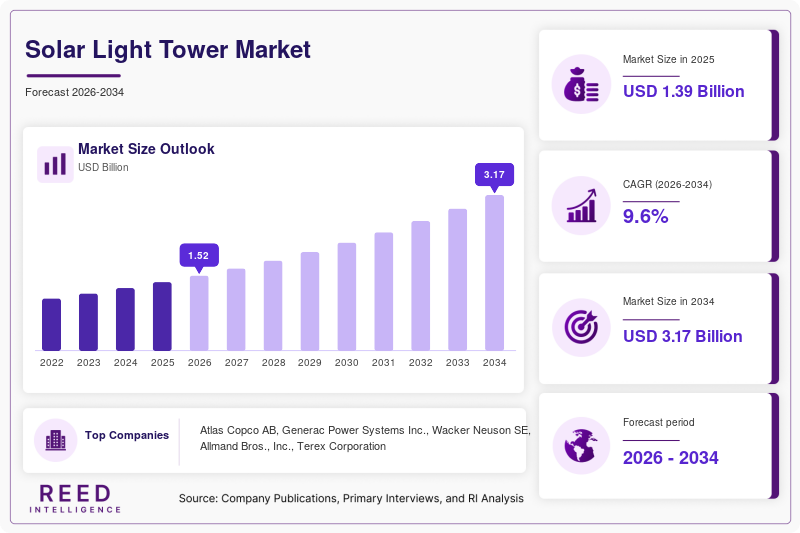
The Solar Light Tower Market size is witnessing steady expansion, with the global market size estimated at USD 1.52 billion in 2026 and projected to reach approximately USD 3.18 billion by 2034, growing at a CAGR of 9.6% during the forecast period (2026–2034). The increasing emphasis on sustainable infrastructure and low-emission construction solutions has played a critical role in accelerating demand. Solar-powered lighting towers provide an energy-efficient alternative to diesel-powered systems, reducing operational costs and environmental impact, which aligns with global decarbonization goals.
A key global factor supporting market growth is the rapid adoption of renewable energy technologies across construction, mining, and emergency response sectors. Governments and private organizations are prioritizing clean energy integration, which has boosted the demand for mobile solar lighting systems in off-grid and remote applications. The shift toward hybrid and fully solar-powered light towers has also improved operational reliability and reduced fuel dependency, making them increasingly viable in diverse climatic conditions.
Key Highlights
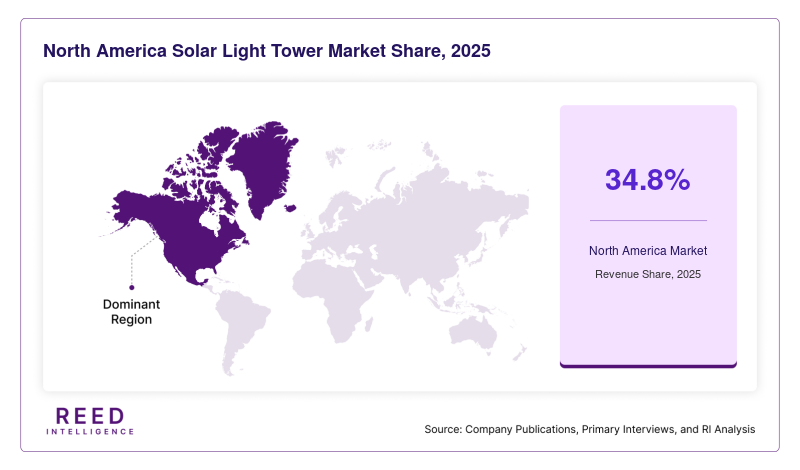
- North America held a dominant regional share of 34.8% in 2025.
- Asia Pacific is expected to register the fastest CAGR of 11.2%.
- The LED lighting segment accounted for the largest share among types, while hybrid solar towers are projected to grow at the fastest CAGR of 10.8%. In applications, construction remained dominant, whereas emergency and disaster relief applications are anticipated to expand at a CAGR of 11.5%.
- The United States recorded market values of USD 420 million in 2024 and USD 455 million in 2025, maintaining its position as the leading country.
Market Trends
Integration of Smart Monitoring and IoT Capabilities
One of the emerging trends in the Solar Light Tower Market is the integration of smart monitoring systems powered by IoT technology. Manufacturers are increasingly incorporating remote tracking, automated brightness control, and predictive maintenance features into solar light towers. These capabilities allow operators to monitor energy consumption, battery health, and operational efficiency in real time, reducing downtime and maintenance costs. The use of connected platforms enhances fleet management, particularly for rental companies managing multiple units across locations. As digital transformation continues to shape industrial operations, smart-enabled solar light towers are becoming a preferred choice, offering improved performance visibility and operational optimization across construction sites and infrastructure projects.
Rising Preference for Hybrid Solar Light Towers
Another notable trend is the growing adoption of hybrid solar light towers that combine solar energy with backup battery or diesel systems. These systems ensure uninterrupted operation even during periods of low sunlight or adverse weather conditions. Hybrid configurations provide flexibility and reliability, making them suitable for high-demand environments such as mining operations and large-scale construction projects. The demand for hybrid systems is also driven by the need to balance sustainability with operational efficiency. As battery storage technology advances and costs decline, hybrid solar light towers are becoming more cost-effective, further supporting their widespread adoption across both developed and emerging markets.
Market Drivers
Increasing Demand for Sustainable Construction Practices
The rising focus on sustainable construction practices is a major driver for the Solar Light Tower Market. Governments and regulatory bodies are enforcing stricter environmental guidelines, encouraging the adoption of eco-friendly equipment. Solar light towers offer a clean energy solution by eliminating fuel consumption and reducing carbon emissions, making them an attractive option for contractors aiming to meet sustainability targets. In addition, green building certifications and environmental compliance requirements are pushing companies to adopt renewable-powered equipment. The long-term cost savings associated with reduced fuel usage and lower maintenance further strengthen the value proposition of solar light towers in the construction industry.
Growth in Infrastructure and Mining Activities
The expansion of infrastructure and mining activities globally is another key factor driving market growth. Large-scale construction projects, particularly in developing regions, require reliable and portable lighting solutions for nighttime operations. Solar light towers provide a practical solution in remote areas where grid connectivity is limited or unavailable. Similarly, mining operations benefit from solar-powered lighting systems due to their ability to operate in off-grid environments with minimal logistical support. The increasing investment in infrastructure development, including roads, bridges, and energy projects, is expected to sustain demand for solar light towers over the forecast period.
Market Restraint
High Initial Investment and Limited Awareness
A significant restraint affecting the Solar Light Tower Market is the relatively high initial investment compared to conventional diesel-powered lighting systems. Although solar light towers offer long-term cost benefits through reduced fuel and maintenance expenses, the upfront cost can deter small and medium-sized enterprises from adopting this technology. Additionally, limited awareness regarding the total cost of ownership and operational advantages of solar systems further restricts market penetration in certain regions. For example, in developing economies, contractors often prioritize lower upfront costs over long-term savings, leading to continued reliance on traditional lighting solutions. This challenge highlights the need for increased awareness campaigns and financing options to support adoption.
Market Opportunities
Expansion in Disaster Relief and Emergency Applications
The increasing frequency of natural disasters and emergency situations presents a significant opportunity for the Solar Light Tower Market. Solar-powered lighting systems are highly suitable for disaster relief operations due to their portability, quick deployment, and independence from fuel supply chains. Relief agencies and government organizations are investing in solar light towers to ensure reliable illumination in affected areas where infrastructure is damaged. These systems can operate continuously without requiring fuel replenishment, making them essential in remote and crisis-affected regions. The growing emphasis on disaster preparedness is expected to drive demand in this segment.
Technological Advancements in Battery Storage
Advancements in battery storage technology are creating new growth opportunities in the Solar Light Tower Market. The development of high-capacity lithium-ion batteries has significantly improved energy storage efficiency, enabling longer operational hours and enhanced reliability. Improved battery performance allows solar light towers to function effectively even in low sunlight conditions, expanding their usability across different geographies. Additionally, declining battery costs are making solar solutions more affordable, encouraging wider adoption. As innovation continues in energy storage and solar panel efficiency, the performance and cost-effectiveness of solar light towers are expected to improve further.
Segmental Analysis
By Type
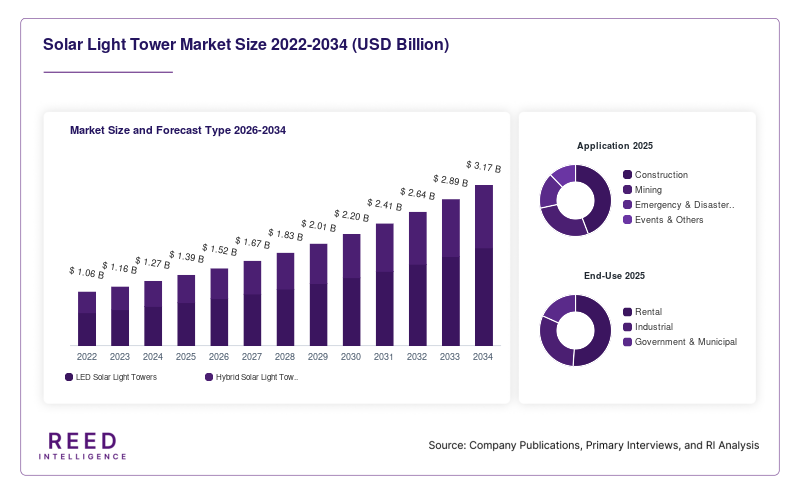
The LED solar light tower segment dominated the market in 2024, accounting for approximately 58.3% of the total share. LED technology offers higher energy efficiency, longer lifespan, and better illumination compared to traditional lighting systems. These advantages make LED-based solar light towers the preferred choice across construction and industrial applications. Additionally, the reduced energy consumption of LED lights allows for smaller solar panels and batteries, enhancing portability and cost-effectiveness.
The hybrid solar light tower segment is expected to grow at the fastest CAGR of 10.8% during the forecast period. The increasing need for reliable lighting in varying weather conditions is driving demand for hybrid systems that combine solar power with backup energy sources. These systems provide uninterrupted operation, making them suitable for critical applications such as mining and emergency response. Technological advancements in hybrid systems are further improving efficiency and performance.
By Application
The construction segment held the largest market share in 2024, accounting for around 46.2%. The demand for solar light towers in construction is driven by the need for portable and energy-efficient lighting solutions for nighttime operations. Solar-powered systems reduce fuel costs and emissions, making them an attractive option for contractors. The increasing focus on sustainable construction practices further supports the adoption of solar light towers in this segment.
The emergency and disaster relief segment is projected to grow at the fastest CAGR of 11.5%. The increasing frequency of natural disasters and the need for rapid deployment of lighting solutions are driving demand in this segment. Solar light towers are ideal for emergency applications due to their portability and independence from fuel supply chains. Government agencies and relief organizations are investing in solar-powered lighting systems to enhance disaster preparedness.
By End-Use
The rental segment dominated the market in 2024, accounting for approximately 52.7% of the total share. Rental companies play a crucial role in the market by providing cost-effective access to solar light towers for short-term projects. The growing preference for rental services is driven by the high initial cost of purchasing equipment and the need for flexibility in project-based operations.
The industrial segment is expected to grow at the fastest CAGR of 10.6% during the forecast period. The increasing adoption of solar light towers in mining, oil & gas, and other industrial applications is driving growth in this segment. The ability of solar systems to operate in remote and off-grid locations makes them suitable for industrial use. Additionally, the focus on reducing operational costs and environmental impact is encouraging industries to adopt solar-powered solutions.
Regional Analysis
North America
North America accounted for approximately 34.8% of the Solar Light Tower Market share in 2025 and is expected to grow at a CAGR of 8.9% during the forecast period. The region benefits from strong regulatory support for renewable energy adoption and a well-established construction sector. Increasing investments in infrastructure modernization and smart city projects are driving demand for energy-efficient lighting solutions. Additionally, the presence of leading manufacturers and rental service providers contributes to market growth.
The United States dominates the regional market, supported by extensive infrastructure development and strict environmental regulations. A unique growth factor in the country is the increasing adoption of solar-powered equipment by rental companies, which are expanding their fleets to meet customer demand for sustainable solutions. This trend is enhancing accessibility and accelerating market penetration across various industries.
Europe
Europe held a significant share of around 26.5% in 2025 and is projected to grow at a CAGR of 9.1%. The region’s commitment to reducing carbon emissions and promoting renewable energy adoption is a key factor supporting market growth. Government initiatives and subsidies for clean energy technologies are encouraging the use of solar light towers across construction and industrial applications.
Germany leads the European market, driven by its strong focus on sustainability and advanced infrastructure. A unique growth factor is the widespread adoption of green construction practices, which prioritize the use of low-emission equipment. This trend is driving demand for solar light towers in both public and private sector projects.
Asia Pacific
Asia Pacific is the fastest-growing region, with a projected CAGR of 11.2% and a market share of 22.4% in 2025. Rapid urbanization, industrialization, and infrastructure development are key drivers of growth in this region. The increasing need for reliable lighting solutions in remote and off-grid areas further supports demand for solar light towers.
China dominates the regional market, supported by large-scale infrastructure projects and government initiatives promoting renewable energy. A unique growth factor is the expansion of rural electrification programs, which are increasing the adoption of solar-powered lighting systems in underserved areas.
Middle East & Africa
The Middle East & Africa region accounted for approximately 9.6% of the market share in 2025 and is expected to grow at a CAGR of 10.3%. The region’s growth is driven by increasing construction activities and the need for reliable lighting solutions in remote areas. Solar light towers are particularly suitable for desert and off-grid environments.
Saudi Arabia leads the market in this region, driven by large-scale infrastructure projects under economic diversification plans. A unique growth factor is the increasing investment in renewable energy projects, which is promoting the adoption of solar-powered equipment across various sectors.
Latin America
Latin America held a market share of around 6.7% in 2025 and is projected to grow at a CAGR of 9.4%. The region is experiencing growth due to expanding construction and mining activities, particularly in remote locations where grid access is limited.
Brazil dominates the regional market, supported by ongoing infrastructure development and mining operations. A unique growth factor is the increasing adoption of solar solutions in rural and remote areas, where traditional energy sources are less accessible, driving demand for portable solar light towers.
Competitive Landscape
The Solar Light Tower Market is characterized by the presence of several global and regional players focusing on product innovation and strategic partnerships. Leading companies are investing in research and development to enhance the efficiency and performance of solar light towers. The market is moderately fragmented, with players competing on factors such as product quality, pricing, and technological advancements.
Atlas Copco AB is considered a leading player in the market, known for its advanced solar lighting solutions. The company has recently introduced a new range of hybrid solar light towers with improved battery efficiency and remote monitoring capabilities. Other companies are also expanding their product portfolios and strengthening their distribution networks to gain a competitive edge. The increasing focus on sustainability and renewable energy is expected to intensify competition in the market.
Key Players
- Atlas Copco AB
- Generac Power Systems Inc.
- Wacker Neuson SE
- Allmand Bros., Inc.
- Terex Corporation
- Doosan Portable Power
- Chicago Pneumatic
- Trime Group
- Larson Electronics LLC
- United Rentals, Inc.
- Herc Rentals Inc.
- J C Bamford Excavators Ltd
- Progressive Dynamics Inc.
- Greensky Mobile Power & Light
- Dragon Lighting
Recent Developments
- Atlas Copco AB launched an upgraded solar light tower series with enhanced lithium-ion battery systems and smart monitoring features.
- Generac Power Systems Inc. expanded its renewable product portfolio by introducing hybrid solar lighting solutions for construction applications.
- Wacker Neuson SE announced a partnership with a renewable energy firm to develop next-generation solar-powered equipment for industrial use.
Solar Light Tower Market Segments
Type
- LED Solar Light Towers
- Hybrid Solar Light Towers
Application
- Construction
- Mining
- Emergency & Disaster Relief
- Events & Others
End-Use
- Rental
- Industrial
- Government & Municipal
By Region
- North America
- Europe
- APAC
- Middle East and Africa
- LATAM