Solar Powered Agricultural Dryer Market Size, Share, Demand Report By Type (Direct Solar Dryer, Indirect Solar Dryer, Hybrid Solar Dryer), By Application (Fruits & Vegetables, Grains, Spices, Others), By End-Use (Small-Scale Farmers, Commercial Agribusinesses, Food Processing Units), By Region & Segment Forecasts, 2026–2034
USD 3950
Market Overview
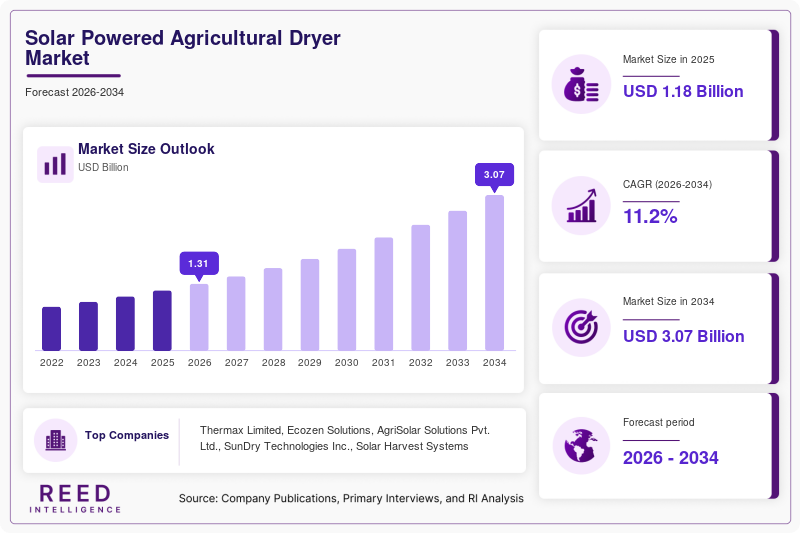
The Solar Powered Agricultural Dryer Market was valued at approximately USD 1.18 billion in 2026 and is projected to reach USD 2.76 billion by 2034, expanding at a CAGR of 11.2% during the forecast period (2026–2034). The market growth is largely driven by increasing demand for sustainable post-harvest solutions that reduce crop losses while lowering energy costs. Solar-powered dryers are gaining traction among farmers and agribusinesses due to their ability to improve product quality, extend shelf life, and minimize dependence on fossil fuels.
A major global factor supporting market expansion is the rising emphasis on renewable energy adoption in agriculture. Governments and international organizations are promoting clean energy technologies through subsidies, awareness programs, and rural electrification initiatives. This shift is encouraging small and medium-scale farmers to adopt solar drying systems as a cost-effective and environmentally responsible alternative to traditional drying methods.
Key Highlights
- North America dominated the market with a 32.8% share in 2025.
- Asia Pacific is expected to grow at the fastest CAGR of 12.6% during 2026–2034.
- By type, indirect solar dryers accounted for the largest share of 44.3%.
- while hybrid solar dryers are projected to grow at a CAGR of 13.2%.
- By application, fruits and vegetables led with a 46.5% share, whereas grains drying is expected to expand at a CAGR of 12.1%.
- India remained the dominant country, with market values of USD 210 million in 2024 and USD 238 million in 2025.
Market Trends
Increasing Adoption of Hybrid Solar Drying Systems
The market is witnessing a steady shift toward hybrid solar drying systems that combine solar energy with auxiliary power sources such as biomass or electricity. These systems address the limitations of conventional solar dryers, particularly their dependence on weather conditions. Hybrid models ensure continuous drying even during cloudy or rainy periods, improving operational efficiency and output consistency. This trend is particularly prominent in regions with fluctuating climatic conditions, where farmers require reliable drying solutions. Manufacturers are integrating advanced temperature control systems and automated airflow mechanisms to enhance performance. As a result, hybrid solar dryers are becoming a preferred choice for commercial-scale agricultural operations.
Integration of Smart Monitoring and IoT Technologies
Another notable trend is the integration of smart technologies such as IoT sensors and remote monitoring systems in solar dryers. These innovations allow users to track temperature, humidity, and drying time in real time, improving process control and reducing product spoilage. Smart solar dryers are increasingly being adopted in export-oriented agricultural sectors where quality consistency is critical. Data-driven insights enable farmers to optimize drying cycles and enhance productivity. Additionally, mobile-based applications are being developed to provide alerts and performance analytics, making the technology more accessible. This trend reflects the broader digital transformation occurring in agriculture, contributing to improved efficiency and scalability.
Market Drivers
Rising Demand for Post-Harvest Loss Reduction
Post-harvest losses remain a major challenge in the agricultural sector, particularly in developing countries where infrastructure limitations persist. Solar-powered agricultural dryers offer an efficient solution to this issue by enabling controlled drying conditions that preserve product quality and reduce spoilage. Farmers are increasingly recognizing the economic benefits of minimizing losses, especially for perishable commodities such as fruits and vegetables. Governments and NGOs are also promoting the adoption of solar drying technologies through training programs and financial incentives. As awareness grows, the demand for reliable drying systems is expected to increase, driving market expansion.
Growing Focus on Renewable Energy in Agriculture
The global shift toward renewable energy is significantly influencing the adoption of solar-powered technologies in agriculture. Rising fuel costs and environmental concerns are prompting farmers to explore alternative energy sources. Solar dryers provide a sustainable and cost-effective solution, particularly in off-grid and rural areas where access to electricity is limited. Policy support in the form of subsidies, tax benefits, and funding initiatives is further accelerating adoption. Additionally, international efforts to reduce carbon emissions are encouraging the use of clean energy technologies across industries. This alignment with sustainability goals is a key driver for the solar powered agricultural dryer market.
Market Restraint
High Initial Investment and Limited Awareness
Despite the long-term benefits, the high initial cost of solar-powered agricultural dryers remains a significant barrier to widespread adoption. Small and marginal farmers often lack the financial resources to invest in advanced drying systems, especially in regions with limited access to credit facilities. While government subsidies exist in some countries, they are not uniformly available or sufficient to offset the upfront costs. Additionally, a lack of awareness about the benefits and operational efficiency of solar dryers further limits market penetration. Many farmers continue to rely on traditional open-air drying methods due to familiarity and lower initial costs. This reliance on conventional techniques can slow the adoption of modern technologies. Addressing these challenges requires increased investment in awareness campaigns, training programs, and financial support mechanisms. Without such measures, the market may face constraints in achieving its full growth potential.
Market Opportunities
Expansion in Emerging Economies
Emerging economies present significant growth opportunities for the solar powered agricultural dryer market due to their large agricultural base and increasing focus on modernization. Countries in Asia, Africa, and Latin America are investing in improving post-harvest infrastructure to enhance food security and reduce waste. Solar dryers are particularly suitable for these regions due to abundant sunlight and limited access to conventional energy sources. Government initiatives aimed at rural development and sustainable agriculture are creating a favorable environment for market expansion. Partnerships between private companies and development organizations are also facilitating technology adoption. This trend is expected to drive substantial growth in underserved markets.
Development of Portable and Low-Cost Dryer Solutions
The development of portable and affordable solar drying solutions is another promising opportunity for market players. Manufacturers are focusing on designing compact and cost-effective systems that cater to small-scale farmers and local cooperatives. These solutions are easier to install, operate, and maintain, making them accessible to a broader user base. Innovations in materials and design are helping reduce production costs without compromising efficiency. Portable dryers also enable farmers to process crops directly at the farm level, reducing transportation costs and improving profitability. This segment is expected to witness strong growth as companies target rural and remote markets.
Segmental Analysis
By Type
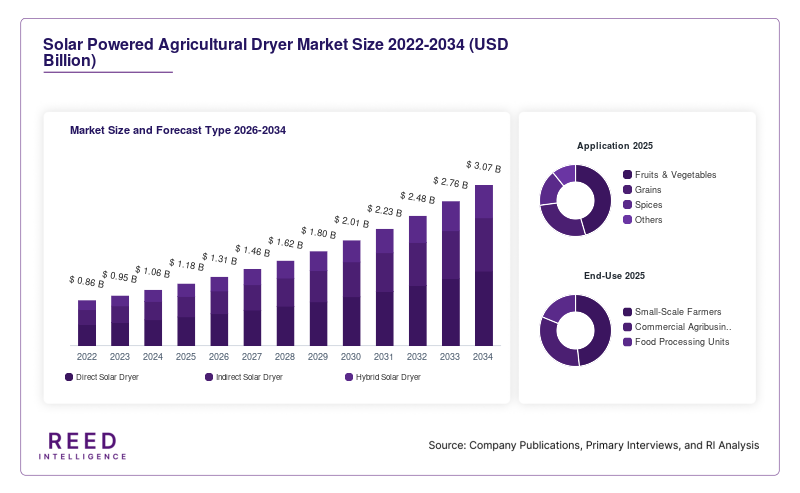
Indirect solar dryers held the dominant position in 2024, accounting for approximately 44.3% of the market share. These systems are widely preferred due to their ability to protect agricultural products from direct sunlight, thereby preserving color, nutrients, and overall quality. Indirect dryers operate by heating air through solar collectors and circulating it through the drying chamber, ensuring controlled drying conditions. This method is particularly suitable for high-value crops such as fruits and spices, where quality retention is critical. The reliability and efficiency of indirect solar dryers have made them a standard choice across both small-scale and commercial agricultural operations.
Hybrid solar dryers are projected to be the fastest-growing subsegment, with a CAGR of 13.2% during the forecast period. The growth of this segment is driven by the need for consistent drying performance regardless of weather conditions. Hybrid systems incorporate additional heat sources such as biomass or electricity, enabling continuous operation. This feature is particularly beneficial in regions with variable climate patterns. Increasing demand for scalable and efficient drying solutions in commercial agriculture is further supporting the adoption of hybrid systems. Technological advancements and decreasing costs are expected to accelerate growth in this segment.
By Application
The fruits and vegetables segment dominated the market in 2024, holding a 46.5% share. This dominance is attributed to the high perishability of these products and the need for effective preservation methods. Solar dryers help maintain the nutritional value and extend the shelf life of fruits and vegetables, making them suitable for both domestic consumption and export. The growing demand for dried food products and snacks is also contributing to segment growth. Farmers and food processors are increasingly adopting solar dryers to enhance product quality and reduce post-harvest losses.
The grains segment is expected to grow at the fastest CAGR of 12.1% during the forecast period. The growth is driven by the increasing need for efficient grain drying to prevent spoilage and maintain quality during storage. Solar dryers provide a cost-effective solution for drying large quantities of grains, particularly in regions with abundant sunlight. Government initiatives promoting food security and storage efficiency are further supporting the adoption of solar drying technologies in this segment. The scalability of solar dryers makes them suitable for both small and large-scale grain processing operations.
By End-Use
The small-scale farmers segment held the largest share in 2024, accounting for 52.7% of the market. This dominance is due to the widespread use of solar dryers among individual farmers and cooperatives. These users benefit from the cost savings and improved product quality offered by solar drying technologies. The availability of affordable and portable solutions has further increased adoption among small-scale farmers. Government support and awareness programs are also playing a key role in promoting the use of solar dryers in this segment.
Commercial agribusinesses are expected to be the fastest-growing subsegment, with a CAGR of 12.8%. The growth is driven by the increasing demand for large-scale and efficient drying solutions. Agribusinesses require reliable systems to process high volumes of agricultural products while maintaining quality standards. Solar dryers offer a sustainable and cost-effective alternative to conventional drying methods. The integration of advanced technologies and automation is further enhancing the efficiency of these systems, making them suitable for commercial applications.
Regional Analysis
North America
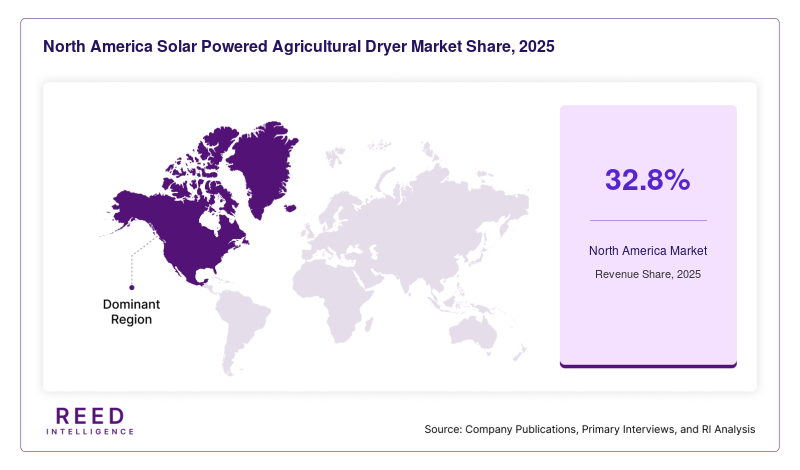
North America accounted for a 32.8% share of the solar powered agricultural dryer market in 2025 and is expected to grow at a CAGR of 10.4% during the forecast period. The region benefits from advanced agricultural infrastructure and increasing adoption of renewable energy technologies. Government incentives and sustainability initiatives are encouraging farmers to integrate solar-powered solutions into their operations. The presence of established agribusinesses and strong distribution networks further supports market growth.
The United States dominates the regional market, driven by its focus on sustainable farming practices and technological innovation. One key growth factor is the increasing demand for organic and high-quality agricultural products, which require efficient drying processes. Farmers are adopting solar dryers to maintain product quality while reducing energy costs, contributing to steady market expansion.
Europe
Europe held a 24.6% market share in 2025 and is projected to grow at a CAGR of 9.8% during the forecast period. The region’s strong emphasis on environmental sustainability and renewable energy adoption is driving market growth. Policies aimed at reducing carbon emissions and promoting clean energy solutions are encouraging the use of solar dryers in agriculture.
Germany leads the European market due to its advanced renewable energy infrastructure and supportive government policies. A unique growth factor is the increasing adoption of energy-efficient technologies in food processing industries. Solar dryers are being used to improve efficiency and reduce environmental impact, supporting the region’s sustainability goals.
Asia Pacific
Asia Pacific is expected to register the fastest CAGR of 12.6% from 2026 to 2034, with a market share of 21.5% in 2025. The region’s large agricultural base and high levels of post-harvest losses are driving demand for efficient drying solutions. Governments are actively promoting solar technologies to improve rural livelihoods and reduce energy dependency.
India dominates the Asia Pacific market, supported by government initiatives and abundant solar resources. A key growth factor is the increasing adoption of solar dryers among small and marginal farmers to reduce crop losses and improve income. Awareness programs and subsidies are further accelerating market penetration in rural areas.
Middle East & Africa
The Middle East & Africa region accounted for 11.2% of the market in 2025 and is expected to grow at a CAGR of 11.8%. The region’s high solar irradiance levels make it ideal for solar-powered technologies. Agricultural modernization efforts and increasing investments in renewable energy are supporting market growth.
South Africa is a leading market in the region, driven by its focus on improving agricultural productivity. A unique growth factor is the growing use of solar dryers in small-scale farming communities to reduce food spoilage. This adoption is helping enhance food security and economic stability in rural areas.
Latin America
Latin America held a market share of 9.9% in 2025 and is projected to grow at a CAGR of 10.9%. The region’s agricultural sector is expanding, with increasing focus on improving post-harvest processes. Solar dryers are gaining popularity as a cost-effective solution for preserving crops.
Brazil dominates the regional market, supported by its large agricultural output. A key growth factor is the rising demand for processed agricultural products, which requires efficient drying technologies. Solar dryers are being adopted to improve product quality and meet export standards, driving market growth.
Competitive Landscape
The solar powered agricultural dryer market is characterized by the presence of several regional and global players focusing on innovation and product development. Key companies are investing in research and development to improve efficiency, reduce costs, and expand their product portfolios. Strategic partnerships and collaborations with government agencies and non-profit organizations are also common, aimed at increasing market penetration in emerging economies.
One of the leading players in the market is Thermax Limited, known for its advanced solar thermal solutions and strong presence in developing regions. The company has recently introduced an upgraded hybrid solar dryer system designed for commercial-scale applications, enhancing drying efficiency and reliability. Other major players are focusing on expanding their distribution networks and offering customized solutions to cater to diverse agricultural needs. The competitive landscape is expected to remain dynamic, with continuous innovation driving market growth.
Key Players List
- Thermax Limited
- AgriSolar Solutions Pvt. Ltd.
- SunDry Technologies Inc.
- Solar Harvest Systems
- Ecozen Solutions
- GreenAgroTech
- DryTech International
- SunCrop Innovations
- EnSol Agro Systems
- Solar Dryer Technologies LLC
- AgriTech Solar Solutions
- EcoDry Systems
- SolarFlex Agro
- Harvest Sun Energy
- AgroSun Dryers
Recent Developments
- In 2025, Thermax Limited launched a hybrid solar dryer with enhanced thermal efficiency for large-scale agricultural applications.
- In 2024, Ecozen Solutions partnered with rural development agencies to deploy solar dryers across multiple farming communities in Asia.
- In 2025, SunDry Technologies introduced a portable solar dryer model targeting small-scale farmers in emerging markets.
Solar Powered Agricultural Dryer Market Segments
Type
- Direct Solar Dryer
- Indirect Solar Dryer
- Hybrid Solar Dryer
Application
- Fruits & Vegetables
- Grains
- Spices
- Others
End-Use
- Small-Scale Farmers
- Commercial Agribusinesses
- Food Processing Units
By Region
- North America
- Europe
- APAC
- Middle East and Africa
- LATAM