Solar Roadway Market Size, Share & Demand Report By Technology (Photovoltaic Solar Roadways, Thermal Solar Roadways, Hybrid Solar Roadway Systems), By Application (Highways and Roads, Parking Lots, Bicycle Paths), By End Use (Public Infrastructure, Commercial Infrastructure, Industrial Infrastructure), By Component (Solar Panels, Energy Storage Systems, LED Lighting Systems), By Region & Segment Forecasts, 2026–2034
USD 3950
Market Overview
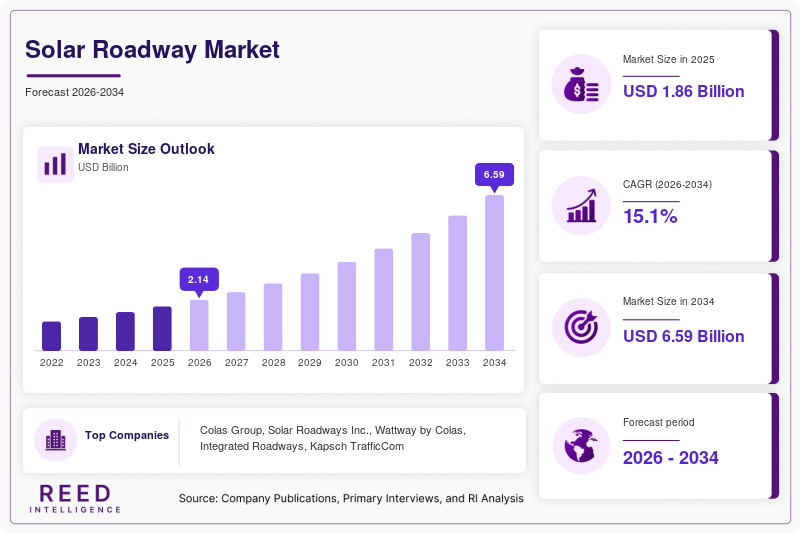
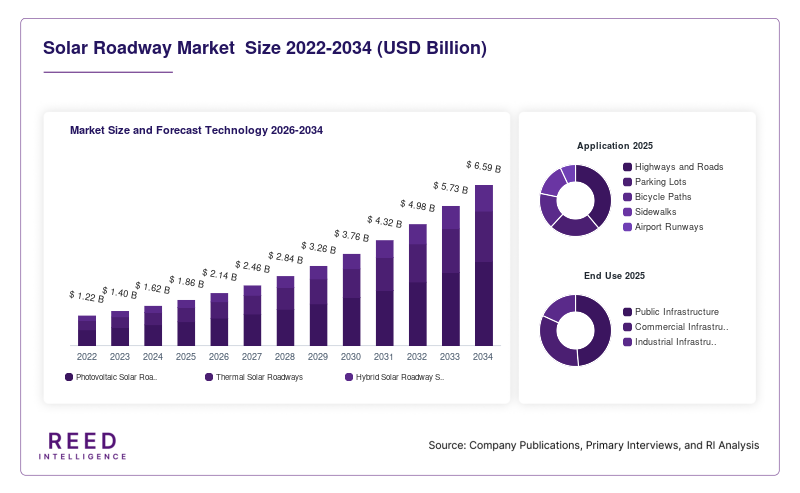
The Solar Roadway Market Size was valued at approximately USD 1.86 billion in 2026 and is projected to reach USD 5.74 billion by 2034, expanding at a CAGR of 15.1% during the forecast period from 2026 to 2034. The global Solar Roadway Market growth has been supported by increasing investments in renewable energy infrastructure and the growing focus on sustainable transportation systems worldwide. Governments and urban development authorities are increasingly adopting clean energy technologies to reduce carbon emissions and improve energy efficiency in public infrastructure projects.
The Solar Roadway Market has gained significant attention due to rising demand for multifunctional infrastructure capable of generating electricity while supporting transportation activities. Solar roadways integrate photovoltaic panels into roads, highways, parking areas, sidewalks, and cycling tracks, allowing energy generation from unused surface spaces. These systems contribute to energy diversification while supporting smart city initiatives and sustainable urban planning programs.
Key Highlights
- Europe accounted for 35.8% of the global Solar Roadway Market share in 2025, while Asia Pacific is projected to register the fastest CAGR of 16.8% during 2026–2034.
- By technology, photovoltaic solar roadways dominated the market with a 54.6% share in 2025, while hybrid solar roadway systems are forecast to grow at a CAGR of 17.5%.
- By application, highways and roads represented the leading segment with 46.9% market share in 2025, whereas parking lots are expected to expand at a CAGR of 16.9%.
- By end use, public infrastructure held 63.2% of the market share in 2025, while commercial infrastructure is projected to grow at a CAGR of 16.2%.
- France remained the dominant country market, valued at USD 214 million in 2024 and USD 238 million in 2025.
Market Trends
Integration of Smart Transportation Technologies
Smart transportation infrastructure has become a major trend influencing the Solar Roadway Market. Governments and municipal authorities are increasingly integrating smart lighting systems, traffic monitoring technologies, and connected transportation networks into roadway infrastructure projects. Solar roadways are being designed with embedded LED indicators, temperature sensors, and traffic management capabilities to improve transportation efficiency and road safety.
The integration of intelligent infrastructure systems is particularly visible in urban smart city projects. Advanced solar roadway technologies can support automated traffic guidance, dynamic road markings, and energy-efficient lighting systems, creating additional value beyond electricity generation.
Rising Adoption of Modular Solar Panels
Manufacturers are increasingly focusing on modular solar roadway panels that simplify installation and maintenance procedures. Modular systems enable damaged sections to be replaced individually without disrupting entire roadway operations. This trend has improved the scalability and operational flexibility of solar roadway infrastructure projects.
The Solar Roadway Market is also benefiting from advancements in lightweight photovoltaic materials and high-strength tempered glass technologies. These innovations are improving panel durability while reducing installation complexity and maintenance costs.
Market Drivers
Increasing Government Investments in Renewable Infrastructure
Governments across multiple regions are investing heavily in renewable energy infrastructure to support decarbonization goals and sustainable urban development. Solar roadway projects are increasingly included in national clean energy strategies due to their ability to generate renewable electricity without requiring additional land resources.
Public funding initiatives and renewable energy incentives have encouraged municipalities and infrastructure developers to explore solar-integrated transportation systems. These investments continue to support the expansion of the Solar Roadway Market globally.
Growing Demand for Energy-Efficient Urban Infrastructure
Urbanization and rising energy consumption have increased the need for efficient infrastructure systems capable of supporting sustainable city development. Solar roadways provide a dual-function solution by combining transportation infrastructure with renewable energy generation capabilities.
The Solar Roadway Market has therefore experienced rising interest from city planners and transportation agencies seeking innovative solutions for reducing operational energy costs and improving environmental sustainability.
Market Restraint
High Installation and Maintenance Costs
The Solar Roadway Market faces significant challenges associated with high installation expenses and complex maintenance requirements. Solar roadway systems require advanced engineering materials, specialized installation procedures, and continuous monitoring systems, which increase project costs compared to conventional road infrastructure.
Market Opportunities
Expansion of Electric Vehicle Charging Infrastructure
The growing adoption of electric vehicles is creating new opportunities for the Solar Roadway Market. Solar-integrated roads and parking areas can support decentralized charging infrastructure by generating renewable electricity for EV charging stations.
This opportunity is expected to gain importance as governments continue expanding EV charging networks and promoting low-emission transportation systems.
Development of Smart Highways
The increasing development of smart highways presents strong growth opportunities for solar roadway manufacturers. Transportation agencies are investing in connected road systems capable of supporting autonomous vehicles, intelligent traffic management, and renewable energy integration.
Solar roadway technologies can contribute to energy-efficient highway operations while supporting smart mobility infrastructure initiatives.
Segmental Analysis
By Technology
Photovoltaic Solar Roadways Dominated the Market
Photovoltaic solar roadways accounted for 54.6% of the Solar Roadway Market share in 2025. Their dominance was attributed to widespread adoption of photovoltaic energy generation systems and increasing infrastructure pilot projects utilizing solar panel integration.
These systems offered efficient electricity generation capabilities and compatibility with smart grid infrastructure, supporting broader commercial deployment.
Hybrid Solar Roadway Systems to Witness Fastest Growth
Hybrid solar roadway systems are projected to grow at a CAGR of 17.5% during the forecast period. Growth will be driven by increasing integration of energy storage systems, smart sensors, and intelligent transportation technologies within roadway infrastructure.
The ability to combine energy generation with data monitoring and traffic management functions is expected to strengthen demand for hybrid systems.
By Application
Highways and Roads Held the Largest Share
Highways and roads represented 46.9% of the Solar Roadway Market share in 2025 because of growing government initiatives focused on renewable transportation infrastructure. Public authorities increasingly explored solar roadway deployment along major transportation corridors to improve energy efficiency.
Parking Lots to Grow Rapidly
Parking lots are forecast to expand at a CAGR of 16.9% through 2034. Growth will be supported by increasing installation of solar-integrated parking systems in commercial complexes, airports, and public transportation hubs.
These applications provide controlled operational environments that simplify installation and maintenance processes.
By End Use
Public Infrastructure Dominated the Market
Public infrastructure accounted for 63.2% of the Solar Roadway Market share in 2025. Government agencies increasingly adopted solar roadway systems for highways, public parking facilities, and urban transportation projects.
The focus on reducing carbon emissions and improving renewable energy generation supported continued investment in public infrastructure applications.
Commercial Infrastructure to Register Strong Expansion
Commercial infrastructure is expected to grow at a CAGR of 16.2% during the forecast period. Growth will be driven by increasing adoption of renewable energy systems across shopping centers, industrial parks, airports, and logistics facilities.
Businesses are increasingly investing in sustainable infrastructure to improve energy efficiency and meet environmental objectives.
By Component
Solar Panels Segment Led the Market
Solar panels captured 44.1% of the market share in 2025 because of their central role in energy generation within roadway systems. Manufacturers focused on improving panel efficiency, durability, and traffic load resistance.
Energy Storage Systems to Expand Significantly
Energy storage systems are projected to grow at a CAGR of 17.1% through 2034. Their growth will be supported by increasing demand for reliable electricity storage solutions capable of supporting continuous roadway energy supply and smart infrastructure operations.
Regional Analysis
North America
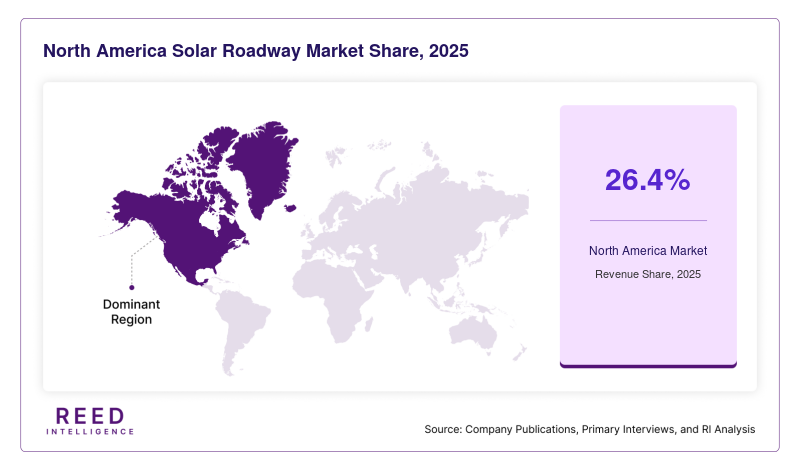
North America held 26.4% of the global Solar Roadway Market share in 2025 and will grow at a CAGR of 14.2% through 2034. The regional market expanded steadily due to increasing investments in renewable infrastructure and smart transportation projects.
The United States dominated the regional market because of strong government support for clean energy innovation and increasing pilot projects involving solar-integrated roads and parking systems.
Europe
Europe accounted for 35.8% of the Solar Roadway Market share in 2025 and will register a CAGR of 14.7% during the forecast period. The region maintained its leading position due to aggressive renewable energy targets and increasing adoption of sustainable transportation infrastructure.
France emerged as the dominant country because of extensive investment in solar roadway pilot programs and strong focus on energy-efficient public infrastructure development.
Asia Pacific
Asia Pacific represented 24.3% of the global Solar Roadway Market share in 2025 and will witness the fastest CAGR of 16.8% through 2034. Rapid urbanization and large-scale smart city projects accelerated regional market growth.
China dominated the market because of significant renewable energy investments and expansion of sustainable transportation infrastructure projects. Government-backed clean energy initiatives further strengthened demand for solar roadway systems.
Middle East & Africa
Middle East & Africa captured 7.5% of the Solar Roadway Market share in 2025 and will grow at a CAGR of 13.9% during the forecast period. Rising investments in sustainable urban infrastructure and smart mobility projects supported regional expansion.
The United Arab Emirates led the market because of increasing smart city developments and renewable energy diversification strategies.
Latin America
Latin America accounted for 6.0% of the global Solar Roadway Market share in 2025 and will expand at a CAGR of 13.4% through 2034. The regional market experienced gradual growth because of increasing renewable infrastructure investments and modernization of urban transportation systems.
Brazil remained the dominant country due to rising public infrastructure initiatives and growing adoption of renewable energy technologies in urban development projects.
Competitive Landscape
The Solar Roadway Market remains moderately fragmented, with companies focusing on renewable infrastructure innovation, strategic partnerships, and smart transportation technologies. Market participants are investing heavily in advanced photovoltaic materials, modular roadway systems, and intelligent infrastructure integration.
Colas Group remained one of the leading participants in the Solar Roadway Market due to its strong expertise in road construction and renewable transportation infrastructure. The company recently expanded deployment of solar-integrated roadway pilot projects focused on improving renewable energy generation efficiency.
Other companies are emphasizing durable surface engineering, modular panel development, and integrated smart traffic technologies to strengthen their market position.
Key Players List
- Colas Group
- Solar Roadways Inc.
- Wattway by Colas
- Integrated Roadways
- Kapsch TrafficCom
- Siemens AG
- Schneider Electric
- Panasonic Corporation
- Bosch Mobility Solutions
- ABB Ltd.
- EnGoPlanet
- SolaRoad
- Heijmans N.V.
- VolkerWessels
- Ferrovial
Recent Developments
- Colas Group expanded solar roadway pilot installations across urban transportation projects in Europe.
- Solar Roadways Inc. introduced upgraded roadway panels with improved traction and energy conversion efficiency.
- Integrated Roadways strengthened partnerships focused on smart highway infrastructure development.
- Siemens AG invested in intelligent transportation technologies integrated with renewable energy systems.
- Schneider Electric developed advanced energy management platforms for solar roadway applications.
- EnGoPlanet expanded smart solar pathway deployment projects in urban public infrastructure.
- Panasonic Corporation increased research activities related to durable photovoltaic roadway materials.
- ABB Ltd. introduced integrated power management systems for renewable transportation infrastructure applications.
Solar Roadway Market Segments
Technology
- Photovoltaic Solar Roadways
- Thermal Solar Roadways
- Hybrid Solar Roadway Systems
Application
- Highways and Roads
- Parking Lots
- Bicycle Paths
- Sidewalks
- Airport Runways
End Use
- Public Infrastructure
- Commercial Infrastructure
- Industrial Infrastructure
Component
- Solar Panels
- Energy Storage Systems
- LED Lighting Systems
- Smart Sensors and Controllers
By Region
- North America
- Europe
- APAC
- Middle East and Africa
- LATAM