Solar Train Market Size, Share & Demand Report By Train Type (Hybrid Solar-Electric Trains, Fully Solar-Powered Trains), By Application (Passenger Transport, Freight Transport), By Component (Solar Panels, Energy Storage Systems, Control Systems), By Region & Segment Forecasts, 2026–2034
USD 3950
Market Overview
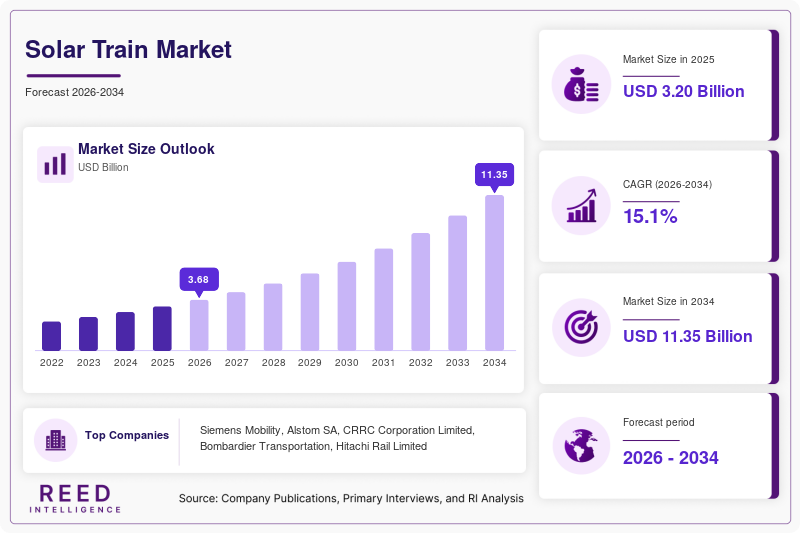
The global Solar Train Market size was valued at approximately USD 3.2 billion in 2026 and is projected to reach USD 9.8 billion by 2034, expanding at a CAGR of 15.1% during the forecast period (2026–2034). The market is gaining traction as governments and rail operators focus on reducing carbon emissions and energy costs in public transportation systems. Solar-powered trains, which integrate photovoltaic panels into rail infrastructure or train roofs, are emerging as a sustainable alternative to conventional diesel and electric trains.
A key global factor supporting market growth is the increasing commitment to decarbonization across the transportation sector. National climate policies and international sustainability targets have accelerated investments in renewable-powered rail systems. Solar trains reduce dependency on fossil fuels while lowering operational expenses over time, making them an attractive solution for both developed and emerging economies.
Key Highlights
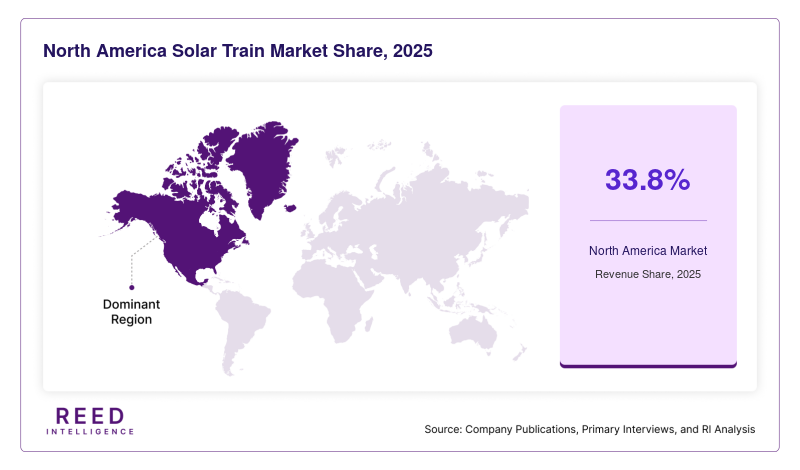
- North America dominated the market with a 33.8% share in 2025.
- Asia Pacific is expected to grow at the fastest CAGR of 16.4% during 2026–2034.
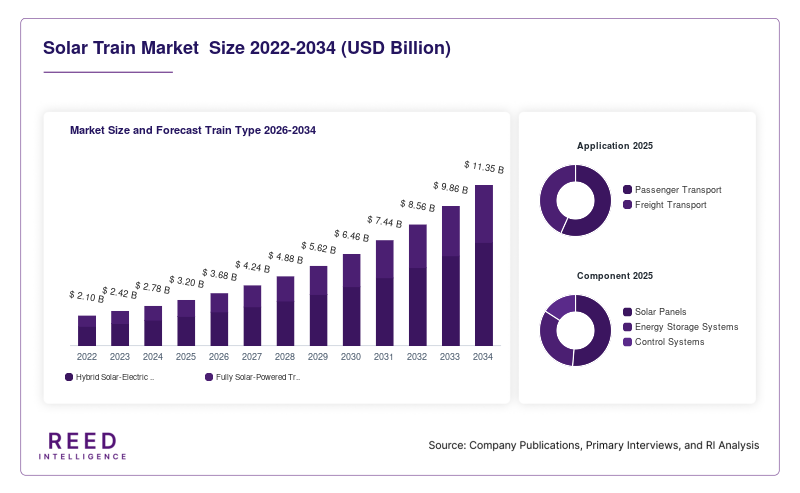
- By train type, hybrid solar-electric trains accounted for the largest share of 44.6%.
- while fully solar-powered trains are projected to grow at a CAGR of 17.2%.
- By application, passenger transport led with a 58.9% share, whereas freight transport is expected to expand at a CAGR of 15.8%.
- The United States remained the dominant country, with market values of USD 620 million in 2024 and USD 710 million in 2025.
Market Trends
Integration of Solar Panels with Advanced Energy Storage Systems
One of the notable trends in the Solar Train Market is the integration of photovoltaic systems with advanced battery storage technologies. Rail operators are increasingly deploying high-capacity lithium-ion and solid-state batteries to store solar energy generated during peak sunlight hours. This stored energy is then used during non-solar periods, ensuring uninterrupted train operations. The trend is particularly relevant for regions with variable sunlight conditions, where consistent power supply is critical. Additionally, the development of energy management systems allows operators to optimize power usage, reduce wastage, and enhance efficiency. As battery costs decline and performance improves, this integration is expected to become a standard feature across solar-powered rail systems, supporting long-term market growth.
Expansion of Solar Rail Infrastructure in Emerging Economies
Emerging economies are increasingly investing in solar rail infrastructure as part of broader transportation modernization initiatives. Governments in Asia Pacific, Latin America, and parts of Africa are focusing on cost-effective and sustainable solutions to expand their rail networks. Solar-powered trains provide a viable alternative in regions where grid connectivity is limited or unreliable. Additionally, international funding agencies and public-private partnerships are supporting large-scale solar rail projects. This trend is driving the adoption of modular solar installations along railway tracks and stations, enabling scalable deployment. As infrastructure development accelerates, emerging markets are expected to play a significant role in shaping the future landscape of the Solar Train Market.
Market Drivers
Increasing Focus on Carbon Emission Reduction in Transportation
The rising emphasis on reducing greenhouse gas emissions is a major driver of the Solar Train Market. Governments worldwide are implementing strict environmental regulations to curb emissions from transportation, which is a significant contributor to global carbon output. Solar-powered trains offer a clean and renewable energy solution that aligns with these regulatory goals. By replacing diesel-powered locomotives and supplementing electric systems with solar energy, rail operators can significantly reduce their carbon footprint. This transition is further supported by subsidies, tax incentives, and policy frameworks that encourage the adoption of renewable energy technologies. As environmental concerns continue to grow, the demand for sustainable rail solutions is expected to increase, driving market expansion.
Rising Energy Costs and Demand for Cost-Efficient Operations
The increasing cost of conventional energy sources is prompting rail operators to explore alternative energy solutions. Solar energy provides a cost-effective option by reducing reliance on external power sources and minimizing operational expenses over time. Although the initial investment in solar infrastructure may be high, the long-term savings in fuel and electricity costs make it economically viable. Additionally, advancements in solar technology have improved efficiency and reduced installation costs, making solar trains more accessible. This driver is particularly significant for developing regions where energy costs are volatile and infrastructure budgets are constrained. As operators seek to optimize costs and improve efficiency, the adoption of solar-powered trains is expected to grow steadily.
Market Restraint
High Initial Investment and Infrastructure Limitations
Despite the growing adoption of solar-powered trains, high initial investment remains a significant restraint in the Solar Train Market. The installation of photovoltaic panels, energy storage systems, and supporting infrastructure requires substantial capital expenditure. For many rail operators, especially in developing regions, securing funding for such projects can be challenging. Additionally, existing rail networks may not be compatible with solar integration, necessitating costly upgrades or modifications. This includes reinforcing train roofs, installing trackside solar panels, and upgrading electrical systems to handle variable energy inputs.
Another limitation is the dependency on geographic and climatic conditions. Regions with limited sunlight may not achieve optimal energy generation, reducing the efficiency and economic viability of solar train systems. For instance, countries with long winters or frequent cloud cover may face challenges in maintaining consistent energy output. These factors can deter investment and slow down market growth. To overcome these challenges, stakeholders are exploring hybrid models and government-backed financing solutions. However, until costs decrease further and infrastructure becomes more adaptable, these barriers are likely to impact the pace of adoption.
Market Opportunities
Development of Smart Solar Rail Networks
The emergence of smart rail networks presents a significant opportunity for the Solar Train Market. By integrating solar power systems with digital technologies such as IoT, AI, and predictive analytics, rail operators can optimize energy usage and improve operational efficiency. Smart systems can monitor energy generation, storage, and consumption in real time, enabling better decision-making. This approach also supports predictive maintenance, reducing downtime and maintenance costs. As cities move toward smart infrastructure development, the demand for intelligent and sustainable transportation solutions is expected to rise. Solar-powered trains, combined with smart technologies, can play a crucial role in this transformation, creating new growth avenues for market participants.
Expansion of Solar-Powered Freight Transportation
While passenger transport currently dominates the market, the expansion of solar-powered freight transportation offers substantial growth potential. Freight trains consume large amounts of energy, making them ideal candidates for solar integration. By adopting solar energy, logistics companies can reduce operational costs and improve sustainability. This is particularly relevant as global trade increases and demand for efficient freight transportation grows. Additionally, the use of solar-powered trains in remote or off-grid areas can enhance connectivity and support economic development. As technology advances and infrastructure improves, the adoption of solar-powered freight trains is expected to increase, contributing to overall market growth.
Segmental Analysis
By Train Type
Hybrid solar-electric trains dominated the Solar Train Market in 2024, accounting for a share of 44.6%. These systems combine solar energy with conventional electric power, ensuring reliable performance even in varying weather conditions. The dominance of this segment can be attributed to its flexibility and compatibility with existing rail infrastructure. Hybrid systems allow operators to gradually transition to renewable energy without significant disruptions. Additionally, they offer improved efficiency by utilizing solar energy during peak sunlight hours and switching to electric power when needed. This adaptability makes hybrid trains a preferred choice for many rail operators, particularly in regions with inconsistent sunlight availability.
Fully solar-powered trains are expected to be the fastest-growing subsegment, with a projected CAGR of 17.2% during the forecast period. The growth of this segment is driven by advancements in solar panel efficiency and energy storage technologies. As these technologies continue to improve, fully solar-powered trains are becoming more viable for large-scale deployment. Additionally, increasing environmental awareness and government support for renewable energy are encouraging the adoption of fully solar systems. These trains offer significant cost savings and environmental benefits, making them an attractive option for future rail networks.
By Application
Passenger transport held the largest share of 58.9% in 2024, driven by the increasing demand for sustainable public transportation solutions. Urbanization and population growth have led to higher demand for efficient and eco-friendly transit systems. Solar-powered passenger trains help reduce carbon emissions while providing reliable transportation services. Additionally, government initiatives aimed at promoting public transportation and reducing traffic congestion are supporting the growth of this segment. The integration of solar energy with passenger trains also enhances energy efficiency, making them a preferred choice for urban and suburban transit systems.
Freight transport is projected to be the fastest-growing subsegment, with a CAGR of 15.8% during the forecast period. The growth of this segment is driven by the increasing demand for efficient logistics and transportation solutions. Solar-powered freight trains offer significant cost savings by reducing fuel consumption and operational expenses. Additionally, they support sustainability goals by lowering carbon emissions. The expansion of global trade and the need for reliable transportation networks are further driving the adoption of solar-powered freight trains. As infrastructure improves and technology advances, this segment is expected to witness substantial growth.
By Component
Solar panels accounted for the largest share of 39.7% in 2024, driven by their critical role in energy generation. The efficiency and performance of solar panels directly impact the overall effectiveness of solar-powered trains. Advances in photovoltaic technology have improved energy conversion rates, making solar panels more efficient and cost-effective. Additionally, the development of lightweight and flexible panels has enabled their integration into train structures without compromising performance. These factors contribute to the dominance of the solar panel segment in the market.
Energy storage systems are expected to be the fastest-growing subsegment, with a CAGR of 16.6% during the forecast period. The growth of this segment is driven by the need for reliable energy storage solutions to ensure continuous train operations. Advanced battery technologies, such as lithium-ion and solid-state batteries, are improving storage capacity and efficiency. These systems enable trains to store excess solar energy and use it during periods of low sunlight. As the demand for efficient energy management solutions increases, the adoption of advanced storage systems is expected to grow significantly.
Regional Analysis
North America
North America held a significant share of 33.8% in the Solar Train Market in 2025 and is projected to grow at a CAGR of 13.9% during the forecast period. The region benefits from advanced rail infrastructure and strong investments in renewable energy technologies. Government initiatives aimed at reducing carbon emissions and promoting sustainable transportation have played a key role in driving market growth. Additionally, the presence of established rail operators and technology providers supports the adoption of solar-powered systems across the region.
The United States dominates the North American market, driven by substantial investments in clean energy and transportation modernization. A unique growth factor is the integration of solar energy with existing electrified rail systems, allowing operators to enhance efficiency without overhauling infrastructure. Federal funding programs and state-level incentives further encourage adoption, making the U.S. a key contributor to regional growth.
Europe
Europe accounted for approximately 27.6% of the market share in 2025 and is expected to grow at a CAGR of 14.5% through 2034. The region’s strong commitment to sustainability and stringent environmental regulations have accelerated the adoption of solar-powered trains. European countries are actively investing in renewable energy projects and upgrading their rail networks to align with climate goals. The presence of advanced technology and innovation hubs further supports market expansion.
Germany leads the European market, supported by its focus on renewable energy integration and efficient public transportation systems. A unique growth factor is the development of solar-powered rail corridors, where solar panels are installed along tracks to generate energy. This approach enhances energy efficiency and supports large-scale deployment, contributing to market growth in the region.
Asia Pacific
Asia Pacific is the fastest-growing region in the Solar Train Market, with a CAGR of 16.4% during the forecast period and a market share of 24.3% in 2025. Rapid urbanization, population growth, and increasing demand for efficient transportation systems are driving market expansion. Governments in the region are investing heavily in rail infrastructure and renewable energy projects, creating favorable conditions for solar train adoption.
China dominates the Asia Pacific market, driven by large-scale infrastructure projects and government support for clean energy initiatives. A unique growth factor is the deployment of solar-powered high-speed rail networks, which enhance efficiency and reduce environmental impact. The country’s focus on innovation and technology development further strengthens its position in the market.
Middle East & Africa
The Middle East & Africa region held a market share of 8.1% in 2025 and is projected to grow at a CAGR of 15.2% during the forecast period. The region’s abundant solar resources make it an ideal market for solar-powered transportation solutions. Governments are increasingly investing in renewable energy projects to diversify their energy mix and reduce dependence on fossil fuels.
The United Arab Emirates is a leading country in the region, driven by its focus on sustainability and smart city development. A unique growth factor is the integration of solar-powered trains with urban transit systems, supporting efficient and eco-friendly transportation. The country’s strategic investments in infrastructure and technology are expected to drive market growth.
Latin America
Latin America accounted for 6.2% of the market share in 2025 and is expected to grow at a CAGR of 14.8% during the forecast period. The region is witnessing increased investments in transportation infrastructure and renewable energy projects. Governments are focusing on improving connectivity and reducing environmental impact, which supports the adoption of solar-powered trains.
Brazil dominates the Latin American market, driven by its extensive rail network and growing focus on sustainability. A unique growth factor is the use of solar-powered trains in remote areas, where traditional energy infrastructure is limited. This approach enhances connectivity and supports economic development, contributing to market growth.
Competitive Landscape
The Solar Train Market is moderately competitive, with several global and regional players focusing on innovation and strategic partnerships to strengthen their market position. Key companies are investing in research and development to enhance solar panel efficiency, energy storage capabilities, and overall system performance. Collaborations with government agencies and rail operators are also common, enabling companies to participate in large-scale infrastructure projects.
One of the leading players in the market is Siemens Mobility, which has been actively involved in developing sustainable rail solutions. The company recently introduced a solar-integrated rail system designed to improve energy efficiency and reduce emissions. Other major players are focusing on expanding their product portfolios and entering new markets to capitalize on growing demand. The competitive landscape is expected to evolve as new entrants bring innovative solutions and established players continue to invest in advanced technologies.
Key Players List
- Siemens Mobility
- Alstom SA
- CRRC Corporation Limited
- Bombardier Transportation
- Hitachi Rail Limited
- Wabtec Corporation
- ABB Ltd.
- Toshiba Infrastructure Systems
- Kawasaki Heavy Industries
- Stadler Rail AG
- Talgo S.A.
- Hyundai Rotem Company
- CAF (Construcciones y Auxiliar de Ferrocarriles)
- Thales Group
- General Electric Transportation
Recent Developments
- In 2025, Siemens Mobility launched a pilot solar-powered train project in Europe to test energy efficiency improvements.
- In 2024, CRRC Corporation introduced a new solar-integrated high-speed train designed for urban transit systems.
- In 2025, Alstom partnered with a renewable energy firm to develop solar rail infrastructure in Asia Pacific.
Solar Train Market Segments
Train Type
- Hybrid Solar-Electric Trains
- Fully Solar-Powered Trains
Application
- Passenger Transport
- Freight Transport
Component
- Solar Panels
- Energy Storage Systems
- Control Systems
By Region
- North America
- Europe
- APAC
- Middle East and Africa
- LATAM