Solar Window Market Size, Share & Demand Report By Technology (Thin-Film Photovoltaic Windows, Crystalline Silicon Windows, Organic Photovoltaic Windows), By Application (Commercial Buildings, Residential Buildings, Industrial Buildings), By End-Use (Construction, Automotive, Others), By Region & Segment Forecasts, 2026–2034
USD 3950
Market Overview
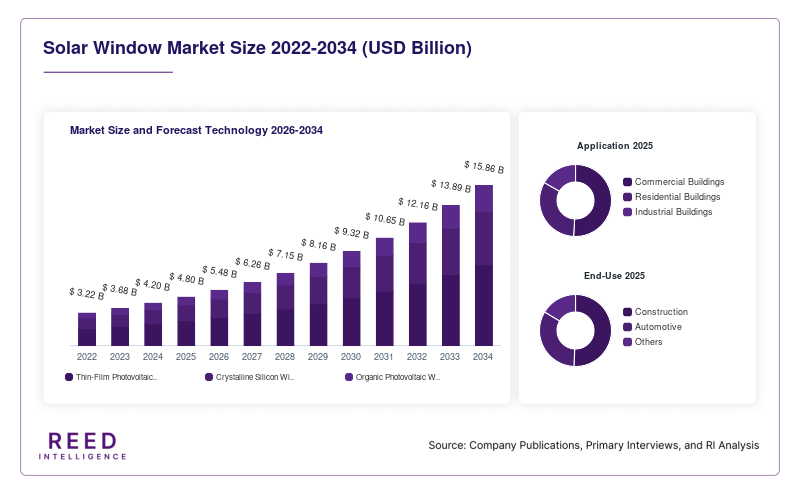
The global Solar Window Market size was valued at approximately USD 4.8 billion in 2026 and is projected to reach around USD 13.9 billion by 2034, expanding at a compound annual growth rate (CAGR) of 14.2% during the forecast period (2026–2034). The market is gaining traction due to increasing demand for energy-efficient building materials and the integration of renewable energy technologies into urban infrastructure. Solar windows, which combine photovoltaic capabilities with conventional glazing functions, are becoming an essential component of sustainable architecture and smart city initiatives.
A major global factor supporting market growth is the rising emphasis on net-zero energy buildings. Governments and private developers are adopting green construction standards, encouraging the use of energy-generating materials such as solar windows. These solutions reduce dependency on external power sources while improving building efficiency, making them attractive in both commercial and residential applications.
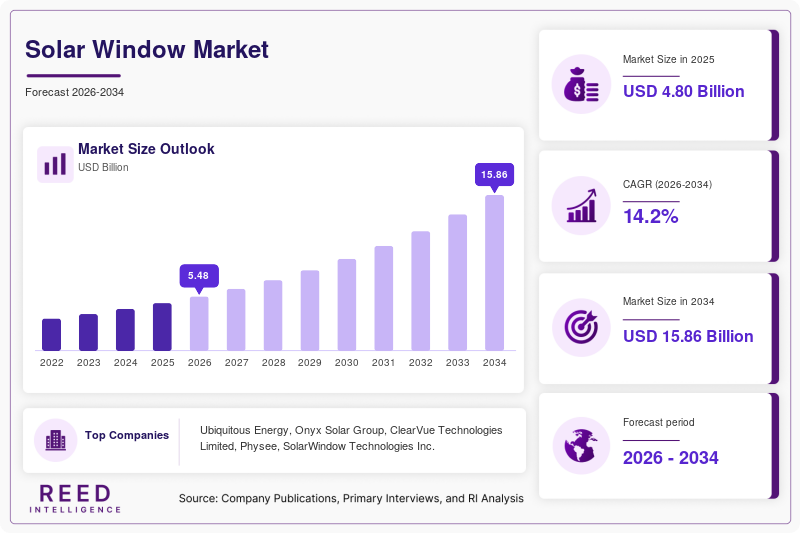
Key Highlights
- North America dominated the market with a 33.8% share in 2025.
- Asia Pacific is expected to grow at the fastest CAGR of 15.1% during 2026–2034.
- By technology, thin-film photovoltaic windows accounted for the largest share of 42.6%.
- while organic photovoltaic windows are projected to grow at a CAGR of 16.4%.
- By application, commercial buildings led with a 47.9% share, whereas residential buildings are expected to expand at a CAGR of 14.8%.
- The United States remained the dominant country, with market values of USD 920 million in 2024 and USD 1,050 million in 2025.
Market Trends
Increasing integration of smart building technologies
The adoption of smart building technologies is shaping the Solar Window Market by enhancing the functionality of solar-integrated glass systems. Solar windows are increasingly being combined with intelligent energy management systems, allowing buildings to monitor and optimize power generation and consumption in real time. This integration supports automated shading, temperature regulation, and energy storage, improving overall efficiency. The trend is particularly evident in commercial infrastructure such as office complexes and airports, where energy optimization plays a critical role in operational cost management. Additionally, advancements in Internet of Things (IoT) connectivity are enabling seamless communication between solar windows and building management systems. As urban infrastructure evolves toward digitization, the demand for multifunctional building materials like solar windows continues to rise, supporting long-term market growth.
Advancements in transparent photovoltaic technologies
Technological innovation in transparent photovoltaic materials is significantly influencing market trends. Manufacturers are focusing on developing highly efficient, visually appealing solar windows that maintain transparency while generating electricity. Recent developments in organic photovoltaics and perovskite-based materials have improved energy conversion efficiency without compromising aesthetics. These innovations are expanding the application scope of solar windows in residential and commercial buildings where design considerations are critical. Furthermore, research efforts are aimed at reducing production costs and enhancing durability, making these solutions more accessible. As performance improves and costs decline, transparent photovoltaic technologies are expected to drive wider adoption across global markets, strengthening the Solar Window Market outlook.
Market Drivers
Rising demand for sustainable construction materials
The increasing focus on sustainable construction is a major driver of the Solar Window Market. Builders and developers are actively seeking materials that reduce carbon emissions and improve energy efficiency. Solar windows address both requirements by generating renewable energy while functioning as standard glazing systems. Green building certifications and regulatory frameworks are encouraging the use of such technologies, particularly in developed economies. The construction sector is undergoing a transition toward environmentally responsible practices, which includes integrating renewable energy solutions into building design. As sustainability becomes a priority for governments and corporations, the adoption of solar windows is expected to grow steadily, supporting overall market expansion.
Government incentives and renewable energy policies
Supportive government policies and financial incentives are accelerating the adoption of solar window technologies. Many countries offer tax credits, subsidies, and grants for renewable energy installations, including building-integrated photovoltaics. These incentives reduce the initial cost burden and encourage investment in advanced technologies such as solar windows. Additionally, regulations promoting energy-efficient buildings are creating a favorable environment for market growth. Urban development programs and climate action plans are further driving the demand for renewable energy solutions. As governments continue to prioritize clean energy transitions, policy support will remain a critical factor in expanding the Solar Window Market globally.
Market Restraint
High installation costs and limited efficiency compared to traditional panels
Despite promising growth prospects, the Solar Window Market faces challenges related to high installation costs and relatively lower efficiency compared to conventional solar panels. Solar windows require advanced materials and manufacturing processes, which increase production costs. This makes them less affordable for widespread adoption, particularly in price-sensitive markets. Additionally, the energy conversion efficiency of solar windows is generally lower than that of traditional photovoltaic panels, limiting their power generation capabilities. This can affect their attractiveness for large-scale energy applications. The combination of high costs and performance limitations may slow market penetration, especially in regions where cost-effectiveness is a primary consideration. However, ongoing research and technological advancements are expected to address these challenges over time.
Market Opportunities
Expansion of smart cities and urban infrastructure projects
The rapid development of smart cities presents significant opportunities for the Solar Window Market. Urban planners are incorporating renewable energy solutions into infrastructure projects to reduce environmental impact and improve energy efficiency. Solar windows can be seamlessly integrated into modern buildings, providing both functional and aesthetic benefits. Large-scale projects such as commercial complexes, transportation hubs, and public facilities are increasingly adopting these technologies. The growing focus on sustainable urbanization is expected to create substantial demand for solar-integrated materials. As governments invest in smart city initiatives, the adoption of solar windows is likely to expand, offering new growth avenues for market participants.
Increasing adoption in residential construction
The residential sector offers strong growth potential for the Solar Window Market as homeowners become more aware of energy efficiency and sustainability. Solar windows provide an innovative solution for generating electricity without requiring additional installation space. This is particularly beneficial in urban areas where rooftop space is limited. Advances in design and affordability are making solar windows more appealing to residential consumers. Additionally, rising energy costs are encouraging homeowners to invest in renewable energy solutions. As awareness increases and technology becomes more accessible, the residential segment is expected to contribute significantly to market growth during the forecast period.
Segmental Analysis
By Technology
Thin-film photovoltaic windows dominated the Solar Window Market in 2024, accounting for approximately 42.6% of the total share. These windows are widely used due to their flexibility, lightweight design, and ability to be integrated into various building structures. Thin-film technology offers cost advantages compared to traditional photovoltaic systems, making it suitable for large-scale applications. The growing demand for energy-efficient buildings is further driving the adoption of thin-film solar windows. Additionally, advancements in manufacturing processes have improved the performance and durability of these products, enhancing their market appeal.
Organic photovoltaic windows are expected to witness the fastest growth, with a projected CAGR of 16.4% during the forecast period. This growth is driven by increasing research and development activities aimed at improving efficiency and reducing production costs. Organic materials offer advantages such as transparency and design flexibility, making them suitable for modern architectural applications. The rising demand for aesthetically pleasing renewable energy solutions is supporting the adoption of organic photovoltaic windows. As technology continues to evolve, these solutions are expected to gain traction across various end-use sectors.
By Application
Commercial buildings held the largest share of the Solar Window Market in 2024, accounting for 47.9%. The adoption of solar windows in commercial infrastructure is driven by the need for energy efficiency and cost savings. Office buildings, shopping centers, and airports are increasingly incorporating solar-integrated materials to reduce energy consumption. The growing emphasis on sustainability and green building certifications is further supporting market growth in this segment. Additionally, commercial projects often have larger budgets, enabling the adoption of advanced technologies such as solar windows.
Residential buildings are expected to grow at the fastest CAGR of 14.8% during the forecast period. This growth is driven by increasing awareness of renewable energy solutions among homeowners. Solar windows provide an efficient way to generate electricity without requiring additional installation space. The rising cost of energy and the availability of government incentives are encouraging residential adoption. As technology becomes more affordable and accessible, the residential segment is expected to contribute significantly to overall market growth.
By End-Use
The construction sector dominated the Solar Window Market in 2024, accounting for a substantial share. The increasing focus on sustainable building practices is driving demand for solar-integrated materials. Construction companies are adopting innovative technologies to meet environmental regulations and improve energy efficiency. Solar windows offer a practical solution for integrating renewable energy into building design. The growing trend of green construction is expected to sustain demand in this segment.
The automotive sector is projected to grow at the fastest CAGR during the forecast period. The integration of solar windows in vehicles is gaining attention as manufacturers seek to improve energy efficiency and reduce emissions. Solar-integrated glass can power auxiliary systems and enhance vehicle performance. The rising demand for electric vehicles is further supporting growth in this segment. As automotive technology evolves, the adoption of solar windows is expected to increase.
Regional Analysis
North America
North America held a significant share of the Solar Window Market, accounting for approximately 33.8% in 2025. The region is expected to maintain steady growth, with a projected CAGR of 13.5% during the forecast period. The presence of advanced infrastructure and strong adoption of renewable energy technologies supports market expansion. Increasing investments in green building projects and energy-efficient construction practices are driving demand for solar windows across the region.
The United States dominates the North American market due to its well-established construction industry and supportive regulatory framework. A key growth factor is the widespread adoption of net-zero energy building standards, which encourage the integration of renewable energy solutions. This trend is expected to sustain demand for solar windows in both commercial and residential applications.
Europe
Europe accounted for a notable share of the Solar Window Market in 2025, supported by stringent environmental regulations and sustainability goals. The region is projected to grow at a CAGR of 13.8% from 2026 to 2034. Countries across Europe are focusing on reducing carbon emissions and improving energy efficiency, which is driving the adoption of solar-integrated building materials.
Germany leads the European market, benefiting from strong government support for renewable energy initiatives. A unique growth factor is the implementation of energy-efficient building codes that mandate the use of sustainable materials. These regulations are encouraging developers to incorporate solar windows into new construction projects, boosting market growth.
Asia Pacific
Asia Pacific is expected to witness the fastest growth in the Solar Window Market, with a projected CAGR of 15.1% during the forecast period. The region’s rapid urbanization and expanding construction industry are key factors driving demand. Increasing investments in smart city projects are further supporting market expansion.
China dominates the Asia Pacific market due to its large-scale infrastructure development and focus on renewable energy adoption. A key growth factor is government-backed initiatives promoting green construction and energy efficiency. These efforts are expected to drive significant demand for solar windows in the coming years.
Middle East & Africa
The Middle East & Africa region is experiencing gradual growth in the Solar Window Market, with increasing interest in renewable energy solutions. The market accounted for a smaller share in 2025 but is expected to grow at a CAGR of 12.6% during the forecast period. Rising investments in sustainable infrastructure are supporting market development.
The United Arab Emirates is a leading country in the region, driven by ambitious sustainability goals and smart city projects. A unique growth factor is the focus on reducing energy consumption in high-temperature environments, which is encouraging the adoption of solar windows in commercial buildings.
Latin America
Latin America is emerging as a potential market for solar windows, supported by growing awareness of renewable energy solutions. The region is expected to grow at a CAGR of 12.9% during the forecast period. Increasing investments in infrastructure development are contributing to market expansion.
Brazil leads the Latin American market, driven by its expanding construction sector and renewable energy initiatives. A key growth factor is the rising demand for energy-efficient building materials in urban areas. This trend is expected to drive adoption of solar windows in the region.

Competitive Landscape
The Solar Window Market is characterized by the presence of several key players focusing on innovation and strategic partnerships to strengthen their market position. Companies are investing in research and development to improve efficiency and reduce production costs. The competitive environment is driven by technological advancements and increasing demand for sustainable solutions.
Among the leading players, Ubiquitous Energy stands out as a market leader due to its advanced transparent photovoltaic technology. The company has recently introduced new products with improved efficiency and transparency, enhancing its competitive edge. Other major companies are also expanding their product portfolios and entering strategic collaborations to capture market share. The focus on innovation and sustainability is expected to shape the competitive landscape in the coming years.
Key Players List
- Ubiquitous Energy
- Onyx Solar Group
- ClearVue Technologies Limited
- Physee
- SolarWindow Technologies Inc.
- Heliatek GmbH
- Polysolar Ltd.
- Brite Solar
- AGC Inc.
- Guardian Glass
- NSG Group
- Sunpartner Technologies
- Tesla Inc.
- Panasonic Corporation
- First Solar Inc.
Recent Developments
- A leading manufacturer introduced a new generation of transparent solar windows with improved energy efficiency and durability.
- A major construction firm partnered with a solar technology company to integrate solar windows into large-scale commercial projects.
- An automotive company announced the development of vehicles equipped with solar-integrated windows to enhance energy efficiency.
Solar Window Market Segments
Technology
- Thin-Film Photovoltaic Windows
- Crystalline Silicon Windows
- Organic Photovoltaic Windows
Application
- Commercial Buildings
- Residential Buildings
- Industrial Buildings
End-Use
- Construction
- Automotive
- Others
By Region
- North America
- Europe
- APAC
- Middle East and Africa
- LATAM