Solder Recycling Market Size, Share & Demand Report By Source (Electronics Manufacturing Waste, Semiconductor Fabrication Waste, Electronic Scrap, Industrial Solder Residues, Others), By Recycling Process (Pyrometallurgical Recycling, Hydrometallurgical Recycling, Electrochemical Recycling, Mechanical Separation), By End-Use Industry (Electronics and Electrical Manufacturing, Semiconductor Industry, Automotive and Electric Vehicles, Telecommunications, Industrial Equipment, Others), By Region &
USD 3950
Market Overview
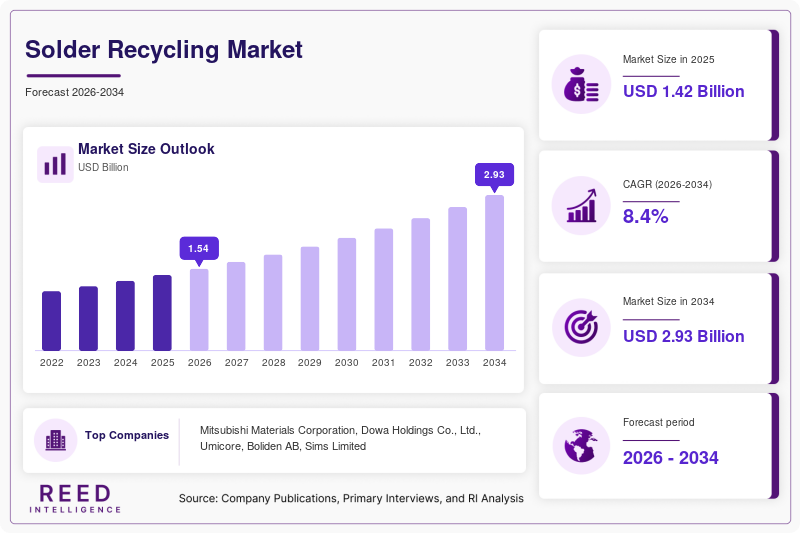
The global Solder Recycling Market size was valued at USD 1.42 billion in 2026 and is projected to reach USD 2.71 billion by 2034, expanding at a CAGR of 8.4% during 2026–2034. The market continues to gain momentum as electronics manufacturing, semiconductor production, automotive electronics, and industrial equipment sectors increasingly prioritize material recovery and circular economy practices. Solder recycling involves the collection, processing, purification, and reuse of solder waste generated during manufacturing, assembly, maintenance, and end-of-life electronic product disposal.
One of the primary global factors supporting market expansion is the growing emphasis on sustainable resource management across manufacturing industries. Rising consumption of electronic devices has generated substantial volumes of solder-containing waste, encouraging companies to recover valuable metals such as tin, silver, copper, and lead from discarded materials. Governments and environmental agencies are also introducing regulations that promote waste reduction and responsible recycling practices, creating favorable conditions for market growth.
Key Highlights
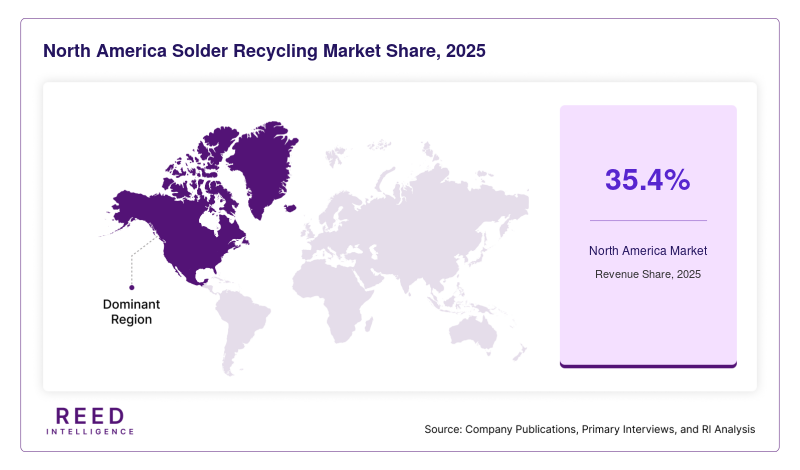
- North America dominated the market with a 35.4% share in 2025, while Asia Pacific is expected to grow at the fastest CAGR of 10.8% during 2026–2034.
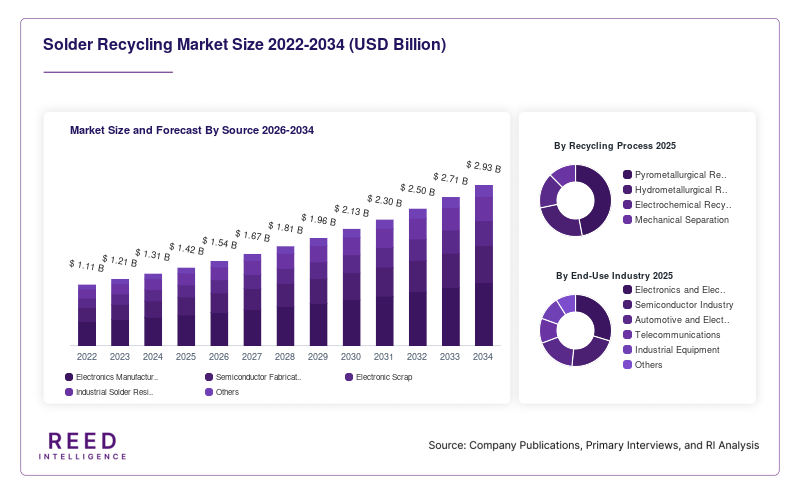
- By source, electronics manufacturing waste accounted for the largest share of 44.1%, while semiconductor fabrication waste is projected to grow at a CAGR of 11.3%.
- By recycling process, pyrometallurgical recycling held the largest share of 48.6%, whereas hydrometallurgical recycling is anticipated to expand at a CAGR of 10.9%.
- By end-use industry, electronics and electrical manufacturing led with a 52.7% share, while electric vehicle manufacturing is expected to grow at a CAGR of 12.1%.
- The United States remained the dominant country, with market values of USD 338 million in 2024 and USD 368 million in 2025.
Market Trends
Integration of Circular Economy Strategies Across Electronics Manufacturing
The adoption of circular economy principles is becoming a defining trend in the Solder Recycling Market. Electronics manufacturers are increasingly implementing closed-loop material recovery systems to reduce waste generation and dependence on virgin raw materials. Companies are establishing partnerships with recycling providers to recover solder dross, solder paste residues, defective circuit boards, and manufacturing scrap. These recovered materials are refined and reintroduced into production processes, helping organizations achieve sustainability targets while improving resource efficiency. The trend is particularly visible among multinational electronics producers that face growing environmental reporting requirements. As environmental, social, and governance initiatives gain importance across global supply chains, recycled solder materials are becoming an integral component of sustainable manufacturing strategies.
Rising Adoption of Advanced Metal Recovery Technologies
Another significant trend shaping the market is the growing deployment of advanced recovery and purification technologies. Recycling companies are investing in sophisticated refining systems capable of extracting high-purity tin, silver, copper, and other metals from complex solder waste streams. Automation, digital monitoring platforms, and process optimization tools are improving operational efficiency while reducing processing costs. These innovations enable recyclers to handle increasingly diverse waste sources generated by semiconductor facilities, telecommunications equipment manufacturers, and automotive electronics producers. The ability to achieve higher recovery yields is attracting additional investment into the industry. As technology advances continue to improve economic viability, modern recycling facilities are expected to play a larger role in global solder supply chains throughout the forecast period.
Market Drivers
Expansion of Global Electronics and Semiconductor Manufacturing
The rapid expansion of electronics and semiconductor manufacturing activities is a major factor driving the Solder Recycling Market. Increasing production of smartphones, computers, industrial control systems, telecommunications infrastructure, and consumer electronics generates significant volumes of solder waste. Manufacturing processes often produce solder dross, excess solder paste, defective assemblies, and scrap materials that contain valuable recoverable metals. Semiconductor fabrication facilities also generate specialized waste streams suitable for recycling. As governments and private companies invest heavily in domestic semiconductor production capabilities, the volume of recyclable solder material continues to rise. This expanding waste generation creates a stable feedstock supply for recycling operations and supports long-term market growth across developed and emerging economies.
Growing Focus on Cost Optimization and Raw Material Security
Manufacturers are increasingly seeking methods to reduce production costs and mitigate exposure to raw material price fluctuations. Tin, silver, and other metals used in solder production are subject to supply chain uncertainties and changing commodity prices. Recycling offers a practical solution by recovering valuable materials from industrial waste streams and reintroducing them into manufacturing processes. Companies benefit from reduced procurement expenses while maintaining material availability. Furthermore, organizations are adopting recycling programs to strengthen supply chain resilience and minimize dependence on imported raw materials. The financial advantages associated with metal recovery, combined with sustainability benefits, are encouraging broader adoption of solder recycling services across multiple industrial sectors.
Market Restraint
Variability in Waste Composition and Processing Complexity
A major challenge affecting the Solder Recycling Market is the variability in solder waste composition and the technical complexity associated with processing diverse materials. Solder waste originates from multiple industries and often contains different metal combinations, contaminants, flux residues, plastics, and electronic components. Recycling facilities must employ specialized sorting, separation, and refining techniques to achieve desired purity levels. These requirements increase operational costs and capital investment needs. Smaller recycling operators may face difficulties maintaining profitability when processing low-volume or highly contaminated waste streams. In addition, quality standards established by electronics and semiconductor manufacturers require consistent material performance, making purification processes more demanding. The complexity of handling mixed waste materials can limit recycling efficiency and slow adoption in regions where advanced processing infrastructure remains underdeveloped. Consequently, operational challenges continue to influence market competitiveness and investment decisions across the industry.
Market Opportunities
Growth of Electric Vehicle Electronics and Battery Manufacturing
The expansion of electric vehicle production presents substantial opportunities for the Solder Recycling Market. Modern electric vehicles contain sophisticated electronic systems, power management modules, sensors, battery management units, and communication technologies that require extensive solder usage. As vehicle production volumes increase worldwide, manufacturers generate larger quantities of solder-containing waste during component assembly and maintenance operations. Recycling providers can capitalize on this trend by offering specialized recovery services tailored to automotive electronics applications. The increasing focus on sustainable manufacturing within the automotive sector further supports demand for recycled materials. As electric mobility adoption accelerates globally, opportunities for solder recovery and reuse are expected to expand significantly throughout the forecast period.
Increasing Recycling Infrastructure Investments in Emerging Economies
Emerging economies are investing heavily in waste management and recycling infrastructure, creating favorable conditions for market expansion. Governments are implementing environmental policies that encourage industrial recycling and resource recovery initiatives. Investments in electronics manufacturing hubs across Asia, Latin America, and parts of the Middle East are generating growing volumes of recyclable solder waste. New recycling facilities equipped with modern processing technologies are improving regional collection and recovery capabilities. Additionally, international manufacturers are collaborating with local recycling firms to establish sustainable supply chains. These developments create opportunities for service providers, technology suppliers, and metal refiners operating within the solder recycling ecosystem. The expansion of recycling infrastructure is expected to unlock significant growth potential in previously underserved markets.
Segmental Analysis
By Source
Electronics manufacturing waste represented the dominant subsegment, accounting for 44.1% of market share in 2024. This category includes solder dross, solder paste residues, defective circuit boards, assembly line scrap, and production leftovers generated during electronics manufacturing processes. The extensive use of solder in consumer electronics, telecommunications equipment, industrial devices, and computing hardware contributes to a consistent supply of recyclable materials. Manufacturers increasingly recognize the economic value of recovering tin and other metals from waste streams. Growing sustainability initiatives and corporate environmental commitments further encourage systematic collection and recycling of production waste. As electronics production volumes continue to expand globally, this subsegment maintains its leading position within the market.
Semiconductor fabrication waste is expected to be the fastest-growing subsegment, advancing at a CAGR of 11.3% through 2034. Semiconductor manufacturing facilities require highly specialized solder materials and generate valuable metal-containing waste during production processes. Expansion of domestic chip manufacturing programs across multiple countries is increasing the availability of recyclable feedstock. Advanced recovery technologies enable efficient extraction of high-purity metals from fabrication waste streams. Additionally, semiconductor manufacturers prioritize resource optimization and cost reduction, creating favorable conditions for recycling partnerships. Rising investments in new fabrication facilities and increasing demand for semiconductors across automotive, industrial, and consumer applications support strong growth prospects for this subsegment.
By Recycling Process
Pyrometallurgical recycling held the largest market share at 48.6% in 2024, making it the dominant recycling process. This method utilizes high-temperature treatment to recover valuable metals from solder waste efficiently and at scale. Pyrometallurgical systems are widely adopted due to their ability to process large volumes of material while achieving satisfactory recovery rates. Many established recycling facilities rely on this approach because of its operational reliability and compatibility with diverse waste streams. The process remains particularly attractive for handling industrial solder residues generated by electronics manufacturers. Continuous improvements in furnace efficiency and emissions control technologies further strengthen the competitiveness of pyrometallurgical recycling across global markets.
Hydrometallurgical recycling is projected to witness the fastest growth, registering a CAGR of 10.9% during the forecast period. This process uses chemical solutions to selectively recover metals from solder waste while achieving high purity levels. Increasing demand for environmentally responsible recycling methods is encouraging adoption of hydrometallurgical technologies. Compared with some traditional approaches, these systems can reduce energy consumption and improve recovery efficiency for specific waste categories. Technological advancements are also helping recyclers lower processing costs and enhance operational performance. As sustainability considerations become more important across manufacturing industries, hydrometallurgical recycling is expected to gain broader acceptance and contribute significantly to future market expansion.
By End-Use Industry
Electronics and electrical manufacturing emerged as the dominant end-use industry, accounting for 52.7% of market share in 2024. The sector generates substantial quantities of solder waste through assembly operations, component manufacturing, testing activities, and production line maintenance. High-volume manufacturing environments create a continuous supply of recyclable materials, making the industry a primary customer base for recycling providers. Growing demand for consumer electronics, industrial automation equipment, communication systems, and computing devices supports sustained recycling activity. Manufacturers increasingly integrate recovered materials into production processes to reduce costs and achieve sustainability objectives. These factors collectively reinforce the segment's leadership position within the Solder Recycling Market.
Electric vehicle manufacturing is anticipated to be the fastest-growing end-use industry, expanding at a CAGR of 12.1% through 2034. Electric vehicles rely on sophisticated electronic architectures, battery systems, sensors, power electronics, and connectivity technologies that require significant solder usage. As global EV production continues to increase, manufacturers generate larger volumes of solder-related waste suitable for recycling. Automotive companies are also emphasizing sustainable supply chain practices and circular economy strategies. Recycled solder materials help reduce environmental impact while supporting resource efficiency goals. Continued investment in EV manufacturing facilities and battery production infrastructure is expected to drive substantial growth opportunities for recycling companies serving this segment.
Regional Analysis
North America
North America accounted for 35.4% of the global Solder Recycling Market in 2025 and is projected to register a CAGR of 7.9% through 2034. The region benefits from a mature electronics manufacturing ecosystem, established recycling infrastructure, and strong environmental compliance frameworks. Increasing recovery of valuable metals from industrial waste streams supports market development. Companies across the United States and Canada continue investing in advanced recycling technologies to improve material recovery efficiency and reduce production costs.
The United States remains the dominant country within the region. A key growth factor is the ongoing expansion of semiconductor manufacturing investments supported by domestic industrial policies. New fabrication facilities are generating additional volumes of solder-containing waste suitable for recovery. Furthermore, sustainability commitments among electronics manufacturers are encouraging long-term partnerships with specialized recycling providers, strengthening market demand throughout the country.
Europe
Europe represented 27.1% of the global market in 2025 and is anticipated to expand at a CAGR of 8.1% during the forecast period. The region benefits from stringent environmental regulations and strong adoption of circular economy principles. Electronics producers increasingly utilize recycled materials to meet sustainability objectives and reduce environmental impact. Growing awareness regarding resource conservation is supporting investments in advanced recycling technologies and efficient waste management systems across major industrial economies.
Germany dominates the European market due to its strong industrial base and advanced manufacturing capabilities. A unique growth factor is the country's emphasis on industrial sustainability and material efficiency programs. Electronics manufacturers and automotive suppliers actively incorporate recycled materials into production processes. This focus on resource recovery supports consistent demand for high-quality recycled solder materials and encourages innovation within the regional recycling industry.
Asia Pacific
Asia Pacific held 24.8% of the global market in 2025 and is expected to record the fastest CAGR of 10.8% between 2026 and 2034. The region is a major center for electronics assembly, semiconductor production, and consumer device manufacturing. Rapid industrialization, increasing electronic device consumption, and expanding production capacities are generating substantial volumes of recyclable solder waste. These factors collectively create strong growth prospects for recycling service providers and material recovery companies.
China remains the leading country in the regional market. A significant growth factor is the continued expansion of electronics and semiconductor manufacturing clusters. Large-scale production facilities generate considerable quantities of solder residues and scrap materials suitable for recycling. Government initiatives supporting resource efficiency and industrial sustainability are also encouraging wider adoption of recycling practices, contributing to market growth across the country.
Middle East & Africa
The Middle East & Africa region captured 6.3% of global market revenue in 2025 and is forecast to grow at a CAGR of 8.5% through 2034. Increasing industrial diversification and rising investments in electronics assembly operations are supporting demand for recycling services. Governments are implementing waste management initiatives aimed at reducing environmental impact and promoting resource recovery. As industrial sectors expand, the need for efficient metal recycling solutions continues to increase across the region.
Saudi Arabia leads the regional market. One distinctive growth factor is the country's economic diversification strategy, which encourages development of advanced manufacturing and technology industries. New industrial projects generate opportunities for recycling companies to establish localized recovery operations. Growing sustainability awareness among manufacturers further contributes to market expansion and supports investment in modern recycling infrastructure.
Latin America
Latin America accounted for 6.4% of the Solder Recycling Market in 2025 and is expected to register a CAGR of 8.3% during the forecast period. The region is experiencing gradual growth in electronics manufacturing and industrial recycling activities. Increasing focus on waste reduction and environmental management is encouraging adoption of resource recovery practices. Public and private investments in recycling infrastructure are helping improve collection networks and processing capabilities across several countries.
Brazil dominates the Latin American market due to its large manufacturing sector and expanding electronics industry. A unique growth factor is the increasing development of formal electronic waste management programs. These initiatives improve the collection and processing of solder-containing materials while supporting broader recycling objectives. As recycling systems become more organized, market participants are expected to benefit from improved feedstock availability and operational efficiency.
Competitive Landscape
The Solder Recycling Market is moderately consolidated, with established metal recovery specialists and industrial recycling companies competing through technology innovation, processing efficiency, and regional expansion strategies. Leading participants focus on improving recovery rates, increasing refining capacity, and strengthening partnerships with electronics manufacturers and semiconductor producers.
Mitsubishi Materials Corporation remains a market leader due to its extensive metal recovery expertise and integrated refining capabilities. The company continues investing in advanced recycling technologies to enhance material purity and operational efficiency. Other prominent participants are expanding collection networks and developing specialized solutions for high-value solder waste streams.
Companies are increasingly pursuing strategic collaborations with electronics manufacturers to secure stable feedstock supplies and support circular economy objectives. Investments in automated sorting systems, digital process monitoring, and environmentally efficient refining technologies are becoming common competitive strategies. Market participants are also expanding into emerging regions where electronics manufacturing activity is increasing. Recent developments include facility upgrades, capacity expansions, and partnerships aimed at improving resource recovery performance and strengthening long-term market positions.
Key Players
- Mitsubishi Materials Corporation
- Dowa Holdings Co., Ltd.
- Umicore
- Boliden AB
- Sims Limited
- Aurubis AG
- Veolia Environment S.A.
- Heraeus Holding GmbH
- Glencore plc
- JX Advanced Metals Corporation
- Johnson Matthey plc
- TES Group
- Kuusakoski Group
- Stena Recycling AB
- Electronic Recyclers International
Recent Developments
- In 2025, a leading metal recycling company expanded its solder recovery and refining facility to increase processing capacity for electronics manufacturing waste and improve metal recovery efficiency.
- In 2025, a major electronics recycling provider launched an advanced hydrometallurgical recycling system designed to enhance the recovery of tin, silver, and copper from complex solder waste streams.
- In 2024, several semiconductor manufacturers established long-term partnerships with specialized recycling firms to strengthen circular material management and reduce dependence on virgin solder materials.
- In 2024, a global metal recovery company introduced automated sorting and purification technologies to improve recycled solder quality and support high-purity applications in electronics production.
- In 2025, a large industrial recycling group invested in next-generation refining infrastructure to increase sustainable solder recycling capacity and minimize material losses during processing.
Solder Recycling Market Segments
By Source
- Electronics Manufacturing Waste
- Semiconductor Fabrication Waste
- Electronic Scrap
- Industrial Solder Residues
- Others
By Recycling Process
- Pyrometallurgical Recycling
- Hydrometallurgical Recycling
- Electrochemical Recycling
- Mechanical Separation
By End-Use Industry
- Electronics and Electrical Manufacturing
- Semiconductor Industry
- Automotive and Electric Vehicles
- Telecommunications
- Industrial Equipment
- Others
By Region
- North America
- Europe
- APAC
- Middle East and Africa
- LATAM