Solid Ion Conductor Market Size, Share & Demand Report By Material Type (Ceramic Solid Ion Conductors, Polymer Solid Ion Conductors), By Ion Type (Lithium-Ion Conductors, Sodium-Ion Conductors, Proton Conductors), By Application (Solid-State Batteries, Fuel Cells, Sensors and Electrochemical Devices, Supercapacitors), By End-Use Industry (Automotive and Transportation, Consumer Electronics, Energy and Utilities), By Region & Segment Forecasts, 2026–2034
USD 3950
Market Overview
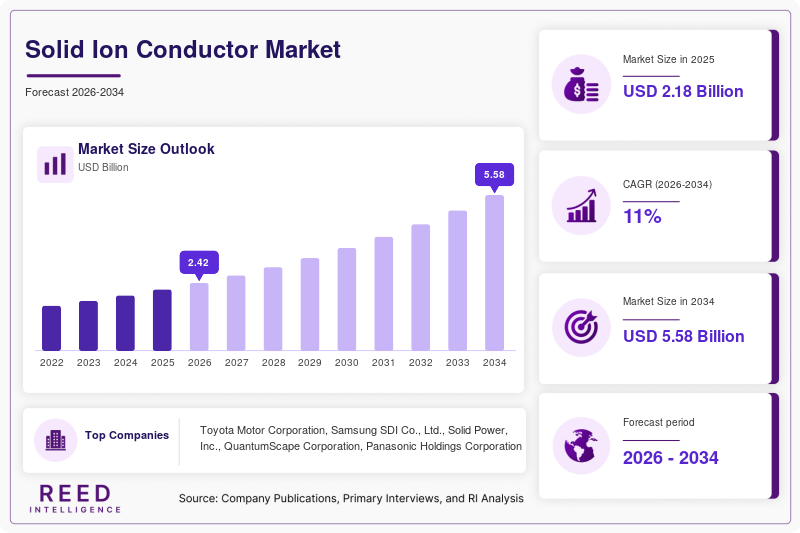
The Solid Ion Conductor Market size was valued at USD 2.18 billion in 2026 and is projected to reach USD 5.04 billion by 2034, expanding at a CAGR of 11.0% during the forecast period of 2026–2034. The global Solid Ion Conductor Market growth was supported by the increasing global transition toward advanced energy storage technologies and high-performance electronic systems. Industries across automotive, electronics, aerospace, and renewable energy sectors increasingly adopted solid ion conductor materials to improve energy efficiency, enhance safety, and support next-generation battery technologies. The growing investment in electric vehicle infrastructure and solid-state battery development further accelerated market expansion globally.
The rising demand for high-energy-density storage systems significantly contributed to the growth of the Solid Ion Conductor Market. Manufacturers increasingly focused on ceramic, polymer, and glass-based ion conductors to improve ionic conductivity and thermal stability in battery systems. In addition, growing research activities related to lithium-ion and sodium-ion solid electrolytes strengthened innovation across advanced material manufacturing industries.
Key Highlights
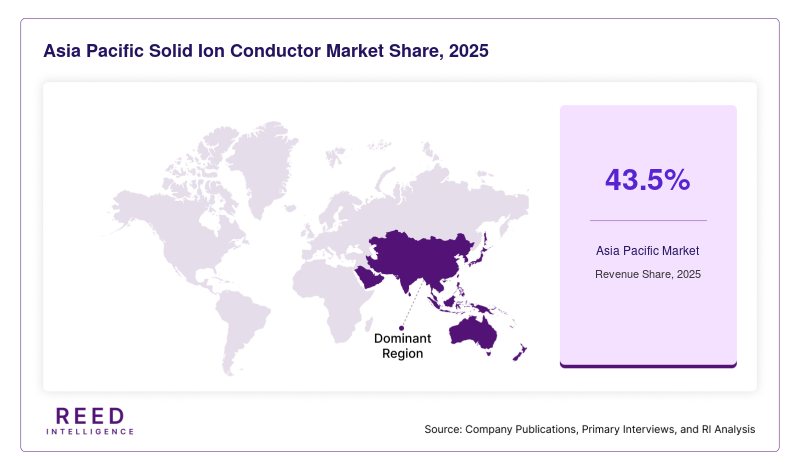
- Asia Pacific dominated the Solid Ion Conductor Market with 43.5% share in 2025, while North America is projected to register the fastest CAGR of 11.8% during 2026–2034.
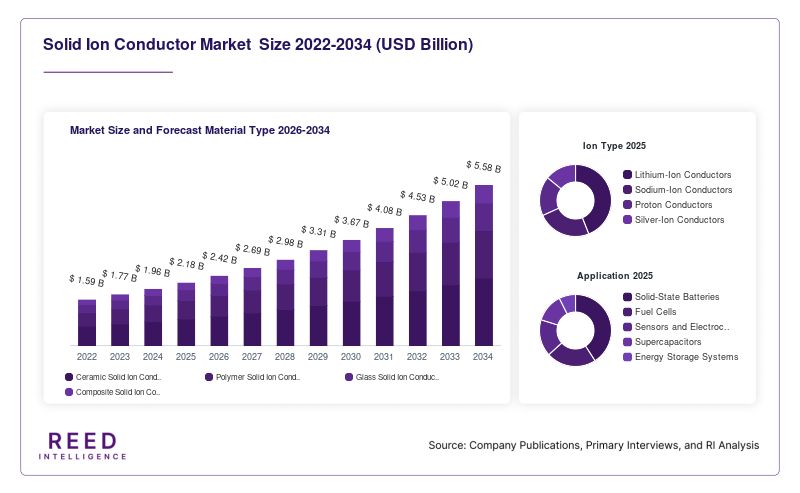
- By material type, ceramic solid ion conductors accounted for the largest market share of 49.6% in 2025, while composite solid ion conductors are anticipated to witness the fastest CAGR of 12.1% during the forecast period.
- By ion type, lithium-ion conductors held the dominant share of 57.2% in 2025, whereas sodium-ion conductors are forecast to grow at a CAGR of 11.9% through 2034.
- By application, solid-state batteries remained the leading segment with 46.4% share in 2025, while energy storage systems are expected to grow at a CAGR of 12.4%.
- By end-use industry, automotive and transportation held the dominant share of 38.7% in 2025, while renewable energy infrastructure is forecast to grow at a CAGR of 12.6% during the forecast period.
- China Solid Ion Conductor Market was valued at USD 412 million in 2024 and reached USD 458 million in 2025.
Market Trends
Increasing Development of Solid-State Battery Technologies
One of the major trends shaping the Solid Ion Conductor Market is the increasing development of solid-state battery technologies across automotive and electronics industries. Battery manufacturers are increasingly adopting solid ion conductor materials to improve battery safety, energy density, and operational stability. Solid-state batteries reduce leakage risks associated with liquid electrolytes and support higher charging efficiency.
Manufacturers are also increasing investments in advanced electrolyte research and pilot-scale production facilities. The growing commercialization of electric vehicles and portable electronics is expected to accelerate adoption of solid ion conductor materials during the forecast period.
Growing Focus on Sodium-Ion and Hybrid Electrolyte Systems
Another notable trend in the Solid Ion Conductor Market is the growing focus on sodium-ion and hybrid electrolyte technologies. Researchers and manufacturers are increasingly exploring alternatives to lithium-based systems to reduce raw material dependency and improve cost efficiency. Sodium-ion conductors are gaining attention due to their material abundance and compatibility with large-scale energy storage applications.
Hybrid electrolyte technologies combining ceramic and polymer materials are also improving ionic conductivity and flexibility in electrochemical devices. This trend is expected to create favorable opportunities for material innovation and large-scale commercialization.
Market Drivers
Rising Adoption of Electric Vehicles
The increasing global adoption of electric vehicles is a major driver supporting the growth of the Solid Ion Conductor Market. Automotive manufacturers are increasingly investing in advanced battery technologies to improve driving range, charging speed, and battery safety. Solid ion conductors provide improved thermal stability and higher electrochemical performance compared to conventional liquid electrolytes.
The expansion of electric mobility infrastructure and supportive government policies for clean transportation continue to increase demand for solid-state battery materials globally.
Expansion of Renewable Energy Storage Infrastructure
The continuous expansion of renewable energy storage infrastructure is another important factor driving the Solid Ion Conductor Market. Energy providers increasingly require advanced battery systems capable of supporting efficient grid storage and renewable energy integration. Solid ion conductor technologies improve energy storage reliability and operational lifespan in stationary battery applications.
Governments and private energy companies are increasing investments in sustainable power infrastructure, supporting demand for advanced electrochemical materials across large-scale energy storage systems.
Market Restraint
High Manufacturing Complexity and Material Costs
One major restraint affecting the Solid Ion Conductor Market is the high manufacturing complexity associated with advanced ion-conducting materials. Production of ceramic and composite electrolytes often requires specialized processing technologies, controlled manufacturing environments, and expensive raw materials.
In addition, scalability challenges and high research costs may limit commercial adoption among smaller battery manufacturers and emerging technology developers.
Market Opportunities
Increasing Investment in Next-Generation Battery Research
Growing investments in next-generation battery research are creating strong opportunities for the Solid Ion Conductor Market. Governments, research institutes, and private companies are increasingly funding solid-state battery development projects to improve energy efficiency and battery safety.
The expansion of pilot manufacturing facilities and strategic collaborations between automotive and battery companies are expected to support long-term market growth.
Expansion of Consumer Electronics Manufacturing
The increasing production of portable consumer electronics is creating additional growth opportunities for the Solid Ion Conductor Market. Smartphone, wearable device, and laptop manufacturers increasingly require compact and high-performance energy storage technologies with improved durability and thermal safety.
Solid ion conductor materials are expected to gain wider adoption in miniaturized electronic devices requiring stable electrochemical performance and longer operational lifespan.
Segmental Analysis
By Material Type
Based on material type, the Solid Ion Conductor Market is segmented into ceramic solid ion conductors, polymer solid ion conductors, glass solid ion conductors, and composite solid ion conductors.
Ceramic solid ion conductors dominated the market with 49.6% share in 2025 due to their high ionic conductivity, thermal stability, and compatibility with advanced solid-state battery systems. Manufacturers increasingly preferred ceramic materials for electric vehicle battery applications requiring stable electrochemical performance.
Composite solid ion conductors are projected to witness the fastest CAGR of 12.1% during the forecast period. Increasing demand for flexible and high-performance electrolyte systems will support segment growth. The integration of polymer and ceramic materials is expected to improve conductivity and mechanical durability in advanced energy storage systems.
By Ion Type
Based on ion type, the market is categorized into lithium-ion conductors, sodium-ion conductors, proton conductors, and silver-ion conductors.
Lithium-ion conductors accounted for the largest market share of 57.2% in 2025 due to widespread utilization in electric vehicle batteries and portable electronic devices. Strong adoption of lithium-based battery technologies across automotive and consumer electronics industries supported segment dominance.
Sodium-ion conductors are anticipated to grow at the fastest CAGR of 11.9% during 2026–2034. Increasing focus on cost-efficient and abundant energy storage materials will support segment expansion. Large-scale renewable energy storage applications are expected to increase demand for sodium-ion conductor technologies.
By Application
Based on application, the market includes solid-state batteries, fuel cells, sensors and electrochemical devices, supercapacitors, and energy storage systems.
Solid-state batteries held the dominant market share of 46.4% in 2025 due to increasing commercialization of advanced electric vehicle battery systems and portable electronics. Battery manufacturers increasingly adopted solid ion conductor materials to improve operational safety and energy density.
Energy storage systems are expected to register the fastest CAGR of 12.4% during the forecast period. Rising investments in renewable power integration and smart grid infrastructure will support segment growth. Increasing demand for large-capacity stationary battery systems is expected to accelerate adoption.
By End-Use Industry
Based on end-use industry, the market is segmented into automotive and transportation, consumer electronics, energy and utilities, aerospace and defense, and healthcare devices.
Automotive and transportation dominated the market in 2025 with 38.7% share due to increasing electric vehicle production and growing investment in advanced battery technologies. Automotive manufacturers increasingly integrated solid-state battery systems to improve vehicle range and operational efficiency.
Renewable energy infrastructure within the energy and utilities segment is expected to witness the fastest CAGR of 12.6% during the forecast period. Increasing deployment of solar and wind energy systems will support demand for advanced stationary energy storage technologies. The need for reliable grid-scale battery systems is expected to drive market expansion.
Regional Analysis
Asia Pacific
Asia Pacific accounted for 43.5% of the Solid Ion Conductor Market share in 2025 and is expected to grow at a CAGR of 11.3% during 2026–2034. The region maintained strong market demand due to rapid expansion of battery manufacturing industries and increasing investments in electric mobility infrastructure. Electronics manufacturers increasingly adopted advanced electrolyte materials to improve battery performance and operational efficiency.
China remained the dominant country in the region due to large-scale electric vehicle production and extensive investments in solid-state battery research. Government support for advanced battery manufacturing significantly strengthened regional market growth.
North America
North America held 24.6% of the global Solid Ion Conductor Market share in 2025 and is projected to expand at the fastest CAGR of 11.8% during the forecast period. The region experienced strong growth due to increasing investments in clean energy technologies and advanced battery research programs.
The U.S. dominated the regional market owing to strong presence of electric vehicle manufacturers and increasing commercialization of solid-state battery technologies. Expanding partnerships between battery developers and automotive companies contributed to market expansion.
Europe
Europe represented 19.4% of the global market share in 2025 and is anticipated to grow at a CAGR of 10.7% during 2026–2034. The region witnessed increasing demand for sustainable energy storage technologies and advanced automotive battery systems. European governments increasingly supported clean transportation and renewable energy integration projects.
Germany emerged as the leading country in the region due to strong automotive manufacturing capabilities and increasing investments in battery technology innovation. Expansion of electric vehicle production facilities supported regional demand for solid ion conductor materials.
Middle East & Africa
The Middle East & Africa accounted for 6.4% of the Solid Ion Conductor Market share in 2025 and is forecast to grow at a CAGR of 9.8% through 2034. The region experienced increasing investments in renewable energy infrastructure and advanced industrial technologies. Governments increasingly focused on diversifying energy sources and improving energy storage capabilities.
The United Arab Emirates led the regional market due to rising investments in sustainable energy projects and advanced technology research initiatives. Expanding industrial modernization activities further contributed to market development.
Latin America
Latin America captured 6.1% of the global market share in 2025 and is expected to expand at a CAGR of 9.9% during the forecast period. Increasing adoption of renewable energy systems and gradual expansion of battery manufacturing activities supported regional market growth.
Brazil remained the dominant country in Latin America owing to increasing investments in renewable power infrastructure and growing interest in electric mobility technologies. Rising industrial energy storage requirements contributed to market expansion.
Competitive Landscape
The Solid Ion Conductor Market remains moderately competitive with the presence of advanced material manufacturers, battery technology companies, and electrochemical research organizations. Market participants are focusing on product innovation, strategic partnerships, and large-scale manufacturing expansion to strengthen their competitive position.
Toyota Motor Corporation remained a leading player in the market due to its strong investments in solid-state battery development and advanced electrolyte technologies. The company recently expanded research activities focused on next-generation solid ion conductor materials for electric vehicle applications.
Samsung SDI continued focusing on high-performance battery materials and solid electrolyte technologies. Solid Power, Inc. increased investments in commercial-scale solid-state battery production facilities. QuantumScape Corporation strengthened its advanced ceramic electrolyte development programs. Panasonic Holdings Corporation focused on expanding solid-state battery material research for automotive applications.
Key Players List
- Toyota Motor Corporation
- Samsung SDI Co., Ltd.
- Solid Power, Inc.
- QuantumScape Corporation
- Panasonic Holdings Corporation
- LG Energy Solution Ltd.
- Murata Manufacturing Co., Ltd.
- Hitachi Zosen Corporation
- ProLogium Technology Co., Ltd.
- Ilika plc
- BrightVolt, Inc.
- Ampcera Inc.
- Saint-Gobain S.A.
- Ion Storage Systems
- Contemporary Amperex Technology Co., Limited (CATL)
Recent Developments
- In 2025, Toyota Motor Corporation expanded its solid-state battery research facilities focused on advanced ceramic electrolyte technologies.
- In 2024, QuantumScape Corporation introduced next-generation lithium metal battery prototypes utilizing advanced solid ion conductor materials.
- In 2025, Samsung SDI increased investments in solid electrolyte manufacturing technologies for automotive battery systems.
- In 2024, Solid Power, Inc. expanded pilot-scale production capabilities for solid-state battery materials in North America.
- In 2025, Panasonic Holdings Corporation announced new research partnerships focused on high-conductivity composite electrolyte technologies.
Solid Ion Conductor Market Segments
Material Type
- Ceramic Solid Ion Conductors
- Polymer Solid Ion Conductors
- Glass Solid Ion Conductors
- Composite Solid Ion Conductors
Ion Type
- Lithium-Ion Conductors
- Sodium-Ion Conductors
- Proton Conductors
- Silver-Ion Conductors
Application
- Solid-State Batteries
- Fuel Cells
- Sensors and Electrochemical Devices
- Supercapacitors
- Energy Storage Systems
End-Use Industry
- Automotive and Transportation
- Consumer Electronics
- Energy and Utilities
- Aerospace and Defense
- Healthcare Devices
By Region
- North America
- Europe
- APAC
- Middle East and Africa
- LATAM