Solid-State Micro Battery Market Size, Share, Demand & Industry Analysis Report By Battery Type (Thin-Film Solid-State Micro Batteries, Printed Solid-State Micro Batteries), By Application (Medical Implantable Devices,Wearable Electronics, Smart Packaging Systems, Aerospace & Defense Electronics), By End-Use Industry (Consumer Electronics, Industrial Automation, Aerospace & Defense, Logistics & Supply Chain Monitoring) & Regional Forecasts, 2026–2034
USD 3950
Market Overview
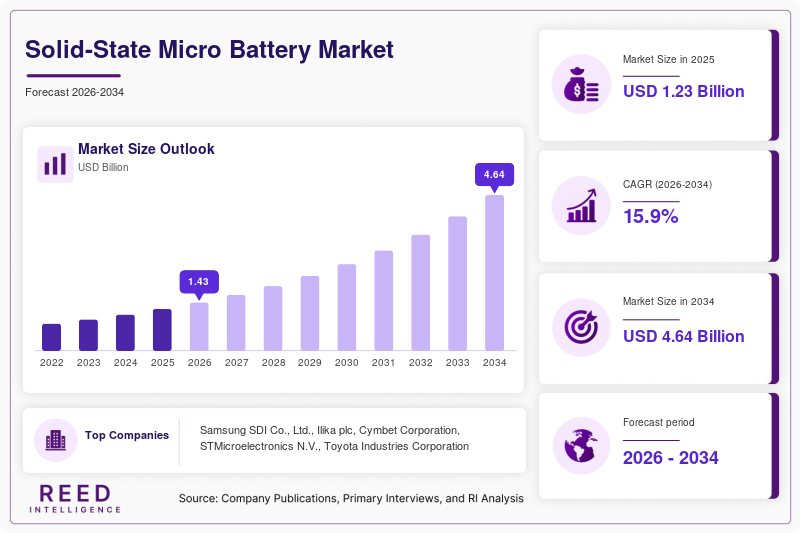
The Solid-State Micro Battery Market size is estimated at approximately USD 1.42 billion, and it is projected to reach nearly USD 4.68 billion by 2034, expanding at a CAGR of 15.9% (2026–2034). Growth is primarily supported by the accelerating adoption of IoT-enabled devices, where compact energy systems are essential for uninterrupted performance and long lifecycle operation.
One of the major global factors supporting market growth is the surge in connected medical and wearable technologies. As healthcare systems increasingly integrate remote monitoring and implantable devices, solid-state micro batteries are becoming critical due to their enhanced safety profile, long operational life, and resistance to leakage compared to conventional lithium-ion alternatives. Additionally, advancements in nanomaterials and solid electrolytes have improved energy density and reduced thermal risks, further strengthening adoption across industries such as consumer electronics, aerospace, and defense.
Key Highlights
- North America dominated the market with a 34.2% share in 2025.
- Asia Pacific is expected to grow at the fastest CAGR of 11.2% during 2026–2034.
- By battery type, thin-film solid-state micro batteries accounted for the largest share of 39.6%.
- while flexible micro batteries are projected to grow at a CAGR of 13.8%.
- By application, medical implantable devices led with a 42.3% share, whereas IoT sensors are expected to expand at a CAGR of 14.5%.
- The United States remained the dominant country, with market values of USD 620 million in 2024 and USD 690 million in 2025.
Market Trends
Miniaturization of Electronic Devices Driving Battery Innovation
The increasing trend toward miniaturization in consumer electronics, industrial sensors, and medical implants is significantly shaping the Solid-State Micro Battery Market. Manufacturers are focusing on developing ultra-thin batteries that can be integrated into compact devices without compromising energy efficiency. Solid-state micro batteries offer advantages such as higher energy density, improved safety, and longer shelf life, making them suitable for next-generation microelectronics. The demand for smaller yet more powerful components in wearables, smart cards, and wireless sensors is pushing R&D investments toward nanostructured electrodes and solid electrolytes, enabling more efficient energy storage in reduced form factors.
Integration of IoT and Smart Sensor Networks
Another key trend is the rapid expansion of IoT ecosystems, which rely heavily on self-powered, maintenance-free micro energy sources. Solid-state micro batteries are increasingly being used in distributed sensor networks for smart cities, industrial automation, and environmental monitoring. These batteries support long-term operation without frequent replacement, reducing maintenance costs and improving system reliability. The growing deployment of connected devices in agriculture, logistics, and infrastructure monitoring is further accelerating adoption. Additionally, advancements in energy harvesting integration with micro batteries are enabling hybrid power systems that enhance operational efficiency in remote and low-access environments.
Market Drivers
Rising Demand for Medical Implantable and Wearable Devices
The expanding use of implantable medical devices such as pacemakers, neurostimulators, and biosensors is a significant driver for the Solid-State Micro Battery Market. These devices require highly reliable, biocompatible, and long-lasting power sources, making solid-state micro batteries an ideal choice. Their solid electrolyte structure minimizes leakage risks and enhances safety within the human body. Additionally, the increasing prevalence of chronic diseases and the growing geriatric population are boosting demand for continuous health monitoring systems, further accelerating the need for compact energy solutions that ensure uninterrupted device operation over extended periods.
Advancements in Solid Electrolyte and Nanomaterials
Technological progress in solid electrolyte materials and nanotechnology is significantly enhancing battery performance, driving market expansion. Innovations such as lithium phosphorus oxynitride (LiPON) and sulfide-based electrolytes have improved ionic conductivity and energy density, making micro batteries more efficient. Nanostructured electrodes are also enabling faster charge-discharge cycles and better stability. These advancements are encouraging manufacturers to replace traditional micro batteries with solid-state alternatives in high-performance applications. Increased investment in material science research by both private companies and government institutions is further accelerating commercialization and scaling of next-generation micro battery technologies.
Market Restraint
High Manufacturing Complexity and Cost Constraints
Despite strong growth potential, the Solid-State Micro Battery Market faces significant challenges due to high manufacturing complexity and production costs. The fabrication of ultra-thin solid electrolytes requires advanced deposition techniques and precision engineering, which increases overall production expenses. Additionally, maintaining consistent performance at micro-scale dimensions is technically challenging, leading to higher defect rates during manufacturing. These cost barriers limit large-scale commercialization, especially in price-sensitive markets. Small and medium enterprises often struggle to invest in the required infrastructure, slowing down widespread adoption despite growing demand across multiple end-use industries.
Market Opportunities
Expansion of Smart Packaging and Flexible Electronics
The increasing adoption of smart packaging solutions presents a major opportunity for the Solid-State Micro Battery Market. These batteries are being integrated into intelligent labels and packaging systems used in pharmaceuticals, food safety, and logistics tracking. Their thin and flexible design allows seamless integration into packaging materials, enabling real-time temperature, humidity, and freshness monitoring. As global supply chains become more digitized, demand for such self-powered packaging solutions is expected to rise significantly. The shift toward sustainability and reduced electronic waste further enhances the appeal of solid-state micro batteries in this emerging application area.
Growth in Aerospace and Defense Microelectronics
The aerospace and defense sector offers another promising opportunity due to its increasing reliance on compact, high-reliability electronic systems. Solid-state micro batteries are well-suited for satellites, unmanned aerial vehicles, and advanced navigation systems where size, weight, and safety are critical factors. Their resistance to extreme temperatures and vibration enhances operational reliability in harsh environments. Rising defense modernization programs and increased investment in space exploration initiatives are expected to create sustained demand. Additionally, the development of autonomous defense systems and micro-robotics further expands the application scope for these advanced energy storage solutions.
Segmental Analysis
Battery Type Segment
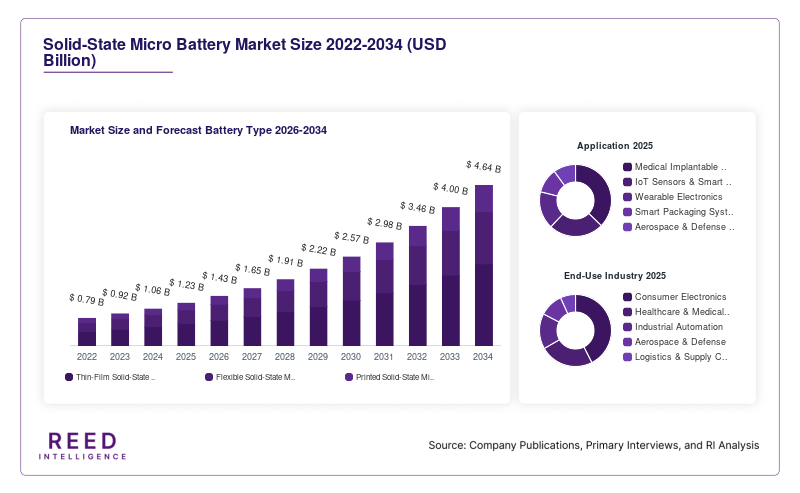
Thin-film solid-state micro batteries held approximately 39.6% share in 2024, making them the dominant subsegment. Their widespread use in medical implants and compact electronics is driven by their high energy density and long operational life. These batteries are extensively used in applications requiring stable, long-term power supply in extremely small form factors. Their ability to maintain performance consistency under varying temperature conditions makes them highly preferred across industries where reliability is critical.
Flexible solid-state micro batteries are expected to grow at a CAGR of 13.8%, driven by increasing demand for bendable and wearable electronics. Their integration into smart textiles, flexible displays, and next-generation wearable devices is expanding rapidly. Advances in polymer-based electrolytes and stretchable electrode materials are enabling improved durability and performance. This growth is further supported by increasing consumer demand for lightweight, flexible, and ergonomically designed electronic devices.
Application Segment
Medical implantable devices dominated the application segment with a 42.3% share in 2024, driven by increasing adoption of pacemakers, neurostimulators, and biosensors. These applications require highly reliable and long-lasting power sources that ensure patient safety and continuous operation. Solid-state micro batteries are preferred due to their biocompatibility and resistance to leakage, making them ideal for internal medical applications.
IoT sensors are expected to grow at a CAGR of 14.5%, supported by widespread deployment in smart cities, industrial automation, and environmental monitoring. These sensors require compact, maintenance-free power sources capable of operating in remote locations. Increasing adoption of predictive maintenance systems and connected infrastructure is significantly boosting demand for micro-scale energy storage solutions.
End-Use Segment
Consumer electronics accounted for 36.8% share in 2024, driven by integration into smartwatches, earbuds, and portable devices. The demand for smaller, high-performance batteries is increasing as manufacturers focus on enhancing device portability and battery life. Continuous innovation in electronics design is reinforcing the need for compact energy storage solutions.
Industrial applications are projected to grow at a CAGR of 14.2%, supported by automation and smart factory adoption. Solid-state micro batteries are increasingly used in industrial sensors, robotics, and monitoring systems. Their reliability and low maintenance requirements make them suitable for continuous industrial operations in harsh environments.
Regional Analysis
North America
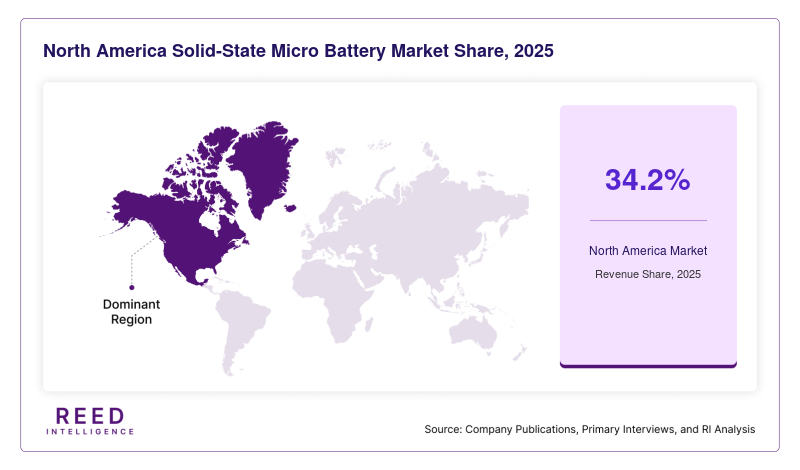
North America accounted for approximately 34.2% market share in 2025, with a projected CAGR of 14.8% during 2026–2034. The region benefits from strong technological infrastructure, early adoption of advanced medical devices, and high investment in semiconductor innovation.
The United States dominates the regional market due to strong R&D activities and the presence of leading microelectronics manufacturers. A key growth factor is the rapid expansion of wearable healthcare technology and defense-grade miniaturized electronics, which require high-reliability power sources.
Europe
Europe held around 27.5% market share in 2025, with a forecast CAGR of 14.1% during the same period. The region’s growth is supported by strong automotive electronics integration and increasing demand for energy-efficient micro devices.
Germany leads the European market, driven by advanced industrial automation and strong automotive R&D. A major growth factor is the rising adoption of smart manufacturing systems, where micro batteries are used in distributed sensors and monitoring equipment.
Asia Pacific
Asia Pacific captured 25.8% market share in 2025 and is expected to register the fastest CAGR of 16.3%. Growth is driven by large-scale electronics manufacturing and expanding consumer device demand.
China dominates the regional landscape due to its extensive semiconductor production base. A key growth driver is the rapid expansion of IoT-enabled consumer electronics and government support for advanced battery innovation programs.
Middle East & Africa
The region accounted for 6.1% market share in 2025, with a projected CAGR of 12.9%. Growth is gradually increasing due to rising smart infrastructure investments.
Saudi Arabia leads the region, supported by digital transformation initiatives. A major growth factor is the adoption of smart city projects requiring distributed sensor networks powered by micro energy storage systems.
Latin America
Latin America held 6.4% market share in 2025, with a CAGR of 13.2% expected through 2034. The market is supported by increasing adoption of connected devices and healthcare digitization.
Brazil dominates the region due to expanding electronics manufacturing and healthcare modernization. A key growth driver is the rising use of remote monitoring systems in rural healthcare applications.
Competitive Landscape
The Solid-State Micro Battery Market is moderately consolidated, with key players focusing on innovation, material advancement, and strategic partnerships. Leading companies include Samsung SDI, Cymbet Corporation, Ilika plc, STMicroelectronics, and Solid Power. Samsung SDI holds a strong position due to its advanced R&D capabilities in solid-state technologies and large-scale production expertise.
Recently, Ilika plc announced progress in scaling its Goliath micro battery platform for automotive and medical applications, strengthening its commercialization strategy in high-growth sectors.
Key Players List
- Samsung SDI
- Cymbet Corporation
- Ilika plc
- STMicroelectronics
- Solid Power
- Toyota Industries Corporation
- Murata Manufacturing Co., Ltd.
- TDK Corporation
- Excellatron Solid State LLC
- Fujitsu Laboratories
- Panasonic Holdings Corporation
- Robert Bosch GmbH
- Blue Spark Technologies
- Planar Energy Devices
- Front Edge Technology
Recent Developments
- Recent advancements in the Solid-State Micro Battery Market include Ilika plc’s progress in scaling solid-state micro battery production for commercial deployment in medical and automotive applications.
- Samsung SDI has expanded its R&D investments toward ultra-thin solid electrolyte development to enhance energy density and reduce charging time.
- STMicroelectronics has partnered with research institutions to develop next-generation micro energy solutions for IoT and wearable devices, focusing on long-life, maintenance-free battery systems.
Solid-State Micro Battery Market Segments
Battery Type
- Thin-Film Solid-State Micro Batteries
- Flexible Solid-State Micro Batteries
- Printed Solid-State Micro Batteries
Application
- Medical Implantable Devices
- IoT Sensors & Smart Devices
- Wearable Electronics
- Smart Packaging Systems
- Aerospace & Defense Electronics
End-Use Industry
- Consumer Electronics
- Healthcare & Medical Devices
- Industrial Automation
- Aerospace & Defense
- Logistics & Supply Chain Monitoring
By Region
- North America
- Europe
- APAC
- Middle East and Africa
- LATAM