Solid Sulphur Market Size, Share & Demand Report By Form (Granular, Pastilles, Powder), By Application (Fertilizers, Chemical Processing, Metal Processing, Rubber Manufacturing), By End-Use Industry (Agriculture, Chemicals, Industrial Manufacturing, Construction), By Region & Segment Forecasts, 2025–2034
USD 3950
Market Overview
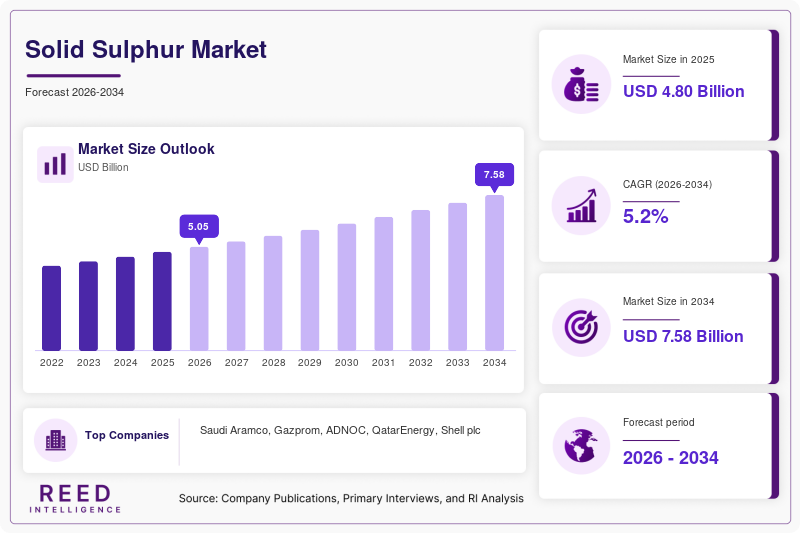
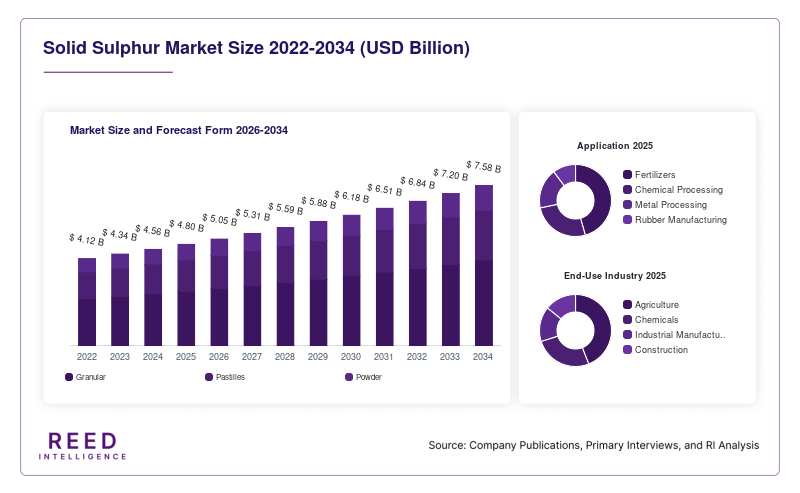
The global Solid Sulphur Market was valued at approximately USD 4.8 billion in 2025 and is projected to reach USD 7.6 billion by 2034, expanding at a CAGR of 5.2% during 2025–2034. Solid sulphur, primarily derived as a byproduct of oil and gas refining, plays a critical role in fertilizer production, chemical processing, and industrial manufacturing. Its widespread application in sulfuric acid production continues to anchor demand across multiple sectors.
One of the primary global factors supporting market growth is the steady expansion of agricultural activities, particularly in emerging economies. The increasing need to enhance crop yield and soil quality has significantly boosted the consumption of sulfur-based fertilizers. Additionally, tightening environmental regulations have encouraged sulfur recovery from refineries, ensuring a consistent supply stream for the solid sulphur market.
Key Highlights:
- Asia Pacific dominated the market with a 38.5% share in 2025, while it is projected to register the fastest growth at a CAGR of 6.1%.
- In application, fertilizers held the largest share (over 62%), while chemical processing is expected to grow fastest at a CAGR of 5.8%.
- By form, granular sulphur led the segment, while pastilles are anticipated to grow at a CAGR of 5.6%.
- China remained the dominant country, with market values of USD 920 million in 2024 and USD 970 million in 2025.
Market Trends
Rising Integration of Sulphur in Sustainable Agriculture
The solid sulphur market is witnessing a growing emphasis on sustainability in agriculture. Farmers are increasingly adopting sulfur-enriched fertilizers to address soil nutrient deficiencies and improve crop productivity. This trend is particularly evident in regions with intensive farming practices where soil degradation is a concern. The demand for micronutrient-balanced fertilizers has contributed to higher usage of solid sulphur in agricultural applications.
Expansion of Sulphur-Based Industrial Applications
Beyond traditional uses, solid sulphur is gaining traction in new industrial applications. It is increasingly used in the production of advanced materials, including sulfur-based polymers and eco-friendly construction materials. Additionally, research into sulfur utilization in energy storage systems, such as lithium-sulfur batteries, is opening new avenues for market growth. This diversification is gradually reducing dependence on conventional end-use sectors and enhancing long-term market stability.
Market Drivers
Increasing Demand for Sulfuric Acid Production
A significant portion of solid sulphur is consumed in the production of sulfuric acid, which is a key input for fertilizers, chemicals, and metal processing. The steady expansion of these industries has directly influenced the growth of the solid sulphur market. The versatility of sulfuric acid in various industrial processes ensures sustained demand for solid sulphur globally.
Growth in Oil & Gas Refining Activities
Solid sulphur is primarily obtained through desulfurization processes in oil and gas refining. As global energy demand continues to rise, refining activities have expanded, resulting in increased sulfur recovery. This has ensured a stable supply of solid sulphur, supporting its widespread industrial usage. Additionally, regulatory mandates to reduce sulfur emissions have further strengthened sulfur recovery operations, indirectly boosting the market.
Market Restraint
Volatility in Supply Due to Dependency on Hydrocarbon Industry
The solid sulphur market is heavily dependent on the oil and gas sector for its supply, as it is largely produced as a byproduct of refining processes. Fluctuations in crude oil production, refinery shutdowns, or shifts toward renewable energy can disrupt sulfur supply chains. This dependency introduces uncertainty in pricing and availability, which can affect downstream industries relying on consistent sulfur supply. Additionally, logistical challenges related to storage and transportation of solid sulphur further add to operational complexities, limiting market expansion in certain regions.
Market Opportunities
Emerging Applications in Energy Storage
The development of lithium-sulfur batteries presents a promising growth avenue for the solid sulphur market. These batteries offer higher energy density and lower environmental impact compared to conventional lithium-ion batteries. As research progresses and commercialization accelerates, solid sulphur demand is expected to rise significantly in the energy sector.
Infrastructure Development in Emerging Economies
Rapid urbanization and infrastructure development in emerging economies are creating new opportunities for solid sulphur usage in construction materials. Sulfur-based concrete and asphalt offer enhanced durability and environmental benefits. Increasing investments in infrastructure projects are expected to drive demand for such materials, thereby expanding the application scope of solid sulphur.
Segmental Analysis
By Form
Granular sulphur dominated the solid sulphur market, accounting for approximately 54% of the market share in 2024. Its ease of handling, storage, and transportation made it the preferred form across industries. Granular sulphur is widely used in fertilizer production due to its uniform particle size and efficient application.
Pastilles are expected to be the fastest-growing subsegment, projected to expand at a CAGR of 5.6%. Their superior handling characteristics and reduced dust formation make them increasingly attractive for industrial applications. The growing emphasis on operational efficiency is expected to drive their adoption.
By Application
Fertilizers represented the largest application segment, holding over 62% of the market share in 2024. The widespread use of sulfur in nutrient formulations has supported its dominance. Sulfur plays a vital role in improving crop yield and quality, making it essential in modern agriculture.
Chemical processing is anticipated to be the fastest-growing segment, with a CAGR of 5.8%. The increasing use of sulfur in the production of chemicals and industrial intermediates is expected to drive growth. The expansion of chemical manufacturing industries globally will further boost demand.
By End-Use Industry
Agriculture dominated the end-use segment, accounting for approximately 58% of the market share in 2024. The sector’s reliance on sulfur-based fertilizers has been a key factor driving demand.
The industrial sector is projected to grow at the fastest rate, with a CAGR of 5.5%. The increasing use of sulfur in manufacturing processes and emerging applications in construction materials are expected to support growth.
Regional Analysis
North America
North America accounted for approximately 21.4% of the solid sulphur market share in 2025 and is expected to grow at a CAGR of 4.6% during the forecast period. The region benefits from well-established refining infrastructure and consistent sulfur recovery processes. The presence of advanced agricultural practices also supports steady demand for sulfur-based fertilizers.
The United States dominated the regional market due to its robust refining sector and extensive use of sulfur in industrial applications. The country’s focus on maintaining soil fertility and improving crop yields has sustained demand for sulfur fertilizers. Additionally, technological advancements in sulfur handling have enhanced operational efficiency across the supply chain.
Europe
Europe held a 19.2% share of the solid sulphur market in 2025 and is projected to grow at a CAGR of 4.3%. The region’s stringent environmental regulations have driven sulfur recovery from refineries, ensuring a steady supply. The increasing adoption of sustainable agricultural practices further supports market growth.
Germany emerged as the dominant country, driven by its strong chemical industry and focus on environmental sustainability. The country’s emphasis on reducing emissions has encouraged efficient sulfur recovery and utilization, boosting the market.
Asia Pacific
Asia Pacific dominated the global solid sulphur market with a 38.5% share in 2025 and is anticipated to grow at the fastest CAGR of 6.1%. Rapid industrialization and expanding agricultural activities have significantly increased demand for sulfur-based products.
China led the regional market due to its large-scale fertilizer production and extensive industrial base. The country’s focus on improving agricultural productivity and supporting industrial growth has driven substantial demand for solid sulphur.
Middle East & Africa
The Middle East & Africa accounted for 12.6% of the market share in 2025 and is expected to grow at a CAGR of 5.4%. The region’s strong oil and gas sector ensures abundant sulfur production, making it a key supplier in the global market.
Saudi Arabia dominated the region, benefiting from its extensive refining capacity and export-oriented sulfur production. The country’s strategic investments in petrochemical infrastructure have strengthened its position in the global solid sulphur market.
Latin America
Latin America held an 8.3% share in 2025 and is projected to grow at a CAGR of 4.9%. Agricultural expansion and increasing demand for fertilizers have been key growth factors in the region.
Brazil emerged as the dominant country due to its large agricultural sector and growing focus on improving soil quality. The rising adoption of sulfur-based fertilizers has significantly contributed to market growth in the country.

Competitive Landscape
The solid sulphur market is moderately fragmented, with several global and regional players competing based on pricing, supply capabilities, and distribution networks. Key companies focus on expanding production capacity and improving logistics to strengthen their market position.
Saudi Aramco emerged as a market leader due to its extensive sulfur recovery operations and strong global distribution network. The company recently expanded its sulfur handling infrastructure to enhance export capabilities and meet rising global demand.
Other players are focusing on strategic partnerships and technological advancements to improve operational efficiency and capture new growth opportunities in emerging markets.
Key Players List
- Saudi Aramco
- Gazprom
- ADNOC
- QatarEnergy
- Shell plc
- ExxonMobil Corporation
- Valero Energy Corporation
- Marathon Petroleum Corporation
- Reliance Industries Limited
- Sinopec
- CNPC
- OxyChem
- Tengizchevroil
- Kuwait Petroleum Corporation
- Pemex
Recent Developments
- In 2025, Saudi Aramco expanded its sulfur export terminals to enhance global supply capabilities.
- ExxonMobil increased sulfur recovery efficiency across its refining operations.
- QatarEnergy invested in advanced sulfur granulation technologies.
- Reliance Industries strengthened its distribution network for sulfur-based products.
- Sinopec announced capacity expansion in sulfur processing units to meet rising domestic demand.
Solid Sulphur Market Segments
Form
- Granular
- Pastilles
- Powder
Application
- Fertilizers
- Chemical Processing
- Metal Processing
- Rubber Manufacturing
End-Use Industry
- Agriculture
- Chemicals
- Industrial Manufacturing
- Construction
By Region
- North America
- Europe
- APAC
- Middle East and Africa
- LATAM