Solid Surface & Other Cast Polymers Market Size, Share, Demand Report By Product Type (Acrylic Solid Surfaces, Polyester Solid Surfaces, Engineered Cast Polymers, Cultured Marble, Others), By Application (Countertops and Kitchen Surfaces, Bathroom and Sanitary Ware, Healthcare and Laboratory Applications, Wall Cladding and Furniture, Commercial Interiors), By End-Use Industry (Residential, Commercial, Healthcare, Hospitality, Institutional) By Region & Segment Forecasts, 2026–2034
USD 3950
Market Overview
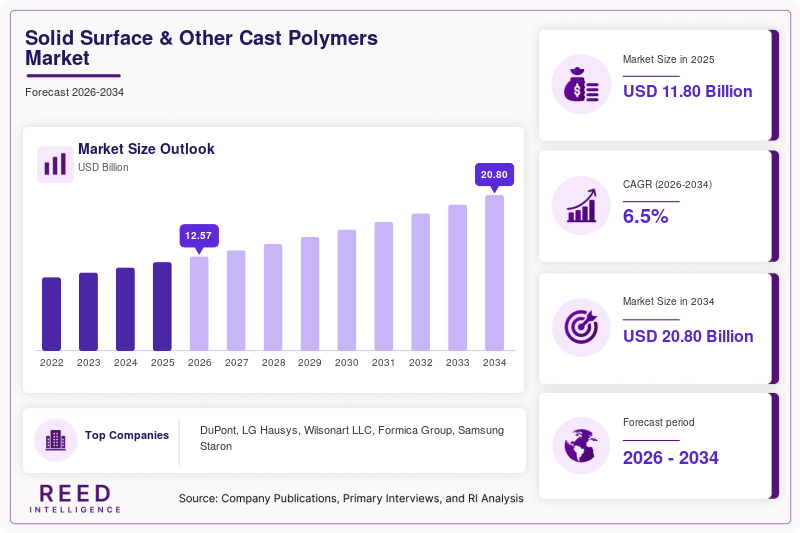
The global Solid Surface & Other Cast Polymers Market size Research Report market was valued at USD 11.8 billion in 2026 and is projected to reach USD 19.6 billion by 2034, expanding at a CAGR of 6.5% during the forecast period from 2026 to 2034. The market continues to benefit from rising investments in commercial infrastructure, residential remodeling, and premium interior applications. Solid surface materials and cast polymers are increasingly used in countertops, wall panels, sanitary ware, furniture surfaces, and healthcare interiors because of their durability, low maintenance, seamless appearance, and resistance to moisture and chemicals. Demand has also increased across hospitality, healthcare, and retail sectors where hygienic and visually consistent surfaces are essential.
One of the major global factors supporting market growth is the increasing preference for engineered decorative materials in modern construction and renovation projects. Architects and interior designers are shifting toward customizable surfacing materials that combine aesthetics with functionality. Solid surfaces and cast polymers provide flexibility in design, allowing manufacturers to offer seamless finishes, varied textures, and enhanced durability compared to natural stone alternatives. Rising urbanization and the expansion of smart residential projects across emerging economies are also supporting market demand.
Key Highlights
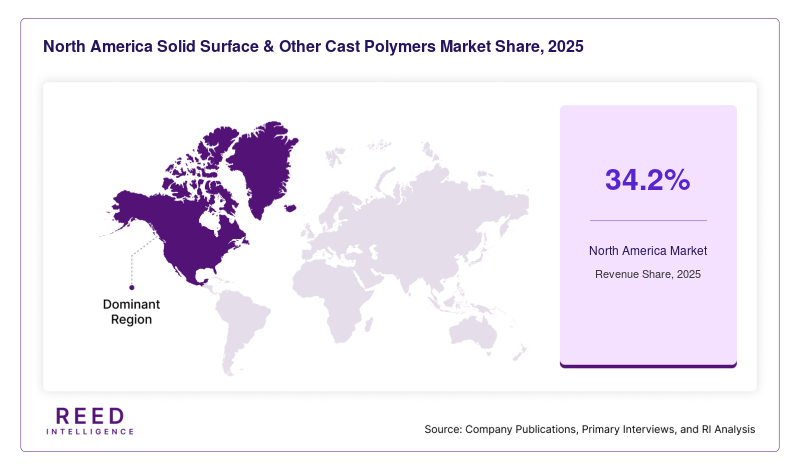
- North America dominated the market with a 34.2% share in 2025.
- Asia Pacific is expected to grow at the fastest CAGR of 8.7% during 2026–2034.
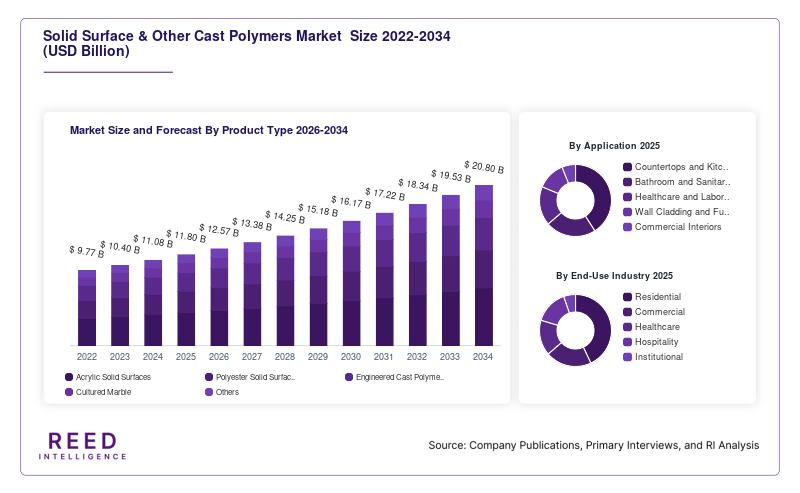
- By product type, acrylic solid surfaces accounted for the largest share of 39.4%, while engineered cast polymers are projected to grow at a CAGR of 9.1%.
- By application, countertops and kitchen surfaces led with a 42.6% share, whereas healthcare and laboratory applications are expected to expand at a CAGR of 8.9%.
- The United States remained the dominant country, with market values of USD 2.9 billion in 2024 and USD 3.1 billion in 2025.
Market Trends
Growing Preference for Sustainable and Recyclable Surface Materials
The market is witnessing rising demand for environmentally responsible materials across residential and commercial construction projects. Builders, architects, and institutional buyers are increasingly selecting solid surface and cast polymer products manufactured with recycled minerals, low-VOC resins, and renewable additives. Sustainability certifications are becoming an important purchasing factor, particularly in North America and Europe where green building regulations continue to tighten. Manufacturers are therefore investing in eco-friendly formulations that reduce environmental impact without compromising durability or visual quality.
The use of recycled aluminum trihydrate fillers and bio-based acrylic resins is gaining attention among leading producers. Several companies are also introducing closed-loop recycling systems that allow fabrication scraps to be reused during manufacturing. Hospitality, healthcare, and educational facilities are increasingly adopting sustainable surface materials to align with corporate environmental goals. This trend is expected to influence product innovation and strengthen long-term demand for advanced cast polymer solutions.
Increasing Adoption of Seamless and Customized Interior Designs
Demand for seamless and customized interior surfaces is becoming a major trend across the construction and renovation industries. Consumers and commercial developers are increasingly choosing solid surface materials because they allow integrated sinks, curved structures, invisible joints, and personalized textures. Modern kitchens, luxury bathrooms, retail outlets, and healthcare facilities are adopting these materials to create visually clean and functional spaces.
Advancements in digital fabrication technologies and CNC machining are helping manufacturers deliver highly customized products with improved precision and shorter lead times. Designers are also experimenting with translucent panels, embedded lighting effects, and thermoformed structures that are difficult to achieve with natural stone materials. The trend toward premium interior aesthetics in urban housing projects and commercial infrastructure developments is contributing to strong market momentum. Increasing disposable income levels in developing economies are further supporting demand for customized cast polymer products across residential applications.
Market Drivers
Expansion of Residential Remodeling and Renovation Activities
The increasing number of home renovation and remodeling projects worldwide is a major driver supporting market expansion. Consumers are investing more in modern kitchens, bathrooms, and living spaces that require durable and visually attractive surfacing materials. Solid surfaces and cast polymers are widely preferred because they offer stain resistance, easy maintenance, and long product life. Growing urban housing upgrades and aging residential infrastructure in developed economies are generating consistent replacement demand.
Homeowners are increasingly choosing engineered surfaces over natural stone due to lower maintenance requirements and improved customization capabilities. Demand is especially strong for kitchen countertops, vanity tops, shower panels, and integrated sinks. E-commerce platforms and digital interior design services are also helping consumers access a wider variety of product styles and finishes. Rising disposable income and changing lifestyle preferences are expected to continue supporting renovation-driven market growth over the forecast period.
Rising Demand from Healthcare and Commercial Infrastructure
Healthcare facilities and commercial infrastructure projects are creating strong demand for solid surface and cast polymer products. Hospitals, clinics, laboratories, airports, and hotels require hygienic, non-porous, and durable materials that can withstand heavy usage and frequent cleaning. Solid surface materials provide antimicrobial performance and seamless joints, making them suitable for healthcare environments where infection control is essential.
Commercial property developers are increasingly selecting engineered surfaces because of their design flexibility and lower lifecycle maintenance costs. The expansion of healthcare infrastructure across Asia Pacific and the Middle East is particularly contributing to higher product adoption. Educational institutions and corporate offices are also integrating cast polymer surfaces into workspaces, cafeterias, and public washrooms. Increasing public infrastructure spending and rising investments in smart commercial buildings are expected to strengthen long-term demand across institutional applications.
Market Restraint
Volatility in Raw Material Prices and Competition from Alternative Materials
Fluctuating raw material prices remain a major challenge for manufacturers operating in the solid surface and cast polymers industry. Key materials such as acrylic resins, polyester resins, alumina trihydrate, and specialty pigments are heavily influenced by petrochemical price movements and global supply chain disruptions. Sudden increases in resin costs can reduce manufacturer profit margins and create pricing pressure across the value chain. Smaller regional manufacturers often struggle to absorb these cost fluctuations, which can limit expansion opportunities and investment capacity.
The market also faces increasing competition from alternative surfacing materials including quartz, ceramic slabs, natural stone, and laminate products. Quartz surfaces, in particular, are gaining popularity because of their premium appearance and strong scratch resistance. Some consumers continue to prefer natural stone for luxury projects despite higher maintenance requirements. In price-sensitive markets, laminate materials remain attractive because of their affordability and wide availability. These competitive pressures require solid surface manufacturers to continuously innovate through enhanced durability, sustainable formulations, and differentiated aesthetics to maintain market share and customer loyalty.
Market Opportunities
Rising Infrastructure Development in Emerging Economies
Emerging economies are creating substantial opportunities for solid surface and cast polymer manufacturers due to rapid urbanization and infrastructure expansion. Countries across Asia Pacific, Latin America, and the Middle East are investing heavily in residential complexes, transportation infrastructure, healthcare facilities, and commercial real estate projects. These developments are increasing demand for modern interior materials that combine durability, hygiene, and aesthetic value.
Government-supported smart city initiatives and affordable housing programs are encouraging wider use of engineered surface materials in kitchens, bathrooms, and public facilities. International hospitality chains and healthcare providers entering emerging markets are also adopting premium interior standards that support cast polymer demand. Manufacturers are expanding regional production facilities and distribution networks to capitalize on these opportunities. Increasing consumer awareness regarding long-lasting engineered materials is expected to support future market penetration in developing economies.
Integration of Advanced Manufacturing and Smart Fabrication Technologies
The adoption of advanced manufacturing technologies presents strong growth opportunities for industry participants. Automation, digital fabrication, and precision molding technologies are improving production efficiency and reducing operational costs. CNC cutting systems and thermoforming technologies allow manufacturers to create highly customized products with reduced waste and faster delivery times.
Artificial intelligence and digital design software are also improving product development capabilities by enabling accurate material simulations and design optimization. Smart manufacturing systems help producers monitor quality control and reduce defects during fabrication. These technological advancements are particularly beneficial for large commercial projects requiring customized dimensions and seamless installation. Companies investing in automation and advanced fabrication technologies are expected to strengthen their competitive positioning while improving profitability and operational scalability across regional markets.
Segmental Analysis
By Product Type
Acrylic solid surfaces accounted for the largest market share in 2024 due to their superior durability, seamless appearance, and strong resistance to stains and moisture. These materials are widely used in residential kitchens, healthcare interiors, hospitality projects, and commercial workspaces because they can be easily repaired and thermoformed into customized shapes. Acrylic-based products are particularly preferred in premium interior applications where design flexibility and long service life are important purchasing factors. The segment has also benefited from increasing consumer preference for non-porous and hygienic materials that require minimal maintenance. Manufacturers are continuously introducing new colors, textures, and translucent effects to strengthen product appeal and address evolving architectural trends in both developed and emerging markets.
Engineered cast polymers are expected to register the fastest CAGR of 9.1% during the forecast period because of their expanding application scope and cost-effective production characteristics. These products are increasingly used in shower bases, vanity tops, bathtubs, and commercial sanitary installations due to their strength and design adaptability. Manufacturers are improving resin formulations and surface coatings to enhance impact resistance and product lifespan. Growing demand for customized bathroom fixtures and modular construction solutions is further supporting segment expansion. The increasing adoption of engineered cast polymers in institutional infrastructure projects, including hospitals and hotels, is also contributing to rapid growth. Emerging economies are expected to create strong future demand due to expanding residential and hospitality construction activities.
By Application
Countertops and kitchen surfaces held the dominant share of the market in 2024 due to increasing residential remodeling activities and rising demand for premium kitchen interiors. Solid surface materials are widely preferred for countertops because they offer seamless integration, easy cleaning, and strong resistance to moisture and stains. The segment has witnessed substantial growth across both residential and commercial sectors including restaurants, hotels, and office cafeterias. Consumers increasingly favor engineered surfaces over natural stone because of their lower maintenance requirements and enhanced design flexibility. The availability of customizable colors and finishes has further strengthened product adoption. Expanding urban housing projects and rising investments in luxury apartments are expected to continue supporting demand for countertop applications during the forecast period.
Healthcare and laboratory applications are projected to expand at the fastest CAGR of 8.9% from 2026 to 2034. Hospitals, clinics, research laboratories, and diagnostic centers require non-porous and hygienic surfaces that can withstand frequent cleaning and chemical exposure. Solid surface materials provide seamless joints that help reduce bacterial accumulation, making them suitable for healthcare environments. Increasing healthcare infrastructure development across Asia Pacific and the Middle East is contributing significantly to segment growth. Governments and private healthcare providers are investing heavily in modern medical facilities equipped with durable and easy-to-maintain interior materials. Manufacturers are also introducing antimicrobial coatings and specialized healthcare-grade surfaces to address evolving industry requirements and regulatory standards.
By End-Use Industry
The residential segment dominated the market in 2024 due to increasing consumer spending on home improvement and interior renovation projects. Rising urbanization, changing lifestyle preferences, and growing awareness regarding durable surfacing materials are supporting demand across residential applications. Kitchens and bathrooms remain the primary installation areas for solid surface products because homeowners increasingly prioritize aesthetics, hygiene, and functionality. The availability of customizable designs and integrated sink solutions has improved product adoption among middle-income and premium housing segments. Residential developers are also using engineered surfaces in modern apartment projects to enhance property value and interior appeal. Growth in e-commerce furniture and home improvement platforms is further helping consumers access a wider range of products and installation services.
The commercial segment is expected to witness the fastest CAGR during the forecast period due to increasing investments in hospitality, healthcare, retail, and office infrastructure. Commercial property developers prefer solid surface and cast polymer materials because they provide long-term durability and lower maintenance costs in high-traffic environments. Hotels, shopping malls, airports, and educational institutions are increasingly using these materials in reception counters, wall panels, washrooms, and workstations. Growing emphasis on visually consistent interiors and hygienic public spaces is supporting wider adoption. Smart commercial buildings and sustainable infrastructure projects are also driving demand for advanced engineered surfaces. Manufacturers are responding by introducing fire-resistant, antimicrobial, and eco-friendly product variants tailored for commercial applications.
Regional Analysis
North America
North America accounted for 34.2% of the global market share in 2025 and maintained its position as the largest regional market for solid surface and other cast polymers. The region is projected to grow at a CAGR of 5.9% during the forecast period. Strong demand from residential remodeling projects, healthcare infrastructure, and commercial office renovations continues to support market expansion. The United States and Canada are witnessing increasing adoption of engineered surfaces in kitchens, healthcare workstations, and hospitality interiors due to their durability and seamless appearance.
The United States remains the dominant country within the regional market due to high consumer spending on premium interior materials and advanced construction practices. The country benefits from strong distribution networks, established fabrication industries, and high awareness regarding hygienic surfacing products. Rising investments in healthcare facility modernization and sustainable building projects are supporting additional demand. Increasing replacement of traditional laminate surfaces with acrylic solid surfaces is also contributing to market growth across residential applications.
Europe
Europe represented a significant share of the global market in 2025 and is expected to register a CAGR of 5.7% during the forecast period. Demand for environmentally sustainable construction materials is playing a major role in regional growth. Countries across Western Europe are implementing stricter environmental standards for building materials, encouraging manufacturers to develop low-emission and recyclable cast polymer products. Commercial renovation projects and premium residential developments are further supporting regional demand.
Germany remains the dominant country within Europe because of its advanced construction sector and strong focus on sustainable infrastructure. The country has witnessed growing demand for solid surface materials in healthcare, retail, and hospitality projects. German manufacturers are also investing heavily in automation and material innovation to improve product quality and production efficiency. Rising consumer preference for seamless and minimalist interior designs is creating favorable opportunities for market expansion across the region.
Asia Pacific
Asia Pacific is projected to record the fastest CAGR of 8.7% from 2026 to 2034 due to rapid urbanization and expanding infrastructure investments. The region is experiencing strong growth in residential construction, commercial real estate development, and healthcare facility expansion. Countries such as China, India, Japan, and South Korea are increasingly adopting engineered surfacing materials because of their cost efficiency, aesthetic flexibility, and durability. Rising disposable incomes and changing consumer lifestyles are further supporting product demand.
China dominates the Asia Pacific market due to its large construction industry and strong manufacturing capabilities. The country benefits from expanding urban housing projects and increasing demand for modern interior surfaces in commercial spaces. Chinese manufacturers are also increasing exports of cast polymer products to global markets. Government investments in healthcare infrastructure and transportation projects are contributing to rising consumption of solid surface materials across institutional applications and public facilities.
Middle East & Africa
The Middle East & Africa region is expected to witness moderate but stable growth during the forecast period. Increasing investments in tourism infrastructure, luxury hotels, and commercial developments are creating favorable opportunities for solid surface manufacturers. Countries within the Gulf Cooperation Council are focusing on high-end architectural projects that require premium surfacing materials for kitchens, bathrooms, and public spaces. Demand for hygienic and durable materials in healthcare facilities is also increasing steadily.
Saudi Arabia remains the dominant country in the regional market due to large-scale infrastructure projects and rapid urban development initiatives. Mega projects related to tourism, entertainment, and smart city development are generating strong demand for engineered surfaces. The country’s hospitality and commercial sectors are increasingly adopting cast polymer materials because of their premium appearance and long-term durability. Expanding healthcare investments and modern retail construction projects are expected to further support regional market growth.
Latin America
Latin America is witnessing gradual market growth supported by expanding residential renovation activities and commercial infrastructure development. The region is expected to register a CAGR of 5.3% during the forecast period. Increasing urbanization and rising middle-class income levels are encouraging consumers to invest in modern kitchen and bathroom surfaces. Demand is also increasing across hospitality and retail sectors where visually appealing and low-maintenance materials are preferred.
Brazil remains the leading country within the Latin American market due to its large construction industry and growing urban population. The country is experiencing increasing demand for affordable yet durable surfacing materials in residential and commercial projects. Local manufacturers are expanding production capacity to meet rising domestic demand. Government initiatives aimed at infrastructure modernization and public housing development are also supporting broader adoption of solid surface and cast polymer products across the country.
Competitive Landscape
The global solid surface and other cast polymers market is moderately consolidated, with several international and regional manufacturers competing through product innovation, distribution expansion, and strategic partnerships. Companies are increasingly focusing on sustainable material development, digital fabrication technologies, and customized design solutions to strengthen market presence. Product differentiation through color variety, durability enhancement, and advanced surface finishes remains a key competitive strategy.
DuPont continues to maintain a leading market position due to its extensive product portfolio, strong global distribution network, and established brand recognition in premium solid surface materials. The company recently expanded its sustainable surfacing product line with recycled-content acrylic solutions aimed at commercial infrastructure projects. Other major companies are also investing in automated manufacturing facilities and environmentally responsible production technologies to improve operational efficiency and meet evolving customer preferences.
Key Players
- DuPont
- LG Hausys
- Wilsonart LLC
- Formica Group
- Samsung Staron
- Aristech Surfaces LLC
- LX Hausys
- Hanex Solid Surfaces
- Swan Corporation
- Bradley Corporation
- Kingkonree International
- Gelandi Group
- Meganite
- Systempool S.p.A.
- Avonite Surfaces
Recent Developments
- In March 2026, DuPont announced the expansion of its advanced solid surface manufacturing operations in North America to support rising demand from healthcare and commercial infrastructure projects.
- In October 2025, LG Hausys introduced a new eco-friendly acrylic solid surface collection manufactured with recycled mineral fillers and low-emission resin technology for sustainable building applications.
- In July 2025, Wilsonart LLC partnered with regional fabrication companies across Asia Pacific to strengthen customized countertop production capabilities for residential and hospitality construction projects.
- In January 2026, Formica Group launched a digitally integrated fabrication platform designed to improve precision cutting, reduce production waste, and accelerate delivery timelines for commercial interior installations.
Solid Surface & Other Cast Polymers Market Segments
By Product Type
- Acrylic Solid Surfaces
- Polyester Solid Surfaces
- Engineered Cast Polymers
- Cultured Marble
- Others
By Application
- Countertops and Kitchen Surfaces
- Bathroom and Sanitary Ware
- Healthcare and Laboratory Applications
- Wall Cladding and Furniture
- Commercial Interiors
By End-Use Industry
- Residential
- Commercial
- Healthcare
- Hospitality
- Institutional
By Region
- North America
- Europe
- APAC
- Middle East and Africa
- LATAM