Solvent Dye Market Size, Share Demand Report By Type (Azo Solvent Dyes, Anthraquinone Solvent Dyes), By Application (Plastics, Printing Inks, Fuels and Lubricants, Coatings), By Solubility Medium (Hydrocarbon Solvents, Alcohol Solvents, Ketone Solvents, Aromatic Solvents), By End-Use Industry (Packaging, Automotive, Textiles, Electronics), By Form (Powder, Liquid, Granules), By Region & Segment Forecasts, 2026–2034
USD 3950
Market Overview
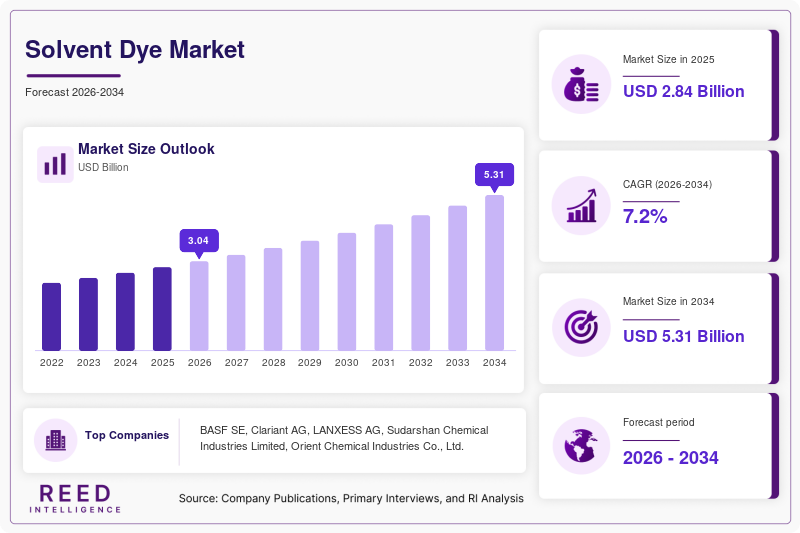
The Solvent Dye Market size was valued at USD 2.84 billion in 2026 and is projected to reach USD 4.96 billion by 2034, expanding at a CAGR of 7.2% during 2026–2034. The global Solvent Dye Market growth has been supported by increasing demand for high-performance coloring agents across plastics, printing inks, fuels, coatings, and textile applications. Rising industrial manufacturing activities and the growing use of transparent and vibrant color formulations in consumer goods significantly contributed to the expansion of the Solvent Dye Market.
Solvent dyes are widely used because of their excellent solubility in organic solvents, superior brightness, and strong compatibility with synthetic materials. Industries such as automotive, packaging, electronics, and printing increasingly adopted solvent dyes to enhance product aesthetics and functional performance. In addition, the expansion of polymer manufacturing and specialty chemical production accelerated market demand across both developed and emerging economies.
Key Highlights
- Asia Pacific accounted for 38.9% of the global Solvent Dye Market share in 2025, while the Middle East & Africa is projected to register the fastest CAGR of 8.4% during 2026–2034.
- By type, azo solvent dyes held the leading market share of 41.6% in 2025, while anthraquinone solvent dyes are projected to expand at a CAGR of 8.1% during the forecast period.
- By application, plastics represented 36.8% of the Solvent Dye Market share in 2025, while printing inks are anticipated to grow at a CAGR of 8.3%.
- By end-use industry, packaging dominated with 29.7% share in 2025, whereas automotive applications are expected to grow at a CAGR of 8.5%.
- China remained the dominant country market and was valued at USD 486 million in 2024 and USD 521 million in 2025.
Market Trends
Increasing Adoption of High-Performance Dyes in Engineering Plastics
One of the notable trends influencing the Solvent Dye Market is the increasing use of high-performance solvent dyes in engineering plastics and specialty polymers. Manufacturers of consumer electronics, automotive interiors, and industrial components increasingly preferred solvent dyes due to their thermal stability and compatibility with synthetic resins.
The demand for transparent and vibrant plastic coloration encouraged the use of solvent dyes in polycarbonate, polystyrene, acrylic, and polyester materials. This trend became more prominent as industries focused on premium product appearance and durable color performance.
Growing Focus on Low-VOC and Environmentally Compatible Formulations
Another major trend shaping the Solvent Dye Market is the growing development of environmentally compatible dye formulations. Regulatory authorities and industrial users increasingly emphasized low volatile organic compound emissions and safer chemical processing standards.
Manufacturers introduced solvent dyes with improved eco-friendly characteristics and reduced hazardous content. The trend supported investments in cleaner production technologies and advanced solvent recovery systems across dye manufacturing facilities.
Market Drivers
Rising Demand from the Packaging Industry
The increasing use of colored plastic packaging materials significantly supported the growth of the Solvent Dye Market. Packaging manufacturers widely adopted solvent dyes for flexible packaging films, containers, caps, and specialty labels due to their strong color intensity and transparency properties.
The expansion of food packaging, personal care products, and industrial packaging industries accelerated the consumption of solvent dyes. Rapid growth in e-commerce packaging applications also strengthened product demand across global markets.
Expanding Applications in Printing Ink Manufacturing
The growing printing ink industry acted as another major driver for the Solvent Dye Market. Solvent dyes are extensively utilized in gravure printing, digital printing, and specialty ink formulations because of their excellent solubility and color clarity.
Increasing demand for commercial printing, product labeling, and advertising materials supported the expansion of dye consumption. The growth of high-speed industrial printing technologies further encouraged the use of advanced solvent dye formulations.
Market Restraint
Volatility in Raw Material Prices
Fluctuating prices of petrochemical-based raw materials remained a significant restraint for the Solvent Dye Market. Variations in crude oil prices directly impacted the production costs of solvents and dye intermediates, affecting overall manufacturing profitability.
In addition, supply chain disruptions and environmental compliance expenses created operational challenges for dye manufacturers, particularly small and medium-scale producers.
Market Opportunities
Expansion of Fuel and Lubricant Coloring Applications
The increasing use of solvent dyes in fuel identification and lubricant coloration presents substantial opportunities for market participants. Fuel manufacturers increasingly adopted solvent dyes to distinguish product grades and improve distribution management.
The growing industrial lubricants sector is also expected to support demand for durable and heat-resistant solvent dye formulations.
Rising Demand from Emerging Textile Processing Industries
The expansion of textile processing industries in developing economies is anticipated to create new opportunities in the Solvent Dye Market. Solvent dyes are increasingly used in synthetic textile coloration and specialty fabric treatments.
Industrial growth in countries across South Asia and Southeast Asia is expected to support investments in advanced dye manufacturing and textile chemical production facilities.
Segmental Analysis
By Type
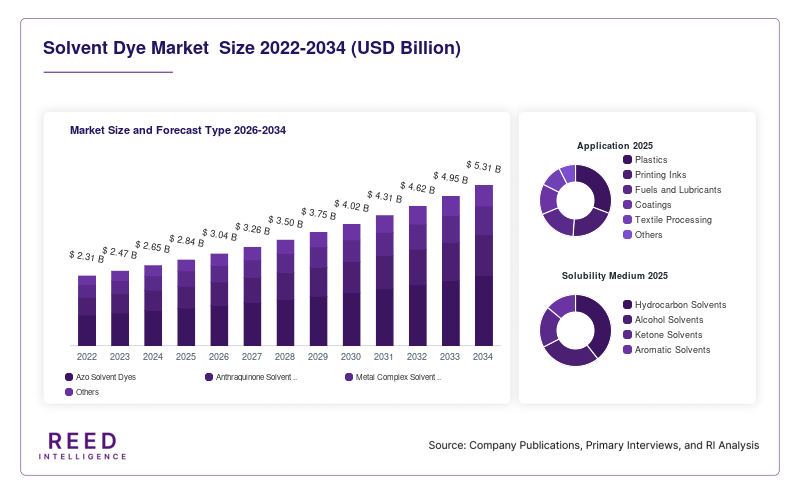
Based on type, the Solvent Dye Market is segmented into azo solvent dyes, anthraquinone solvent dyes, metal complex solvent dyes, and others.
Azo solvent dyes dominated the market with a 41.6% share in 2025 due to their cost efficiency, strong tinting strength, and broad industrial applicability. These dyes were widely utilized across plastics, coatings, and printing ink formulations.
Anthraquinone solvent dyes are projected to grow at the fastest CAGR of 8.1% during the forecast period. The growth will be driven by increasing demand for superior heat resistance and lightfastness properties in high-performance industrial applications.
By Application
Based on application, the Solvent Dye Market is categorized into plastics, printing inks, fuels and lubricants, coatings, textile processing, and others.
Plastics accounted for 36.8% of the market share in 2025 due to increasing consumption of colored polymer products in packaging, automotive, and consumer electronics industries.
Printing inks are expected to register the fastest CAGR of 8.3% during 2026–2034. The growth will be supported by rising demand for high-quality commercial printing and digital packaging solutions.
By Solubility Medium
Based on solubility medium, the Solvent Dye Market is divided into hydrocarbon solvents, alcohol solvents, ketone solvents, and aromatic solvents.
Hydrocarbon solvents held the dominant market share of 39.5% in 2025 because of their extensive use in industrial dye formulations and compatibility with synthetic polymers.
Ketone solvents are forecast to grow at the fastest CAGR of 7.8% during the assessment period. The segment will benefit from rising utilization in specialty coating and advanced ink manufacturing applications.
By End-Use Industry
Based on end-use industry, the Solvent Dye Market is segmented into packaging, automotive, textiles, electronics, construction, and others.
Packaging represented 29.7% of the market share in 2025 due to increasing demand for visually appealing plastic containers, films, and industrial packaging products.
Automotive is anticipated to expand at a CAGR of 8.5% over the forecast period. Growing use of colored engineering plastics and specialty coatings in vehicle interiors and exterior components will support segment growth.
By Form
Based on form, the Solvent Dye Market is segmented into powder, liquid, and granules.
Powder solvent dyes dominated the market with a 48.2% share in 2025 due to their longer shelf life, ease of transportation, and widespread industrial usage.
Liquid solvent dyes are expected to grow at the fastest CAGR of 7.9% during the forecast period. Increasing demand for ready-to-use industrial formulations and automated dosing systems will drive segment expansion.
Regional Analysis
North America
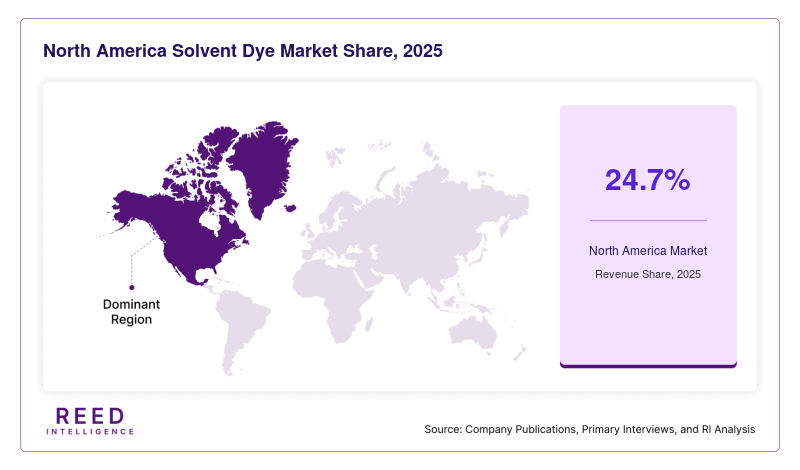
North America accounted for 24.7% of the global Solvent Dye Market share in 2025 and is projected to grow at a CAGR of 6.6% during 2026–2034. The regional market benefited from the strong presence of specialty chemical manufacturers and advanced plastics processing industries.
The United States dominated the regional market due to rising demand for colored engineering plastics in automotive and electronics manufacturing. Industrial packaging expansion also supported the adoption of solvent dye products across commercial applications.
Europe
Europe held 27.1% of the Solvent Dye Market share in 2025 and is expected to expand at a CAGR of 6.9% over the forecast period. The region experienced stable growth due to increasing demand for specialty coatings, printing inks, and industrial coloring applications.
Germany represented the leading country market in Europe. The country witnessed increased utilization of solvent dyes in automotive coatings and industrial polymer manufacturing operations.
Asia Pacific
Asia Pacific represented 38.9% of the global Solvent Dye Market share in 2025 and is forecast to register a CAGR of 7.9% during 2026–2034. Rapid industrialization, expanding plastics manufacturing, and increasing printing activities contributed to regional market growth.
China emerged as the dominant country market due to large-scale chemical manufacturing capabilities and expanding exports of dyed plastic products. The country also benefited from strong demand across packaging and textile industries.
Middle East & Africa
The Middle East & Africa accounted for 5.1% of the Solvent Dye Market share in 2025 and is anticipated to grow at the fastest CAGR of 8.4% during the forecast period. Increasing investments in petrochemical manufacturing and industrial packaging production supported regional market expansion.
Saudi Arabia remained the dominant country market due to growing downstream petrochemical processing activities and rising industrial colorant consumption in plastic applications.
Latin America
Latin America captured 4.2% of the global Solvent Dye Market share in 2025 and is expected to grow at a CAGR of 7.1% through 2034. The regional market benefited from expanding packaging manufacturing and increasing industrial printing activities.
Brazil dominated the Latin American market due to the growth of domestic plastics processing and rising demand for colored consumer packaging materials.
Competitive Landscape
The Solvent Dye Market remained moderately fragmented, with manufacturers focusing on product innovation, production expansion, and environmental compliance strategies. Companies increasingly invested in specialty dye formulations with improved thermal stability, color consistency, and industrial compatibility.
BASF SE remained one of the leading market participants due to its extensive specialty chemicals portfolio and global distribution network. The company recently expanded production capabilities for industrial colorants designed for plastics and coatings applications.
Clariant AG focused on developing environmentally compatible solvent dye solutions for packaging and polymer industries.
LANXESS AG strengthened its industrial dye portfolio to support advanced engineering plastic applications.
Sudarshan Chemical Industries Limited expanded manufacturing investments to increase specialty dye production capacity.
Orient Chemical Industries Co., Ltd. emphasized high-performance dye technologies for automotive and electronics applications.
Key Players List
- BASF SE
- Clariant AG
- LANXESS AG
- Sudarshan Chemical Industries Limited
- Orient Chemical Industries Co., Ltd.
- DIC Corporation
- Ravago Chemicals
- Keystone Aniline Corporation
- Synthesia a.s.
- Aarti Industries Limited
- Atul Ltd.
- DyStar Group
- Nippon Kayaku Co., Ltd.
- Hubei Chuyuan Group
- Kiri Industries Limited
Recent Developments
- In 2025, BASF SE expanded specialty solvent dye production facilities for engineering plastics applications.
- In 2024, Clariant AG introduced new low-emission solvent dye formulations for industrial packaging solutions.
- In 2025, LANXESS AG strengthened its industrial colorant portfolio for automotive polymer manufacturing.
- In 2024, Sudarshan Chemical Industries Limited announced capacity expansion for specialty dyes targeting export markets.
- In 2025, DIC Corporation launched advanced solvent dye solutions for high-speed commercial printing applications.
Solvent Dye Market Segments
Type
- Azo Solvent Dyes
- Anthraquinone Solvent Dyes
- Metal Complex Solvent Dyes
- Others
Application
- Plastics
- Printing Inks
- Fuels and Lubricants
- Coatings
- Textile Processing
- Others
Solubility Medium
- Hydrocarbon Solvents
- Alcohol Solvents
- Ketone Solvents
- Aromatic Solvents
End-Use Industry
- Packaging
- Automotive
- Textiles
- Electronics
- Construction
- Others
Form
- Powder
- Liquid
- Granules
By Region
- North America
- Europe
- APAC
- Middle East and Africa
- LATAM