Solvent Recovery Recycling Market Size, Share & Demand Report By Technology (Distillation Systems, Membrane Separation, Adsorption Systems), By Application (Pharmaceuticals, Electronics Manufacturing, Chemicals, Automotive), By End-Use Industry (Chemical Industry, Pharmaceutical Industry, Automotive Industry, Electronics Industry), By Region & Segment Forecasts, 2026–2034
USD 3950
Market Overview
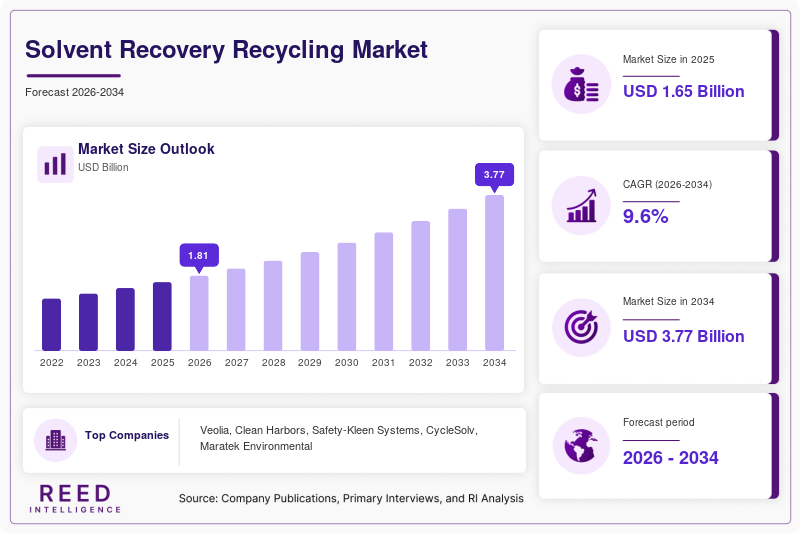
The global Solvent Recovery Recycling Market was valued at approximately USD 1.65 billion in 2026 and is projected to reach USD 3.45 billion by 2034, expanding at a CAGR of 9.6% during 2026–2034. The market is witnessing steady growth due to increasing industrial emphasis on waste reduction, cost optimization, and environmental sustainability. Solvent recovery systems enable industries to reuse valuable chemicals, thereby reducing procurement costs and minimizing hazardous waste disposal, which aligns with stricter environmental regulations globally.
One major global factor supporting market growth is the tightening of environmental policies aimed at reducing industrial emissions and hazardous waste generation. Governments and regulatory bodies are encouraging industries such as pharmaceuticals, chemicals, automotive, and electronics to adopt sustainable practices. This shift is accelerating the demand for solvent recovery and recycling solutions, especially in regions with stringent environmental compliance frameworks.
Key Highlights
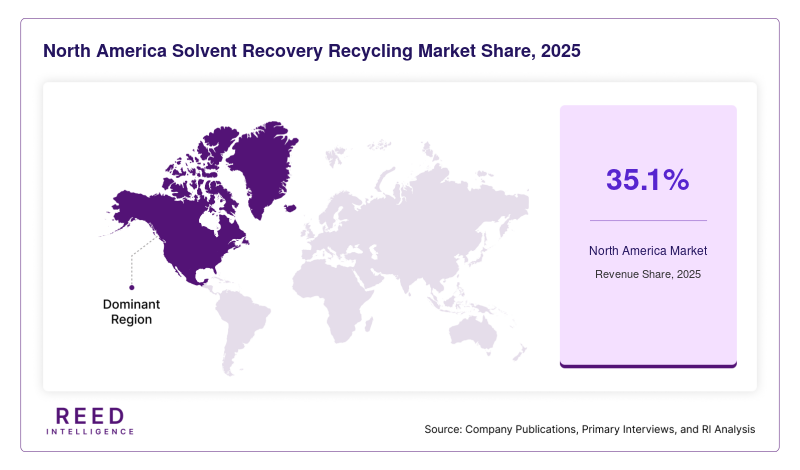
- North America dominated the market with a 35.1% share in 2025.
- Asia Pacific is expected to grow at the fastest CAGR of 10.8% during 2026–2034.
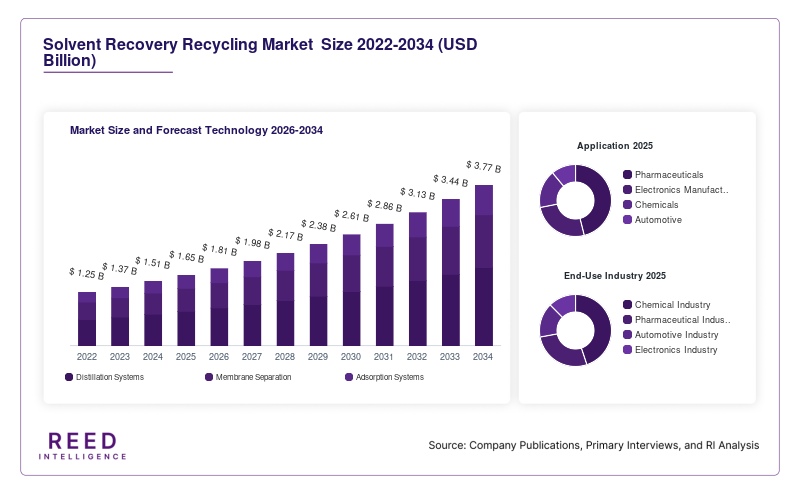
- By technology, distillation systems accounted for the largest share of 42.7%, while membrane separation systems are projected to grow at a CAGR of 11.6%.
- By end-use industry, pharmaceuticals led with a 39.4% share, whereas electronics manufacturing is expected to expand at a CAGR of 10.9%.
- The United States remained the dominant country, with market values of USD 520 million in 2024 and USD 575 million in 2025.
Market Trends
Integration of Advanced Filtration and Membrane Technologies
The Solvent Recovery Recycling Market is witnessing increased adoption of advanced filtration and membrane-based technologies. These systems offer improved efficiency compared to traditional distillation processes by enabling selective separation of solvents with lower energy consumption. Membrane technologies are particularly beneficial in applications requiring high purity levels, such as pharmaceuticals and electronics manufacturing. The shift toward these technologies is also driven by their compact design and ability to operate under lower temperatures, which reduces operational costs. Companies are focusing on hybrid systems that combine distillation and membrane processes to maximize recovery rates and minimize waste, supporting sustainable production goals.
Growing Adoption of On-Site Solvent Recycling Systems
Another key trend is the growing preference for on-site solvent recovery systems across industries. Organizations are investing in in-house recycling units to reduce dependency on third-party waste management services. On-site systems offer better control over solvent quality, reduce transportation costs, and minimize environmental risks associated with hazardous waste handling. Small and medium enterprises are increasingly adopting modular and scalable systems that can be tailored to their production capacity. This trend is particularly evident in sectors such as printing, automotive coatings, and chemical manufacturing, where solvent usage is high and continuous recycling can significantly enhance operational efficiency.
Market Drivers
Stringent Environmental Regulations and Compliance Requirements
The implementation of strict environmental regulations is a major driver for the Solvent Recovery Recycling Market. Governments worldwide are enforcing policies aimed at reducing industrial emissions and hazardous waste disposal. Regulatory frameworks require industries to manage solvent waste responsibly, which has increased the adoption of recycling systems. Companies are under pressure to comply with emission standards and waste disposal norms, leading to investments in solvent recovery technologies. This trend is especially prominent in developed regions where environmental compliance is mandatory and penalties for non-compliance are significant. As regulations continue to tighten, the demand for efficient solvent recycling solutions is expected to grow steadily.
Rising Cost of Raw Materials and Operational Efficiency Needs
The increasing cost of raw solvents is another key factor driving market growth. Industries are seeking ways to optimize production costs by reusing solvents instead of purchasing new ones. Solvent recovery systems enable companies to achieve cost savings by recovering a significant portion of used solvents. This not only reduces procurement costs but also lowers waste disposal expenses. Additionally, businesses are focusing on improving operational efficiency by implementing closed-loop systems that ensure continuous solvent reuse. The economic benefits associated with solvent recycling make it an attractive investment, particularly for industries with high solvent consumption.
Market Restraint
High Initial Investment and Maintenance Costs
One of the primary challenges in the Solvent Recovery Recycling Market is the high initial cost associated with installing recovery systems. Advanced technologies such as multi-stage distillation and membrane filtration require significant capital investment, which can be a barrier for small and medium-sized enterprises. In addition to installation costs, maintenance and operational expenses can also be substantial, especially for systems that require skilled personnel and regular servicing.
The complexity of integrating solvent recovery systems into existing production processes further adds to the cost burden. Industries may face downtime during installation and require modifications to infrastructure, which can impact productivity. For example, small-scale manufacturers often rely on third-party recycling services due to the financial constraints associated with on-site systems. This limits the widespread adoption of solvent recovery technologies in certain regions.
Moreover, the variability in solvent compositions across industries can require customized solutions, increasing the overall cost. Despite long-term cost savings, the initial financial barrier remains a key restraint, particularly in emerging economies where capital investment capacity is limited.
Market Opportunities
Expansion in Emerging Economies
Emerging economies present significant growth opportunities for the Solvent Recovery Recycling Market. Rapid industrialization in regions such as Asia Pacific, Latin America, and parts of Africa is driving the demand for efficient waste management solutions. Governments in these regions are gradually implementing environmental regulations, encouraging industries to adopt sustainable practices. The increasing presence of manufacturing facilities in these markets is creating a strong demand for solvent recovery systems. Additionally, the availability of low-cost labor and favorable government policies are attracting investments in industrial infrastructure, further supporting market expansion.
Technological Advancements and Automation Integration
Advancements in automation and digital monitoring systems are opening new opportunities in the market. Modern solvent recovery systems are being integrated with sensors and control systems that enable real-time monitoring and optimization of processes. Automation reduces human intervention, improves efficiency, and minimizes operational errors. Companies are also developing energy-efficient systems that reduce power consumption while maintaining high recovery rates. The integration of smart technologies is expected to enhance the adoption of solvent recycling solutions, particularly in industries that require precision and consistency, such as pharmaceuticals and electronics manufacturing.
Segmental Analysis
By Technology
Distillation systems dominated the Solvent Recovery Recycling Market, accounting for approximately 42.7% of the market share in 2024. These systems are widely used due to their reliability and ability to handle a broad range of solvents. Industries such as pharmaceuticals and chemicals prefer distillation systems for their high recovery rates and proven performance. The technology is well-established and offers consistent results, making it suitable for large-scale operations. Additionally, advancements in multi-stage distillation have improved efficiency and reduced energy consumption, further supporting its dominance in the market.
Membrane separation systems are expected to be the fastest-growing subsegment, with a CAGR of 11.6% during the forecast period. These systems offer several advantages, including lower energy consumption and higher selectivity. The growing demand for high-purity solvents in industries such as electronics and pharmaceuticals is driving the adoption of membrane technologies. Additionally, the compact design and ease of integration make them suitable for small and medium enterprises. Continuous advancements in membrane materials and technology are expected to enhance performance and expand their application scope.
By Application
The pharmaceuticals segment held the largest share of 39.4% in 2024, driven by the high demand for solvent recovery in drug manufacturing processes. Pharmaceutical companies use a wide range of solvents, making recovery systems essential for cost optimization and compliance with environmental regulations. The need for high purity levels further supports the adoption of advanced solvent recovery technologies in this segment.
The electronics manufacturing segment is projected to grow at the fastest CAGR of 10.9%. The increasing demand for electronic devices and components is driving the need for solvent recovery systems in this industry. Electronics manufacturing requires high-purity solvents for processes such as cleaning and coating, making efficient recovery systems essential. The growing trend of miniaturization and precision manufacturing is further supporting the adoption of advanced solvent recycling technologies.
By End-Use Industry
The chemical industry dominated the market with a significant share in 2024, owing to the extensive use of solvents in production processes. Chemical manufacturers rely on solvent recovery systems to reduce waste and improve operational efficiency. The adoption of recycling systems helps companies comply with environmental regulations and reduce costs associated with raw material procurement and waste disposal.
The automotive industry is expected to be the fastest-growing segment, with a CAGR of 10.5%. The increasing use of solvents in automotive coatings and manufacturing processes is driving demand for recovery systems. Additionally, the industry’s focus on sustainability and cost reduction is encouraging the adoption of solvent recycling technologies. The growing production of electric vehicles is also contributing to increased demand for efficient solvent management solutions.
Regional Analysis
North America
North America held a dominant share of approximately 35.1% in 2025 and is expected to maintain steady growth with a CAGR of around 8.9% during the forecast period. The region benefits from well-established industrial infrastructure and strict environmental regulations that mandate solvent recovery practices. Industries such as pharmaceuticals, chemicals, and automotive manufacturing are major contributors to market demand. The presence of advanced technologies and high awareness regarding sustainability further supports market growth.
The United States dominates the North American market due to its strong regulatory framework and large industrial base. A key growth factor is the increasing adoption of closed-loop manufacturing systems, which promote solvent reuse and waste minimization. Companies are investing in advanced recovery technologies to comply with environmental standards and reduce operational costs, driving market expansion.
Europe
Europe accounted for a significant market share of 28.4% in 2025 and is projected to grow at a CAGR of 9.1% through 2034. The region’s growth is driven by stringent environmental policies and strong emphasis on circular economy practices. Countries in Europe are actively promoting recycling and waste reduction initiatives, which are encouraging industries to adopt solvent recovery systems.
Germany is the leading country in the European market, supported by its robust manufacturing sector and focus on sustainable industrial practices. A unique growth factor is the implementation of advanced waste management policies that incentivize companies to invest in recycling technologies. This has led to increased adoption of solvent recovery systems across various industries.
Asia Pacific
Asia Pacific is expected to be the fastest-growing region, with a CAGR of 10.8% during the forecast period and a market share of 22.6% in 2025. Rapid industrialization and increasing environmental awareness are driving the demand for solvent recovery solutions. The expansion of manufacturing industries, particularly in China and India, is a key factor contributing to market growth.
China dominates the Asia Pacific market due to its large industrial base and increasing focus on environmental sustainability. A major growth factor is the government’s initiatives to reduce industrial pollution and promote recycling practices. This has led to increased adoption of solvent recovery technologies across various sectors.
Middle East & Africa
The Middle East & Africa region held a smaller market share of 7.3% in 2025 but is expected to grow at a CAGR of 9.4%. The growth is driven by increasing industrial activities and rising awareness of environmental sustainability. The region is gradually adopting solvent recovery systems as part of its efforts to improve waste management practices.
Saudi Arabia is the dominant country in this region, supported by its expanding chemical and petrochemical industries. A unique growth factor is the government’s focus on diversifying the economy and investing in sustainable industrial practices. This is encouraging the adoption of solvent recycling technologies.
Latin America
Latin America accounted for 6.6% of the market share in 2025 and is projected to grow at a CAGR of 9.0%. The region’s growth is supported by increasing industrialization and the gradual implementation of environmental regulations. Industries are becoming more aware of the benefits of solvent recovery, leading to increased adoption.
Brazil leads the Latin American market, driven by its strong manufacturing sector and growing emphasis on sustainability. A key growth factor is the rising cost of raw materials, which is encouraging industries to adopt solvent recycling systems to reduce operational expenses and improve efficiency.
Competitive Landscape
The Solvent Recovery Recycling Market is moderately fragmented, with several global and regional players competing based on technology, efficiency, and pricing. Leading companies are focusing on innovation and strategic partnerships to strengthen their market position. The competitive landscape is characterized by continuous advancements in technology and increasing investments in research and development.
One of the leading players in the market is Veolia, which has established a strong presence through its comprehensive waste management and recycling solutions. The company recently introduced advanced solvent recovery systems that improve efficiency and reduce energy consumption. Other key players are also investing in automation and digital monitoring technologies to enhance system performance and provide value-added services to customers.
Companies are adopting strategies such as mergers, acquisitions, and collaborations to expand their product portfolios and geographic presence. The focus on sustainability and regulatory compliance is driving competition, as companies strive to offer solutions that meet evolving industry requirements.
Key Players
- Veolia
- Clean Harbors
- Safety-Kleen Systems
- CycleSolv
- Maratek Environmental
- CBG Technologies
- Solvent Recovery Systems Ltd
- OFRU Recycling
- Nippon Refine
- Quark Glass
- Chemoxy International
- Tradebe Environmental Services
- Eco-Dec
- Hydrite Chemical
- Shinko Organic Chemical Industry
Recent Developments
- In 2025, Veolia launched an advanced solvent recovery system with enhanced energy efficiency and automation features.
- In 2024, Clean Harbors expanded its solvent recycling capacity through a new facility in North America.
- In 2025, Maratek Environmental introduced a modular solvent recovery unit designed for small and medium enterprises.
Solvent Recovery Recycling Market Segments
Technology
- Distillation Systems
- Membrane Separation
- Adsorption Systems
Application
- Pharmaceuticals
- Electronics Manufacturing
- Chemicals
- Automotive
End-Use Industry
- Chemical Industry
- Pharmaceutical Industry
- Automotive Industry
- Electronics Industry
By Region
- North America
- Europe
- APAC
- Middle East and Africa
- LATAM