Solvent Recycling Equipment Market Size, Share & Demand Report By Equipment Type (Distillation Units, Membrane-Based Systems, Adsorption Systems), By Application (Pharmaceuticals, Chemicals, Electronics Manufacturing, Paints & Coatings), By End-Use Industry (Chemical Industry, Pharmaceutical Industry, Automotive Industry, Electronics Industry), By Region & Segment Forecasts, 2026–2034
USD 3950
Market Overview
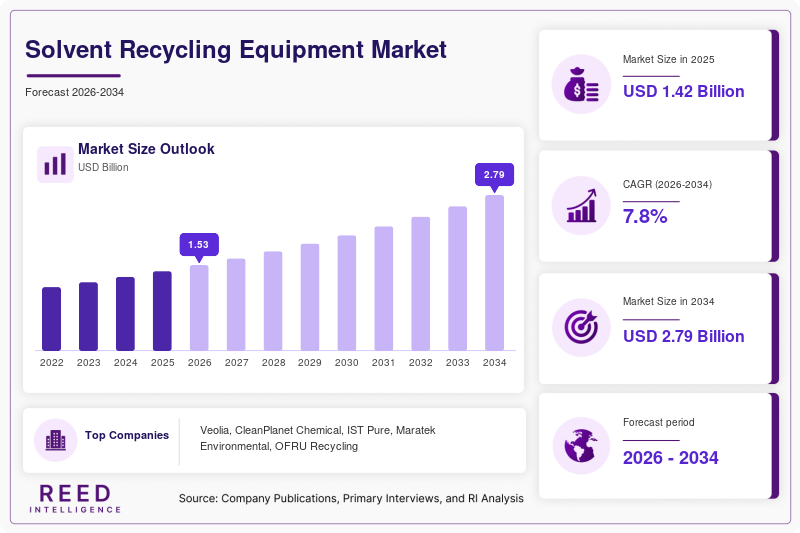
The Solvent Recycling Equipment Market size was valued at approximately USD 1.42 billion in 2026 and is projected to reach USD 2.58 billion by 2034, expanding at a CAGR of 7.8% during the forecast period (2026–2034). The market is witnessing steady growth due to rising environmental regulations and the increasing need for sustainable industrial practices. Industries such as pharmaceuticals, chemicals, automotive, and electronics are adopting solvent recycling systems to reduce hazardous waste, lower operational costs, and improve compliance with emission norms.
A key global factor supporting market growth is the tightening of environmental regulations governing industrial waste disposal. Governments across developed and emerging economies are enforcing stricter limits on volatile organic compound (VOC) emissions and hazardous waste discharge. This regulatory pressure has encouraged companies to invest in solvent recycling equipment as a cost-effective and environmentally responsible solution. Additionally, rising raw material costs have made solvent recovery an economically viable approach, further driving adoption across multiple industries.
Key Highlights
- North America dominated the market with a 33.8% share in 2025.
- Asia Pacific is expected to grow at the fastest CAGR of 9.6% during 2026–2034.
- By equipment type, distillation units accounted for the largest share of 42.3%.
- while membrane-based systems are projected to grow at a CAGR of 10.8%.
- By application, pharmaceuticals led with a 39.5% share, whereas electronics manufacturing is expected to expand at a CAGR of 9.9%.
- The United States remained the dominant country, with market values of USD 420 million in 2024 and USD 460 million in 2025.
Market Trends
Increasing adoption of closed-loop recycling systems
Industries are increasingly adopting closed-loop solvent recycling systems to minimize waste and enhance operational efficiency. These systems allow companies to recover and reuse solvents within their production cycles, significantly reducing the need for fresh solvent procurement. This trend is particularly evident in the pharmaceutical and chemical sectors, where solvent usage is high and regulatory compliance is critical. Closed-loop systems also help reduce transportation and disposal costs associated with hazardous waste. As sustainability becomes a core focus for organizations, companies are integrating these systems into their long-term environmental strategies. The growing emphasis on circular economy models is further reinforcing the demand for such technologies, as businesses aim to reduce their carbon footprint and achieve resource efficiency.
Integration of automation and smart monitoring technologies
Another notable trend in the market is the integration of automation and digital monitoring technologies into solvent recycling equipment. Modern systems are equipped with sensors, real-time monitoring tools, and data analytics capabilities that enhance process efficiency and reduce human intervention. Automated systems can optimize distillation parameters, detect anomalies, and ensure consistent solvent purity levels. This trend is gaining traction in advanced manufacturing industries, including electronics and automotive, where precision and quality control are critical. The adoption of Industry 4.0 practices is also contributing to this trend, as companies seek to streamline operations and improve productivity. As a result, smart solvent recycling solutions are becoming a key differentiator in the market.
Market Drivers
Stringent environmental regulations and compliance requirements
The enforcement of strict environmental regulations is a major driver for the Solvent Recycling Equipment Market. Governments across regions are implementing policies to limit hazardous waste generation and reduce industrial emissions. Regulations targeting VOC emissions and chemical waste disposal have compelled industries to adopt solvent recycling solutions. Compliance with these regulations not only helps avoid penalties but also enhances corporate reputation. Industries such as pharmaceuticals, paints and coatings, and chemicals are particularly affected by these mandates, leading to increased investment in recycling equipment. The growing emphasis on sustainability reporting and environmental accountability is further accelerating the adoption of solvent recovery systems across various sectors.
Rising cost of raw materials and operational efficiency needs
The increasing cost of raw solvents is another significant factor driving market growth. Industries that rely heavily on solvents are facing rising procurement costs, prompting them to explore cost-saving alternatives. Solvent recycling equipment offers a practical solution by enabling the reuse of solvents, thereby reducing the need for frequent purchases. This not only lowers operational expenses but also improves overall resource utilization. Additionally, recycling systems help reduce waste disposal costs, which can be substantial for hazardous materials. As companies strive to enhance profitability and efficiency, the adoption of solvent recycling equipment is becoming a strategic priority across multiple industries.
Market Restraint
High initial investment and maintenance costs
The high upfront cost associated with solvent recycling equipment remains a key restraint for market growth. Advanced systems, particularly those with automation and high recovery efficiency, require significant capital investment. Small and medium-sized enterprises often find it challenging to allocate resources for such equipment, limiting adoption in this segment. Additionally, maintenance costs, including periodic servicing and replacement of components, can add to the overall expense. In industries with fluctuating production volumes, the return on investment may take longer to realize, further discouraging adoption. For example, smaller manufacturing units may prefer outsourcing waste management services instead of investing in in-house recycling systems. This financial barrier continues to impact market penetration, especially in developing regions.
Market Opportunities
Expansion in emerging economies with industrial growth
Emerging economies present significant growth opportunities for the Solvent Recycling Equipment Market due to rapid industrialization. Countries in Asia Pacific and Latin America are witnessing increased manufacturing activities, particularly in chemicals, pharmaceuticals, and electronics. As these industries expand, the demand for efficient waste management solutions is rising. Governments in these regions are also introducing environmental regulations, creating a favorable environment for solvent recycling equipment adoption. Companies are increasingly investing in local manufacturing facilities, which further boosts the demand for recycling systems. The combination of industrial growth and regulatory support is expected to drive substantial market expansion in these regions.
Development of energy-efficient and compact recycling systems
The development of energy-efficient and compact solvent recycling systems is creating new opportunities in the market. Manufacturers are focusing on designing equipment that consumes less energy while maintaining high recovery efficiency. Compact systems are particularly suitable for small-scale industries and facilities with limited space. These innovations are making solvent recycling more accessible to a broader range of users. Additionally, advancements in membrane technology and hybrid systems are enhancing the performance of recycling equipment. As industries seek cost-effective and sustainable solutions, the demand for such advanced systems is expected to grow significantly, opening new avenues for market players.
Segmental Analysis
By Equipment Type
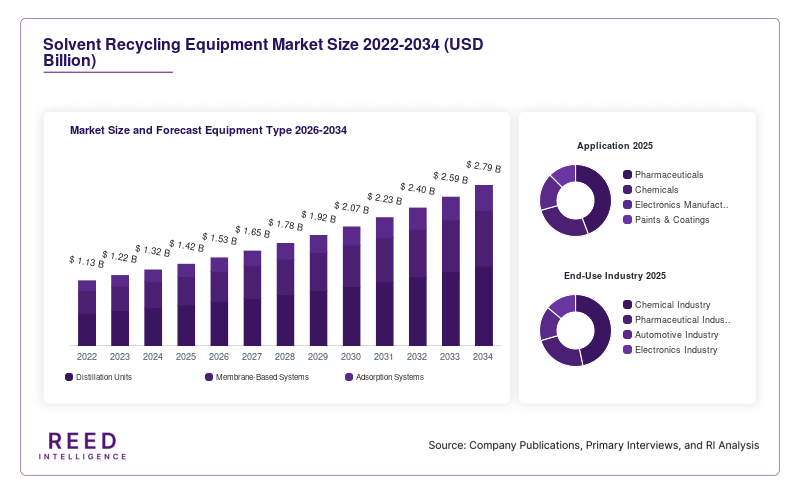
Distillation units dominated the market in 2024, accounting for a share of 42.3%. These systems are widely used due to their efficiency in separating and purifying solvents. Industries such as pharmaceuticals and chemicals rely heavily on distillation units for high-quality solvent recovery. The ability to handle large volumes and achieve high recovery rates makes these systems a preferred choice. Additionally, advancements in distillation technology, such as automated controls and energy-efficient designs, are enhancing their performance and adoption across various industries.
Membrane-based systems are expected to be the fastest-growing subsegment, with a CAGR of 10.8% during the forecast period. These systems offer advantages such as lower energy consumption and compact design. The growing demand for sustainable and cost-effective solutions is driving the adoption of membrane technologies. Industries are increasingly using these systems for applications requiring selective separation and high purity levels. The development of advanced membranes is further boosting their adoption.
By Application
The pharmaceutical segment held the largest share of 39.5% in 2024. The extensive use of solvents in drug manufacturing processes drives the demand for recycling equipment in this sector. Strict regulatory requirements for waste management and solvent purity further support the adoption of recycling systems. Pharmaceutical companies are increasingly investing in advanced equipment to ensure compliance and reduce operational costs.
The electronics manufacturing segment is expected to grow at the fastest CAGR of 9.9%. The increasing demand for electronic devices and components is driving solvent usage in cleaning and processing applications. The need for high purity and precision in electronics manufacturing is encouraging the adoption of advanced recycling systems. This growth is further supported by the expansion of the electronics industry in emerging economies.
By End-Use Industry
The chemical industry dominated the market in 2024, accounting for a significant share. The extensive use of solvents in chemical production processes drives the demand for recycling equipment. Companies in this sector are focusing on reducing waste and improving efficiency, leading to increased adoption of recycling systems. The implementation of environmental regulations further supports market growth in this segment.
The automotive industry is expected to be the fastest-growing segment, with a CAGR of 8.7%. The use of solvents in painting, coating, and cleaning processes is driving demand for recycling equipment. The growing focus on sustainability and cost reduction in the automotive sector is encouraging the adoption of solvent recovery systems. This trend is expected to continue during the forecast period.
Regional Analysis
North America
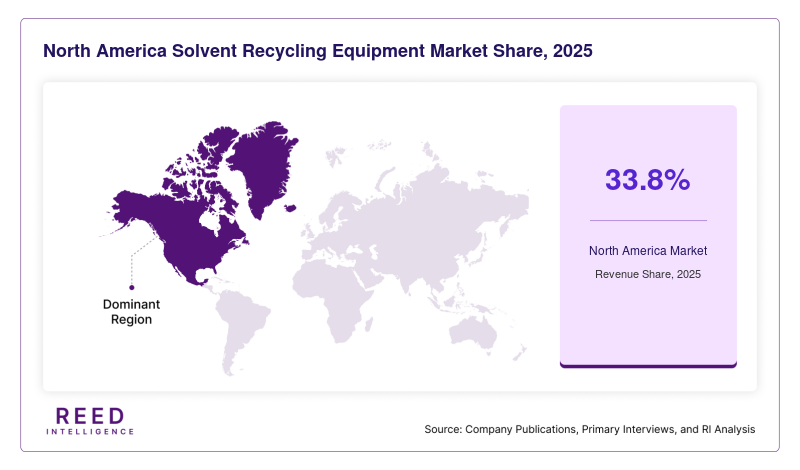
North America held a dominant share of 33.8% in 2025 and is expected to maintain steady growth with a CAGR of 6.9% during the forecast period. The region’s mature industrial base and stringent environmental regulations are key factors driving market growth. Industries in the United States and Canada are increasingly adopting solvent recycling systems to comply with environmental standards and reduce operational costs. The presence of established manufacturers and advanced technological infrastructure further supports market expansion.
The United States remains the leading country in the region, driven by strict regulatory frameworks and high awareness of sustainable practices. A unique growth factor in this region is the widespread adoption of automation in industrial processes. Companies are integrating advanced recycling systems with digital monitoring tools, enhancing efficiency and reducing manual intervention. This technological advancement is contributing significantly to market growth.
Europe
Europe accounted for a significant market share in 2025 and is projected to grow at a CAGR of 7.2% during the forecast period. The region’s strong focus on environmental sustainability and circular economy principles is driving the adoption of solvent recycling equipment. Countries such as Germany, France, and the UK are implementing stringent regulations on industrial waste management, encouraging industries to adopt recycling solutions.
Germany is the dominant country in the European market, supported by its robust manufacturing sector. A unique growth factor in this region is the emphasis on circular economy initiatives. European industries are actively investing in technologies that enable resource recovery and waste reduction. This focus on sustainability is expected to drive continuous demand for solvent recycling equipment across the region.
Asia Pacific
Asia Pacific is expected to witness the fastest growth, with a CAGR of 9.6% during the forecast period. The region’s rapid industrialization and expanding manufacturing sector are key drivers of market growth. Countries such as China, India, and Japan are experiencing increased demand for solvent recycling systems due to rising environmental concerns and regulatory developments.
China dominates the regional market, driven by its large-scale industrial activities. A unique growth factor in Asia Pacific is the increasing government support for environmental protection initiatives. Policies promoting waste reduction and resource efficiency are encouraging industries to adopt solvent recycling technologies. This regulatory support, combined with industrial growth, is fueling market expansion.
Middle East & Africa
The Middle East & Africa region is expected to grow at a moderate CAGR of 6.5% during the forecast period. The market is driven by increasing industrial activities in sectors such as oil and gas, chemicals, and manufacturing. Governments are gradually introducing regulations to manage industrial waste, creating opportunities for solvent recycling equipment.
Saudi Arabia is the leading country in the region, supported by its strong industrial base. A unique growth factor is the diversification of economies away from oil dependency. Investments in manufacturing and chemical industries are increasing, leading to higher demand for waste management solutions. This shift is expected to drive the adoption of solvent recycling equipment.
Latin America
Latin America is projected to grow at a CAGR of 7.0% during the forecast period. The region is witnessing gradual industrial development, particularly in Brazil and Mexico. Increasing awareness of environmental issues and the need for efficient waste management solutions are driving market growth.
Brazil is the dominant country in the region, supported by its growing industrial sector. A unique growth factor is the rising adoption of sustainable practices in manufacturing industries. Companies are increasingly focusing on reducing waste and improving resource efficiency, which is boosting the demand for solvent recycling equipment in the region.
Competitive Landscape
The Solvent Recycling Equipment Market is moderately competitive, with several global and regional players operating in the industry. Companies are focusing on product innovation, technological advancements, and strategic partnerships to strengthen their market position. Leading players are investing in research and development to introduce energy-efficient and automated systems that meet evolving industry requirements.
A prominent leader in the market is Veolia, known for its advanced recycling solutions and strong global presence. The company recently introduced a new range of energy-efficient solvent recovery systems designed for high-volume industrial applications. This development highlights the increasing focus on sustainability and innovation in the market. Other companies are also expanding their product portfolios and enhancing their distribution networks to gain a competitive edge.
Key Players List
- Veolia
- CleanPlanet Chemical
- IST Pure
- Maratek Environmental
- OFRU Recycling
- B/R Instrument Corporation
- CBG Technologies
- Formeco
- SRS Engineering Corporation
- Parker Hannifin
- Horizon Technology
- KOBEX
- Nexus Corporation
- BECCA Inc.
- Dürr Group
Recent Developments
- Veolia launched a new energy-efficient solvent recycling system designed to reduce operational costs and improve recovery rates.
- Dürr Group introduced an advanced automated solvent recovery unit integrated with digital monitoring capabilities for industrial applications.
- CleanPlanet Chemical expanded its product portfolio with compact solvent recycling systems targeting small and medium-sized enterprises.
Solvent Recycling Equipment Market Segments
Equipment Type
- Distillation Units
- Membrane-Based Systems
- Adsorption Systems
Application
- Pharmaceuticals
- Chemicals
- Electronics Manufacturing
- Paints & Coatings
End-Use Industry
- Chemical Industry
- Pharmaceutical Industry
- Automotive Industry
- Electronics Industry
By Region
- North America
- Europe
- APAC
- Middle East and Africa
- LATAM