Sophorolipids Market Size, Share & Demand Report By Type (Lactonic Sophorolipids, Acidic Sophorolipids), By Application (Household Detergents, Personal Care Products, Agriculture, Industrial Cleaning, Food Processing), By End-Use Industry (Personal Care & Cosmetics, Agriculture, Household Cleaning, Industrial Manufacturing, Food & Beverage), By Region & Segment Forecasts, 2025–2034
USD 3950
Market Overview
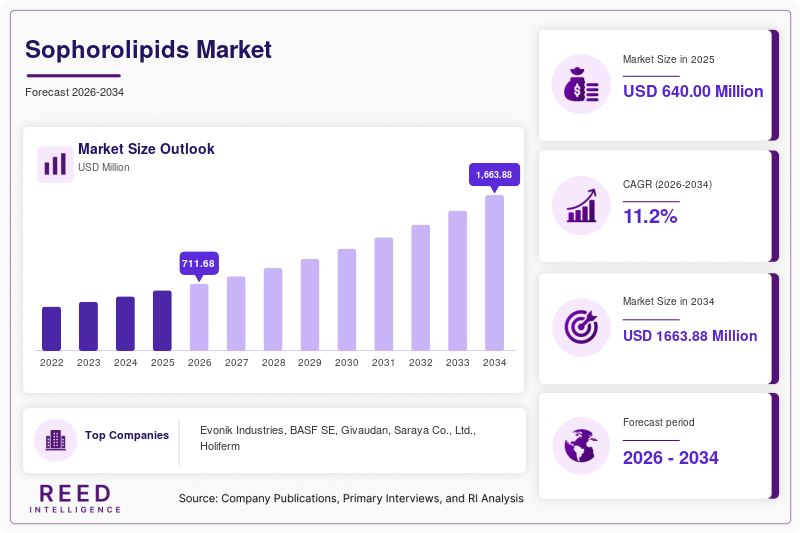
The Sophorolipids Market Size was valued at USD 640 million in 2025 and is projected to reach USD 1.54 billion by 2033, expanding at a compound annual growth rate (CAGR) of 11.2% during 2025–2034. Sophorolipids are biosurfactants produced through microbial fermentation, primarily using yeast species such as Candida bombicola. These molecules possess favorable biodegradability, low toxicity, and surface-active properties, making them suitable alternatives to petroleum-based surfactants in multiple industries including personal care, detergents, agriculture, and food processing.
A key global factor supporting the growth of the Sophorolipids Market has been the shift toward sustainable and bio-based chemicals across manufacturing industries. Governments and environmental agencies are introducing stricter regulations targeting synthetic surfactants due to their persistence in aquatic ecosystems. As a result, manufacturers of cleaning agents, cosmetic products, and agricultural formulations are integrating biosurfactants to improve sustainability profiles while maintaining functional performance. In addition, improvements in fermentation technologies and feedstock optimization have gradually reduced production costs, improving the commercial viability of sophorolipids.
Key Highlights
- Dominant Region: North America accounted for 34.6% share in 2025, while Asia Pacific will register the fastest CAGR of 13.4% through 2034.
- Dominant Subsegments: Lactonic sophorolipids led the type segment with 61% share, while household detergents dominated applications with 38% share.
- Fastest-Growing Subsegments: Acidic sophorolipids will expand at 12.8% CAGR, and agricultural applications will grow at 13.7% CAGR.
- Dominant Country: The United States generated USD 178 million in 2025, increasing to USD 195 million in 2026.
Market Trends
Expansion of Bio-Based Surfactant Formulations
Manufacturers across the cleaning and cosmetics industries are integrating bio-based surfactants to reduce environmental impact and meet sustainability commitments. Sophorolipids have gained attention due to their strong emulsification properties and compatibility with natural product formulations. Companies producing personal care products are reformulating shampoos, facial cleansers, and skincare solutions with biosurfactants to reduce reliance on petrochemical ingredients. The trend has accelerated as consumer demand for environmentally responsible formulations increases in both developed and emerging economies. As a result, product development pipelines within the Sophorolipids Market increasingly focus on multifunctional biosurfactants that combine foaming, antimicrobial, and conditioning properties.
Technological Improvements in Fermentation and Feedstock Utilization
Advancements in microbial fermentation technologies are improving production efficiency for sophorolipids. Biotechnology companies are optimizing yeast strains, fermentation conditions, and feedstock sources to enhance yield while lowering operational costs. Agricultural waste streams, vegetable oils, and industrial by-products are being evaluated as feedstocks to improve sustainability and reduce raw material expenses. These technological developments support scaling of commercial production facilities and facilitate adoption in cost-sensitive sectors such as detergents and agriculture. Consequently, improved fermentation productivity is shaping the long-term growth trajectory of the Sophorolipids Market by enabling broader industrial use.
Market Drivers
Increasing Demand for Sustainable Surfactants
Global industries are transitioning toward environmentally compatible chemicals, which is accelerating the demand for biosurfactants such as sophorolipids. Conventional surfactants derived from petrochemical sources often display limited biodegradability and may cause ecological concerns. Sophorolipids provide an alternative with favorable environmental characteristics including low toxicity, rapid biodegradation, and renewable sourcing. Consumer product manufacturers are responding by introducing eco-labeled formulations containing biosurfactants. This transition has created consistent demand across detergents, personal care, and industrial cleaning sectors, contributing to the expansion of the Sophorolipids Market.
Rising Applications in Agricultural Formulations
Agriculture has emerged as an expanding application area for sophorolipids due to their ability to function as natural wetting agents, emulsifiers, and antimicrobial compounds. Sophorolipid-based formulations can improve pesticide dispersion, enhance soil health, and support plant protection. With global agriculture facing pressure to reduce chemical residues and environmental damage, biological surfactants are gaining acceptance in crop protection products. Research institutions and biotechnology companies are also exploring sophorolipids as potential biopesticides. The increasing focus on sustainable agriculture and integrated pest management is expected to support steady demand within the Sophorolipids Market.
Market Restraint
High Production Costs Compared with Synthetic Surfactants
Despite their environmental benefits, sophorolipids remain relatively expensive compared with conventional petrochemical surfactants. The fermentation process used to produce sophorolipids requires specialized equipment, microbial strain management, and controlled processing conditions. Additionally, feedstock costs such as vegetable oils and sugars contribute to the overall manufacturing expense. These factors can limit adoption among large-volume industries that prioritize cost efficiency.
Scaling up fermentation operations also presents operational challenges, including maintaining microbial productivity and ensuring consistent product quality. In regions where industrial biotechnology infrastructure is limited, establishing production facilities can require substantial capital investment. Consequently, some detergent and chemical manufacturers continue to rely on synthetic surfactants due to their lower price and established supply chains.
While ongoing research aims to improve fermentation yields and reduce raw material costs, price competitiveness remains a barrier to rapid adoption in certain applications. Addressing these cost challenges will be an important factor influencing the long-term expansion of the Sophorolipids Market.
Market Opportunities
Expansion of Green Personal Care Products
The growing demand for natural and environmentally responsible personal care products presents an opportunity for sophorolipid manufacturers. Cosmetic brands are increasingly adopting ingredients derived from biological sources to appeal to sustainability-focused consumers. Sophorolipids can function as mild cleansing agents and emulsifiers, making them suitable for facial cleansers, shampoos, and skincare formulations. Their low irritation potential also supports use in sensitive-skin products. As the natural cosmetics sector continues to expand globally, suppliers of sophorolipid ingredients are expected to gain opportunities to collaborate with consumer product manufacturers.
Integration into Industrial Cleaning and Oilfield Applications
Industrial cleaning formulations require surfactants capable of emulsifying oils, reducing surface tension, and improving contaminant removal. Sophorolipids possess these properties and can be used in degreasers, metal cleaners, and environmental remediation solutions. In addition, research indicates that biosurfactants can enhance oil recovery processes and aid in cleaning hydrocarbon-contaminated sites. As industries seek environmentally compatible cleaning technologies, sophorolipids are expected to gain attention in industrial and energy applications. This expansion into non-traditional markets creates additional revenue streams within the Sophorolipids Market.
Segmental Analysis
By Type
Dominant Subsegment: Lactonic Sophorolipids
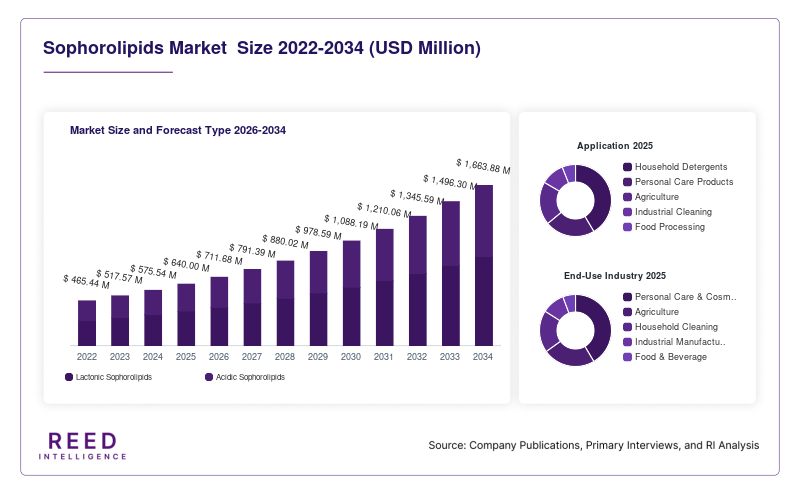
The lactonic sophorolipids segment held the largest share of the Sophorolipids Market in 2025, accounting for approximately 61% of total revenue. These molecules possess strong surface-active properties and display enhanced antimicrobial activity compared with other sophorolipid structures. As a result, lactonic sophorolipids are widely used in personal care formulations, detergents, and industrial cleaning products. Their ability to reduce surface tension and stabilize emulsions has made them a preferred ingredient for manufacturers seeking bio-based alternatives to synthetic surfactants.
Fastest-Growing Subsegment: Acidic Sophorolipids
The acidic sophorolipids segment will expand at an estimated CAGR of 12.8% during the forecast period. This growth will be supported by their improved solubility in aqueous solutions and compatibility with environmentally friendly product formulations. Acidic sophorolipids will gain traction in applications requiring mild surfactant properties, including agricultural formulations and cosmetics. Their unique ability to function as wetting agents and emulsifiers while maintaining biodegradability will support increasing adoption across several industries.
By Application
Dominant Subsegment: Household Detergents
The household detergents application segment accounted for approximately 38% of the Sophorolipids Market in 2025. Detergent manufacturers have incorporated biosurfactants to improve environmental sustainability while maintaining cleaning performance. Sophorolipids demonstrate effective foaming, grease removal, and emulsification properties, which are essential characteristics in cleaning formulations. As consumer demand for eco-labeled cleaning products increased, manufacturers integrated biosurfactants into liquid detergents and dishwashing formulations.
Fastest-Growing Subsegment: Agriculture
The agriculture application segment will grow at a projected CAGR of 13.7% during the forecast period. Sophorolipids will gain adoption in crop protection formulations due to their ability to improve pesticide dispersion and enhance soil compatibility. Agricultural producers are increasingly seeking solutions that minimize chemical residues and environmental impact. Biosurfactants will therefore be incorporated into pesticide and herbicide formulations to improve product effectiveness while supporting sustainable farming practices.
By End-Use Industry
Dominant Subsegment: Personal Care and Cosmetics
The personal care and cosmetics segment represented 32% of the Sophorolipids Market in 2025. Cosmetic manufacturers utilize sophorolipids as natural surfactants, emulsifiers, and mild cleansing agents in formulations such as shampoos, body washes, and facial cleansers. Their low irritation potential and compatibility with natural ingredient formulations have supported adoption among personal care product manufacturers. The increasing popularity of natural cosmetics and environmentally responsible skincare products has further reinforced demand for sophorolipid ingredients.
Fastest-Growing Subsegment: Industrial Cleaning
The industrial cleaning segment will expand at a projected CAGR of 12.5% through 2034. Industries including manufacturing, automotive, and energy require cleaning agents capable of removing oils, grease, and chemical residues. Sophorolipids will gain attention as environmentally compatible surfactants suitable for degreasing and equipment cleaning. Their biodegradability and ability to perform under various operating conditions will support growth across industrial cleaning formulations.
Regional Analysis
North America
North America accounted for 34.6% of the Sophorolipids Market share in 2025. The region benefited from the presence of biotechnology research institutions, established fermentation infrastructure, and growing demand for sustainable chemicals across manufacturing industries. During the forecast period, the regional market will expand at a CAGR of 10.8% between 2025 and 2034. Environmental regulations promoting biodegradable ingredients in cleaning and personal care products have also contributed to adoption of biosurfactants across consumer goods manufacturing.
The United States represented the dominant country within the regional market. A major growth factor has been the strong biotechnology ecosystem supporting microbial fermentation technologies. Companies such as Evonik Industries and Givaudan maintain research initiatives in biosurfactant development, enabling commercialization of sophorolipid ingredients for cosmetic and cleaning formulations. In addition, the presence of environmentally conscious consumers has encouraged brands to incorporate bio-based ingredients into product portfolios, supporting consistent market demand.
Europe
Europe represented 27.4% of the global Sophorolipids Market in 2025. The region has a well-established regulatory framework emphasizing environmental protection and chemical safety. Policies promoting biodegradable ingredients in industrial processes and consumer goods have supported adoption of biosurfactants across several industries. Over the forecast period, the European market will grow at a CAGR of 10.5% through 2034 as companies continue to invest in sustainable chemical alternatives.
Germany dominated the regional market due to its strong specialty chemicals industry and research infrastructure. A key factor driving growth has been the integration of biosurfactants within sustainable industrial chemical portfolios. Companies such as BASF SE have expanded research activities focused on biotechnology-derived surfactants. Germany’s advanced chemical manufacturing sector and emphasis on environmentally responsible production have supported development of biosurfactant technologies, contributing to steady growth in sophorolipid demand across industrial and consumer product applications.
Asia Pacific
Asia Pacific accounted for 23.1% share of the Sophorolipids Market in 2025. Rapid industrialization, increasing environmental awareness, and expanding consumer goods manufacturing have supported demand for biosurfactants in the region. The market will grow at the fastest CAGR of 13.4% during 2025–2034 as regional manufacturers increasingly incorporate sustainable ingredients into product formulations.
China emerged as the dominant country within the region. One major factor supporting growth has been the expansion of biotechnology research and fermentation-based manufacturing capabilities. The country has invested significantly in industrial biotechnology to support sustainable chemical production. Domestic manufacturers are evaluating biosurfactants such as sophorolipids for use in detergents, agriculture, and personal care products. As China continues to develop green chemical manufacturing initiatives, the adoption of biosurfactants is expected to increase steadily across multiple industries.
Middle East & Africa
The Middle East & Africa accounted for 7.1% of the Sophorolipids Market share in 2025. Although the regional market remains relatively small, interest in environmentally compatible industrial chemicals has increased in recent years. The regional market will grow at a CAGR of 9.3% through 2034, supported by expanding industrial and agricultural sectors.
Saudi Arabia dominated the regional market due to its investment in chemical manufacturing and environmental sustainability initiatives. Industrial companies in the country are exploring biosurfactants for applications such as industrial cleaning and oilfield operations. Sophorolipids have attracted attention because of their ability to reduce environmental impact while maintaining surfactant performance. As sustainability initiatives continue to expand across industrial sectors, the country is expected to play a significant role in regional market development.
Latin America
Latin America represented 7.8% share of the Sophorolipids Market in 2025. Growing awareness of sustainable agricultural practices and environmentally compatible chemical formulations has encouraged the adoption of biosurfactants across regional industries. The regional market will expand at a CAGR of 10.2% between 2025 and 2034.
Brazil remained the dominant country within the regional market. One important factor driving growth has been the country’s strong agricultural sector, which requires surfactants for pesticide and crop protection formulations. Biosurfactants such as sophorolipids offer potential benefits in improving formulation stability and environmental compatibility. As Brazil continues to promote sustainable agriculture practices, the use of biosurfactant-based additives is expected to increase across agricultural applications.

Competitive Landscape
The Sophorolipids Market features a mix of biotechnology firms, specialty chemical companies, and ingredient suppliers focusing on biosurfactant development. Companies are investing in fermentation technology, research partnerships, and product innovation to expand the commercial availability of sophorolipids.
Among the market participants, Evonik Industries holds a significant position due to its expertise in biotechnology-derived specialty chemicals. The company has expanded research efforts aimed at developing sustainable biosurfactants for personal care and industrial applications. Recent initiatives have focused on improving microbial fermentation efficiency to support scalable production.
Other companies such as BASF SE and Givaudan are also investing in sustainable ingredient development and expanding biosurfactant portfolios. Strategic collaborations between biotechnology startups and large chemical manufacturers are shaping the competitive landscape, enabling faster commercialization of sophorolipid-based products.
Key Players List
- Evonik Industries
- BASF SE
- Givaudan
- Saraya Co., Ltd.
- Holiferm
- Stepan Company
- Croda International
- Solvay
- Clariant
- Evodos
- Jeneil Biotech
- AGAE Technologies
- Kaneka Corporation
- Dow
- Unilever
Recent Developments
- 2024: Holiferm expanded its biosurfactant fermentation facility to increase commercial production of sophorolipids for European detergent manufacturers.
- 2024: Givaudan strengthened its biotechnology portfolio through additional research investments focused on sustainable cosmetic ingredients.
- 2023: Evonik Industries advanced biosurfactant development programs targeting eco-friendly cleaning formulations.
- 2023: Saraya Co., Ltd. expanded production of sophorolipid-based cleaning products for the Asian market.
- 2023: AGAE Technologies introduced new sophorolipid formulations designed for agricultural applications.
Sophorolipids Market Segments
Type
- Lactonic Sophorolipids
- Acidic Sophorolipids
Application
- Household Detergents
- Personal Care Products
- Agriculture
- Industrial Cleaning
- Food Processing
End-Use Industry
- Personal Care & Cosmetics
- Agriculture
- Household Cleaning
- Industrial Manufacturing
- Food & Beverage
Region
- North America
- Europe
- Asia Pacific
- Middle East & Africa
- Latin America
By Region
- North America
- Europe
- APAC
- Middle East and Africa
- LATAM