Sorbic Acid Market Size, Share & Demand Report By Type (Potassium Sorbate, Calcium Sorbate, Sorbic Acid), By Form (Powder, Granular, Liquid), By Application (Food & Beverages, Pharmaceuticals, Cosmetics & Personal Care, Industrial), By End-Use Industry (Food Processing, Pharmaceutical Industry, Cosmetics Industry, Chemical Industry), By Region & Segment Forecasts, 2025–2034
USD 3950
Market Overview
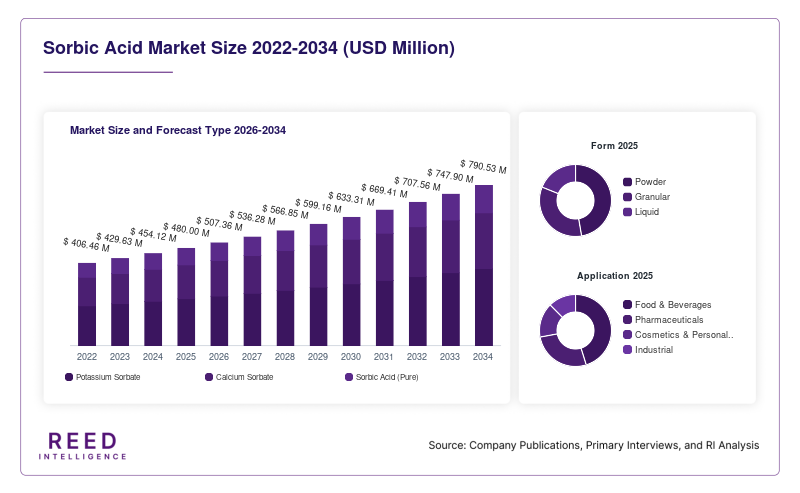
The global Sorbic Acid Market size was valued at approximately USD 480 million in 2025 and is projected to reach USD 790 million by 2034, expanding at a compound annual growth rate (CAGR) of 5.7% during the forecast period (2025–2034). Sorbic acid, a widely used food preservative, has gained significant traction due to its effectiveness in inhibiting mold, yeast, and microbial growth across food, beverage, and pharmaceutical applications.
A major global factor supporting market growth is the increasing demand for packaged and processed food products driven by urbanization, changing dietary habits, and rising disposable incomes. As consumers seek longer shelf life and improved food safety, manufacturers are increasingly incorporating sorbic acid into bakery, dairy, and beverage formulations. Additionally, regulatory approvals across multiple regions for its safe consumption have reinforced its adoption across industries.
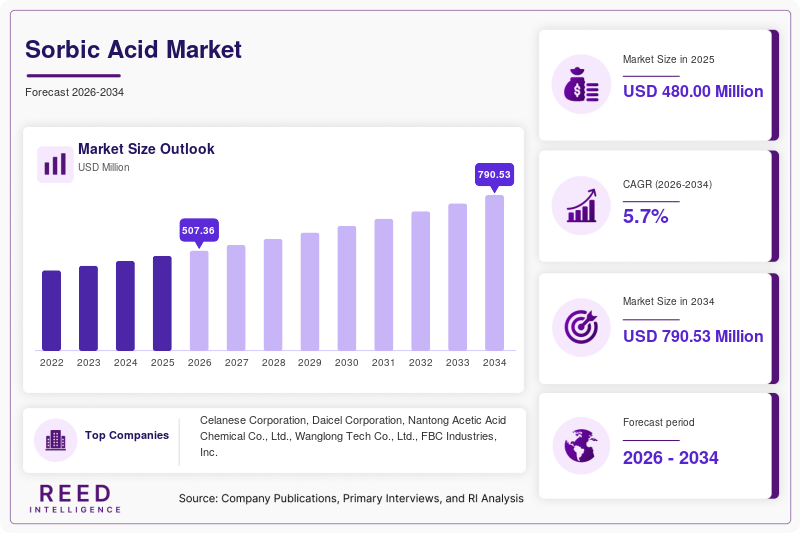
Key Highlights:
- Asia Pacific dominated the market with a share of 38% in 2025, while it is expected to register the fastest CAGR of 6.4% during the forecast period.
- By type, potassium sorbate was the leading subsegment with a 62% share, while liquid sorbic acid is anticipated to grow at the fastest CAGR of 6.8%.
- By application, food & beverages accounted for the largest share at 68%, whereas pharmaceuticals are projected to grow at a CAGR of 6.2%.
- China remained the dominant country, with market values of USD 92 million in 2024 and USD 97 million in 2025.
Market Trends
Rising Preference for Clean-Label Preservatives
The growing demand for clean-label and naturally derived ingredients is shaping the Sorbic Acid Market. Consumers are increasingly scrutinizing ingredient lists and favoring products with recognizable additives. Sorbic acid, often perceived as a safer preservative compared to synthetic alternatives, is benefiting from this shift. Manufacturers are reformulating products to meet regulatory guidelines and consumer expectations, which is driving consistent demand across food and beverage segments.
Expansion of Shelf-Stable Food Products
The expansion of shelf-stable and ready-to-eat food categories is significantly influencing market trends. With increasing urban lifestyles and demand for convenience foods, producers are focusing on extending product shelf life without compromising quality. Sorbic acid plays a key role in maintaining freshness in baked goods, dairy products, and processed meats. The rise of e-commerce grocery platforms has further amplified the need for stable food products that can withstand extended storage and transportation durations.
Market Drivers
Growth in Processed Food Consumption
The increasing consumption of processed and packaged foods is a primary driver of the Sorbic Acid Market. Rapid urbanization and busy lifestyles have led consumers to prefer ready-to-eat and convenience foods. Sorbic acid is widely used in these products to prevent spoilage and maintain quality. The expansion of the global food processing industry, particularly in emerging economies, continues to support steady demand for preservatives.
Regulatory Approval and Safety Profile
Sorbic acid benefits from widespread regulatory approval across major markets, including North America, Europe, and Asia Pacific. Its low toxicity and effectiveness at low concentrations make it a preferred preservative. Regulatory bodies have established acceptable daily intake levels, reinforcing its safety for human consumption. This regulatory support encourages manufacturers to adopt sorbic acid in diverse applications, including food, beverages, cosmetics, and pharmaceuticals.
Market Restraint
Availability of Alternative Preservatives
The presence of alternative preservatives poses a challenge to the growth of the Sorbic Acid Market. Natural preservatives such as rosemary extract, vinegar, and essential oils are gaining popularity due to their perceived health benefits. Additionally, technological advancements in packaging, such as modified atmosphere packaging, reduce the reliance on chemical preservatives.
Some manufacturers are also exploring fermentation-based preservation methods to meet clean-label requirements. These alternatives can limit the adoption of sorbic acid, particularly in premium and organic product segments. Furthermore, fluctuations in raw material prices and supply chain disruptions can impact production costs, affecting market stability.
Market Opportunities
Expansion in Pharmaceutical Applications
The pharmaceutical sector presents a promising opportunity for the Sorbic Acid Market. Sorbic acid is increasingly used as an antimicrobial agent in syrups, ointments, and topical formulations. As the global pharmaceutical industry expands, particularly in emerging markets, the demand for safe and effective preservatives is expected to rise. This trend will create new avenues for market growth.
Growth in Emerging Economies
Emerging economies in Asia Pacific, Latin America, and Africa offer significant growth potential. Rising incomes, urbanization, and increasing awareness of food safety are driving demand for processed foods. Local manufacturers are expanding production capacities, leading to higher consumption of sorbic acid. Government initiatives supporting food safety standards further enhance market opportunities in these regions.
Segmental Analysis
By Type
Potassium sorbate dominated the Sorbic Acid Market by type, accounting for approximately 62% of the market share in 2024. Its high solubility in water and effectiveness as a preservative have made it the preferred choice across food and beverage applications. It is widely used in baked goods, dairy products, and beverages due to its stability and ease of use.
Liquid sorbic acid is anticipated to be the fastest-growing subsegment, with a projected CAGR of 6.8% during the forecast period. Its ease of application in liquid formulations and improved dispersion properties will drive its adoption. The increasing demand for beverages and liquid-based pharmaceutical products will further support its growth.
By Application
The food & beverages segment held the largest share of around 68% in 2024. Sorbic acid is extensively used to prevent microbial growth in bakery, dairy, and processed food products. Its effectiveness at low concentrations and compatibility with various food systems have contributed to its dominance.
The pharmaceutical segment is expected to grow at the fastest CAGR of 6.2%. The increasing use of sorbic acid in medicinal formulations as a preservative will drive this growth. The expansion of the global pharmaceutical industry and rising demand for over-the-counter drugs will further support the segment.
By Form
The powder form dominated the market with a share of approximately 55% in 2024. Powdered sorbic acid is easy to handle, store, and transport, making it suitable for large-scale industrial applications. Its longer shelf life and stability have contributed to its widespread use.
The granular form is projected to grow at a CAGR of 6.1%. Its improved handling properties and reduced dust formation will drive its adoption in industrial processes. The increasing focus on workplace safety and efficiency will support the growth of this segment.
By End-Use Industry
The food processing industry accounted for the largest share of around 60% in 2024. The extensive use of sorbic acid in preserving food products has driven its dominance in this segment.
The cosmetics industry is expected to grow at the fastest CAGR of 5.9%. Sorbic acid is increasingly used in personal care products as a preservative to prevent microbial contamination. The growing demand for skincare and cosmetic products will support this segment’s growth.
Regional Analysis
North America
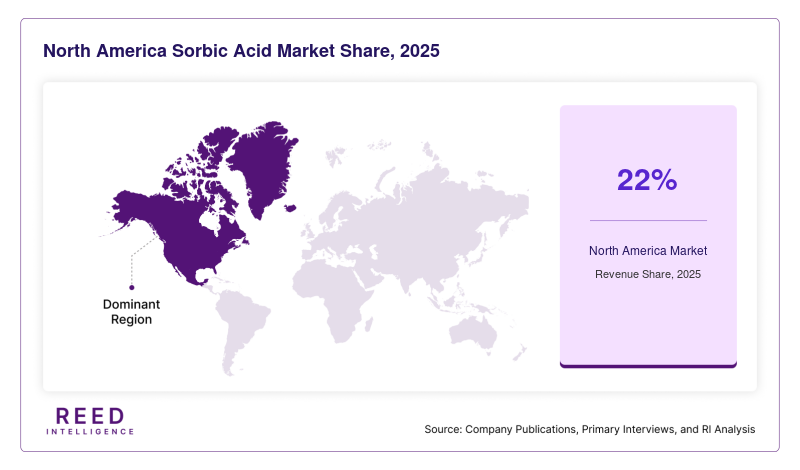
North America accounted for approximately 22% of the Sorbic Acid Market share in 2025 and is expected to grow at a CAGR of 4.9% during the forecast period. The region's mature food processing industry and strong regulatory framework have supported steady demand for sorbic acid. The presence of established manufacturers and advanced preservation technologies has contributed to consistent market performance.
The United States dominated the regional market due to its extensive packaged food industry. The increasing demand for convenience foods and strict food safety regulations have driven the adoption of sorbic acid. Additionally, the growth of the pharmaceutical sector in the country has supported demand for preservatives in medicinal formulations.
Europe
Europe held a market share of around 20% in 2025 and is projected to grow at a CAGR of 5.1% through 2034. The region’s focus on food safety and quality standards has played a crucial role in driving market growth. Sorbic acid is widely used in bakery and dairy products across European countries.
Germany emerged as the dominant country in the region, driven by its strong food processing industry. The country’s emphasis on high-quality food products and adherence to regulatory standards has increased the demand for effective preservatives. The growing trend toward clean-label products has further influenced market dynamics.
Asia Pacific
Asia Pacific led the Sorbic Acid Market with a 38% share in 2025 and is expected to grow at the fastest CAGR of 6.4% during the forecast period. Rapid urbanization, population growth, and rising disposable incomes have fueled demand for processed foods in the region.
China dominated the regional market due to its large-scale food manufacturing sector. The country’s expanding export-oriented food industry has increased the demand for preservatives to ensure product stability during transportation. Additionally, the growth of the pharmaceutical sector has contributed to increased consumption of sorbic acid.
Middle East & Africa
The Middle East & Africa accounted for approximately 10% of the market share in 2025 and is expected to grow at a CAGR of 5.3%. The region’s growing population and increasing urbanization have driven demand for packaged foods.
Saudi Arabia led the regional market, supported by its expanding food processing industry. Government initiatives to improve food security and reduce dependency on imports have encouraged local production, increasing the demand for preservatives such as sorbic acid.
Latin America
Latin America held a market share of about 10% in 2025 and is projected to grow at a CAGR of 5.5% during the forecast period. The region’s growing middle-class population and increasing demand for convenience foods have supported market growth.
Brazil emerged as the dominant country, driven by its large food and beverage industry. The increasing export of processed foods has necessitated the use of preservatives to maintain product quality, thereby boosting demand for sorbic acid.
Competitive Landscape
The Sorbic Acid Market is moderately fragmented, with several global and regional players competing based on product quality, pricing, and distribution networks. Key companies are focusing on expanding production capacities and developing innovative formulations to strengthen their market position.
A leading player in the market has been actively investing in research and development to enhance product efficiency and sustainability. Recent developments include the introduction of high-purity sorbic acid variants designed for pharmaceutical applications, reflecting the company’s focus on diversification.
Strategic collaborations, mergers, and acquisitions are common strategies adopted by market participants to expand their global presence. Companies are also focusing on entering emerging markets to capitalize on growing demand.
Key Players
- Celanese Corporation
- Daicel Corporation
- Nantong Acetic Acid Chemical Co., Ltd.
- Wanglong Tech Co., Ltd.
- FBC Industries, Inc.
- Sorbic International Plc
- Shandong Kunda Biotechnology Co., Ltd.
- Jiangsu Mupro IFT Corp.
- Anhui Jinhe Industrial Co., Ltd.
- Shanghai ChemPartner Co., Ltd.
Recent Developments
- In 2024, a major manufacturer expanded its production capacity in Asia to meet rising regional demand.
- In 2023, a leading company introduced a new high-purity sorbic acid product for pharmaceutical applications.
- In 2023, several companies focused on sustainable production methods to reduce environmental impact.
- In 2022, strategic partnerships were formed to enhance distribution networks in emerging markets.
- In 2022, investments in research and development increased to improve product formulations and efficiency.
Sorbic Acid Market Segments
Type
- Potassium Sorbate
- Calcium Sorbate
- Sorbic Acid (Pure)
Form
- Powder
- Granular
- Liquid
Application
- Food & Beverages
- Pharmaceuticals
- Cosmetics & Personal Care
- Industrial
End-Use Industry
- Food Processing
- Pharmaceutical Industry
- Cosmetics Industry
- Chemical Industry
Distribution Channel
- Direct Sales (B2B)
- Distributors & Wholesalers
- Online Chemical Marketplaces
- Specialty Chemical Suppliers
By Region
- North America
- Europe
- APAC
- Middle East and Africa
- LATAM