Sorbitan Laurate Market Size, Share & Demand Report By Form (Liquid, Powder), By Application (Personal Care & Cosmetics, Pharmaceutical Formulations, Food Processing, Industrial Applications), By End-Use Industry (Cosmetics & Personal Care, Healthcare & Pharmaceuticals, Food & Beverage, Chemical Industry), By Distribution Channel (Direct Sales, Distributors & Wholesalers, Online Platforms), By Region & Segment Forecasts, 2026–2034
USD 3950
Market Overview
The global Sorbitan Laurate Market size was valued at approximately USD 185 million in 2026 and is projected to reach USD 312 million by 2034, expanding at a CAGR of 6.7% during the forecast period (2026–2034). Sorbitan laurate, a non-ionic surfactant derived from sorbitol and lauric acid, is widely used as an emulsifier and stabilizer across personal care, pharmaceuticals, food processing, and industrial formulations. Its mildness, biodegradability, and compatibility with a wide range of ingredients have positioned it as a preferred additive in formulations requiring stable emulsions.
A major global factor supporting the growth of the Sorbitan Laurate Market is the increasing shift toward bio-based and sustainable surfactants. Manufacturers across industries are actively replacing synthetic emulsifiers with plant-derived alternatives to align with regulatory standards and consumer preferences. This transition has significantly strengthened the demand outlook for sorbitan laurate in both developed and emerging markets.
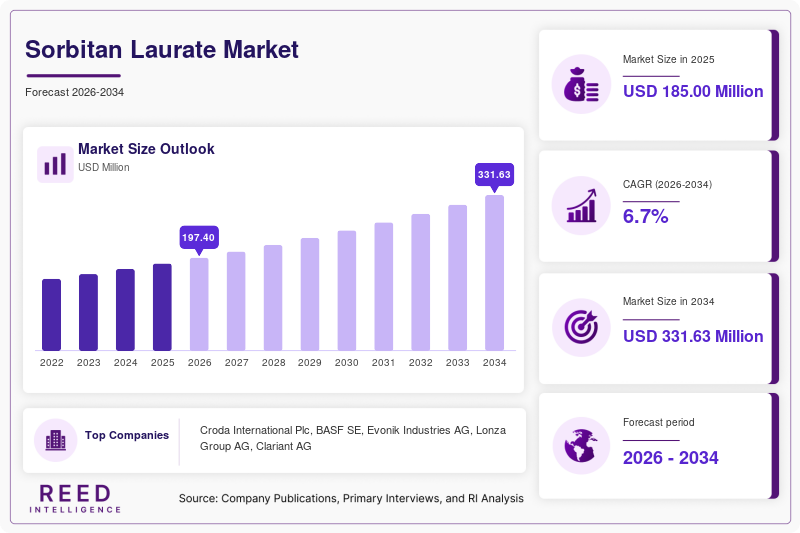
Key Highlights:
- Asia Pacific dominated the market with a 38% share, while Europe is expected to be the fastest-growing region with a CAGR of 7.4%.
- Personal care applications led with a 41% share, whereas pharmaceuticals are projected to grow fastest at a CAGR of 7.8%.
- Liquid form dominated with a 56% share, while powder form is anticipated to grow at a CAGR of 7.1%.
- The U.S. market was valued at USD 42 million in 2024 and USD 45 million in 2025, maintaining its position as the dominant country.
Market Trends
Rising Demand for Natural Emulsifiers
The Sorbitan Laurate Market is witnessing a consistent rise in demand for naturally derived emulsifiers. Consumers are increasingly aware of ingredient sourcing, especially in cosmetics and food products. This has driven manufacturers to adopt sorbitan laurate as a substitute for synthetic emulsifiers. The compound’s plant-based origin and low toxicity profile make it suitable for clean-label products. Additionally, regulatory frameworks across major economies are encouraging the use of environmentally friendly ingredients, reinforcing this trend.
Expansion of Multifunctional Ingredients
Another notable trend shaping the Sorbitan Laurate Market is the growing preference for multifunctional ingredients. Sorbitan laurate not only acts as an emulsifier but also improves texture, stability, and shelf life of formulations. This multifunctionality reduces the need for multiple additives, lowering production complexity and cost. Industries such as pharmaceuticals and personal care are increasingly integrating such ingredients into their formulations. As product innovation accelerates, the demand for versatile compounds like sorbitan laurate is expected to rise steadily.
Market Drivers
Growth in Personal Care and Cosmetics Industry
The rapid expansion of the global personal care sector is a primary driver of the Sorbitan Laurate Market. Sorbitan laurate is widely used in creams, lotions, and makeup products due to its emulsifying and stabilizing properties. Increasing consumer spending on skincare and grooming products, especially in emerging economies, has significantly boosted demand. Additionally, the shift toward organic and mild formulations further enhances its adoption.
Increasing Use in Pharmaceutical Formulations
The pharmaceutical industry is another key driver supporting the Sorbitan Laurate Market. The compound is commonly used in drug delivery systems, ointments, and emulsions due to its biocompatibility. As global healthcare expenditure rises and drug development activities increase, the demand for stable and safe excipients is also growing. Sorbitan laurate’s ability to enhance drug solubility and stability makes it a valuable component in modern pharmaceutical formulations.
Market Restraint
Fluctuating Raw Material Prices
One of the primary challenges in the Sorbitan Laurate Market is the volatility in raw material prices. Sorbitan laurate is derived from sorbitol and fatty acids, which are influenced by agricultural output and global supply chain conditions. Fluctuations in the prices of these raw materials can impact production costs and profit margins for manufacturers. Additionally, dependency on natural feedstocks exposes the market to risks such as climate variability and supply disruptions. These factors may hinder consistent growth, particularly for small and medium-scale producers.
Market Opportunities
Growth in Clean-Label Food Products
The increasing demand for clean-label food products presents a significant opportunity for the Sorbitan Laurate Market. Consumers are seeking transparency in food ingredients, leading manufacturers to adopt natural emulsifiers. Sorbitan laurate, being derived from plant-based sources, aligns well with this trend. Its use in bakery and processed food products is expected to expand, creating new growth avenues.
Emerging Markets Expansion
Emerging economies in Asia, Latin America, and Africa offer untapped potential for the Sorbitan Laurate Market. Rapid industrialization, rising disposable incomes, and increasing awareness about personal care products are driving demand in these regions. Manufacturers are focusing on expanding their distribution networks and production capacities to capture these opportunities. The growing middle-class population further supports long-term market growth.
Segmental Analysis
By Form
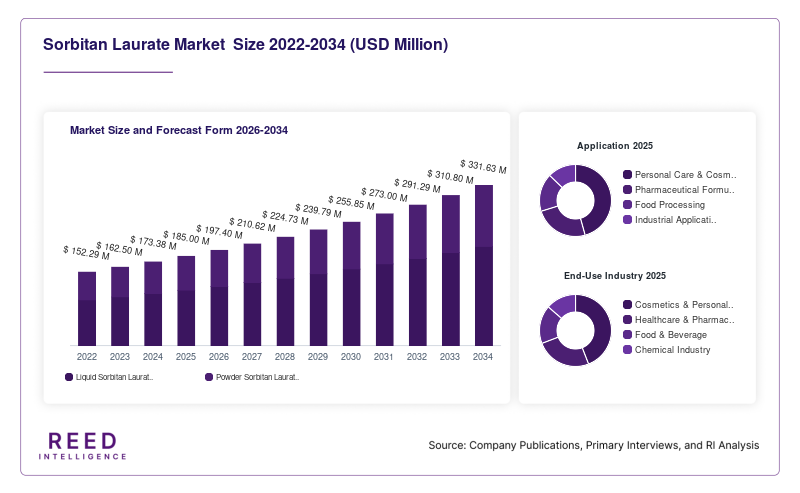
The liquid segment dominated the Sorbitan Laurate Market with a 56% share in 2025, owing to its ease of incorporation in formulations. Liquid sorbitan laurate is widely used in cosmetics and pharmaceuticals due to its superior solubility and stability.
The powder segment is expected to grow at a CAGR of 7.1%, driven by its longer shelf life and ease of transportation. Increasing demand in food processing applications is a key growth factor.
By Application
Personal care applications accounted for the largest share of 41% in 2025, driven by the widespread use of sorbitan laurate in skincare and haircare products. Its mild nature and compatibility with sensitive skin make it highly preferred.
Pharmaceutical applications are projected to grow at a CAGR of 7.8%, supported by increasing drug formulation activities. The need for stable and effective excipients is driving demand in this segment.
By End-Use Industry
The cosmetics industry dominated with a 39% share in 2025, reflecting strong consumer demand for beauty products. Sorbitan laurate is widely used in creams, lotions, and makeup products.
The food industry is expected to grow at a CAGR of 7.3%, driven by the rising demand for processed and packaged foods. Its role as an emulsifier in bakery products is a key growth factor.
By Distribution Channel
Direct sales accounted for a 62% share in 2025, as manufacturers prefer direct supply to large industrial clients. This channel ensures better pricing and long-term contracts.
Online distribution is expected to grow at a CAGR of 8.0%, driven by the increasing adoption of digital platforms. Small and medium enterprises are increasingly relying on online channels for procurement.
Regional Analysis
North America
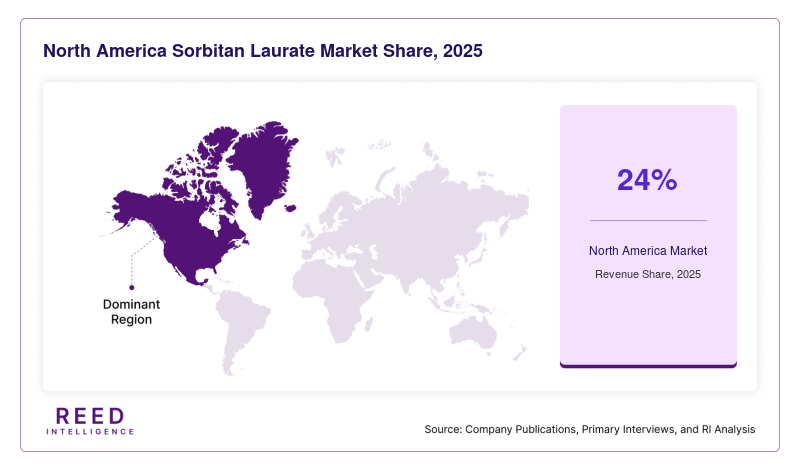
North America accounted for approximately 24% of the Sorbitan Laurate Market share in 2025 and is expected to grow at a CAGR of 6.2% from 2026 to 2034. The region benefits from advanced manufacturing capabilities and strong demand from the personal care and pharmaceutical industries.
The United States dominated the regional market due to its well-established cosmetics and healthcare sectors. The increasing focus on product innovation and regulatory compliance has driven the adoption of high-quality emulsifiers like sorbitan laurate.
Europe
Europe held around 27% market share in 2025 and is projected to grow at a CAGR of 7.4% during the forecast period. The region’s growth is supported by strict regulations promoting sustainable and biodegradable ingredients.
Germany emerged as the dominant country, driven by its robust chemical manufacturing industry. The country’s emphasis on eco-friendly production processes has increased the demand for plant-based surfactants.
Asia Pacific
Asia Pacific led the Sorbitan Laurate Market with a 38% share in 2025 and is anticipated to grow at a CAGR of 6.9%. Rapid urbanization and industrial expansion are key growth factors in the region.
China dominated the regional market due to its large-scale manufacturing base and increasing consumption of personal care products. The availability of raw materials and cost-effective production further supports market growth.
Middle East & Africa
The Middle East & Africa region accounted for approximately 6% of the market share in 2025 and is expected to grow at a CAGR of 5.8%. Growth is driven by rising demand for cosmetics and processed foods.
The UAE emerged as a key country, supported by its expanding retail and hospitality sectors. Increasing consumer awareness about quality products is boosting demand for emulsifiers.
Latin America
Latin America held about 5% market share in 2025 and is projected to grow at a CAGR of 6.1%. Economic development and urbanization are contributing to market expansion.
Brazil dominated the region due to its strong cosmetics industry. The growing demand for affordable and effective personal care products has increased the use of sorbitan laurate in formulations.
Competitive Landscape
The Sorbitan Laurate Market is moderately fragmented, with key players focusing on product innovation and regional expansion. Leading companies are investing in sustainable production processes to align with market trends.
Croda International Plc is a prominent market leader, known for its strong portfolio of specialty chemicals. The company recently introduced a new range of bio-based emulsifiers, enhancing its competitive position. Other players are also expanding their production capacities and forming strategic partnerships to strengthen their market presence.
Key Players List
- Croda International Plc
- BASF SE
- Evonik Industries AG
- Lonza Group AG
- Clariant AG
- Solvay S.A.
- Kao Corporation
- Stepan Company
- Emery Oleochemicals
- Vantage Specialty Chemicals
- IOI Oleochemical Industries
- P&G Chemicals
- Akzo Nobel N.V.
- Oxiteno S.A.
- Galaxy Surfactants Ltd
Recent Developments
- In 2025, leading manufacturers expanded production capacities to meet rising demand from personal care industries.
- Several companies introduced bio-based sorbitan laurate variants to align with sustainability goals.
- Strategic collaborations between chemical companies and cosmetic brands increased product adoption.
- Investments in R&D led to improved formulations with enhanced stability and performance.
Sorbitan Laurate Market Segments
Form
- Liquid Sorbitan Laurate
- Powder Sorbitan Laurate
Application
- Personal Care & Cosmetics
- Pharmaceutical Formulations
- Food Processing
- Industrial Applications
End-Use Industry
- Cosmetics & Personal Care
- Healthcare & Pharmaceuticals
- Food & Beverage
- Chemical Industry
Distribution Channel
- Direct Sales
- Distributors & Wholesalers
- Online Platforms
By Region
- North America
- Europe
- APAC
- Middle East and Africa
- LATAM