Sound Level Meter Market Size, Share & Demand Report By Type (Class 1 Sound Level Meters, Class 2 Sound Level Meters), By Application (Environmental Monitoring, Industrial Noise Monitoring, Occupational Safety, Research & Healthcare), By End-Use Industry (Manufacturing, Construction, Healthcare, Transportation, Others), By Product Type (Handheld Sound Level Meters, Fixed/Installed Monitoring Systems), By Region & Segment Forecasts, 2025–2034
USD 3950
Market Overview
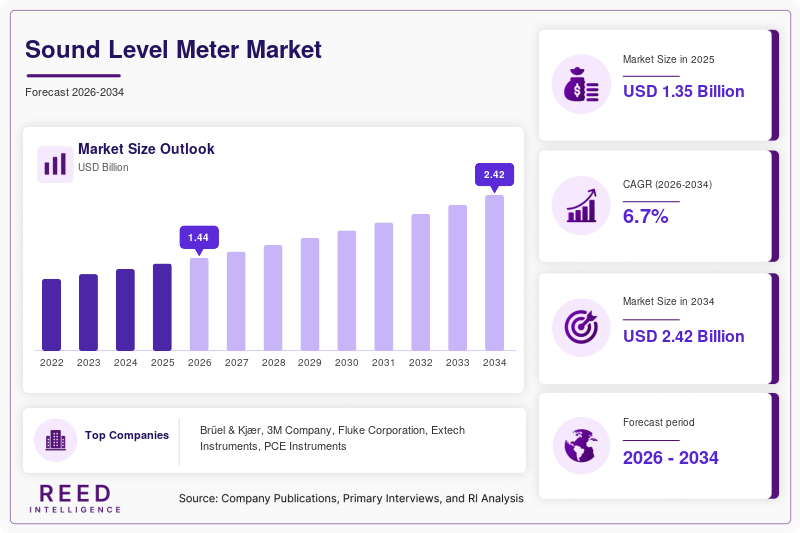
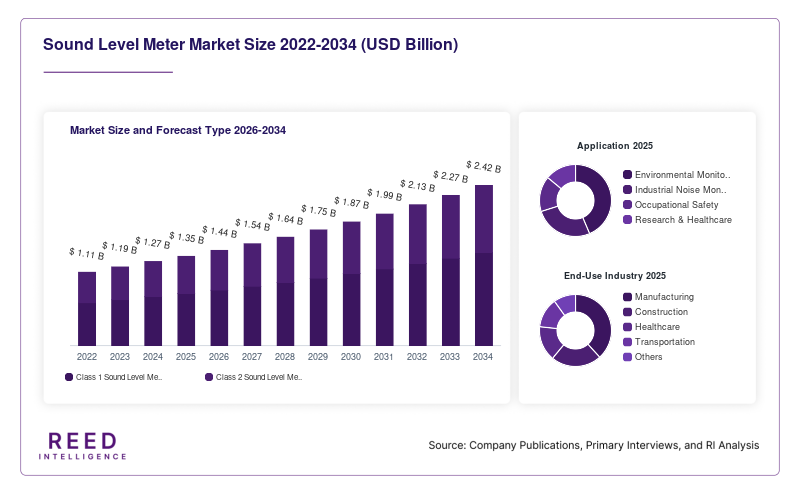
The Sound Level Meter Market size was valued at approximately USD 1.35 billion in 2025 and is projected to reach USD 2.42 billion by 2034, expanding at a CAGR of 6.7% during the forecast period (2025–2034). The market growth is primarily supported by the increasing global emphasis on occupational safety and environmental noise monitoring regulations. Governments and regulatory bodies worldwide are mandating stricter compliance standards for noise exposure in workplaces, urban planning, and industrial operations, thereby accelerating the adoption of sound level meters across diverse industries.
Sound level meters are widely used in sectors such as construction, manufacturing, aviation, environmental monitoring, and healthcare. The integration of digital technologies, including IoT-enabled monitoring systems and wireless connectivity, has further enhanced the usability and efficiency of these devices, contributing to market expansion. Additionally, rising urbanization and infrastructure development projects globally have created consistent demand for noise assessment tools.
Key Highlights
- North America dominated the market with a 34.2% share in 2025, while Asia Pacific is expected to grow at the fastest CAGR of 7.8%.
- By type, Class 1 sound level meters held the leading share of 58.6%, while Class 2 meters are projected to grow at the fastest CAGR of 7.2%.
- By application, environmental monitoring led with a 36.4% share, while industrial noise monitoring is anticipated to grow at a CAGR of 7.5%.
- The United States remained the dominant country, with market values of USD 420 million in 2024 and USD 445 million in 2025.
Market Trends
Integration of Smart and Connected Devices
The Sound Level Meter Market is witnessing a shift toward smart and connected devices equipped with IoT and cloud-based capabilities. Modern sound level meters now offer real-time data transmission, remote monitoring, and automated reporting features. These advancements are particularly beneficial for industries requiring continuous noise tracking, such as construction and smart city projects. The growing adoption of mobile applications linked with sound measurement devices is also improving accessibility and operational efficiency.
Rising Demand for Portable and Handheld Devices
Another key trend shaping the market is the increasing preference for compact, lightweight, and portable sound level meters. Professionals in field applications require devices that are easy to carry and operate without compromising accuracy. Manufacturers are focusing on ergonomic designs and battery efficiency to cater to this demand. Additionally, handheld devices are gaining traction among individual users, researchers, and small-scale industries due to their affordability and ease of use.
Market Drivers
Increasing Stringency of Noise Regulations
The implementation of strict noise pollution regulations across developed and developing economies is a major driver of the Sound Level Meter Market. Regulatory authorities are enforcing workplace safety standards to limit employee exposure to harmful noise levels. Compliance requirements in industries such as manufacturing, mining, and transportation are driving the adoption of advanced sound measurement solutions.
Expansion of Infrastructure and Urban Development
Rapid urbanization and infrastructure development projects are significantly contributing to market growth. Construction activities, including highways, airports, and residential complexes, require regular noise monitoring to comply with environmental standards. This has increased the demand for sound level meters among contractors, engineers, and environmental agencies, supporting overall market expansion.
Market Restraint
High Cost of Precision Instruments
One of the key challenges in the Sound Level Meter Market is the relatively high cost associated with precision-grade instruments, particularly Class 1 sound level meters. These devices are designed for high accuracy and compliance with international standards, making them expensive for small and medium-sized enterprises. Additionally, calibration and maintenance costs further increase the total cost of ownership.
The cost barrier limits adoption in price-sensitive markets, especially in developing regions where budget constraints are prominent. While low-cost alternatives exist, they often lack the precision required for regulatory compliance, restricting their use in critical applications. This creates a gap between affordability and performance, thereby restraining market growth to some extent.
Market Opportunities
Growth in Smart City Projects
The expansion of smart city initiatives presents significant opportunities for the Sound Level Meter Market. Governments are increasingly investing in intelligent urban infrastructure, which includes noise monitoring systems integrated with centralized data platforms. These systems help in managing urban noise pollution effectively, creating sustained demand for advanced sound measurement devices.
Increasing Adoption in Healthcare and Research
The use of sound level meters in healthcare and research applications is gaining traction. Hospitals and research institutions are focusing on maintaining optimal acoustic environments to improve patient outcomes and conduct precise studies. This has led to increased adoption of sound measurement tools for monitoring noise levels in clinical settings, laboratories, and academic institutions, opening new growth avenues for market participants.
Segmental Analysis
By Type
Class 1 sound level meters dominated the Sound Level Meter Market with a 58.6% share in 2024. These devices were widely used in applications requiring high precision and compliance with international standards, such as environmental monitoring and laboratory testing.
Class 2 sound level meters are expected to grow at the fastest CAGR of 7.2% during the forecast period. Their cost-effectiveness and suitability for general-purpose applications will drive adoption, particularly among small and medium enterprises.
By Application
Environmental monitoring held the largest share of 36.4% in 2024. The increasing need to assess and control noise pollution in urban areas contributed to the dominance of this segment.
Industrial noise monitoring is projected to grow at a CAGR of 7.5%. The rising focus on workplace safety and compliance with occupational health regulations will drive demand in this segment.
By End-Use Industry
The manufacturing sector accounted for the largest share of 32.1% in 2024. High noise levels in manufacturing facilities necessitated continuous monitoring, supporting segment growth.
The construction sector is anticipated to grow at a CAGR of 7.6%, driven by increasing infrastructure development projects and the need for compliance with environmental regulations.
By Product Type
Handheld sound level meters dominated the market with a 61.3% share in 2024 due to their portability and ease of use.
Fixed or installed sound level monitoring systems are expected to grow at the fastest CAGR of 7.4%, driven by the need for continuous and automated noise monitoring in industrial and urban environments.
Regional Analysis
North America
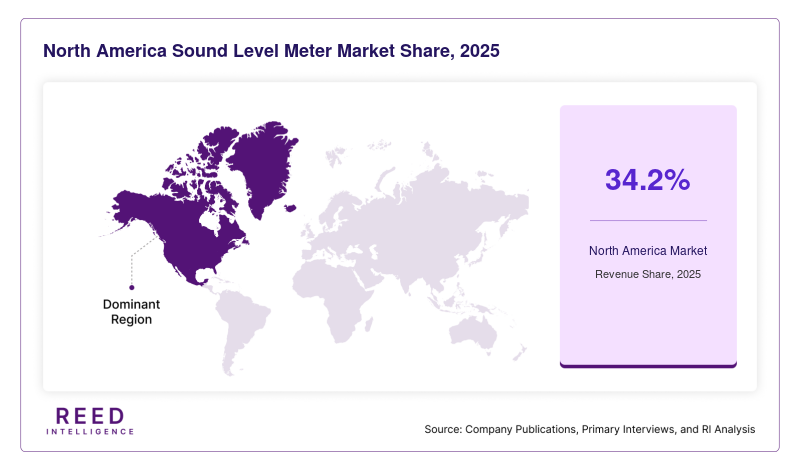
North America accounted for a 34.2% share of the Sound Level Meter Market in 2025 and is expected to grow at a CAGR of 6.1% during the forecast period. The region’s mature industrial base and established regulatory framework supported consistent demand for sound level meters.
The United States dominated the regional market due to strong enforcement of occupational safety standards and environmental regulations. The presence of advanced industries and continuous investments in workplace monitoring technologies contributed to steady market growth.
Europe
Europe held a 27.5% share of the Sound Level Meter Market in 2025 and is projected to expand at a CAGR of 6.3% from 2025 to 2034. The region’s emphasis on environmental sustainability and noise pollution control supported market expansion.
Germany emerged as the dominant country, driven by its robust manufacturing sector and strict compliance with environmental directives. The adoption of sound monitoring technologies in industrial and urban settings further strengthened market demand.
Asia Pacific
Asia Pacific captured 22.8% of the Sound Level Meter Market in 2025 and is anticipated to grow at the fastest CAGR of 7.8% over the forecast period. Rapid industrialization and urbanization contributed significantly to market growth in the region.
China led the regional market due to large-scale infrastructure projects and increasing awareness of environmental noise management. Government initiatives to control urban noise pollution further accelerated the adoption of sound level meters.
Middle East & Africa
The Middle East & Africa region accounted for 8.1% of the Sound Level Meter Market in 2025 and is expected to grow at a CAGR of 5.9% during the forecast period. Infrastructure development and industrial expansion supported market demand.
The United Arab Emirates dominated the region, driven by ongoing construction projects and regulatory measures to ensure environmental compliance. The growing focus on sustainable urban development also contributed to market growth.
Latin America
Latin America held a 7.4% share of the Sound Level Meter Market in 2025 and is projected to grow at a CAGR of 6.0% from 2025 to 2034. Increasing industrial activities and environmental awareness supported market expansion.
Brazil emerged as the leading country, supported by rising investments in infrastructure and regulatory initiatives aimed at controlling noise pollution in urban areas.
Competitive Landscape
The Sound Level Meter Market is moderately fragmented, with several global and regional players competing based on product innovation, accuracy, and pricing. Companies are focusing on developing advanced devices with digital integration and improved user interfaces.
A leading player in the market is Brüel & Kjær, known for its high-precision measurement instruments. The company has recently introduced advanced sound level meters with enhanced connectivity features, strengthening its position in the market. Other key players are emphasizing strategic partnerships and product launches to expand their market presence.
Key Players List
- Brüel & Kjær
- 3M Company
- Fluke Corporation
- Extech Instruments
- PCE Instruments
- Testo SE & Co. KGaA
- NTi Audio AG
- RION Co., Ltd.
- Larson Davis
- Casella Inc.
- Cirrus Research plc
- TSI Incorporated
- Pulsar Instruments Plc
- Lutron Electronic Enterprise Co., Ltd.
- Amprobe
Recent Developments
- 2024: Brüel & Kjær launched a next-generation sound level meter with cloud-based analytics capabilities.
- 2024: Fluke Corporation introduced a compact handheld device designed for field engineers.
- 2023: Testo SE expanded its product portfolio with advanced environmental monitoring solutions.
- 2023: NTi Audio AG developed a new wireless-enabled sound measurement system.
- 2023: Cirrus Research plc introduced an upgraded noise monitoring solution for industrial applications.
Sound Level Meter Market Segments
Type
- Class 1 Sound Level Meters
- Class 2 Sound Level Meters
Application
- Environmental Monitoring
- Industrial Noise Monitoring
- Occupational Safety
- Research & Healthcare
End-Use Industry
- Manufacturing
- Construction
- Healthcare
- Transportation
- Others
Product Type
- Handheld Sound Level Meters
- Fixed/Installed Monitoring Systems
By Region
- North America
- Europe
- APAC
- Middle East and Africa
- LATAM