Sound Therapy Market Size, Share & Trends Analysis Report By Therapy Type (Music Therapy, Sound Bath & Sound Healing, Tinnitus Sound Therapy, Vibroacoustic Therapy, Binaural Beats & Neuroacoustic Therapy, Other Sound-Based Therapies), By Application (Stress & Relaxation, Sleep & Sleep Disorders, Mental & Emotional Well-Being, Pain Management & Rehabilitation, Tinnitus & Hearing Management, Others), By End User (Individual & Home Users, Healthcare Providers, Wellness Centers & Spas, Education & C
USD 3950
Sound Therapy Market Size
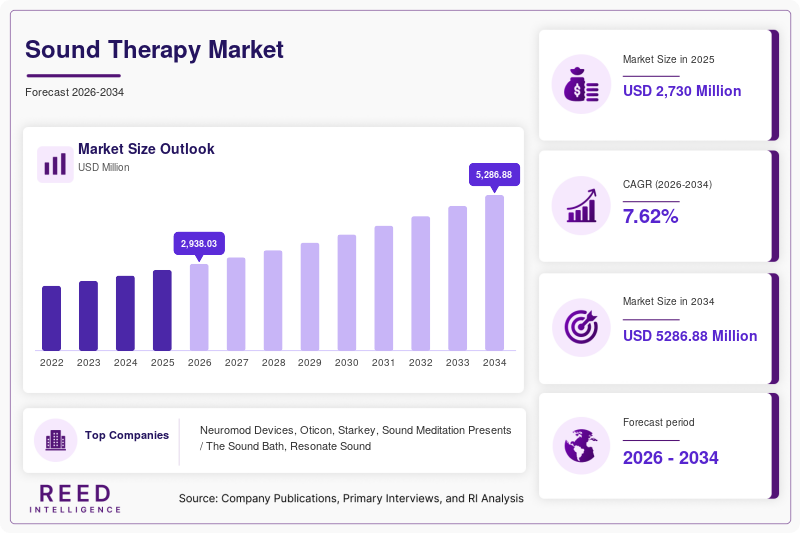
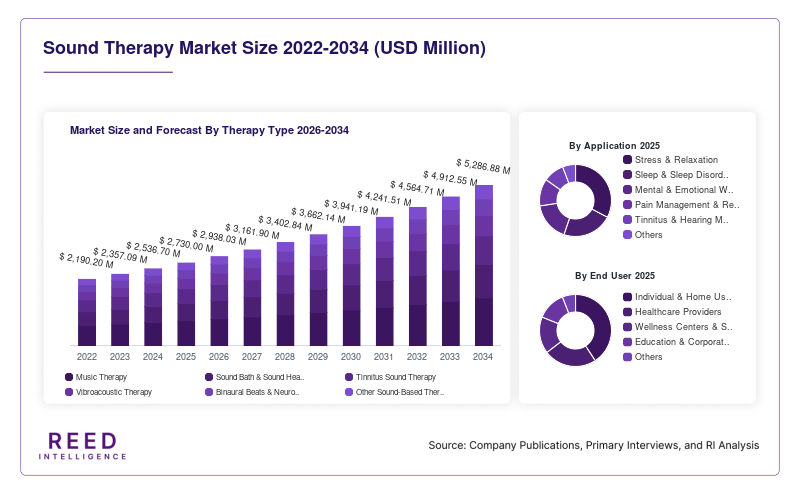
The global sound therapy market is valued at USD 2,730 Million in 2025 and USD 2,938.03 Million in 2026. The market is projected to reach USD 5,286.88 Million by 2034, registering a 7.62% CAGR during the forecast period.
The sound therapy market encompasses a broad group of interventions, products, digital services and devices that use music, environmental sounds, acoustic stimulation, tinnitus-specific sounds, vibroacoustic vibration or other structured auditory stimuli for wellness or therapeutic purposes. The market spans professionally delivered music therapy, consumer sound-bath and relaxation applications, tinnitus sound generators, hearing-aid-based sound programs, vibroacoustic systems and increasingly personalized digital audio platforms.
A critical distinction within the market is between clinical music therapy and broader consumer sound-wellness practices. The American Music Therapy Association defines music therapy as the clinical and evidence-based use of music interventions by a credentialed professional to accomplish individualized goals within a therapeutic relationship.
Sound Therapy Market Drivers
Growing demand for non-pharmacological approaches to stress, anxiety, sleep and pain is increasing interest in structured sound interventions
Interest in sound-based interventions is being supported by research examining their potential role in anxiety, stress, sleep and pain management.
The 2025 multilevel meta-analysis of music therapy found a statistically significant medium overall effect on anxiety outcomes and a medium effect on self-reported anxiety across 51 studies. The authors concluded that receptive and combined receptive-active approaches showed particularly promising results while noting that physiological outcomes require additional research.
A separate 2025 meta-analysis covering chronic-pain studies found significant reductions in chronic pain and depression associated with music therapy, while emphasizing that effectiveness varied according to population and intervention design.
These findings support broader use of sound-based interventions as complementary wellness or supportive-care tools, especially where users seek low-friction experiences that can be delivered through headphones, mobile devices, bedside systems or professional sessions.
The market opportunity is not restricted to formal clinical treatment. Consumer applications are increasingly packaging sound experiences around everyday goals such as relaxation, sleep preparation, meditation and focus, allowing users to access these experiences without scheduling an in-person therapy session.
Healthcare providers are expanding music therapy programs across oncology, neurology, pediatrics and rehabilitation
Institutional use of music therapy is strengthening the clinical side of the market.
Piedmont Athens Regional began a music therapy program in its adult oncology unit in February 2026 through a partnership with the University of Georgia. The program provides individualized sessions using patient-preferred music, songwriting, active music-making, reminiscence and legacy work.
In March 2026, University Hospitals Sussex reported the use of music therapy to support patients with neurological conditions during rehabilitation and hospital care. Sessions were tailored to individual patients and delivered in coordination with clinical teams.
Cedars-Sinai subsequently launched a music therapy program in its neonatal intensive care unit in May 2026. The hospital said the initiative uses live music and individualized interventions as part of supportive care for newborns.
These developments expand the market's addressable healthcare base and also provide institutional validation for professionally delivered music interventions.
Digital delivery is reducing access barriers and expanding sound therapy into daily wellness routines
Smartphones, streaming services, connected speakers, headphones and wearable devices allow sound-based experiences to be delivered on demand.
The Sound Bath app offers hundreds of sound baths and guided journeys, including short sessions, longer sessions and all-night sound experiences, while Resonate markets immersive sound baths and guided practices through mobile devices and Apple Watch.
This digital model changes the economics of the market. A single audio library can be delivered to large numbers of users without the physical limitations of a therapy studio or wellness center.
AI further expands personalization. Musitopia uses AI to personalize audio experiences in real time, while other platforms increasingly allow users to select sound type, session duration, mood or intended use. (UPF Music Technology Group)
Sound Therapy Market Restraints
Clinical evidence remains uneven across sound-therapy modalities and outcomes
Evidence supporting sound-based interventions is not uniform. Music therapy has a growing evidence base for certain outcomes, but results can differ substantially according to patient population, intervention design, duration and outcome measure.
The 2025 anxiety meta-analysis found a meaningful overall effect for anxiety but only a small, non-significant effect for physiological outcomes.
The 2025 systematic review of music therapy for sleep in older adults found significant improvement in sleep quality but classified the certainty of evidence as very low because of risk of bias and substantial heterogeneity.
The evidence situation creates challenges for vendors marketing broad therapeutic claims. Stronger clinical validation is required for products seeking adoption within healthcare settings, reimbursement pathways or regulated medical-device categories.
Sound therapy competes with low-cost general audio, meditation and wellness alternatives
Many consumers can access calming music, white noise, nature sounds and meditation content through general streaming platforms without buying a dedicated product or subscription.
NIDCD notes that simple sound sources such as smartphones, radios and household fans can sometimes be used as sound generators in tinnitus management.
This creates pricing pressure for consumer products. Vendors must demonstrate differentiated value through personalization, professional content, hardware integration, clinical credentials, specialized algorithms or measurable outcomes rather than relying solely on access to relaxing audio.
Sound Therapy Market Opportunities
AI-personalized sound experiences can turn generic audio libraries into adaptive wellness platforms
AI enables sound systems to respond to user preferences, context, session history and potentially physiological signals rather than simply playing static tracks.
Musitopia launched in March 2026 as a personalized music-based mental wellness application using AI and professional collaboration. Its real-time personalization illustrates how artificial intelligence is moving sound therapy toward adaptive rather than fixed content.
Binaural-beat, ambient-sound and personalized soundscape platforms can similarly customize frequency combinations, timing, sound intensity and content based on the intended activity.
The commercial opportunity extends to sleep optimization, workplace stress programs, digital behavioral-health platforms and connected wellness devices.
Specialized vibroacoustic systems can create premium hardware categories
Vibroacoustic therapy combines sound with tactile vibration, creating a hardware-intensive category that is differentiated from ordinary headphone-based audio.
Lifevibe's consumer-grade VAT chair brought a vibroacoustic experience into the home, while Hisooth is preparing a dedicated vibroacoustic music player containing licensed therapeutic tracks optimized for sound-vibration systems.
Clinics, spas, rehabilitation facilities, meditation centers and high-end home-wellness consumers can support premium equipment demand.
Tinnitus management can expand the market through integrated hearing and sound technologies
Tinnitus creates a specialized clinical and consumer market for sound-based products.
NIDCD recognizes sound therapy as one component of tinnitus management, while Oticon and Starkey integrate customizable tinnitus sound programs into hearing aids.
Neuromod Devices is expanding beyond conventional masking through bimodal neuromodulation. In April 2026, the company launched Lenire in Canada through 21 tinnitus-focused hearing-care clinics, combining auditory stimulation with tongue stimulation. the segment creates opportunities for specialized medical devices, hearing-aid integrations, personalized audio profiles and clinician-supported digital services.
Therapy Type Analysis
Music Therapy holds the dominant therapy-type share because healthcare adoption and clinical evidence support professional use
Music therapy accounts for the largest portion of the market because it has a defined professional framework, established clinical applications and an expanding evidence base across oncology, rehabilitation, mental health, pediatrics and supportive care.
The Music Therapy segment accounts for 34% of the global market in 2026 and is projected to register a 7.30% CAGR.
AMTA defines music therapy as a clinical and evidence-based practice delivered by credentialed professionals, differentiating it from general music listening and consumer sound-wellness practices.
Healthcare adoption is also broadening. Piedmont Athens Regional, Cedars-Sinai and University Hospitals Sussex all reported music-therapy activity during 2026.
Binaural Beats & Neuroacoustic Therapy is the fastest-growing major digital sound category
The Binaural Beats & Neuroacoustic Therapy segment accounts for 10% of the global market in 2026 and is projected to register a 9.80% CAGR, making it the fastest-growing major therapy category.
Growth is being supported by smartphone delivery, headphone compatibility, personalization and strong consumer interest in audio-based focus, relaxation and sleep experiences.
The category's commercial momentum is stronger than its clinical certainty; research continues to investigate how different acoustic-stimulation formats influence sleep, attention and psychological states. The broader acoustic-stimulation literature has expanded through recent systematic reviews and controlled studies, but evidence varies by protocol and outcome.
Application Analysis
Stress & Relaxation remains the dominant application because sound is increasingly incorporated into everyday wellness routines
The Stress & Relaxation segment accounts for 31% of the global market in 2026 and is projected to register a 7.20% CAGR.
Relaxation applications are accessible across almost every channel, including music therapy, sound baths, meditation apps, white-noise devices, nature sounds and vibroacoustic systems.
The 2025 meta-analysis of music therapy for anxiety found a statistically significant medium overall effect, supporting continued research and use of professionally delivered music interventions for psychological anxiety outcomes.
Sleep & Sleep Disorders is the fastest-growing major application
The Sleep & Sleep Disorders segment accounts for 22% of the global market in 2026 and is projected to register a 9.10% CAGR, making it the fastest-growing major application.
Sleep is particularly compatible with digital sound delivery because users can access sound through phones, speakers, headphones, bedside devices and wearable systems.
The February 2026 meta-analysis of music-based interventions in older adults reported an improvement in sleep quality but also identified low certainty of evidence, while the broader acoustic-stimulation literature continues to evaluate sound-based methods for insomnia.
Consumer platforms are increasingly responding with longer-form and overnight content. The Sound Bath app, for example, offers all-night sound-bath mixes for sleep.
End User Analysis
Individual & Home Users remain the dominant end-user group as digital sound experiences become widely accessible
The Individual & Home Users segment accounts for 46% of the global market in 2026 and is projected to register a 7.50% CAGR.
Smartphones, headphones, speakers, sound machines and home vibroacoustic systems allow users to access sound-based sessions without visiting a specialist facility.
The rapid development of dedicated sound-bath applications, sleep audio platforms and home vibroacoustic devices demonstrates the continuing expansion of this channel.
Healthcare Providers are the fastest-growing major end-user category
The Healthcare Providers segment accounts for 25% of the global market in 2026 and is projected to register a 9.00% CAGR, making it the fastest-growing major end-user category.
Healthcare adoption is being supported by hospital-based music therapy programs and specialized tinnitus technology.
Piedmont Athens Regional introduced music therapy in oncology, Cedars-Sinai launched a NICU program and University Hospitals Sussex uses music therapy in neurological care.
Wellness Centers & Spas are expanding premium sound experiences
The segment is projected to register a 8.30% CAGR, supported by sound baths, vibroacoustic beds and chairs, meditation programs and immersive wellness experiences.
The availability of specialized sound and vibration hardware makes this a higher-value service category than ordinary streaming audio. Hisooth and vibroacoustic-equipment suppliers are targeting wellness clinics, massage centers and meditation studios.
Sound Therapy Market Regional Analysis
North America Sound Therapy Market
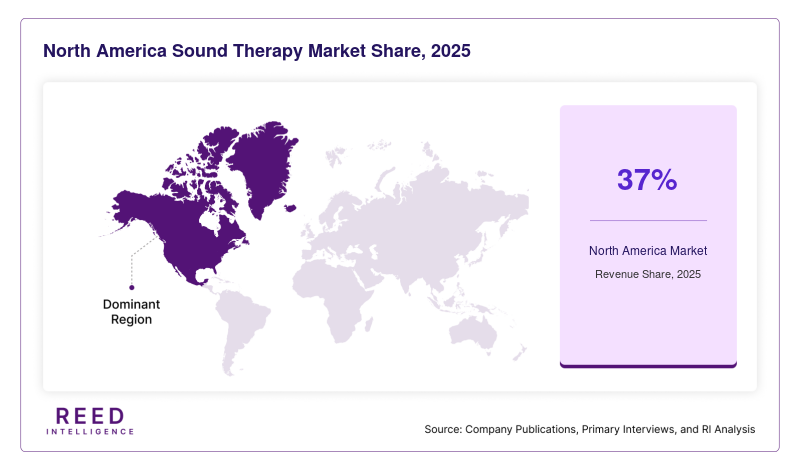
North America remains the dominant regional market due to its established wellness industry, large digital-health market, extensive hospital music-therapy programs and rapid adoption of specialized tinnitus and sound technologies.
The North America region accounts for 37% of the global market in 2026 and is projected to register a 7.10% CAGR.
The United States has a developed professional music-therapy ecosystem alongside consumer wellness applications and hearing-care technology. Cedars-Sinai's 2026 NICU program, Piedmont Athens Regional's oncology program and the University Hospitals music-therapy network demonstrate ongoing institutional use.
The region also supports specialized tinnitus technology. Neuromod Devices has established Lenire in the U.S. and expanded to Canada in 2026, while hearing-aid manufacturers integrate personalized tinnitus sound programs.
Europe Sound Therapy Market
Europe is projected to register a 7.40% CAGR, supported by professional music therapy, wellness tourism, digital-health adoption, hearing-care services and research activity.
The region also has an established history of vibroacoustic and sound-based therapeutic practices. University Hospitals Sussex reported ongoing music therapy for neurological patients in March 2026, while Neuromod's Lenire is available across several European markets.
European consumers also represent an important market for sound baths, meditation platforms and immersive wellness experiences.
APAC Sound Therapy Market
APAC is the fastest-growing regional market as digital health adoption, smartphone penetration, wellness consumption and healthcare modernization expand across China, Japan, India, South Korea, Australia and Southeast Asia.
The APAC region accounts for 25% of the global market in 2026 and is projected to register a 9.10% CAGR, making it the fastest-growing regional market.
The region has significant cultural familiarity with music, meditation and sound-based practices while also developing modern clinical and digital applications. The Chennai School of Music Therapy's 2026 professional programs and hospital internship partnerships illustrate continued development of structured music-therapy practice in India.
China, Japan and South Korea provide additional opportunities through consumer electronics, hearing technology, digital wellness and specialized medical-device ecosystems.
Middle East and Africa Sound Therapy Market
The Middle East and Africa market is projected to register an 8.00% CAGR, supported by premium wellness services, hospitality, healthcare investment and growing demand for digital health and relaxation technologies.
Luxury wellness destinations and hospitality operators provide opportunities for sound baths, immersive audio, meditation experiences and vibroacoustic systems, while healthcare applications provide a separate growth pathway.
LATAM Sound Therapy Market
LATAM is projected to register a 7.80% CAGR, supported by wellness tourism, digital-health adoption, private healthcare and growing consumer interest in mindfulness and relaxation applications.
Smartphone-based sound platforms provide a relatively accessible entry point because they require less infrastructure than dedicated clinical equipment or in-person therapy facilities.
Sound Therapy Market Competitive Landscape
The sound therapy market is highly fragmented because it includes clinical-service providers, medical-device companies, hearing-aid manufacturers, wellness platforms, digital audio applications and vibroacoustic equipment suppliers.
Neuromod Devices competes in specialized tinnitus treatment through Lenire, a bimodal neuromodulation system combining auditory stimulation with tongue stimulation. Its April 2026 Canadian launch expanded access through 21 tinnitus-focused clinics across several provinces.
Oticon incorporates customizable tinnitus sound programs into hearing aids through Tinnitus SoundSupport, offering broadband and nature-based sounds that can be configured with professional support.
Starkey offers Multiflex Tinnitus Technology within its hearing-aid portfolio, allowing hearing professionals to customize sound stimulation around the user's tinnitus profile.
Key Market Players
- Neuromod Devices
- Oticon
- Starkey
- Sound Meditation Presents / The Sound Bath
- Resonate Sound
- Musitopia / Music Technology Group
- Hisooth
- Lifevibe
- Sound Oasis
- HOMedics
- Hatch
- SNOOZ
- Yogasleep
- Calm
- Headspace
- Endel
- Brain.fm
Recent Developments
September 2026 – Hisooth prepared the MP3-V1 VibroAcoustic Therapy Music Player for commercial shipment. The device contains 86 licensed therapeutic tracks selected and categorized for sound-vibration systems, with content spanning relaxation, sleep, meditation, massage and ambient music. Hisooth states that shipping begins in September 2026 and that the device can connect to vibroacoustic beds, massage tables, speakers and headphones. Source: Hisooth official product announcement, September 2026.
August 2026 – the PAUSE Sound Bath application by Sara Auster was updated with immersive sound-bath and meditation content. The application combines guided sound baths, meditation, breathwork and daily rituals and is positioned around relaxation, sleep and focus.
Sound Therapy Market Segments
By Therapy Type
- Music Therapy
- Sound Bath & Sound Healing
- Tinnitus Sound Therapy
- Vibroacoustic Therapy
- Binaural Beats & Neuroacoustic Therapy
- Other Sound-Based Therapies
By Application
- Stress & Relaxation
- Sleep & Sleep Disorders
- Mental & Emotional Well-Being
- Pain Management & Rehabilitation
- Tinnitus & Hearing Management
- Others
By End User
- Individual & Home Users
- Healthcare Providers
- Wellness Centers & Spas
- Education & Corporate Settings
- Others
By Region
- North America
- Europe
- APAC
- Middle East and Africa
- LATAM