Soybean Fungicide Seed Treatment Market Size, Share, Demand Report by Type (Systemic Fungicides, Contact Fungicides), By Formulation (Liquid Formulations, Dry Formulations), By Application Stage (Industrial Seed Treatment, On-Farm Treatment), By Distribution Channel (Direct Sales, Retail & Agro-Dealers, Online Platforms), By Region & Segment Forecasts, 2026–2034
USD 3950
Market Overview
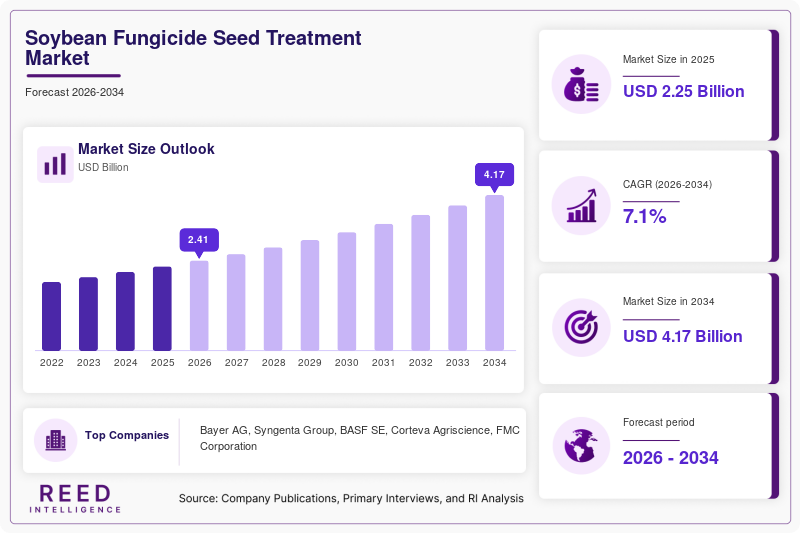
The Soybean Fungicide Seed Treatment Market size is estimated at USD 2.41 billion, and it is projected to reach USD 4.18 billion by 2034, registering a CAGR of 7.1% during 2026–2034.The market growth is primarily supported by the increasing incidence of soil-borne and seed-borne fungal diseases such as Fusarium, Rhizoctonia, and Phytophthora, which significantly impact soybean yield productivity. The adoption of advanced seed treatment technologies integrated with systemic fungicides has strengthened crop resilience and improved germination rates across major soybean-producing countries.
A major global factor supporting the Soybean Fungicide Seed Treatment Market growth is the rapid shift toward sustainable agriculture practices and precision farming, where seed-applied crop protection solutions reduce overall chemical usage while improving yield efficiency.
Key Highlights
- Dominant regional share (2025): North America – 34.6%
- Fastest-growing region CAGR (2026–2034): Asia Pacific – 8.2%
- Leading subsegment (Type): Systemic fungicide seed treatments – 2025 share 58.3%
- Fastest-growing subsegment (Formulation): Biologically integrated liquid formulations – CAGR 8.6%
- Dominant country (2024): United States – USD 0.71 billion
- Dominant country (2025): United States – USD 0.76 billion
The Soybean Fungicide Seed Treatment Market continues to evolve as manufacturers integrate biologicals, microencapsulation technologies, and multi-mode fungicidal combinations.
Market Trends
Shift Toward Biological and Hybrid Seed Treatment Solutions
The Soybean Fungicide Seed Treatment Market is witnessing a transition toward biological-based fungicide formulations integrated with chemical actives. Farmers are increasingly adopting hybrid seed treatment systems that combine synthetic fungicides with microbial agents such as Trichoderma and Bacillus species. This trend is driven by regulatory pressure on chemical pesticides and rising demand for residue-free agricultural output.
Adoption of Precision Agriculture and Coated Seed Technologies
Advanced seed coating technologies are becoming widely adopted in the Soybean Fungicide Seed Treatment Market, enabling precise dosing and uniform distribution of active ingredients. Precision agriculture tools, including AI-based crop monitoring and soil health mapping, are supporting optimized fungicide application rates, reducing wastage, and improving cost efficiency for large-scale soybean farms.
Market Drivers
Rising Incidence of Soybean Crop Diseases
Increasing fungal infections caused by soil-borne pathogens have become a critical challenge for soybean producers. The Soybean Fungicide Seed Treatment Market is benefiting from heightened demand for preventive seed protection, as fungicide treatments significantly reduce early-stage crop losses and enhance yield stability.
Expansion of Commercial Soybean Cultivation
Global expansion of soybean acreage, particularly in Brazil, the United States, and Argentina, is driving demand for high-performance seed treatment solutions. Commercial farmers are increasingly investing in advanced fungicide seed coatings to ensure uniform germination and higher productivity per hectare.
Market Restraint
High Cost of Advanced Seed Treatment Technologies
One of the major restraints in the Soybean Fungicide Seed Treatment Market is the relatively high cost of advanced fungicide formulations and application systems. Small and medium-scale farmers in developing regions often face affordability challenges, limiting widespread adoption of premium seed treatment products.
Market Opportunities
Growth in Biological Fungicide Innovation
The increasing focus on sustainable agriculture is creating significant opportunities in bio-based fungicide seed treatments. Companies investing in microbial seed coating technologies are expected to gain competitive advantages in the Soybean Fungicide Seed Treatment Market.
Expansion in Emerging Agricultural Economies
Emerging economies in Asia Pacific and Latin America present strong opportunities due to expanding soybean cultivation and government subsidies supporting crop protection technologies. These regions are expected to significantly contribute to future demand growth.
Segmental Analysis
By Type
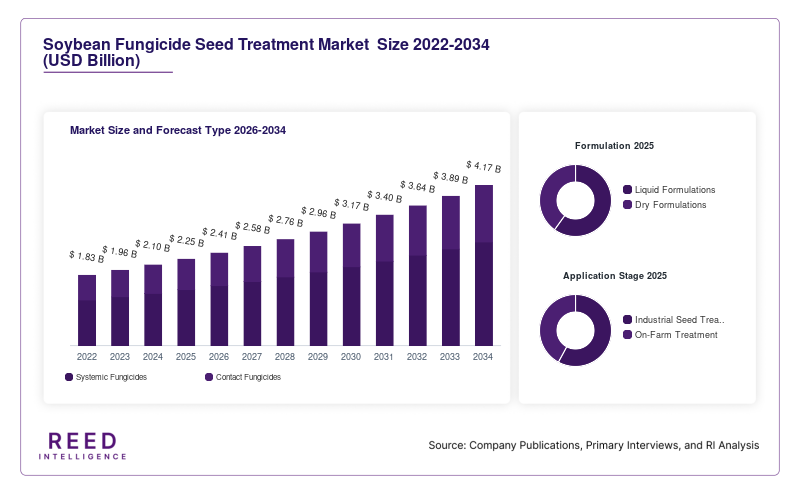
In the Soybean Fungicide Seed Treatment Market, systemic fungicides dominated with a 2025 share of 58.3%, owing to their ability to provide long-lasting protection against internal and external fungal infections. They remain widely used in large-scale soybean farming systems.
Contact fungicides are the fastest-growing subsegment, projected to expand at a CAGR of 7.9%, driven by their cost-effectiveness and increasing use in integrated pest management systems.
By Formulation
Dry formulations held a 52.7% share in 2025, supported by ease of storage and application in commercial farming operations. However, liquid formulations are the fastest-growing segment with a CAGR of 8.6%, driven by improved seed coating uniformity and compatibility with biological agents in the Soybean Fungicide Seed Treatment Market.
By Application Stage
Industrial seed treatment dominated with a 63.1% share in 2025, as large agribusiness firms prefer pre-treated seeds for consistency and efficiency. On-farm treatment is expected to grow at a CAGR of 7.4%, supported by rising adoption among mid-scale farmers seeking cost flexibility.
By Distribution Channel
Direct sales channels accounted for 46.8% share in 2025, driven by strong relationships between agrochemical manufacturers and large farming enterprises. Online distribution channels are the fastest-growing, projected at a CAGR of 9.1%, due to increasing digitalization in agricultural input procurement.
Regional Analysis
North America
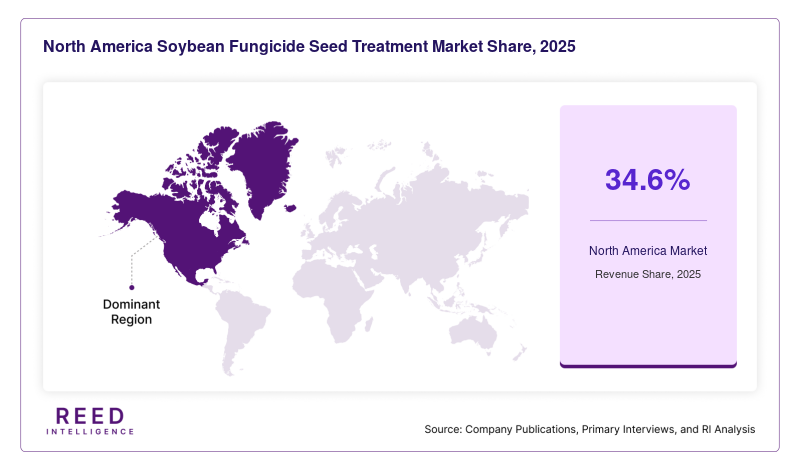
North America held 34.6% market share in 2025 in the Soybean Fungicide Seed Treatment Market, driven by large-scale soybean farming in the U.S. and high adoption of genetically modified crops. The region is projected to grow at a CAGR of 6.8% (2026–2034). The United States remains dominant due to advanced agricultural infrastructure and strong presence of agrochemical companies.
Europe
Europe accounted for 21.4% share in 2025, with a projected CAGR of 6.2% during 2026–2034. Growth is supported by stringent environmental regulations encouraging safer fungicide seed treatments. France is a key country, driven by integrated pest management adoption and sustainable farming initiatives.
Asia Pacific
Asia Pacific represented 26.1% share in 2025 and is forecast to grow at the fastest CAGR of 8.2% (2026–2034) in the Soybean Fungicide Seed Treatment Market. China leads the region due to rising soybean imports, domestic production expansion, and government-backed agricultural modernization programs.
Middle East & Africa
The region held 9.3% share in 2025 and is expected to grow at a CAGR of 7.0%. Growth is supported by expanding agribusiness investments and increasing awareness of crop protection solutions in arid farming environments. South Africa is a key contributor due to soybean acreage expansion.
Latin America
Latin America accounted for 8.6% share in 2025, with a projected CAGR of 7.6% (2026–2034). Brazil dominates the region due to its massive soybean production base and strong adoption of seed-applied fungicide technologies to combat soil pathogens.
Competitive Landscape
The Soybean Fungicide Seed Treatment Market is moderately consolidated with key players focusing on product innovation, biological integration, and strategic partnerships. Major companies include Bayer AG, Syngenta Group, BASF SE, Corteva Agriscience, and FMC Corporation. Bayer AG remains a leading player due to its strong seed treatment portfolio under brands like EverGol and Poncho/VOTiVO, which integrate fungicidal and insecticidal protection.
Syngenta continues to expand its biological seed treatment solutions, strengthening its position in sustainable agriculture. BASF focuses on multi-mode fungicide combinations, while Corteva Agriscience emphasizes genetically optimized seed treatment compatibility. FMC Corporation is expanding its presence in Asia Pacific through distribution partnerships.
Recent developments include increased R&D investment in biofungicide formulations and digital seed treatment monitoring platforms, enhancing precision application in the Soybean Fungicide Seed Treatment Market.
Key Players List
- Bayer AG
- Syngenta Group
- BASF SE
- Corteva Agriscience
- FMC Corporation
- Nufarm Ltd.
- UPL Limited
- Sumitomo Chemical Co., Ltd.
- ADAMA Agricultural Solutions
- Marrone Bio Innovations
- Corteva Seeds
- Novozymes A/S
- Koppert Biological Systems
- Certis Biologicals
- Arysta LifeScience
Recent Developments
- In 2025, Bayer AG expanded its soybean seed treatment portfolio with enhanced multi-mode fungicide coatings designed to improve early-stage crop vigor and disease resistance.
- Syngenta introduced a next-generation biological seed treatment solution combining microbial agents with chemical fungicides for improved sustainability compliance.
- BASF announced increased investment in digital seed treatment analytics to optimize fungicide application rates in precision farming systems.
- Corteva Agriscience partnered with regional distributors in Brazil to expand soybean fungicide seed treatment penetration across high-production agricultural zones.
- FMC Corporation launched a new liquid seed treatment platform in Asia Pacific aimed at improving soybean germination efficiency under variable climatic conditions.
Soybean Fungicide Seed Treatment Market Segments
Type
- Systemic Fungicides
- Contact Fungicides
Formulation
- Liquid Formulations
- Dry Formulations
Application Stage
- Industrial Seed Treatment
- On-Farm Treatment
Distribution Channel
- Direct Sales
- Retail & Agro-Dealers
- Online Platforms
By Region
- North America
- Europe
- APAC
- Middle East and Africa
- LATAM