Space Debris Removal Market Size, Share & Demand Report By Type (Active Debris Removal, On-Orbit Servicing), By Orbit Type (Low Earth Orbit, Medium Earth Orbit, Geostationary Orbit), By Technology (Robotic Arms, Nets & Harpoons, Laser Systems, Drag Enhancement Devices), By End-Use (Government & Defense, Commercial) By Region & Segment Forecasts, 2026–2034
USD 3950
Market Overview
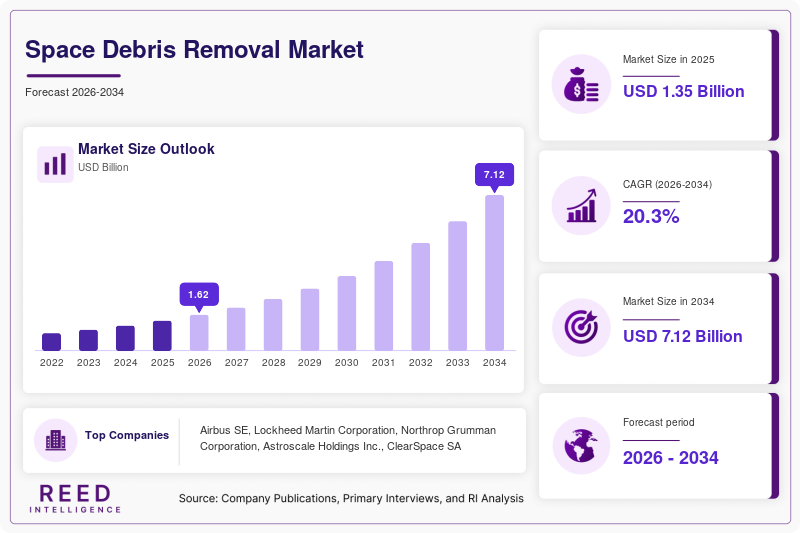
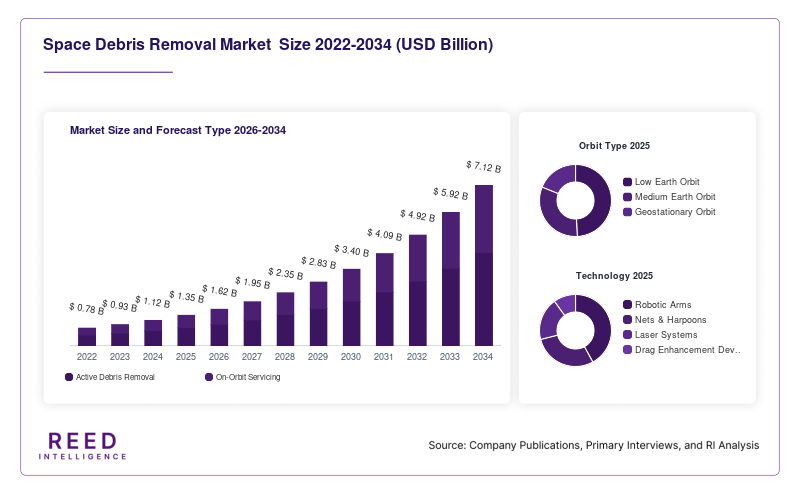
The Space Debris Removal Market size was valued at approximately USD 1.35 billion in 2026 and is projected to reach USD 5.92 billion by 2034, expanding at a CAGR of 20.3% during the forecast period (2026–2034). The market is gaining traction as orbital congestion increases due to the rapid deployment of satellites across low Earth orbit (LEO), medium Earth orbit (MEO), and geostationary orbit (GEO). Governments and private space companies are increasingly prioritizing orbital sustainability, driving investments in debris mitigation and active removal technologies.
A major global factor supporting market growth is the surge in satellite constellations for communication and Earth observation, which has significantly increased the risk of collisions and the generation of secondary debris. This has led to regulatory pressures and international collaborations aimed at ensuring long-term space sustainability.
Key Highlights
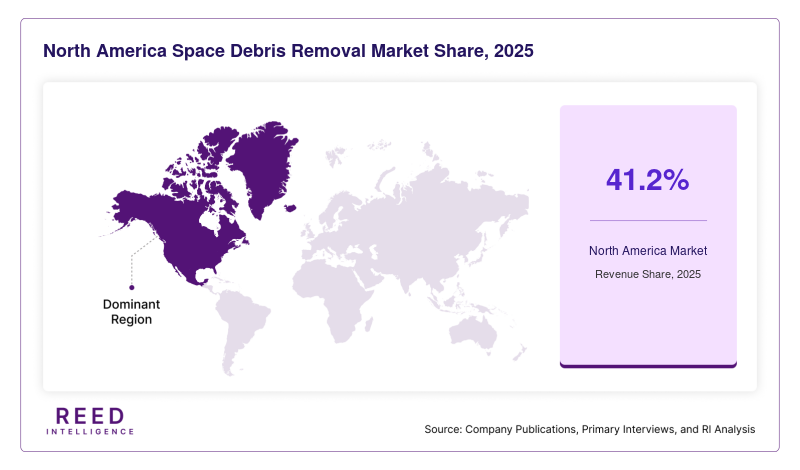
- North America dominated the market with 41.2% share in 2025, while Asia Pacific is expected to register the fastest growth at a CAGR of 22.6%.
- The Active Debris Removal (ADR) segment led the market with 63.5% share in 2025, whereas on-orbit servicing is projected to grow at a CAGR of 24.1%.
- By orbit type, Low Earth Orbit (LEO) dominated with 68.4% share, while GEO debris removal is expected to grow at a CAGR of 21.8%.
- The United States remained the dominant country, with market values of USD 420 million in 2024 and USD 510 million in 2025.
Market Trends
Rise of Autonomous Debris Removal Systems
Increasing integration of artificial intelligence and autonomous navigation technologies is transforming debris removal missions. Autonomous spacecraft capable of identifying, tracking, and capturing debris are improving operational efficiency and reducing mission costs.
Growth in Public-Private Partnerships
Governments are collaborating with private aerospace firms to accelerate debris removal initiatives. These partnerships are fostering innovation, reducing financial burdens, and enabling faster deployment of removal technologies.
Market Drivers
Increasing Satellite Launch Activities
The growing number of satellite launches for broadband internet, navigation, and surveillance is significantly contributing to orbital congestion. This has increased the demand for debris removal solutions to maintain safe operating environments in space.
Stringent Space Regulations and Sustainability Initiatives
Global space agencies and regulatory bodies are implementing stricter guidelines for debris mitigation and end-of-life satellite disposal. These regulations are encouraging operators to adopt active debris removal technologies, driving market expansion.
Market Restraint
High Operational and Mission Costs
Space debris removal missions require advanced technologies, complex logistics, and high capital investments. The significant cost associated with mission deployment and execution remains a key challenge limiting widespread adoption.
Market Opportunities
Development of Commercial Debris Removal Services
The emergence of commercial service providers offering debris removal as a service presents a significant growth opportunity. Satellite operators are increasingly outsourcing debris mitigation responsibilities to specialized firms.
Advancements in Robotics and Capture Mechanisms
Innovations in robotic arms, nets, harpoons, and laser-based systems are enhancing debris capture efficiency. These technological advancements are expected to open new avenues for scalable and cost-effective solutions.
Segmental Analysis
By Type
The Active Debris Removal (ADR) segment dominated the Space Debris Removal Market with a 63.5% share in 2025, as it directly addresses the removal of large and hazardous debris from orbit. ADR technologies are widely adopted due to their effectiveness in reducing collision risks.
The On-Orbit Servicing segment is projected to grow at a CAGR of 24.1%, driven by its ability to extend satellite lifespans and reduce the need for replacement launches. This approach offers a cost-efficient alternative by combining maintenance and debris mitigation functions.
By Orbit Type
Low Earth Orbit (LEO) held the largest share of 68.4% in 2025, owing to the high concentration of satellites and debris in this region. The increasing deployment of mega-constellations has intensified the need for debris removal solutions in LEO.
Geostationary Orbit (GEO) is expected to grow at a CAGR of 21.8%, supported by rising concerns over long-term sustainability of communication satellites and the need for controlled de-orbiting solutions.
By Technology
The Robotic Arm Capture Systems segment accounted for 29.7% share in 2025, as these systems provide precision and flexibility in capturing debris of varying sizes.
The Laser-Based Debris Removal segment is anticipated to grow at a CAGR of 25.2%, driven by its non-contact approach and potential for cost-effective large-scale deployment.
By End-Use
The Government & Defense segment dominated with 57.8% share in 2025, due to extensive funding and strategic importance of space security.
The Commercial Sector is projected to grow at a CAGR of 23.5%, fueled by increasing private sector participation in space activities and the need for sustainable operations.
Regional Analysis
North America
North America accounted for 41.2% market share in 2025 and is expected to grow at a CAGR of 19.8% during 2026–2034. The region benefits from strong government support and advanced space infrastructure.
The United States dominated the regional market due to its robust space programs and increasing investments in orbital sustainability initiatives.
Europe
Europe held 24.6% share in 2025 and is projected to expand at a CAGR of 20.5%. The region has been actively promoting space sustainability through collaborative missions and regulatory frameworks.
Germany led the market, driven by its focus on space technology innovation and participation in joint debris removal missions.
Asia Pacific
Asia Pacific captured 18.9% share in 2025 and is expected to grow at the fastest CAGR of 22.6%. Rapid satellite deployments and expanding space programs are contributing to market growth.
China dominated the region due to its increasing investments in space exploration and debris mitigation technologies.
Middle East & Africa
The Middle East & Africa region accounted for 8.1% share in 2025 and is anticipated to grow at a CAGR of 18.7%. The region is gradually entering the space sector with increasing investments.
The UAE emerged as a key country, driven by its growing focus on space missions and technological development.
Latin America
Latin America held 7.2% share in 2025 and is expected to grow at a CAGR of 17.9%. The region is witnessing gradual adoption of space technologies and international collaborations.
Brazil dominated the market due to its expanding satellite programs and partnerships with global space agencies.
Competitive Landscape
The Space Debris Removal Market is characterized by a mix of established aerospace companies and emerging startups focusing on innovative technologies. Key players are investing in research, partnerships, and demonstration missions to strengthen their market presence. One leading company, Astroscale Holdings Inc., has gained a strong position through successful in-orbit demonstrations and strategic collaborations with global space agencies. Airbus SE continues to focus on advanced robotic systems and mission design for debris capture.
Northrop Grumman Corporation is leveraging its expertise in satellite servicing to expand its capabilities in debris removal. ClearSpace SA is actively developing dedicated debris removal missions, while Lockheed Martin Corporation is investing in integrated space sustainability solutions. The competitive environment is evolving with increased funding and technological advancements, enabling companies to develop scalable and efficient debris removal systems. Strategic alliances and government contracts remain critical for long-term growth and market penetration.
Key Players List
- Airbus SE
- Lockheed Martin Corporation
- Northrop Grumman Corporation
- Astroscale Holdings Inc.
- ClearSpace SA
- Boeing Company
- Thales Group
- OHB SE
- Surrey Satellite Technology Ltd.
- Maxar Technologies Inc.
- Altius Space Machines
- D-Orbit SpA
- LeoLabs Inc.
- Exotrail
- Electro Optic Systems Pty Ltd.
Recent Developments
- In 2025, Astroscale successfully completed a demonstration mission showcasing magnetic capture technology for debris removal.
- In 2024, ClearSpace secured a contract for a multi-debris removal mission in low Earth orbit.
- Airbus announced advancements in autonomous navigation systems for debris capture operations in 2025.
- Northrop Grumman expanded its satellite servicing portfolio to include debris mitigation capabilities.
- Lockheed Martin initiated development of integrated platforms combining debris tracking and removal technologies.
Space Debris Removal Market Segments
Type
- Active Debris Removal
- On-Orbit Servicing
Orbit Type
- Low Earth Orbit
- Medium Earth Orbit
- Geostationary Orbit
Technology
- Robotic Arms
- Nets & Harpoons
- Laser Systems
- Drag Enhancement Devices
End-Use
- Government & Defense
- Commercial
By Region
- North America
- Europe
- APAC
- Middle East and Africa
- LATAM