Spacecraft Avionics Market Size, Share Demand Report By System Type (Navigation & Guidance Systems, Communication Systems, Flight Control Systems, Telemetry & Tracking Systems), By Platform (Satellites, Launch Vehicles, Space Stations), By Component (Hardware, Avionics Software), By End User (Government & Space Agencies, Commercial Space Operators, Defense Organizations) By Region & Segment Forecasts, 2026–2034
USD 3950
Market Overview
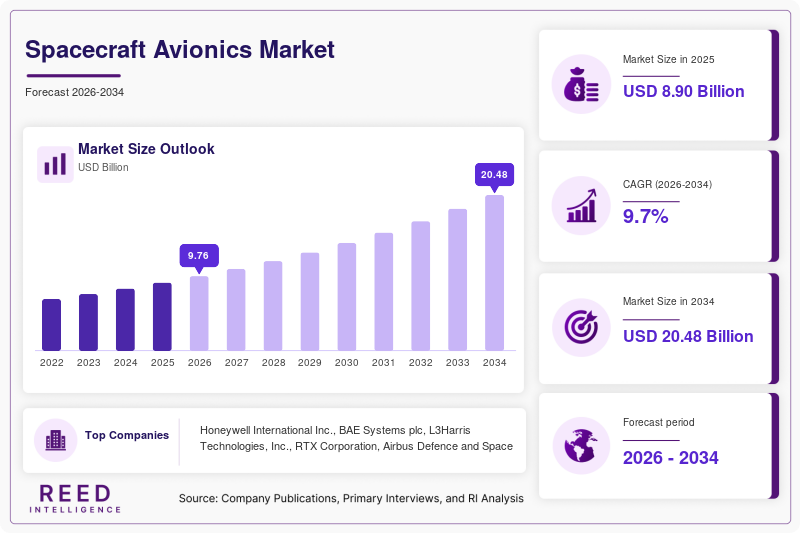
The Spacecraft Avionics Market Size was valued at USD 8.9 billion in 2026 and is projected to reach USD 18.7 billion by 2034, expanding at a CAGR of 9.7% during the forecast period (2026–2034). The market is experiencing significant growth as governments, commercial space companies, and defense organizations continue investing in satellite deployments, deep-space exploration programs, and next-generation launch vehicles. Spacecraft avionics systems serve as the technological backbone of modern spacecraft by enabling navigation, guidance, communication, flight control, telemetry, data processing, and mission management functions.
A major global factor supporting the growth of the Spacecraft Avionics Market has been the accelerating commercialization of the space industry. The emergence of private launch providers, satellite constellation operators, and space-based communication service providers has increased demand for advanced avionics solutions capable of supporting reliable and autonomous mission operations. Miniaturization of electronic systems, advancements in radiation-hardened components, and the adoption of artificial intelligence for spacecraft autonomy have further strengthened market expansion.
Key Highlights
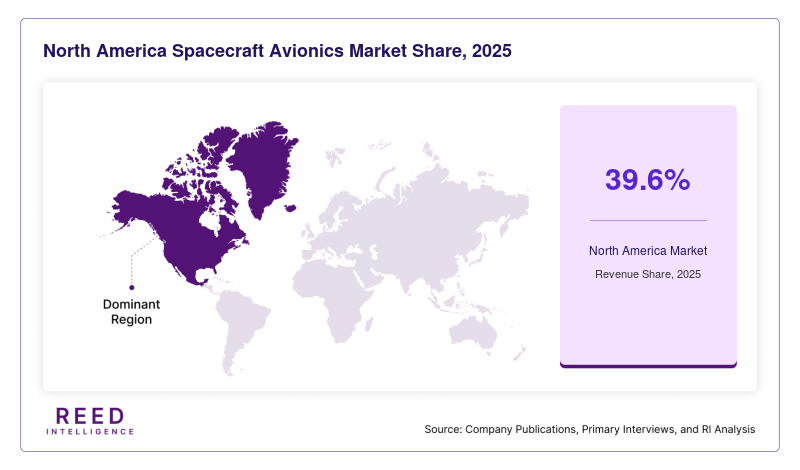
- North America dominated the market with 39.6% share in 2025, while Asia Pacific is projected to register the fastest CAGR of 11.8% during 2026–2034.
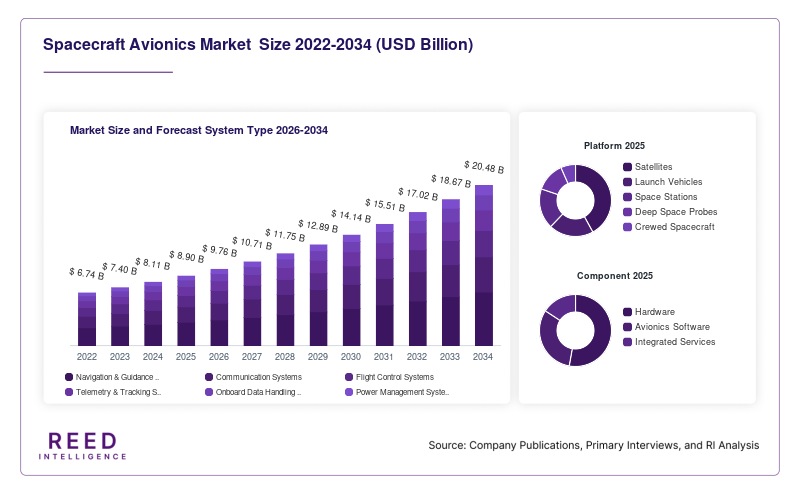
- By System Type, Navigation & Guidance Systems accounted for 29.8% share in 2025, while Onboard Data Handling Systems are expected to grow at a CAGR of 11.6%.
- By Platform, Satellites held 52.4% share in 2025, whereas Deep Space Probes are forecast to expand at a CAGR of 12.1%.
- By Component, Hardware represented 64.2% share in 2025, while Avionics Software is projected to grow at a CAGR of 12.8%.
- By End User, Government & Space Agencies accounted for 58.1% share in 2025, while Commercial Space Operators are expected to grow at a CAGR of 13.2%.
- The United States, the dominant country market, recorded a value of USD 2.84 billion in 2024, increasing to USD 3.12 billion in 2025.
Market Trends
Adoption of Artificial Intelligence-Based Autonomous Flight Systems
Artificial intelligence is increasingly being integrated into spacecraft avionics architectures. Modern spacecraft are equipped with intelligent onboard processing capabilities that enable autonomous navigation, anomaly detection, fault management, and mission optimization. AI-powered avionics reduce communication delays during deep-space missions and improve operational efficiency in complex environments. As mission complexity increases, autonomous decision-making systems are becoming an important component of future spacecraft platforms.
Miniaturization of Radiation-Hardened Electronics
Manufacturers are focusing on compact and lightweight avionics systems without compromising reliability or performance. Advances in semiconductor technologies have enabled the development of smaller radiation-resistant processors, sensors, and communication modules. These innovations are particularly important for nanosatellites and small satellite constellations where size, weight, and power efficiency remain critical design considerations. The trend toward miniaturized avionics is supporting broader deployment of cost-effective spacecraft missions.
Market Drivers
Growing Deployment of Satellite Constellations
The rapid expansion of satellite constellations for broadband internet, Earth observation, navigation services, and defense communications is driving demand for advanced avionics systems. Operators require highly reliable onboard electronics capable of supporting long-duration missions and autonomous operations. Increasing satellite launch activity is expected to sustain demand for spacecraft avionics throughout the forecast period.
Expansion of Lunar and Deep-Space Exploration Programs
National space agencies and commercial organizations are accelerating investments in lunar exploration, Mars missions, and deep-space scientific programs. These missions require sophisticated avionics systems capable of operating under extreme environmental conditions while maintaining accurate navigation and communication capabilities. The growing number of exploration initiatives continues to create opportunities for avionics manufacturers.
Market Restraint
High Development and Qualification Costs
Spacecraft avionics systems must undergo extensive testing and certification procedures to ensure reliability in harsh space environments. The use of specialized radiation-hardened components and stringent qualification requirements significantly increases development costs. These factors can limit market participation for smaller manufacturers and extend product development timelines.
Market Opportunities
Growth of Small Satellite and CubeSat Missions
The increasing adoption of CubeSats and small satellite platforms presents substantial opportunities for avionics suppliers. Educational institutions, commercial enterprises, and research organizations are launching cost-effective satellite missions that require compact and energy-efficient avionics systems. Continued growth in this segment is expected to support innovation and market expansion.
Development of Space-Based Data Processing Platforms
Spacecraft operators are increasingly seeking onboard computing capabilities that can process and analyze mission data directly in orbit. Advanced avionics platforms equipped with edge computing technologies can reduce data transmission requirements and improve mission responsiveness. This emerging capability is expected to generate new revenue opportunities for avionics developers.
Segmental Analysis
By System Type
Navigation & Guidance Systems
Navigation & Guidance Systems accounted for 29.8% of market share in 2025. These systems maintained dominance due to their critical role in spacecraft positioning, orbital control, trajectory correction, and mission execution. Their widespread deployment across satellites, launch vehicles, and exploration missions supported strong market demand.
Onboard Data Handling Systems
Onboard Data Handling Systems are projected to grow at a CAGR of 11.6% through 2034. Growth will be driven by increasing requirements for real-time data processing, autonomous operations, and advanced computational capabilities supporting complex spacecraft missions.
By Platform
Satellites
Satellites represented 52.4% share in 2025. The segment remained dominant because of continuous deployment of communication, navigation, Earth observation, and defense satellites globally. Large-scale satellite constellation programs further strengthened segment demand.
Deep Space Probes
Deep Space Probes are expected to expand at a CAGR of 12.1% during the forecast period. Increasing investments in planetary exploration and scientific missions will encourage adoption of advanced avionics systems capable of supporting autonomous operations in distant environments.
By Component
Hardware
Hardware accounted for 64.2% share in 2025. Radiation-hardened processors, communication modules, sensors, control units, and power management systems collectively generated the majority of market revenue. High reliability requirements supported continued demand for advanced avionics hardware.
Avionics Software
Avionics Software is projected to register a CAGR of 12.8% through 2034. Growth will be supported by increasing adoption of autonomous mission management, predictive maintenance algorithms, cybersecurity solutions, and advanced onboard analytics capabilities.
By End User
Government & Space Agencies
Government & Space Agencies accounted for 58.1% share in 2025. This dominance was supported by sustained investments in scientific exploration, national security programs, and satellite infrastructure development initiatives.
Commercial Space Operators
Commercial Space Operators are expected to grow at a CAGR of 13.2% during the forecast period. Expansion of private satellite constellations, commercial launch services, and emerging space-based business models will drive demand for advanced avionics technologies.
By Orbit Type
Low Earth Orbit (LEO)
Low Earth Orbit missions represented 46.7% share in 2025. The segment benefited from the rapid deployment of communication and Earth observation satellite constellations requiring reliable avionics architectures.
Deep Space Missions
Deep Space Missions are projected to expand at a CAGR of 12.4% through 2034. Future exploration initiatives targeting the Moon, Mars, and other celestial bodies will create demand for highly autonomous and fault-tolerant avionics platforms.
Regional Analysis
North America
North America accounted for 39.6% of the Spacecraft Avionics Market share in 2025 and is expected to grow at a CAGR of 8.9% through 2034. The region benefited from substantial investments in satellite programs, launch vehicle development, and advanced aerospace technologies. The United States dominated the regional market due to its extensive commercial launch ecosystem and strong investment in next-generation spacecraft architectures supporting civil, defense, and scientific missions.
Europe
Europe represented 24.8% market share in 2025 and is projected to expand at a CAGR of 9.1% during the forecast period. Regional growth was supported by collaborative satellite programs, scientific missions, and technological advancements in space electronics. France emerged as the leading country owing to its established aerospace manufacturing infrastructure and continued participation in major international space initiatives.
Asia Pacific
Asia Pacific held 23.7% share in 2025 and is forecast to witness the fastest CAGR of 11.8% from 2026 to 2034. Increasing government investments, expanding satellite deployments, and growing domestic aerospace capabilities contributed to regional development. China led the market because of its expanding space station programs, lunar exploration projects, and growing commercial satellite manufacturing activities.
Middle East & Africa
The Middle East & Africa accounted for 6.1% market share in 2025 and is anticipated to register a CAGR of 10.2% during the forecast period. Investments in national satellite programs and expanding interest in space technologies supported market growth. The United Arab Emirates dominated the region due to its strategic focus on space exploration initiatives and advanced aerospace research programs.
Latin America
Latin America captured 5.8% market share in 2025 and is expected to grow at a CAGR of 8.7% through 2034. Rising investment in Earth observation satellites and scientific space programs supported regional demand. Brazil remained the leading country due to continued development of satellite infrastructure and increasing participation in international space collaborations.
Competitive Landscape
The Spacecraft Avionics Market is characterized by continuous technological innovation, strategic partnerships, and increasing investments in autonomous spacecraft systems. Market participants focus on enhancing processing capabilities, reducing system weight, improving radiation tolerance, and expanding software-driven functionalities.
Honeywell International Inc.
Honeywell remains a leading provider of spacecraft avionics solutions, offering guidance systems, onboard computing platforms, and mission-critical electronics. The company recently introduced advanced modular avionics architectures designed to improve scalability and mission flexibility.
BAE Systems plc
BAE Systems develops radiation-hardened electronics and avionics components for satellites and exploration spacecraft. The company continues investing in next-generation space computing technologies.
L3Harris Technologies, Inc.
L3Harris specializes in space communication systems, navigation solutions, and integrated avionics platforms supporting civil and defense missions.
RTX Corporation
RTX provides advanced avionics subsystems and mission electronics for launch vehicles, satellites, and deep-space exploration programs. The company focuses on enhancing reliability and system integration capabilities.
Airbus Defence and Space
Airbus Defence and Space develops avionics technologies for commercial and government spacecraft missions. The company continues expanding its portfolio through investments in digital spacecraft platforms and advanced onboard processing systems.
Key Players List
- Honeywell International Inc.
- BAE Systems plc
- L3Harris Technologies, Inc.
- RTX Corporation
- Airbus Defence and Space
- Lockheed Martin Corporation
- Northrop Grumman Corporation
- Thales Alenia Space
- Leonardo S.p.A.
- Safran S.A.
- Sierra Space Corporation
- OHB SE
- Cobham Limited
- Teledyne Technologies Incorporated
- Ball Aerospace & Technologies Corp.
Recent Developments
- In 2025, several spacecraft avionics manufacturers introduced AI-enabled onboard processing systems designed to improve autonomous mission execution.
- In 2025, satellite operators adopted advanced radiation-hardened computing platforms to support next-generation communication constellations.
- In 2024, aerospace companies expanded investments in modular avionics architectures to improve spacecraft scalability and integration efficiency.
- In 2025, multiple space agencies initiated technology demonstration missions utilizing advanced autonomous navigation systems.
- In 2024, avionics suppliers launched compact flight-control solutions optimized for CubeSat and small satellite applications.
- In 2025, manufacturers enhanced cybersecurity features within spacecraft avionics platforms to address growing concerns regarding orbital system security.
- In 2025, commercial launch providers integrated next-generation telemetry and tracking systems to improve mission monitoring and operational reliability.
Spacecraft Avionics Market Segments
System Type
- Navigation & Guidance Systems
- Communication Systems
- Flight Control Systems
- Telemetry & Tracking Systems
- Onboard Data Handling Systems
- Power Management Systems
Platform
- Satellites
- Launch Vehicles
- Space Stations
- Deep Space Probes
- Crewed Spacecraft
Component
- Hardware
- Avionics Software
- Integrated Services
End User
- Government & Space Agencies
- Commercial Space Operators
- Defense Organizations
- Research Institutions
By Region
- North America
- Europe
- APAC
- Middle East and Africa
- LATAM