Spark Plasma Sintering Market Size, Share Demand Report By Material (Ceramics, Metals, Composites), By Application (Aerospace Components, Automotive Components, Electronics Components, Medical Devices), By End-Use Industry (Aerospace & Defense, Automotive, Electronics & Semiconductor, Energy, Healthcare), By Equipment Type (Conventional SPS Systems, Hybrid SPS Systems), By Region & Segment Forecasts, 2025–2034
USD 3950
Market Overview
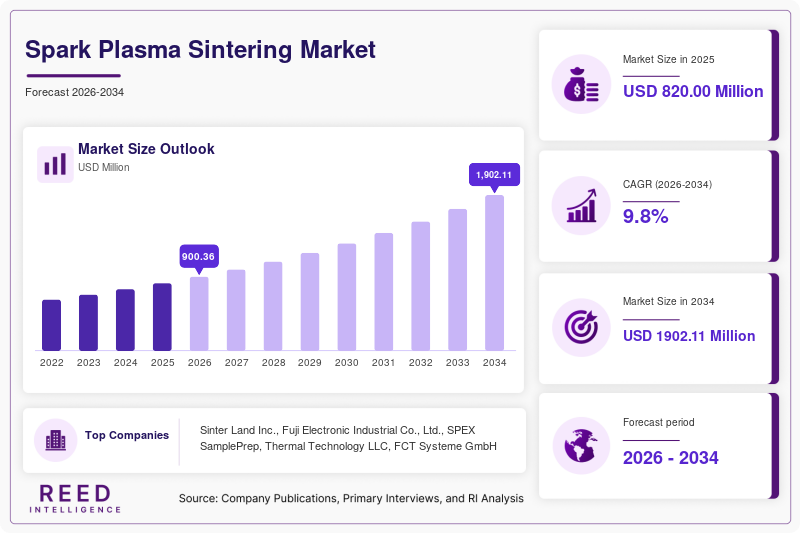
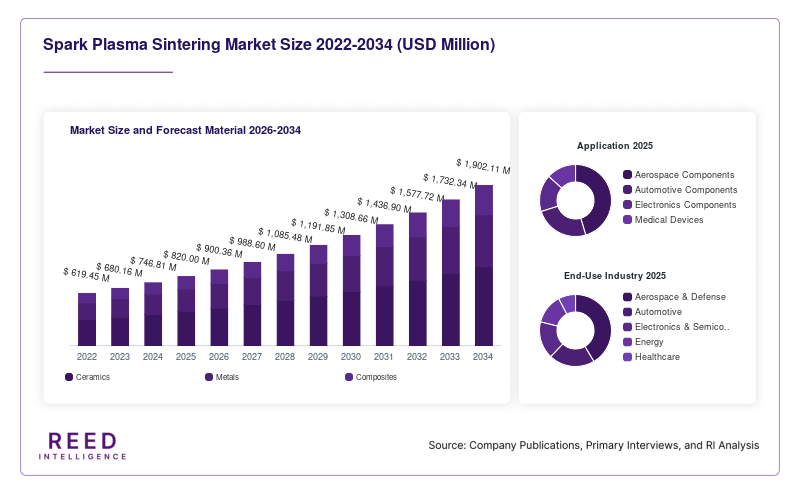
The Spark Plasma Sintering Market size was valued at approximately USD 820 million in 2025 and is projected to reach USD 1.92 billion by 2034, expanding at a CAGR of 9.8% from 2025 to 2034. The market is witnessing steady expansion due to increasing demand for advanced materials with superior mechanical, thermal, and electrical properties across aerospace, automotive, electronics, and energy industries. Spark plasma sintering (SPS), also known as field-assisted sintering technique (FAST), enables rapid densification of powders at lower temperatures, making it a preferred technology for manufacturing high-performance components.
A key global factor supporting the growth of the Spark Plasma Sintering Market is the rising adoption of advanced ceramics and composite materials in high-performance applications. Industries are shifting toward materials that offer enhanced strength-to-weight ratio, corrosion resistance, and thermal stability, which SPS technology efficiently delivers. Additionally, growing investments in research laboratories and pilot-scale manufacturing facilities are further driving market expansion.
Key Highlights
- Asia Pacific dominated the market with 38.5% share in 2025, while it is expected to register the fastest CAGR of 10.6% during the forecast period.
- By material, ceramics accounted for 46% share in 2025, while composites are projected to grow at a CAGR of 10.9%.
- By application, aerospace components led with 28% share, while electronics components are expected to grow at a CAGR of 11.2%.
- The U.S. remained the dominant country with a market size of USD 210 million in 2025, projected to reach USD 225 million in 2026.
Market Trends
Integration of SPS in Additive Manufacturing Workflows
A significant trend shaping the Spark Plasma Sintering Market is the integration of SPS technology with additive manufacturing processes. Manufacturers are increasingly combining 3D printing with SPS to achieve rapid densification of printed parts, reducing porosity and enhancing mechanical properties. This hybrid approach is particularly gaining traction in aerospace and medical device manufacturing, where precision and performance are critical.
Growing Focus on Energy-Efficient Processing Technologies
Another notable trend is the increasing emphasis on energy-efficient and sustainable manufacturing. SPS technology consumes less energy compared to conventional sintering methods due to shorter processing cycles and lower temperature requirements. As industries adopt greener production practices, SPS is being recognized as a viable solution to reduce carbon footprint while maintaining material integrity and performance.
Market Drivers
Rising Demand for Advanced Materials in Aerospace and Defense
The increasing use of high-performance materials in aerospace and defense industries is a major driver of the Spark Plasma Sintering Market. SPS enables the production of dense and durable components such as turbine parts, heat shields, and structural components. These materials offer enhanced resistance to extreme temperatures and mechanical stress, making SPS an essential technology in modern aerospace manufacturing.
Expansion of Electronics and Semiconductor Industry
The growth of the electronics and semiconductor sector is another key factor driving market demand. SPS is widely used to produce advanced conductive materials, thermoelectric materials, and electronic substrates. The rising need for miniaturized and high-efficiency electronic components is accelerating the adoption of SPS technology across global manufacturing ecosystems.
Market Restraint
High Initial Investment and Limited Scalability
One of the primary challenges in the Spark Plasma Sintering Market is the high capital investment required for SPS equipment and infrastructure. Advanced SPS systems involve significant costs related to machinery, maintenance, and skilled workforce. Additionally, scalability remains a concern, as SPS is more suited for small-batch or specialized production rather than mass manufacturing. This limits its adoption among small and medium-sized enterprises and restricts its use in high-volume industrial applications. The complexity of process optimization and lack of standardization further add to operational challenges, slowing down widespread commercialization.
Market Opportunities
Increasing Adoption in Biomedical Applications
The use of SPS technology in biomedical applications presents a strong growth opportunity. SPS enables the fabrication of biocompatible materials such as titanium alloys and ceramic implants with enhanced density and mechanical properties. This is particularly beneficial for orthopedic implants and dental applications, where precision and durability are essential.
Expansion in Renewable Energy Applications
Another emerging opportunity lies in renewable energy systems. SPS is being increasingly utilized to develop advanced materials for fuel cells, thermoelectric devices, and energy storage systems. The demand for efficient energy conversion and storage technologies is driving research and development efforts, creating new avenues for SPS adoption across clean energy sectors.
Segmental Analysis
By Material
Ceramics dominated the Spark Plasma Sintering Market, accounting for 46% share in 2025. The segment has benefited from widespread use in high-temperature and wear-resistant applications. SPS enables the production of dense ceramic components with improved mechanical and thermal properties, making them suitable for aerospace, electronics, and industrial applications.
Composites are projected to be the fastest-growing segment, expected to expand at a CAGR of 10.9% during the forecast period. The growth will be driven by increasing demand for lightweight and high-strength materials. SPS facilitates uniform densification of composite materials, enhancing their structural integrity and performance in demanding environments.
By Application
Aerospace components held the dominant position with 28% share in 2025. The segment has been driven by the need for materials capable of withstanding extreme temperatures and mechanical stress. SPS technology has enabled the production of advanced components such as turbine blades and heat shields.
Electronics components are expected to witness the fastest growth, with a projected CAGR of 11.2%. The increasing demand for miniaturized and high-performance electronic devices will drive this segment. SPS allows precise control over material properties, making it suitable for advanced electronic applications.
By End-Use Industry
The aerospace and defense sector dominated the market with 31% share in 2025. The segment has relied heavily on SPS for producing high-performance materials used in critical applications. The need for durable and lightweight components has supported the adoption of SPS technology.
The energy sector is anticipated to be the fastest-growing segment, with a CAGR of 10.7%. Growth will be driven by increasing investments in renewable energy systems. SPS is being used to develop advanced materials for fuel cells and thermoelectric devices, supporting efficient energy generation and storage.
By Equipment Type
Conventional SPS systems accounted for the largest share of 52% in 2025. These systems have been widely adopted due to their reliability and established use in research and industrial applications.
Hybrid SPS systems are expected to grow at the fastest CAGR of 10.5%. The integration of SPS with other advanced manufacturing technologies will drive this segment. Hybrid systems offer improved flexibility and efficiency, making them suitable for a wider range of applications.
Regional Analysis
North America
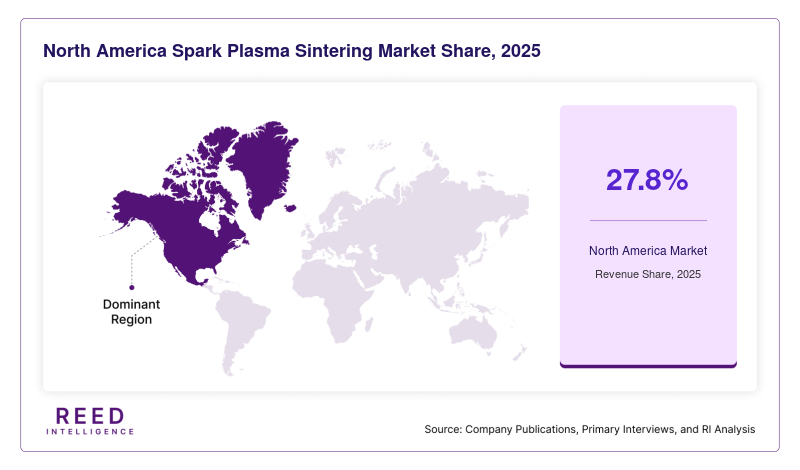
North America accounted for 27.8% of the Spark Plasma Sintering Market share in 2025 and is projected to grow at a CAGR of 9.1% during the forecast period. The region has benefited from strong investments in advanced manufacturing technologies and material science research.
The United States dominated the regional market due to the presence of established aerospace and defense industries. The country’s growth has been supported by continuous advancements in high-performance materials and increasing funding for research institutions focused on innovative sintering technologies.
Europe
Europe held approximately 23.5% share in 2025 and is expected to grow at a CAGR of 9.3% through 2034. The region has experienced steady growth due to its strong automotive and industrial manufacturing base.
Germany emerged as the leading country in Europe, driven by its engineering expertise and emphasis on advanced material processing technologies. The adoption of SPS in automotive lightweight components and industrial tooling has significantly contributed to regional growth.
Asia Pacific
Asia Pacific dominated the Spark Plasma Sintering Market with a 38.5% share in 2025 and is projected to register the fastest CAGR of 10.6% during the forecast period. The region’s growth has been fueled by rapid industrialization and increasing investments in advanced manufacturing technologies.
China led the regional market, supported by strong government initiatives and expanding electronics and semiconductor industries. The country’s focus on self-sufficiency in high-tech materials has accelerated the adoption of SPS technology.
Middle East & Africa
The Middle East & Africa region accounted for 5.2% of the market share in 2025 and is expected to grow at a CAGR of 8.7% over the forecast period. Growth in this region has been moderate due to limited industrial infrastructure.
Saudi Arabia dominated the regional market, driven by investments in industrial diversification and the development of advanced manufacturing capabilities. The adoption of SPS is gradually increasing in specialized applications such as energy and defense.
Latin America
Latin America held 5.0% share in 2025 and is projected to grow at a CAGR of 8.9% through 2034. The region has shown gradual adoption of advanced manufacturing technologies.
Brazil emerged as the leading country in the region, supported by growth in automotive and industrial sectors. Increasing awareness of advanced material processing techniques is expected to boost SPS adoption in the coming years.
Competitive Landscape
The Spark Plasma Sintering Market is characterized by the presence of specialized equipment manufacturers and advanced material solution providers. Companies are focusing on technological innovation, product development, and strategic collaborations to strengthen their market position.
Sinter Land Inc. is recognized as a leading player, known for its advanced SPS systems and strong global presence. The company recently introduced an upgraded SPS platform with enhanced temperature control and automation capabilities, supporting high-precision material processing.
Other key players are actively investing in research and development to expand their product portfolios and cater to evolving industry requirements. Partnerships with research institutions and industrial clients are also a common strategy to accelerate innovation and market penetration.
Key Players List
- Sinter Land Inc.
- Fuji Electronic Industrial Co., Ltd.
- SPEX SamplePrep
- Thermal Technology LLC
- FCT Systeme GmbH
- Sumitomo Coal Mining Co., Ltd.
- Ulpatek Filtration
- Dr. Fritsch GmbH & Co. KG
- MTI Corporation
- Toshiba Corporation
- Kyoto Kagaku Co., Ltd.
- Hohsen Corporation
- PVA TePla AG
- Shimadzu Corporation
- Kobe Steel Ltd.
Recent Developments
- In 2024, leading SPS equipment manufacturers introduced advanced automation features to improve process efficiency and repeatability.
- In 2025, collaborations between research institutes and industrial players increased to accelerate the commercialization of SPS-based materials.
- Several companies expanded their production facilities to meet growing demand from aerospace and electronics sectors.
- Technological advancements in hybrid SPS systems have improved scalability and broadened application scope.
Spark Plasma Sintering Market Segments
Material
- Ceramics
- Metals
- Composites
Application
- Aerospace Components
- Automotive Components
- Electronics Components
- Medical Devices
End-Use Industry
- Aerospace & Defense
- Automotive
- Electronics & Semiconductor
- Energy
- Healthcare
Equipment Type
- Conventional SPS Systems
- Hybrid SPS Systems
By Region
- North America
- Europe
- APAC
- Middle East and Africa
- LATAM