Speaker Market Size, Share & Trends Analysis Report By Product Type (Portable Wireless Speakers, Smart Speakers, Soundbars, Home Audio Speakers, Professional Loudspeakers), By Connectivity (Bluetooth, Wi-Fi & Networked, Wired & Hybrid), By Application (Residential, Automotive, Commercial & Hospitality, Professional & Live Events, Other Applications) and Forecasts, 2026–2034
USD 3950
Speaker Market Size
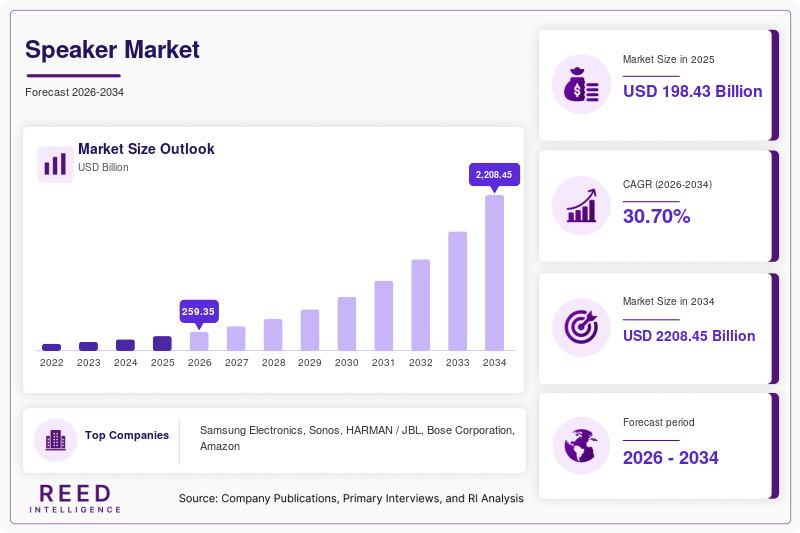
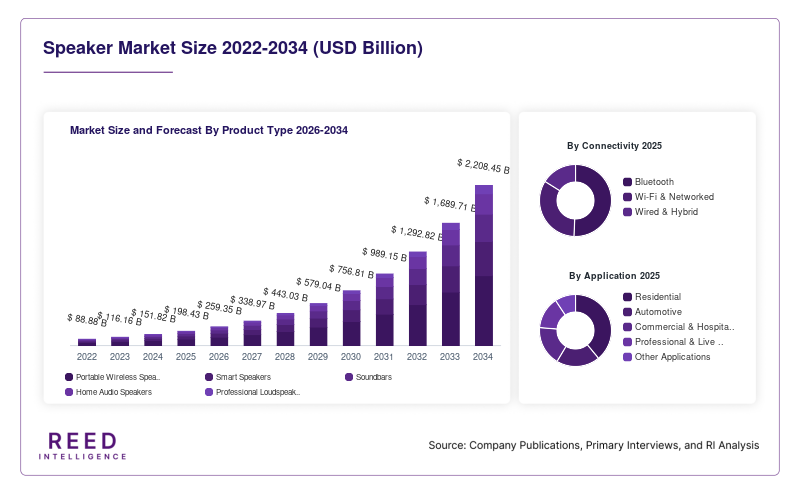
The global speaker market is valued at USD 198.43 Billion in 2025 and USD 259.35 Billion in 2026. The market is projected to reach USD 2,208.45 Billion by 2034, registering a 30.70% CAGR during the forecast period.
The speaker market comprises loudspeaker systems used to reproduce audio across residential, mobile, automotive, commercial, professional and public environments. The market includes conventional wired loudspeakers, portable Bluetooth speakers, smart speakers, Wi-Fi multi-room systems, soundbars, party speakers, professional PA systems and application-specific automotive speakers.
The category is increasingly defined by the convergence of acoustic hardware, wireless connectivity, software, voice assistants, artificial intelligence, spatial audio and multi-device ecosystems. Speaker manufacturers are moving beyond individual audio products toward connected systems that can coordinate multiple speakers, adapt sound to a room, interact with smart-home platforms and provide software-driven features.
Speaker Market Drivers
Wireless and multi-room audio are changing speaker ownership from individual devices to connected systems
Wireless connectivity is increasingly becoming the default architecture for consumer speakers. Bluetooth provides portability, while Wi-Fi provides higher-bandwidth multi-room synchronization, cloud services and integration with home networks.
JBL's September 2026 Cove system illustrates this evolution: its speakers can operate independently, form stereo pairs, participate in whole-home audio and serve as rear channels for compatible soundbars. Sonos similarly designs its portfolio around coordinated system operation rather than isolated speakers.
The same trend supports higher customer lifetime value because a consumer can add speakers over time rather than replace an entire system. Sonos's March 2026 introduction of Sonos Play and Era 100 SL specifically positioned the products as entry points that can be expanded room by room.
Smart-home integration is turning speakers into multifunctional household interfaces
Smart speakers increasingly combine audio playback with voice assistance, environmental sensing and smart-home automation.
Amazon's Echo Dot Max and Echo Studio use AZ3 custom silicon and Omnisense sensing to detect presence, motion and temperature and enable automated smart-home routines. The devices are also positioned as Alexa-enabled household assistants rather than solely audio products.
Sonos is expanding the software layer in another direction. Sonos 27 allows users to control the company's system through external AI assistants and agents and adds software functions to existing speakers without requiring new hardware.
This increases the addressable value of speakers because purchases can be justified by multiple functions: entertainment, voice control, home automation, communication, ambient sensing and connected-device management.
Immersive audio and AI-based acoustic processing are increasing premium speaker differentiation
Manufacturers are increasingly using spatial audio, automatic room correction and real-time AI processing to distinguish new speaker generations.
JBL's Pulse 6 uses AI Sound Boost to analyze music in real time and optimize acoustic output, while Samsung's 2026 Q-Series soundbars use AI-based sound features and room-related optimization.
Amazon uses room-adapting spatial audio and Dolby Atmos in Echo Studio, while Sonos's Beam Ultra provides 7.1.2 Dolby Atmos from a compact form factor.
The result is a shift in competitive differentiation from specifications such as nominal power output toward adaptive sound quality, room optimization, spatial rendering, low distortion and intelligent signal processing.
Speaker Market Restraints
Intense price competition makes hardware differentiation increasingly difficult
The speaker market contains premium high-fidelity products as well as mass-market Bluetooth speakers, smart speakers and inexpensive consumer-audio devices. As wireless components and amplification technologies become more widely available, basic connectivity and acceptable sound quality are increasingly commoditized.
Manufacturers therefore have to differentiate through industrial design, brand, acoustic tuning, battery life, software, smart-home compatibility, spatial audio and proprietary features.
Samsung's 2026 soundbar portfolio, for example, spans multiple price and configuration points, while Bose, JBL and Sonos similarly maintain products across distinct performance and price segments.
Connected speaker ecosystems create interoperability, privacy and software-support requirements
Smart and networked speakers depend on software platforms, mobile applications, cloud services and voice assistants. This adds maintenance obligations that conventional passive speakers do not have.
Bluetooth LE Audio and Auracast are helping establish broader interoperability standards, but ecosystem competition remains strong among Apple AirPlay, Google Cast, Alexa, proprietary multi-room systems and manufacturer-specific applications.
Smart speakers also collect or process voice and environmental information. Amazon's Echo Dot Max and Echo Studio therefore include microphone controls and privacy-management features, illustrating the additional trust requirements that accompany connected audio products.
Speaker Market Opportunities
AI-native speakers can evolve into adaptive home audio and ambient-computing platforms
The integration of AI into speakers is creating opportunities beyond improved sound quality. AI can be used for voice interaction, personalized playback, contextual control, acoustic optimization, language processing, household automation and content discovery.
Amazon's AZ3-powered Echo devices and Sonos 27 illustrate two complementary approaches: Amazon is combining audio with environmental sensing and Alexa, while Sonos is adding AI control to an established whole-home audio architecture.
Future opportunities include context-aware music selection, automated room calibration, voice-personalized listening, intelligent volume control and AI-managed multi-room playback.
Automotive audio is becoming a strategic expansion category for premium speaker brands
Automotive manufacturers increasingly treat cabin audio as part of the vehicle's broader digital experience rather than an isolated component.
Sonos's June 2026 partnership with Škoda places Sonos inside the electric Peaq vehicle, with the company designing the in-cabin listening experience around music, voice and entertainment.
This expands the addressable market for premium audio brands and creates opportunities for automotive-specific speaker arrays, cabin-zone audio, immersive sound and software-defined sound processing.
Auracast and next-generation Bluetooth can broaden shared and public audio applications
Bluetooth LE Audio and Auracast are designed to enable broadcast-style audio experiences in addition to conventional point-to-point Bluetooth connections. The Bluetooth SIG describes Auracast as a new capability that can potentially change how users experience audio in shared environments.
The Bluetooth SIG's product database now includes Auracast-enabled receivers and speakers, including ceiling speakers and specialized audio products.
This provides opportunities in classrooms, airports, conference venues, hospitality, museums, houses of worship, public-information systems and assistive-listening applications.
Product Type Analysis
Portable Wireless Speakers hold the dominant product share as mobility and all-purpose listening broaden speaker demand
Portable wireless speakers account for the largest product category because they combine battery operation, Bluetooth connectivity, relatively compact designs and use across indoor and outdoor environments.
The Portable Wireless Speakers segment accounts for 33% of the global market in 2026 and is projected to register a 29.70% CAGR.
JBL's 2026 product launches illustrate continued innovation in the portable category. Pulse 6 adds AI Sound Boost and a 360-degree lightshow, while PartyBox products combine high-output portable audio with lighting and party-oriented features.
Smart Speakers are the fastest-growing major product category as AI and smart-home capabilities expand their role
The Smart Speakers segment accounts for 24% of the global market in 2026 and is projected to register a 34.80% CAGR, making it the fastest-growing major product category.
Amazon's Echo Dot Max and Echo Studio illustrate the shift toward speakers as multifunctional smart-home interfaces, with Alexa, environmental sensing, custom processing and spatial audio integrated into the devices.
Sonos is adding AI assistants and agents through its software platform, indicating that premium connected audio companies are also increasing the intelligence of their speaker ecosystems.
Soundbars are expanding as consumers consolidate home-theater equipment into simpler systems
The segment is projected to register a 31.20% CAGR.
Soundbars provide a compact alternative to multi-component home-theater systems while increasingly incorporating Dolby Atmos, automatic room correction, wireless rear speakers and subwoofers.
Samsung reported in March 2026 that it had maintained the global soundbar leadership position for the 12th consecutive year, citing Futuresource data showing 21.5% of global soundbar revenue and 19.7% of unit volume in 2025. Its 2026 lineup includes the flagship HW-Q990H and all-in-one HW-QS90H.
Connectivity Analysis
Bluetooth remains the dominant connectivity technology because of its low-friction compatibility across consumer devices
The Bluetooth segment accounts for 51% of the global market in 2026 and is projected to register a 29.80% CAGR.
Bluetooth is widely used in portable speakers, party speakers, personal home audio and vehicle accessories because smartphones, tablets and computers natively support it.
The transition toward Bluetooth LE Audio is also expanding the technology beyond conventional streaming. The Bluetooth SIG identifies improved performance, LC3-based audio capabilities, Auracast broadcast audio and broader device interoperability as key developments.
Wi-Fi & Networked connectivity is the fastest-growing major connectivity category as multi-room and cloud-connected audio expand
The Wi-Fi & Networked segment accounts for 32% of the global market in 2026 and is projected to register a 35.60% CAGR, making it the fastest-growing connectivity category.
Wi-Fi enables multi-room synchronization, higher-bandwidth streaming, software services and smart-home integration.
JBL Cove uses Wi-Fi to coordinate multiple speakers across the home, Samsung's Music Studio products are Wi-Fi speakers designed for unified home entertainment, and Sonos's core architecture is built around networked whole-home audio.
Application Analysis
Residential remains the dominant application as connected audio becomes a core home-entertainment category
The Residential segment accounts for 58% of the global market in 2026 and is projected to register a 30.00% CAGR.
Residential demand spans portable speakers, smart speakers, soundbars, whole-home systems, subwoofers, home-theater speakers and premium hi-fi systems.
Samsung's 2026 Music Studio and Q-Series portfolios, Bose's Lifestyle Collection, Sonos's Beam Ultra and JBL Cove all demonstrate continuing investment in residential audio systems.
Automotive is the fastest-growing major application as premium in-cabin audio becomes part of the vehicle experience
The Automotive segment accounts for 22% of the global market in 2026 and is projected to register a 33.90% CAGR, making it the fastest-growing major application.
Automotive audio is becoming increasingly differentiated through speaker count, cabin-zone tuning, immersive sound and software-controlled acoustic experiences.
Sonos's June 2026 partnership with Škoda to develop the audio experience for the electric Peaq demonstrates how premium consumer-audio brands are entering vehicle platforms.
Commercial & Hospitality applications favor scalable distributed audio systems
The segment is projected to register a 29.20% CAGR.
Hotels, restaurants, retail stores, corporate offices and other commercial environments require distributed audio, multi-zone control, background music and increasingly networked management.
Wi-Fi and networked speakers provide opportunities to centrally manage multiple zones and update audio content without extensive physical rewiring.
Speaker Market Regional Analysis
North America Speaker Market
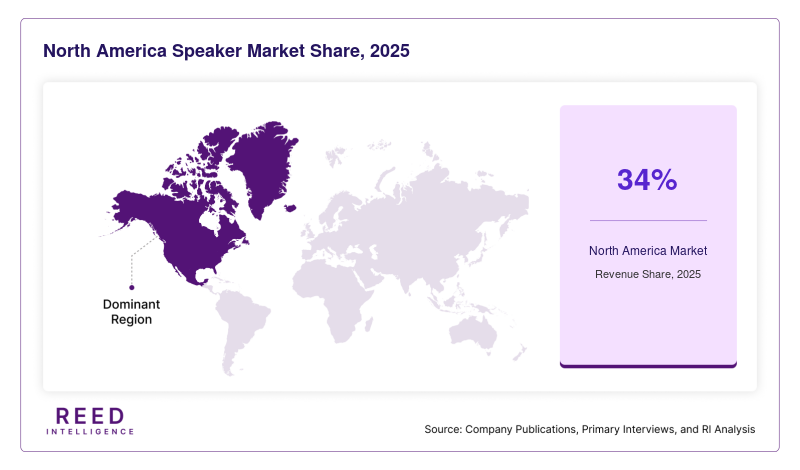
North America remains the dominant regional market because of its large premium-audio customer base, mature smart-home ecosystem, high adoption of connected consumer electronics and concentration of major audio brands.
The North America region accounts for 34% of the global market in 2026 and is projected to register a 29.80% CAGR.
The region is home to major speaker manufacturers and technology companies including Bose, Sonos, Amazon, Apple and Harman/JBL. Sonos introduced Beam Ultra and Sonos 27 in September 2026, Bose launched the Lifestyle Collection in May, and JBL expanded its home and portable portfolios throughout the year.
Premium home theater, smart speakers, party speakers and professional audio provide multiple demand channels.
APAC Speaker Market
APAC is the fastest-growing regional market as consumer electronics production, smartphone penetration, urbanization, smart-home adoption and automotive manufacturing continue expanding.
The APAC region accounts for 30% of the global market in 2026 and is projected to register a 35.10% CAGR, making it the fastest-growing regional market.
China, Japan, South Korea and India are major electronics markets, while the region also supports extensive manufacturing and component ecosystems.
Amazon's May 2026 Echo Dot Max and Echo Studio launch in India illustrates the importance of APAC as a smart-speaker market, while Samsung maintains a broad regional home-audio presence and JBL continues to expand portable and connected audio products.
The automotive opportunity is also increasing as connected and premium in-cabin entertainment becomes more important across rapidly electrifying Asian vehicle markets.
Europe Speaker Market
Europe is projected to register a 30.20% CAGR, supported by strong premium-audio demand, smart-home adoption, automotive audio and professional sound systems.
The region is also important for design-led products. Bose emphasizes multi-room integration and premium materials, while Sonos's partnership with Škoda links premium consumer-audio engineering to a European electric-vehicle platform.
Bluetooth LE Audio and Auracast are also relevant to European public infrastructure, assistive listening and commercial audio deployment.
Middle East and Africa Speaker Market
The Middle East and Africa market is projected to register a 28.40% CAGR, supported by premium residential audio, hospitality, tourism, commercial construction and professional entertainment applications.
Luxury hotels, retail developments, entertainment venues and high-end residential projects create demand for distributed, immersive and aesthetically integrated speaker systems.
Professional speakers are particularly relevant to live events, hospitality and venue development.
LATAM Speaker Market
LATAM is projected to register a 29.40% CAGR, supported by smartphone-led wireless audio adoption, residential entertainment, retail and hospitality development and increasing professional-event activity.
Portable Bluetooth and party speakers provide an accessible growth route, while premium home theater and soundbar systems continue expanding among higher-income consumers.
Speaker Market Competitive Landscape
The speaker market is highly diversified, with competition spanning mass-market consumer electronics, smart-home platforms, premium hi-fi manufacturers, automotive audio suppliers and professional sound-equipment companies.
Samsung Electronics competes across soundbars, Wi-Fi speakers and broader home-entertainment systems. In March 2026, Samsung announced that Futuresource data showed it had captured 21.5% of global soundbar revenue and 19.7% of unit volume in 2025. Its 2026 lineup includes Q-Series soundbars and Music Studio Wi-Fi speakers.
Sonos operates around connected whole-home audio and is increasingly combining speaker hardware with a software platform. Its 2026 portfolio includes Sonos Play, Era 100 SL, Beam Ultra and Ace Ultra, while Sonos 27 adds AI control and broader system integration.
Key Market Players
- Samsung Electronics
- Sonos
- HARMAN / JBL
- Bose Corporation
- Amazon
- Sony
- Apple
- Bowers & Wilkins
- Bose Professional
- Bang & Olufsen
- KEF
- Marshall Group
- Yamaha
- Denon
- Klipsch
- QSC
- L-Acoustics
- d&b audiotechnik
- Electro-Voice
Recent Developments
September 2026 – Sonos introduced Beam Ultra and Sonos Ace Ultra. Beam Ultra expands the company's home-theater range with 7.1.2 Dolby Atmos from a compact soundbar, while Ace Ultra adds a new driver and next-generation Adaptive ANC and connects directly to the Sonos system.
September 2026 – JBL launched the Cove whole-home Wi-Fi audio system. The new M1, P1 and X1 speakers can operate independently, form stereo pairs or work as part of a whole-home system, while selected models can serve as rear channels for JBL Bar MK2 soundbars. Automatic self-tuning and AI Sound Boost are built into the platform.
Speaker Market Segments
By Product Type
- Portable Wireless Speakers
- Smart Speakers
- Soundbars
- Home Audio Speakers
- Professional Loudspeakers
By Connectivity
- Bluetooth
- Wi-Fi & Networked
- Wired & Hybrid
By Application
- Residential
- Automotive
- Commercial & Hospitality
- Professional & Live Events
- Other Applications
By Region
- North America
- Europe
- APAC
- Middle East and Africa
- LATAM