Special Purpose A To D Converter Market Size, Share & Demand Report By Converter Architecture (Pipeline A/D Converters, Sigma-Delta A/D Converters, Successive Approximation Register (SAR) Converters, Flash A/D Converters), By Resolution (Up to 12 Bit, 12–16 Bit, 16–24 Bit, Above 24 Bit), By Application (Communication Systems, Industrial Instrumentation, Medical Equipment, Scientific Measurement Systems), By End-Use Industry (Telecommunications, Industrial Manufacturing, Healthcare, Aerospace & D
USD 3950
Market Overview
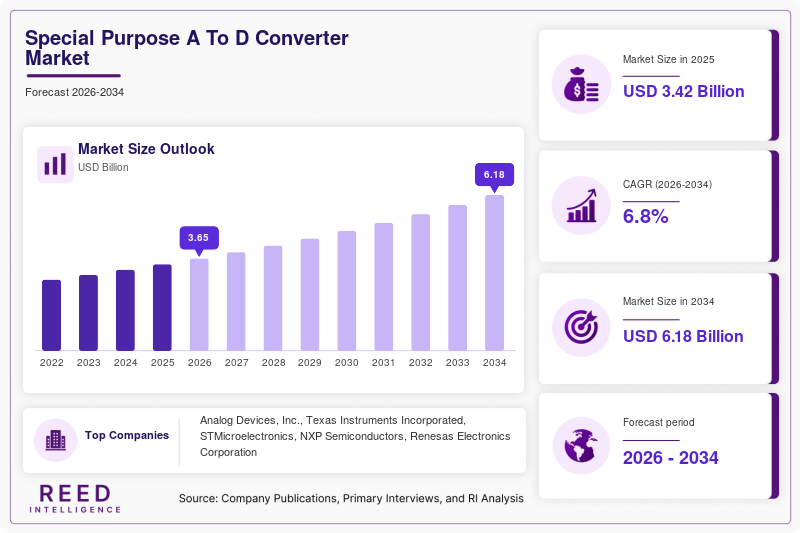
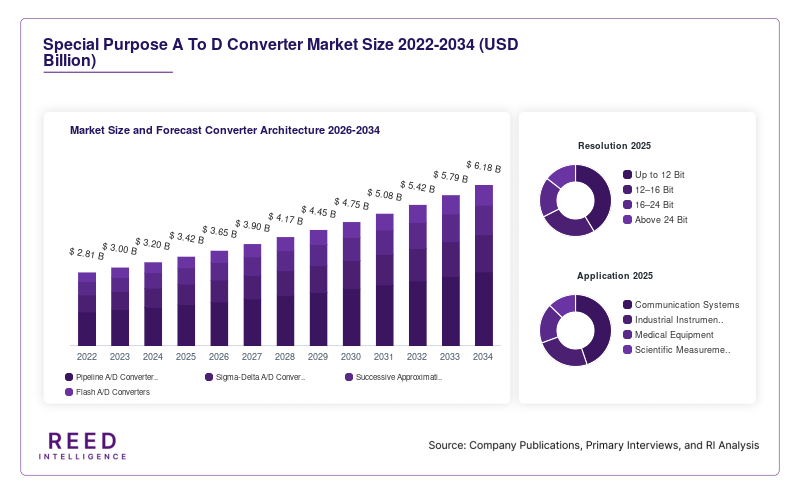
The Special Purpose A To D Converter Market size was valued at USD 3.42 billion in 2025 and is projected to reach USD 6.18 billion by 2034, expanding at a compound annual growth rate (CAGR) of 6.8% from 2025 to 2034. Special purpose analog-to-digital (A/D) converters are semiconductor devices designed to convert analog signals into digital data for specialized applications such as industrial automation, medical imaging, telecommunications, aerospace electronics, and instrumentation systems. These converters are engineered to meet application-specific performance requirements including high resolution, low latency, and optimized signal processing.
One global factor that supported market growth has been the increasing integration of digital signal processing across industrial and communication infrastructure. As industries digitize measurement systems and sensors, the need for accurate signal conversion has grown significantly. Special purpose A/D converters are used in devices where precision and reliability are critical, such as radar systems, medical monitoring equipment, and advanced industrial control systems.
Key Highlights
- Dominant Region: Asia Pacific accounted for 39.7% of the global Special Purpose A To D Converter Market share in 2025, while North America is projected to grow at a CAGR of 7.3% through 2034.
- Segment Leadership: Pipeline A/D converters represented the largest converter architecture segment with 34.6% share, while sigma-delta converters are expected to grow at a CAGR of 7.8%.
- Dominant Country: The United States market reached USD 842.5 million in 2025 and is estimated to reach USD 896.7 million in 2026.
Market Trends
Integration of High-Resolution Converters in Medical and Scientific Equipment
Medical imaging systems and scientific measurement instruments require precise signal conversion to ensure accurate data interpretation. Special purpose A/D converters with high resolution and low noise characteristics are increasingly used in applications such as magnetic resonance imaging systems, ultrasound equipment, and laboratory instrumentation. Manufacturers are developing converter architectures capable of handling complex signal environments while maintaining measurement accuracy. This trend is expanding the role of specialized converters within healthcare technology and scientific research equipment.
Development of Low-Power Converter Architectures for Embedded Systems
Embedded electronic systems often operate under strict power consumption constraints. To address these requirements, semiconductor manufacturers are designing special purpose A/D converters with energy-efficient architectures. These converters are used in battery-powered devices, industrial sensors, and communication modules. Improved power efficiency allows devices to operate longer without increasing system heat or energy demand. This trend supports the adoption of specialized A/D converters in compact and portable electronic systems.
Market Drivers
Expansion of Industrial Automation Systems
Industrial automation systems rely on sensors and control electronics to monitor and manage production processes. These systems frequently require precise signal conversion to translate analog sensor outputs into digital data for processing by control units. Special purpose A/D converters are widely used in industrial control equipment, robotics, and process monitoring systems. As manufacturing facilities adopt advanced automation technologies, the need for high-performance signal conversion devices continues to increase. This growth in automation infrastructure has contributed to the expansion of the Special Purpose A To D Converter Market.
Increasing Adoption of High-Speed Communication Infrastructure
Modern communication systems rely on digital processing of analog signals received from antennas and transmission equipment. High-speed A/D converters are used in communication base stations, radar systems, and satellite communication devices. These converters allow communication equipment to process high-frequency signals with accuracy and stability. As telecommunication networks evolve to support higher data transmission speeds, manufacturers are integrating specialized converter devices into signal processing hardware. The expansion of communication infrastructure has therefore supported demand in the Special Purpose A To D Converter Market.
Market Restraint
Complexity of Converter Design and Development
The development of specialized A/D converters requires advanced semiconductor design expertise and extensive research and testing. Converter architectures must achieve precise signal conversion while minimizing noise, distortion, and power consumption. Achieving this balance often involves complex circuit designs and specialized fabrication processes.
These technical challenges can increase development costs and extend product development cycles. Semiconductor manufacturers must invest in advanced design tools and testing equipment to ensure that converter devices meet performance specifications required by industrial and scientific applications.
Additionally, specialized converter products often target niche markets with specific performance requirements. This can limit production volumes and increase manufacturing costs compared to standard semiconductor components.
These factors may create barriers for new entrants attempting to compete in the Special Purpose A To D Converter Market, as the industry requires significant technological expertise and capital investment.
Market Opportunities
Growth of Industrial Internet of Things (IIoT) Devices
Industrial Internet of Things systems use connected sensors and monitoring devices to collect real-time data from manufacturing equipment and infrastructure. Many of these sensors generate analog signals that must be converted into digital data before transmission to analytics platforms. Special purpose A/D converters are used within IIoT sensor modules to ensure accurate signal conversion. As industries deploy more connected monitoring systems, the demand for specialized converter devices may increase. This development may create opportunities for semiconductor manufacturers within the Special Purpose A To D Converter Market.
Expansion of Aerospace and Defense Electronics
Aerospace and defense systems require highly reliable electronic components capable of operating in demanding environments. Radar systems, navigation equipment, and surveillance technologies rely on specialized A/D converters for signal processing. Defense electronics manufacturers require converter devices with high speed and reliability to support mission-critical operations. As governments increase investment in advanced defense technologies and aerospace systems, the demand for high-performance converter solutions is expected to expand within the Special Purpose A To D Converter Market.
Segmental Analysis
By Converter Architecture
Pipeline A/D converters accounted for 34.6% share of the Special Purpose A To D Converter Market in 2025. These converters are widely used in communication infrastructure and high-speed data acquisition systems due to their ability to process signals at high sampling rates. Pipeline converters provide a balance between speed and resolution, making them suitable for applications such as radar systems and digital receivers.
Sigma-delta converters will represent the fastest-growing architecture with a projected CAGR of 7.8% through 2034. These converters are commonly used in precision measurement systems and audio signal processing applications. Sigma-delta architectures are designed to provide high resolution and low noise performance, making them suitable for instrumentation and scientific measurement devices. As industries require more precise digital signal conversion, adoption of sigma-delta converter designs is expected to increase.
By Resolution
Converters with 16–24 bit resolution accounted for 37.9% of the Special Purpose A To D Converter Market share in 2025. These converters provide high measurement precision required for industrial instrumentation and scientific analysis applications. High-resolution converters enable accurate conversion of small analog signals into digital data that can be processed by analytical systems.
Converters with above 24-bit resolution will grow at the fastest CAGR of 7.5% through 2034. Ultra-high-resolution converters are increasingly used in advanced measurement equipment and laboratory instrumentation where extremely precise signal conversion is required. These devices allow engineers and researchers to analyze subtle signal variations in scientific experiments and measurement systems.
By Application
Communication systems represented the largest application segment with 32.4% share of the Special Purpose A To D Converter Market in 2025. Converter devices are integrated into communication equipment to process analog signals received from transmission systems. Accurate signal conversion is essential for maintaining data integrity and signal quality within communication networks.
Medical equipment will grow at the fastest CAGR of 7.4% through 2034. Medical imaging systems, diagnostic equipment, and patient monitoring devices rely on specialized signal conversion technologies to process biological signals. Converter devices used in healthcare applications are designed to achieve high measurement precision and stable signal processing performance.
By End-Use Industry
The telecommunications industry accounted for 35.8% share of the Special Purpose A To D Converter Market in 2025. Telecommunication infrastructure relies on signal processing systems to convert analog signals into digital data for transmission and analysis. A/D converters are used in base stations, signal processing modules, and communication receivers.
The aerospace and defense industry will grow at the fastest CAGR of 7.1% through 2034. Electronic systems used in radar, navigation, and surveillance equipment require reliable signal conversion to process high-frequency analog signals. Converter devices designed for aerospace and defense applications must meet strict performance and reliability requirements.
Regional Analysis
North America
North America accounted for 27.8% of the Special Purpose A To D Converter Market share in 2025. The region will expand at a forecast CAGR of 7.3% between 2025 and 2034. Demand for specialized converter devices is supported by the presence of semiconductor design companies, aerospace electronics manufacturers, and advanced industrial automation providers. Industries across the region rely on signal processing technologies for applications ranging from communication infrastructure to scientific instrumentation.
The United Statesrepresented the dominant country within the regional market. The country hosts several semiconductor design companies and research institutions that develop advanced electronic components used in communication and industrial systems. Many manufacturers integrate specialized A/D converters into radar systems, aerospace electronics, and laboratory equipment. The presence of a strong electronics design ecosystem has contributed to continued demand for converter technologies within the United States.
Europe
Europe held 21.5% of the Special Purpose A To D Converter Market share in 2025and will grow at a CAGR of 6.4% through 2034. Demand in the region is influenced by industrial automation, automotive electronics, and scientific instrumentation industries. Several European companies design and manufacture semiconductor devices used in high-precision measurement and communication equipment.
Germanyrepresented a key country within the European market. The country’s engineering sector includes advanced manufacturing equipment and industrial measurement systems that rely on accurate signal processing technologies. Special purpose A/D converters are used in industrial monitoring systems and electronic testing equipment used by manufacturing companies. This industrial technology ecosystem has supported demand for converter devices within Germany.
Asia Pacific
Asia Pacific accounted for 39.7% of the Special Purpose A To D Converter Market share in 2025, making it the largest regional market. The region will grow at a CAGR of 6.9% through 2034. Semiconductor manufacturing and electronics production across the region have contributed to strong demand for converter devices used in communication equipment, consumer electronics components, and industrial electronics systems.
Chinadominated the regional market due to its extensive electronics manufacturing infrastructure. Many semiconductor packaging and electronics assembly facilities operate within the country, producing electronic modules used in industrial equipment and communication hardware. Special purpose A/D converters are integrated into various electronic systems produced in the region. The presence of large-scale electronics manufacturing clusters has therefore supported demand within the Asia Pacific Special Purpose A To D Converter Market.
Middle East & Africa
The Middle East & Africa accounted for 5.6% of the Special Purpose A To D Converter Market share in 2025and will grow at a CAGR of 5.9% through 2034. Adoption of specialized electronic components in the region is linked to telecommunications infrastructure development and industrial modernization projects.
The United Arab Emiratesrepresented a notable country within the regional market. The country has invested in advanced communication networks and smart infrastructure systems that rely on digital signal processing technologies. Electronic equipment used in these systems requires reliable signal conversion components to process sensor and communication signals. These infrastructure initiatives have contributed to demand for specialized converter devices within the region.
Latin America
Latin America held 5.4% of the Special Purpose A To D Converter Market share in 2025and is projected to grow at a CAGR of 6.7% through 2034. Industrial electronics manufacturing and communication infrastructure development have contributed to the regional market expansion.
Brazilrepresented the dominant country within the regional market. The country has been expanding its telecommunications networks and industrial automation capabilities. Electronic equipment used in industrial control systems often incorporates signal conversion components to process sensor inputs. As manufacturing modernization efforts continue in Brazil, demand for specialized A/D converters is expected to grow.

Competitive Landscape
The Special Purpose A To D Converter Marketconsists of semiconductor manufacturers that design high-performance analog and mixed-signal integrated circuits. Companies compete by developing converter devices that provide improved resolution, faster sampling rates, and optimized power efficiency.
Analog Devices, Inc.is recognized as a significant market participant due to its extensive portfolio of high-performance A/D converters used in industrial, communication, and aerospace applications. The company continues to introduce converter products designed for precision signal processing systems.
Other companies focus on developing integrated signal processing solutions that combine converters with digital processing capabilities. Semiconductor manufacturers are also investing in research to improve converter accuracy and energy efficiency. Strategic partnerships with electronics equipment manufacturers remain an important approach to expanding product adoption within the Special Purpose A To D Converter Market.
Key Players List
- Analog Devices, Inc.
- Texas Instruments Incorporated
- STMicroelectronics
- NXP Semiconductors
- Renesas Electronics Corporation
- Microchip Technology Inc.
- ON Semiconductor
- Infineon Technologies AG
- Maxim Integrated (Analog Devices)
- Rohm Semiconductor
- Cirrus Logic Inc.
- Silicon Laboratories Inc.
- Broadcom Inc.
- Skyworks Solutions Inc.
- Qualcomm Incorporated
Recent Developments
- Semiconductor companies introduced high-resolution A/D converters designed for industrial instrumentation systems.
- Electronics manufacturers integrated specialized converter devices into advanced communication signal processing modules.
- Research efforts focused on improving low-power converter architectures for embedded electronics applications.
Special Purpose A To D Converter Market Segments
Converter Architecture
- Pipeline A/D Converters
- Sigma-Delta A/D Converters
- Successive Approximation Register (SAR) Converters
- Flash A/D Converters
Resolution
- Up to 12 Bit
- 12–16 Bit
- 16–24 Bit
- Above 24 Bit
Application
- Communication Systems
- Industrial Instrumentation
- Medical Equipment
- Scientific Measurement Systems
End-Use Industry
- Telecommunications
- Industrial Manufacturing
- Healthcare
- Aerospace & Defense
Distribution Channel
- Direct Semiconductor Supply
- Electronic Component Distributors
- Online Electronics Marketplaces
By Region
- North America
- Europe
- APAC
- Middle East and Africa
- LATAM